2001 FORD WINDSTAR fuel cap
[x] Cancel search: fuel capPage 238 of 288

Fuel Filler Cap
Your fuel tank filler cap has an indexed design with a 1/8 turn on/off
feature.
When fueling your vehicle:
1. Turn the engine off.
2.
Carefully turn the filler cap counterclockwise 1/8 of a turn until it stops.
3. Pull to remove the cap from the fuel filler pipe.
4. To install the cap, align the tabs on the cap with the notches on the
filler pipe.
5. Turn the filler cap clockwise 1/8 of a turn until it stops.
If the ªCheck Fuel Capº
indicator comes on or if ªService Engine
Soon/Check Engineº indicator comes on and stays on when you start the
engine, the fuel filler cap may not be properly installed. Turn off the
engine, remove the fuel filler cap, align the cap properly and reinstall it.
If you must replace the fuel filler cap, replace it with a fuel filler
cap that is designed for your vehicle. The customer warranty may
be void for any damage to the fuel tank or fuel system if the
correct genuine Ford or Motorcraft fuel filler cap is not used.
The fuel system may be under pressure. If the fuel filler cap is
venting vapor or if you hear a hissing sound, wait until it stops
before completely removing the fuel filler cap. Otherwise, fuel may
spray out and injure you or others.
If you do not use the proper fuel filler cap, excessive pressure or
vacuum in the fuel tank may damage the fuel system or cause
the fuel cap to disengage in a collision, which may result in possible
personal injury.
Choosing the right fuel
Use only UNLEADED FUEL. The use of leaded fuel is prohibited by law
and could damage your vehicle.
Do not use fuel containing methanol. It can damage critical fuel system
components.
Your vehicle was not designed to use fuel or fuel additives with metallic
compounds, including manganese-based compounds containing MMT.
Maintenance and care
238
Page 240 of 288

Cleaner air
Ford endorses the use of reformulated ªcleaner-burningº gasolines to
improve air quality.
Running out of fuel
Avoid running out of fuel because this situation may have an adverse
affect on powertrain components.
If you have run out of fuel:
²You may need to cycle the ignition from OFF to ON several times after
refueling, to allow the fuel system to pump the fuel from the tank to
the engine.
²Your ªCheck Engineº indicator may come on. For more information on
the ªCheck Engineº indicator, refer to theInstrumentationchapter.
Fuel Filter
For fuel filter replacement, see your dealer or a qualified service
technician. Refer to the scheduled maintenance guide for the appropriate
intervals for changing the fuel filter.
Replace the fuel filter with an authorized Motorcraft part. The
customer warranty may be void for any damage to the fuel system
if an authorized Motorcraft fuel filter is not used.
ESSENTIALS OF GOOD FUEL ECONOMY
Measuring techniques
Your best source of information about actual fuel economy is you, the
driver. You must gather information as accurately and consistently as
possible. Fuel expense, frequency of fillups or fuel gauge readings are
NOT accurate as a measure of fuel economy. We do not recommend
taking fuel economy measurements during the first 1 600 km (1 000
miles) of driving (engine break-in period). You will get a more accurate
measurement after 3 000 km±5 000 km (2 000 miles-3 000 miles).
Filling the tank
The advertised fuel capacity of the fuel tank on your vehicle is equal to
the rated refill capacity of the fuel tank as listed in theRefill Capacities
section of theCapacities and specificationschapter.
The advertised capacity is the amount of the indicated capacity and the
empty reserve combined. Indicated capacity is the difference in the
Maintenance and care
240
Page 241 of 288

amount of fuel in a full tank and a tank when the fuel gauge indicates
empty. Empty reserve is the small amount of fuel remaining in the fuel
tank after the fuel gauge indicates empty.
The amount of usable fuel in the empty reserve varies and should
not be relied upon to increase driving range. When refueling your
vehicle after the fuel gauge indicates empty, you might not be
able to refuel the full amount of the advertised capacity of the
fuel tank due to the empty reserve still present in the tank.
For consistent results when filling the fuel tank:
²Turn the engine/ignition switch to the off position prior to refueling,
an error in the reading will result if the engine is left running.
²Use the same filling rate setting (low Ð medium Ð high) each time
the tank is filled.
²Allow no more than 2 automatic click-offs when filling.
²Always use fuel with the recommended octane rating.
²Use a known quality gasoline, preferably a national brand.
²Use the same side of the same pump and have the vehicle facing the
same direction each time you fill up.
²Have the vehicle loading and distribution the same every time.
Your results will be most accurate if your filling method is consistent.
Calculating fuel economy
1. Fill the fuel tank completely and record the initial odometer reading
(in kilometers or miles).
2. Each time you fill the tank, record the amount of fuel added (in liters
or gallons).
3. After at least three to five tank fill-ups, fill the fuel tank and record
the current odometer reading.
4. Subtract your initial odometer reading from the current odometer
reading.
5. Follow one of the simple calculations in order to determine fuel
economy:
Multiply liters used by 100, then divide by total kilometers
traveled.
Divide total miles traveled by total gallons used.
Maintenance and care
241
Page 257 of 288

Cleaning leather seats (if equipped)
To clean, simply use a soft cloth dampened with water and a mild soap.
Wipe the leather again with a damp cloth to remove soap residue. Dry
with a soft cloth. For tougher soiling concerns, Ford recommends using
the Deluxe Leather Care Kit F8AZ-19G253±AA, which is available from
your Ford Dealer. This mild cleaner and special pad, cleans the leather
and maintains its natural beauty. Follow the instructions on the cleaner
label. Regular cleaning of your leather upholstery helps maintain its
resiliency and color.
Do not use household cleaning products, alcohol solutions,
solvents or cleaners intended for rubber, vinyl or plastics.
Cleaning the interior fabric
Remove dust and loose dirt with a whisk broom or a vacuum cleaner.
Remove fresh spots immediately. Do not use household or glass cleaners.
These agents can stain and discolor the fabric. Use a mild soap and
water solution if necessary.
MOTORCRAFT PART NUMBERS
Component 3.8L OHV V6 engine
Air filter element FA-1616
Fuel filter FG-986B
Battery (standard) BXT-65-650
Battery (optional) BXT-65-750
Oil filter FL-400S
PCV valve EV-152
Spark plugs* AWSF-42EE***
* Refer to Vehicle Emissions Control Information (VECI) decal for spark
plug gap information.
*** If a spark plug is removed for inspection, it must be reinstalled in the
same cylinder. Cylinders No. 1, 2, and 3 have a ªEGº suffix. Cylinders No.
4, 5, and 6 have a ªEº suffix. If a spark plug needs to be replaced, use
only spark plugs with the service part number suffix letter ªEEº as
shown on the engine decal.
Capacities and specifications
257
Page 258 of 288
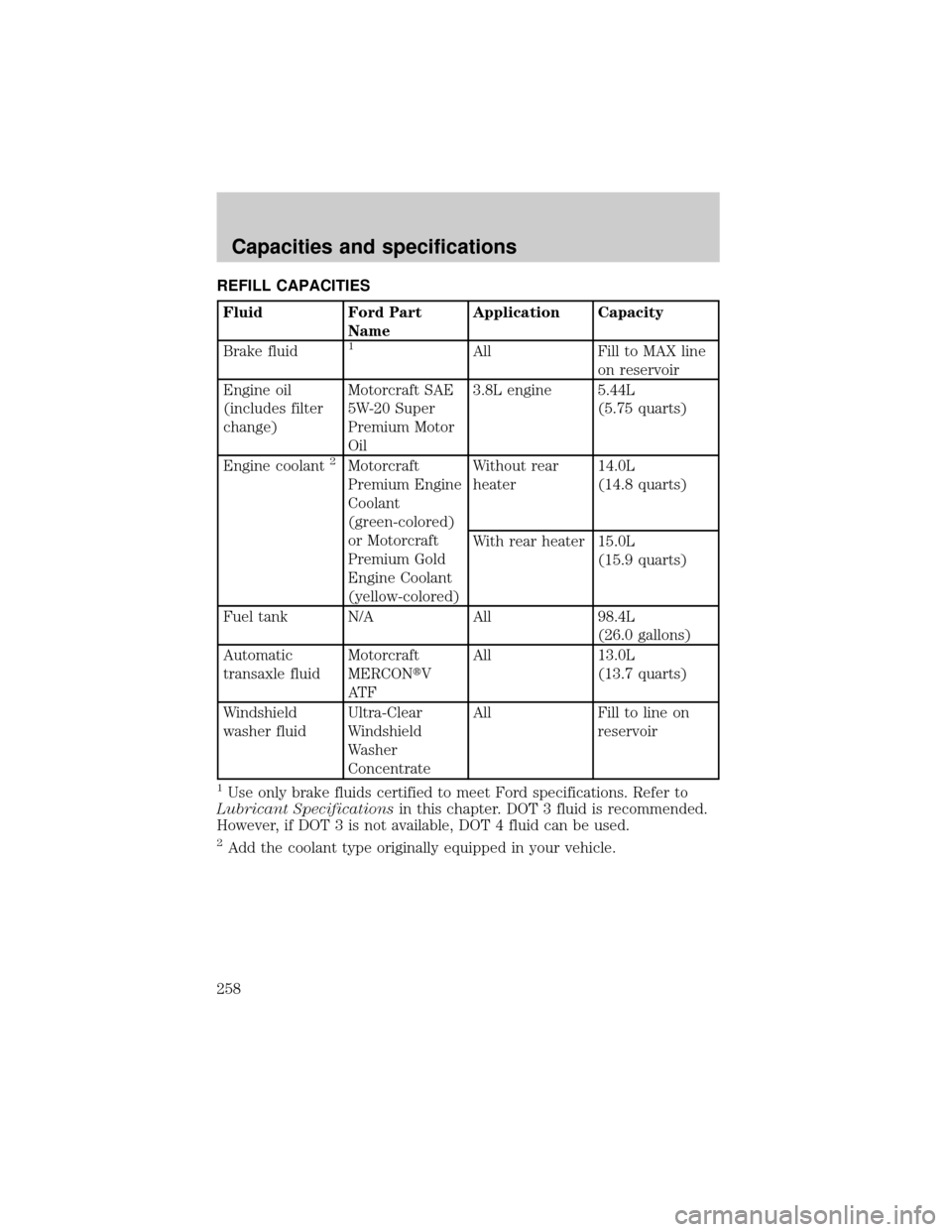
REFILL CAPACITIES
Fluid Ford Part
NameApplication Capacity
Brake fluid
1All Fill to MAX line
on reservoir
Engine oil
(includes filter
change)Motorcraft SAE
5W-20 Super
Premium Motor
Oil3.8L engine 5.44L
(5.75 quarts)
Engine coolant
2Motorcraft
Premium Engine
Coolant
(green-colored)
or Motorcraft
Premium Gold
Engine Coolant
(yellow-colored)Without rear
heater14.0L
(14.8 quarts)
With rear heater 15.0L
(15.9 quarts)
Fuel tank N/A All 98.4L
(26.0 gallons)
Automatic
transaxle fluidMotorcraft
MERCONtV
AT FAll 13.0L
(13.7 quarts)
Windshield
washer fluidUltra-Clear
Windshield
Washer
ConcentrateAll Fill to line on
reservoir
1Use only brake fluids certified to meet Ford specifications. Refer to
Lubricant Specificationsin this chapter. DOT 3 fluid is recommended.
However, if DOT 3 is not available, DOT 4 fluid can be used.
2Add the coolant type originally equipped in your vehicle.
Capacities and specifications
258
Page 259 of 288
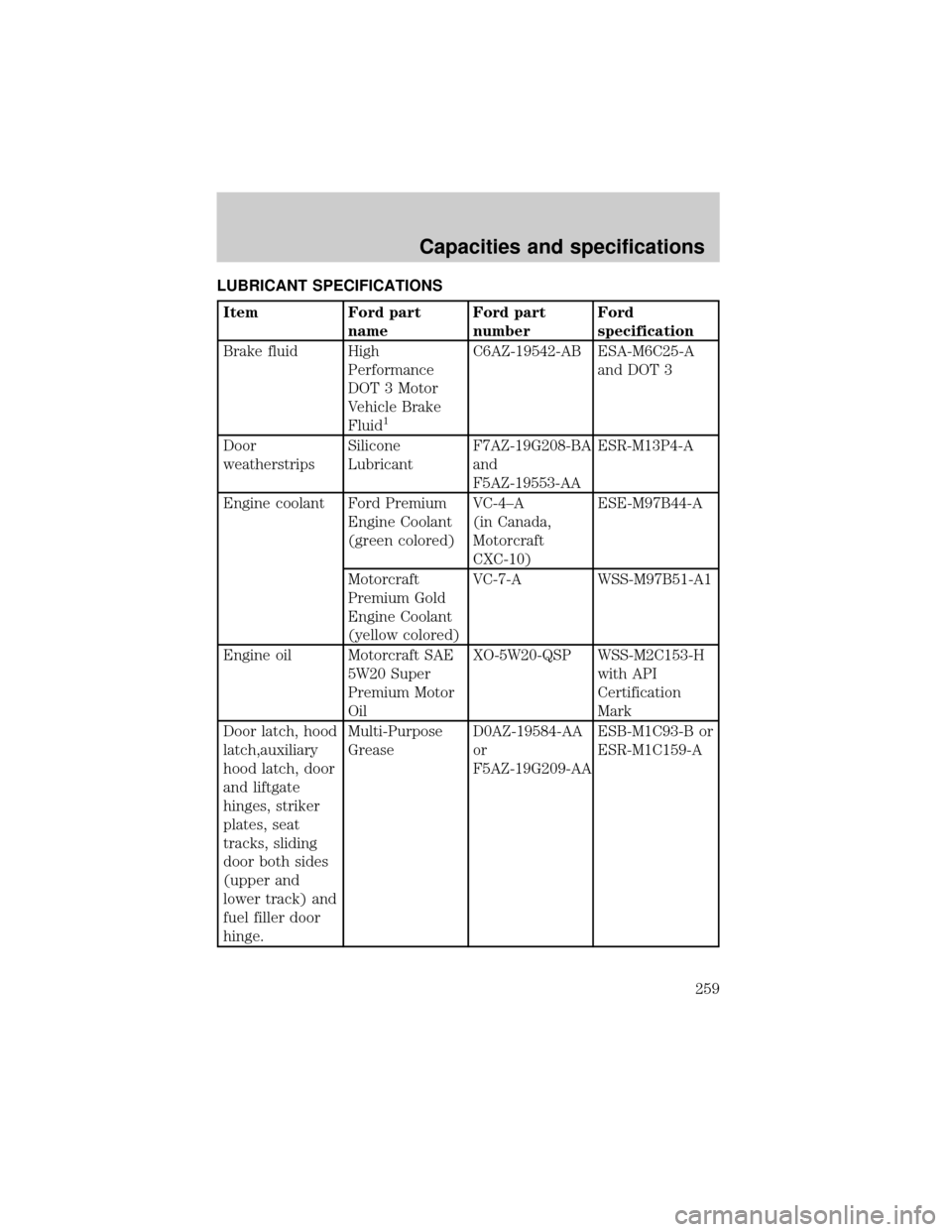
LUBRICANT SPECIFICATIONS
Item Ford part
nameFord part
numberFord
specification
Brake fluid High
Performance
DOT 3 Motor
Vehicle Brake
Fluid
1
C6AZ-19542-AB ESA-M6C25-A
and DOT 3
Door
weatherstripsSilicone
LubricantF7AZ-19G208-BA
and
F5AZ-19553-AAESR-M13P4-A
Engine coolant Ford Premium
Engine Coolant
(green colored)VC-4±A
(in Canada,
Motorcraft
CXC-10)ESE-M97B44-A
Motorcraft
Premium Gold
Engine Coolant
(yellow colored)VC-7-A WSS-M97B51-A1
Engine oil Motorcraft SAE
5W20 Super
Premium Motor
OilXO-5W20-QSP WSS-M2C153-H
with API
Certification
Mark
Door latch, hood
latch,auxiliary
hood latch, door
and liftgate
hinges, striker
plates, seat
tracks, sliding
door both sides
(upper and
lower track) and
fuel filler door
hinge.Multi-Purpose
GreaseD0AZ-19584-AA
or
F5AZ-19G209-AAESB-M1C93-B or
ESR-M1C159-A
Capacities and specifications
259
Page 261 of 288
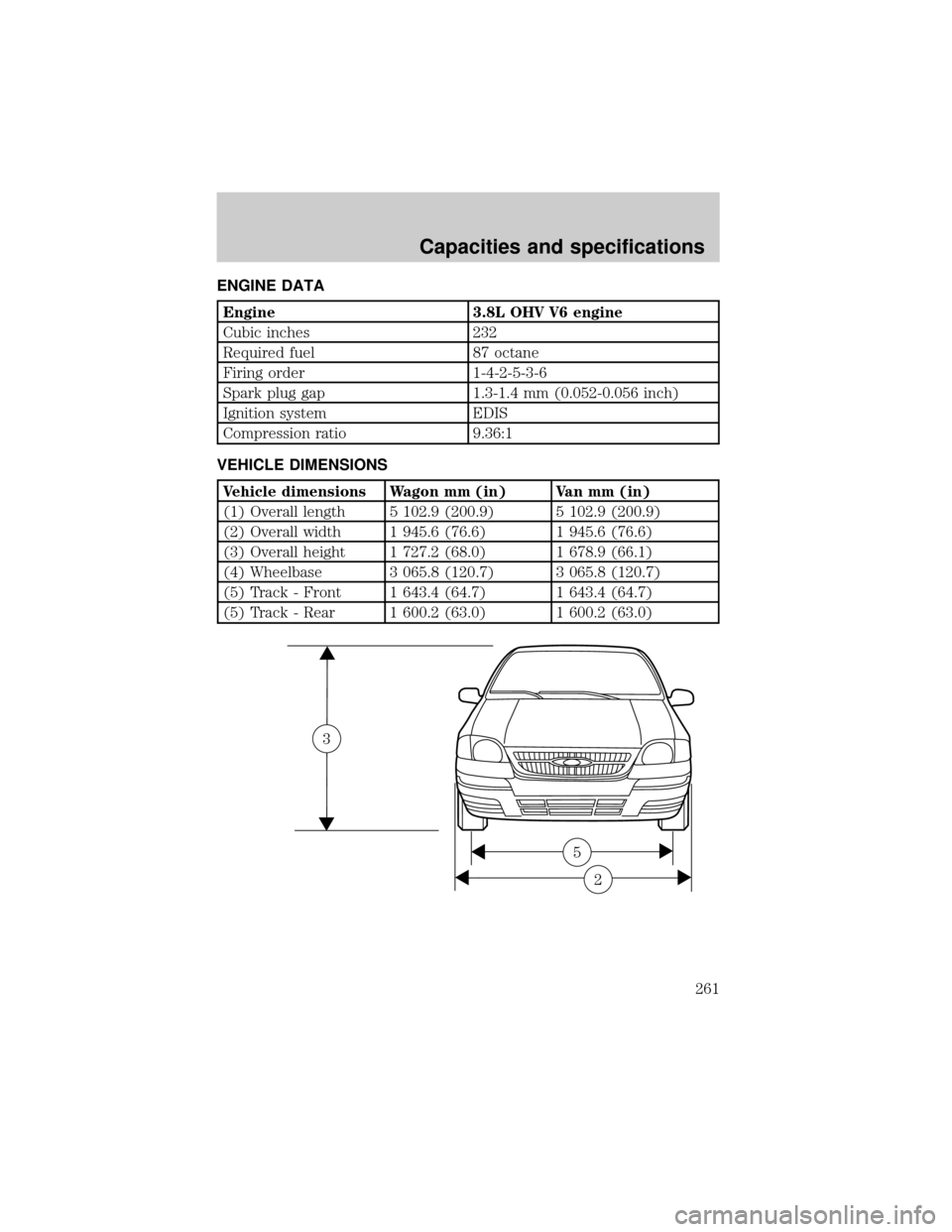
ENGINE DATA
Engine 3.8L OHV V6 engine
Cubic inches 232
Required fuel 87 octane
Firing order 1-4-2-5-3-6
Spark plug gap 1.3-1.4 mm (0.052-0.056 inch)
Ignition system EDIS
Compression ratio 9.36:1
VEHICLE DIMENSIONS
Vehicle dimensions Wagon mm (in) Van mm (in)
(1) Overall length 5 102.9 (200.9) 5 102.9 (200.9)
(2) Overall width 1 945.6 (76.6) 1 945.6 (76.6)
(3) Overall height 1 727.2 (68.0) 1 678.9 (66.1)
(4) Wheelbase 3 065.8 (120.7) 3 065.8 (120.7)
(5) Track - Front 1 643.4 (64.7) 1 643.4 (64.7)
(5) Track - Rear 1 600.2 (63.0) 1 600.2 (63.0)
2
5
3
Capacities and specifications
261
Page 280 of 288

lubrication
specifications ..................259, 261
refill capacities ........................258
service points ..........................210
starting after a collision .........186
Engine block heater .................165
Engine oil ..................................211
change oil soon warning,
message center .......................211
checking and adding ..............211
dipstick ....................................211
filter, specifications ........213, 257
recommendations ...................213
refill capacities ........................258
specifications ..................259, 261
Exhaust fumes ..........................166
F
Floor mats .................................101
Fluid capacities .........................258
Fuel ............................................236
calculating
fuel economy ....................25, 240
cap .....................................12, 238
capacity ...................................258
choosing the right fuel ...........238
comparisons with EPA fuel
economy estimates .................243
detergent in fuel .....................240
filling your vehicle
with fuel ..................236, 238, 240
filter, specifications ........240, 257
fuel pump shut-off switch .....186
gauge .........................................15
improving fuel economy ........240
low fuel warning light ................8
octane rating ...................239, 261
quality ......................................239
running out of fuel .................240safety information relating
to automotive fuels ................236
Fuses ..................................187±188
G
Garage door opener ..............90, 97
Gas cap (see Fuel cap) ......12, 238
Gas mileage
(see Fuel economy) .................240
Gauges .........................................14
engine coolant temperature
gauge .........................................16
fuel gauge ..................................15
odometer ...................................16
speedometer .............................15
tachometer ................................15
trip odometer ............................16
GAWR
(Gross Axle Weight Rating) .....178
calculating ...............................180
definition .................................178
driving with a heavy load ......178
location ....................................178
GVWR (Gross
Vehicle Weight Rating) .............178
calculating .......................178, 180
definition .................................178
driving with a heavy load ......178
location ....................................178
H
Hazard flashers .........................186
Head restraints .................119, 122
Headlamps ...................................27
aiming ..............................250±251
autolamp system .......................29
bulb specifications ..................250
Index
280