Page 38 of 288
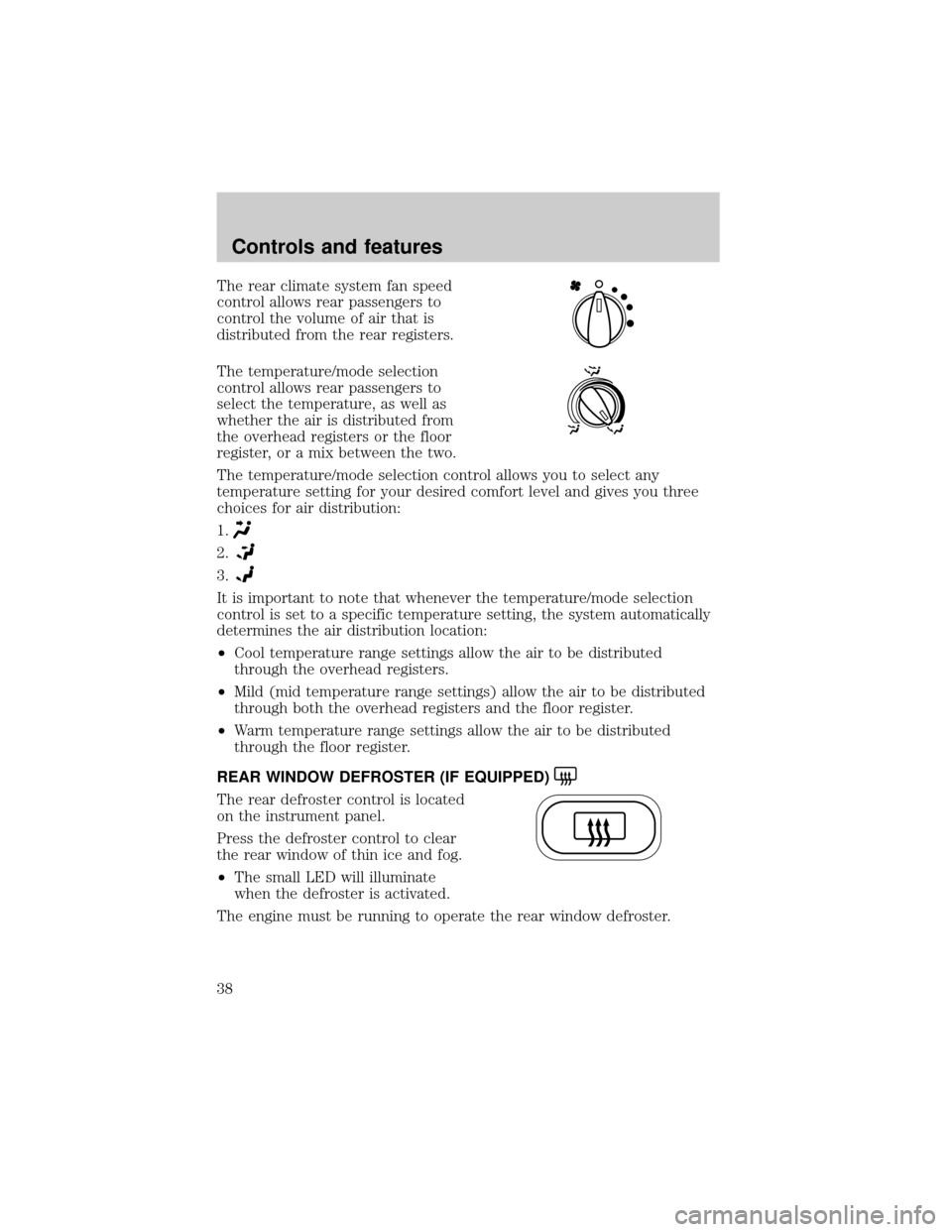
The rear climate system fan speed
control allows rear passengers to
control the volume of air that is
distributed from the rear registers.
The temperature/mode selection
control allows rear passengers to
select the temperature, as well as
whether the air is distributed from
the overhead registers or the floor
register, or a mix between the two.
The temperature/mode selection control allows you to select any
temperature setting for your desired comfort level and gives you three
choices for air distribution:
1.
2.
3.
It is important to note that whenever the temperature/mode selection
control is set to a specific temperature setting, the system automatically
determines the air distribution location:
²Cool temperature range settings allow the air to be distributed
through the overhead registers.
²Mild (mid temperature range settings) allow the air to be distributed
through both the overhead registers and the floor register.
²Warm temperature range settings allow the air to be distributed
through the floor register.
REAR WINDOW DEFROSTER (IF EQUIPPED)
The rear defroster control is located
on the instrument panel.
Press the defroster control to clear
the rear window of thin ice and fog.
²The small LED will illuminate
when the defroster is activated.
The engine must be running to operate the rear window defroster.
Controls and features
38
Page 231 of 288
These Tire Quality Grades are determined by standards that the United
States Department of Transportation has set.
Tire Quality Grades apply to new pneumatic tires for use on passenger
cars. They do not apply to deep tread, winter-type snow tires,
space-saver or temporary use spare tires, tires with nominal rim
diameters of 10 to 12 inches or limited production tires as defined in
Title 49 Code of Federal Regulations Part 575.104(c)(2).
U.S. Department of Transportation-Tire quality grades:The U.S.
Department of Transportation requires Ford to give you the following
information about tire grades exactly as the government has written it.
Treadwear
The treadwear grade is a comparative rating based on the wear rate of
the tire when tested under controlled conditions on a specified
government test course. For example, a tire graded 150 would wear one
and one-half (1 1/2) times as well on the government course as a tire
graded 100. The relative performance of tires depends upon the actual
conditions of their use, however, and may depart significantly from the
norm due to variations in driving habits, service practices, and
differences in road characteristics and climate.
Traction AA A B C
The traction grades, from highest to lowest are AA, A, B, and C. Those
grades represent the tire's ability to stop on wet pavement as measured
under controlled conditions on specified government test surfaces of
asphalt and concrete. A tire marked C may have poor traction
performance.
The traction grade assigned to this tire is based on
straight-ahead braking traction tests, and does not include
acceleration, cornering, hydroplaning or peak traction characteristics.
Temperature A B C
The temperature grades are A (the highest), B, and C, representing the
tire's resistance to the generation of heat and its ability to dissipate heat
when tested under controlled conditions on a specified indoor laboratory
test wheel. Sustained high temperature can cause the material of the tire
to degenerate and reduce tire life, and excessive temperature can lead to
sudden tire failure. The grade C corresponds to a level of performance
Maintenance and care
231
Page 235 of 288
Failure to follow these precautions may adversely affect the
handling of the vehicle and make it easier for the driver to lose
control and roll over.
Tires that are larger or smaller than your vehicle's original tires may also
affect the accuracy of your speedometer.
SNOW TIRES AND CHAINS
Driving too fast for conditions creates the possibility of loss of
vehicle control. Driving at very high speeds for extended periods
of time may result in damage to vehicle components.
Snow tires must be the same size and grade as the tires you
currently have on your vehicle.
The tires on your vehicle have all weather treads to provide traction in
rain and snow. However, in some climates, you may need to use snow
tires and chains. If you need to use chains, it is recommended that steel
wheels (of the same size and specifications) be used as chains may chip
aluminum wheels.
Follow these guidelines when using snow tires and chains:
²Do not use tire chains with 215/65R16 and P225/60R16 size tires.
²Use only SAE Class S chains.
²Install chains securely, verifying that the chains do not touch any
wiring, brake lines or fuel lines.
²Drive cautiously. If you hear the chains rub or bang against your
vehicle, stop and re-tighten the chains. If this does not work, remove
the chains to prevent damage to your vehicle.
²If possible, avoid fully loading your vehicle.
²Remove the tire chains when they are no longer needed. Do not use
tire chains on dry roads.
²The suspension insulation and bumpers will help prevent vehicle
damage. Do not remove these components from your vehicle when
using snow tires and chains.
Maintenance and care
235
Page 279 of 288

exterior ............................252±253
exterior lamps .........................254
instrument cluster lens ..........255
instrument panel ....................255
interior .............................255±257
mirrors .....................................254
plastic parts ............................253
safety belts ..............................256
washing ....................................252
waxing .....................................253
wheels ......................................253
windows ..................................256
wiper blades ............................254
woodtone trim ........................256
Climate control (see Air
conditioning or Heating) ............29
Clock ..........................42, 50, 59, 73
Compass, electronic
set zone adjustment .................24
Console ......................................101
overhead ....................................96
Controls
power seat ...............................120
Coolant
checking and adding ..............215
refill capacities ................220, 258
specifications ..................259, 261
Cruise control
(see Speed control) ....................79
Cupholder(s) .............................123
Customer Assistance ................185
Ford accessories
for your vehicle ......................272
Ford Extended
Service Plan ............................264
Getting assistance outside
the U.S. and Canada ..............271
Getting roadside assistance ...185Getting the
service you need ....................264
Ordering additional
owner's literature ...................275
The Dispute
Settlement Board ...................267
Utilizing the Mediation/
Arbitration Program ...............270
D
Daytime running lamps
(see Lamps) ................................27
Defrost
rear window ..............................38
Dipstick
automatic
transmission fluid ...................222
engine oil .................................211
Doors
door ajar warning .....................13
lubricant specifications ..........259
power sliding ............................98
Driving under special
conditions
through water .........................178
E
Emergencies, roadside
jump-starting ..........................202
Emission control system ..........243
Engine ........................................261
check engine/service engine
soon light ..................................11
cleaning ...................................254
coolant .....................................215
idle speed control ...................227
Index
279