2001 FORD TAURUS coolant temperature
[x] Cancel search: coolant temperaturePage 5 of 256
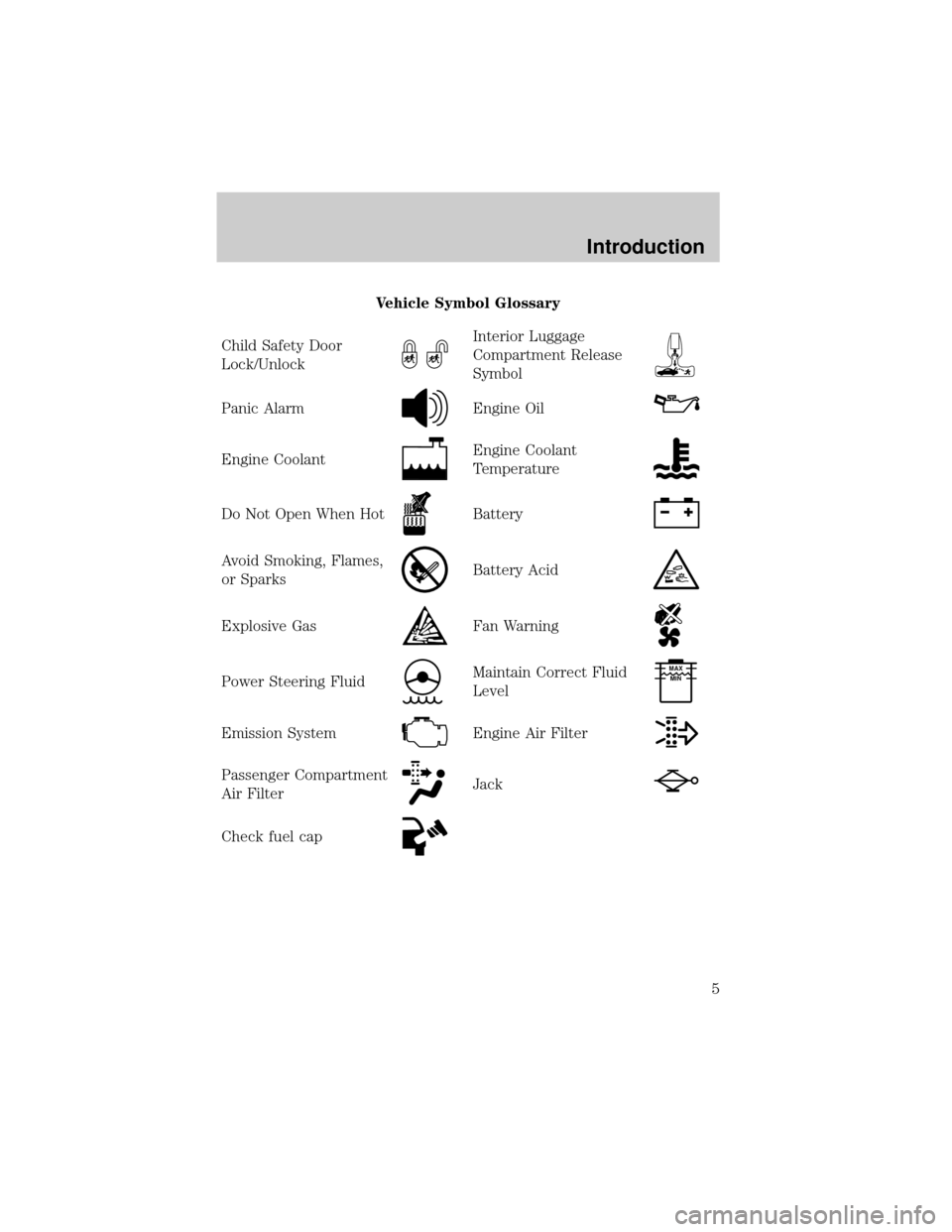
Vehicle Symbol Glossary
Child Safety Door
Lock/Unlock
Interior Luggage
Compartment Release
Symbol
Panic AlarmEngine Oil
Engine CoolantEngine Coolant
Temperature
Do Not Open When HotBattery
Avoid Smoking, Flames,
or SparksBattery Acid
Explosive GasFan Warning
Power Steering FluidMaintain Correct Fluid
LevelMAX
MIN
Emission SystemEngine Air Filter
Passenger Compartment
Air FilterJack
Check fuel cap
Introduction
5
Page 11 of 256
Light is blinking:
Engine misfire is occurring which could damage your catalytic converter.
You should drive in a moderate fashion (avoid heavy acceleration and
deceleration) and have your vehicle serviced at the first available
opportunity.
Under engine misfire conditions, excessive exhaust temperatures
could damage the catalytic converter, the fuel system, interior
floor coverings or other vehicle components, possibly causing a fire.
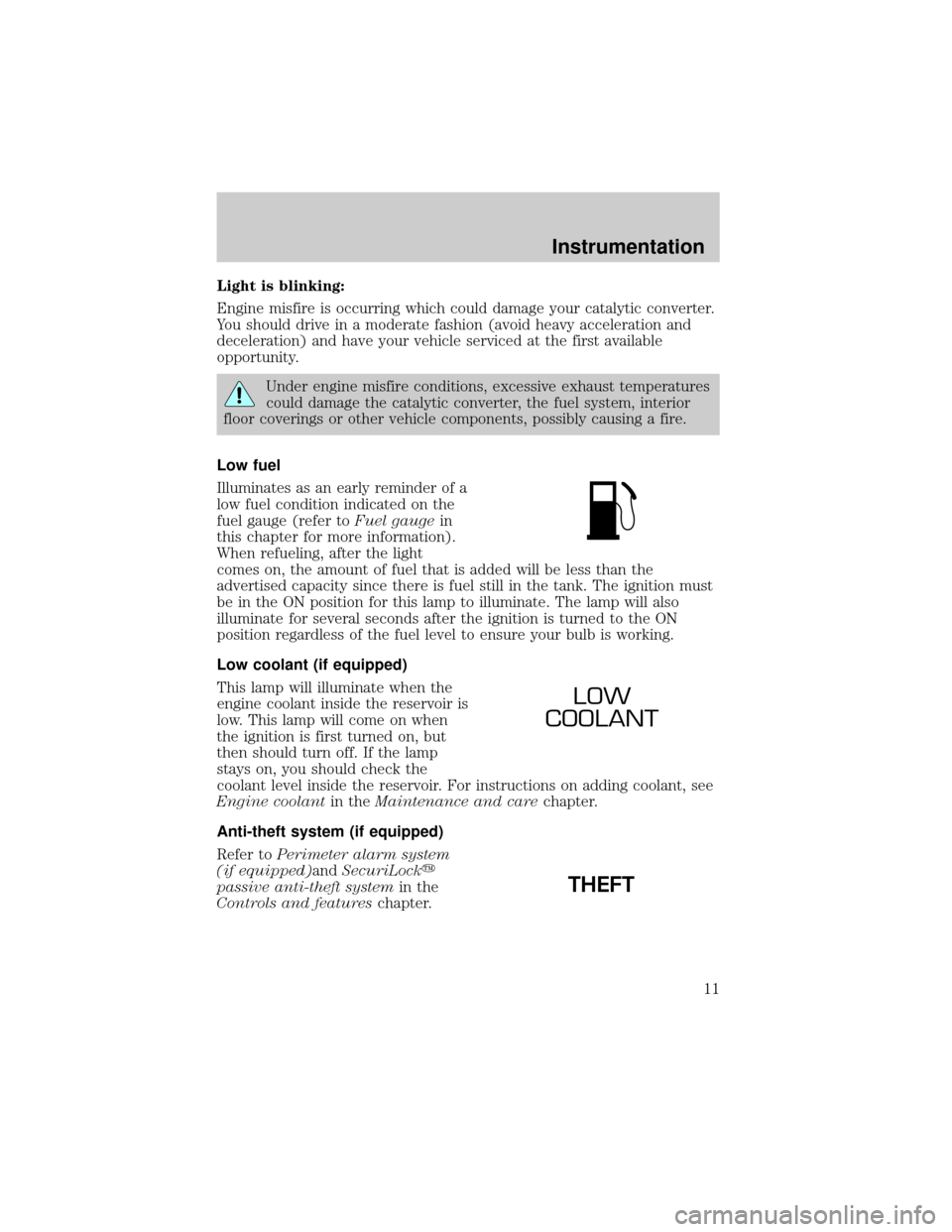
Low fuel
Illuminates as an early reminder of a
low fuel condition indicated on the
fuel gauge (refer toFuel gaugein
this chapter for more information).
When refueling, after the light
comes on, the amount of fuel that is added will be less than the
advertised capacity since there is fuel still in the tank. The ignition must
be in the ON position for this lamp to illuminate. The lamp will also
illuminate for several seconds after the ignition is turned to the ON
position regardless of the fuel level to ensure your bulb is working.
Low coolant (if equipped)
This lamp will illuminate when the
engine coolant inside the reservoir is
low. This lamp will come on when
the ignition is first turned on, but
then should turn off. If the lamp
stays on, you should check the
coolant level inside the reservoir. For instructions on adding coolant, see
Engine coolantin theMaintenance and carechapter.
Anti-theft system (if equipped)
Refer toPerimeter alarm system
(if equipped)andSecuriLocky
passive anti-theft systemin the
Controls and featureschapter.
LOW
COOLANT
THEFT
Instrumentation
11
Page 15 of 256
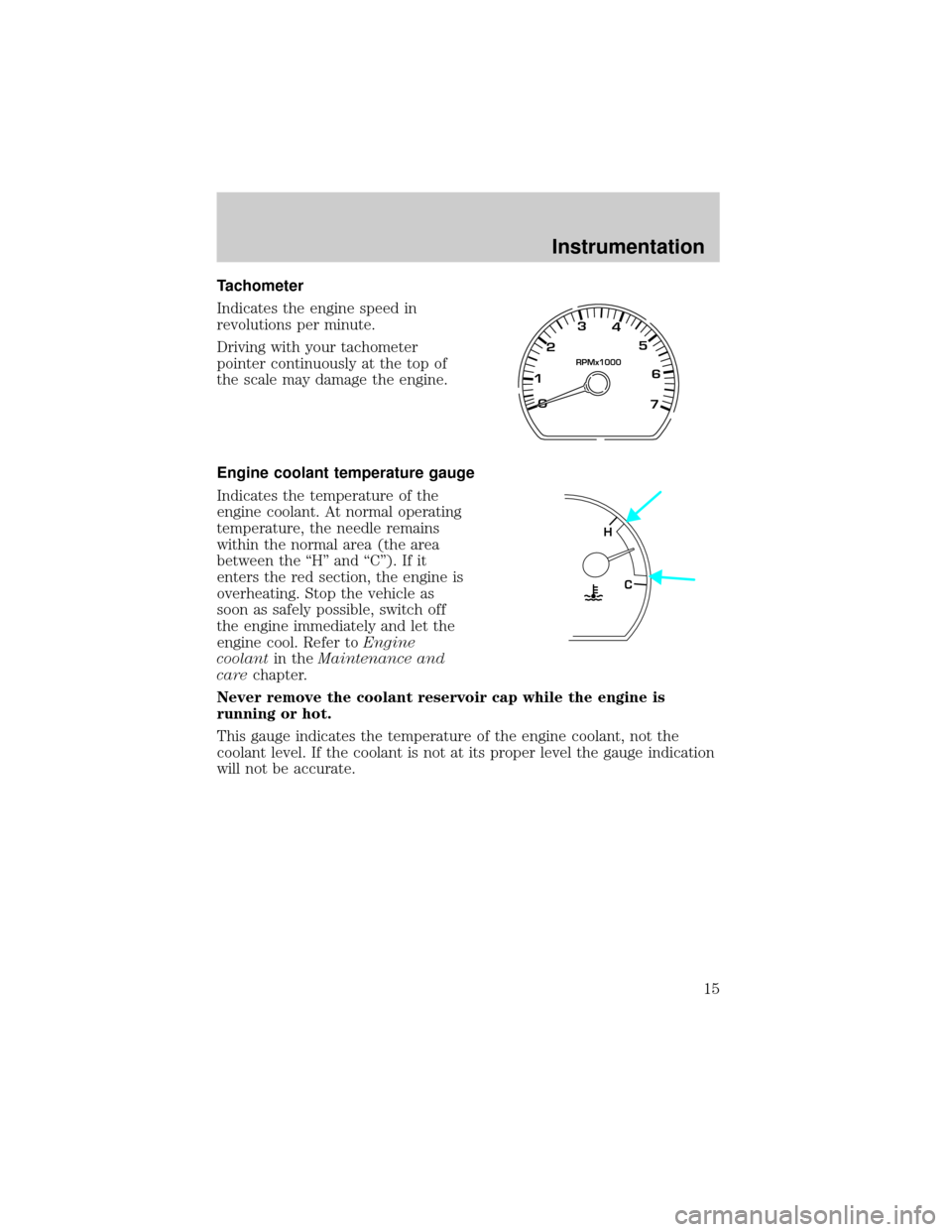
Tachometer
Indicates the engine speed in
revolutions per minute.
Driving with your tachometer
pointer continuously at the top of
the scale may damage the engine.
Engine coolant temperature gauge
Indicates the temperature of the
engine coolant. At normal operating
temperature, the needle remains
within the normal area (the area
between the ªHº and ªCº). If it
enters the red section, the engine is
overheating. Stop the vehicle as
soon as safely possible, switch off
the engine immediately and let the
engine cool. Refer toEngine
coolantin theMaintenance and
carechapter.
Never remove the coolant reservoir cap while the engine is
running or hot.
This gauge indicates the temperature of the engine coolant, not the
coolant level. If the coolant is not at its proper level the gauge indication
will not be accurate.
RPMx1000
0 123
4
5
6
7
C H
Instrumentation
15
Page 125 of 256
Cold starting performance can also be improved with the use of an
engine block heater. The engine block heater is available as a Ford
option and can also be obtained from your Ford dealer. Consult the
engine block heater section for proper use of the engine block heater.
If you should experience cold weather starting problems on (E
d85)
ethanol, and neither an alternative brand of (E
d85) ethanol nor an
engine block heater is available, the addition of unleaded gasoline to your
tank will improve cold starting performance. Your vehicle is designed to
operate on (E
d85) ethanol alone, unleaded gasoline alone, or any mixture
of the two.
If the engine fails to start using the preceding instructions
1. Press the accelerator pedal 1/3 to 1/2 of the way to floor and hold.
2. Turn the key to START position.
3. When the engine starts, release the key, then release the accelerator
pedal gradually as the engine speeds up.
4. If the engine still fails to start, repeat steps one through three.
5. After the engine starts, hold your foot on the brake pedal, put the
gearshift lever in gear and release the parking brake. Slowly release the
brake pedal and drive away in a normal manner.
Using the engine block heater (if equipped)
An engine block heater warms the engine coolant, which improves
starting, warms up the engine faster and allows the heater-defroster
system to respond quickly. Use of an engine block heater is strongly
recommended if you live in a region where temperatures reach -23ÉC
(-10ÉF) or below.
For best results, plug the heater in at least three hours before starting
the vehicle. Using the heater for longer than three hours will not harm
the engine, so the heater can be plugged in the night before starting the
vehicle.
To prevent electrical shock, do not use your heater with
ungrounded electrical systems or two-pronged (cheater)
adapters.
Starting
125
Page 176 of 256
²Refer to the chart on the coolant container to ensure the
coolant concentration in your vehicle will provide adequate
freeze protection at the temperatures in which you drive in the
winter months.
If you drive in extremely hot climates:
²It is still necessary to maintain the coolant concentration
above 40%.
²NEVER decrease the coolant concentration below 40%.
²Decreased engine coolant concentrations below 40% will
decrease the corrosion protection characteristics of the engine
coolant and may cause engine damage.
²Decreased engine coolant concentrations below 40% will
decrease the freeze protection characteristics of the engine
coolant and may cause engine damage.
²Refer to the chart on the coolant container to ensure the
coolant concentration in your vehicle will provide adequate
protection at the temperatures in which you drive.
Vehicles driven year-round in non-extreme climates should use a 50/50
mixture of engine coolant and distilled water for optimum cooling system
and engine protection.
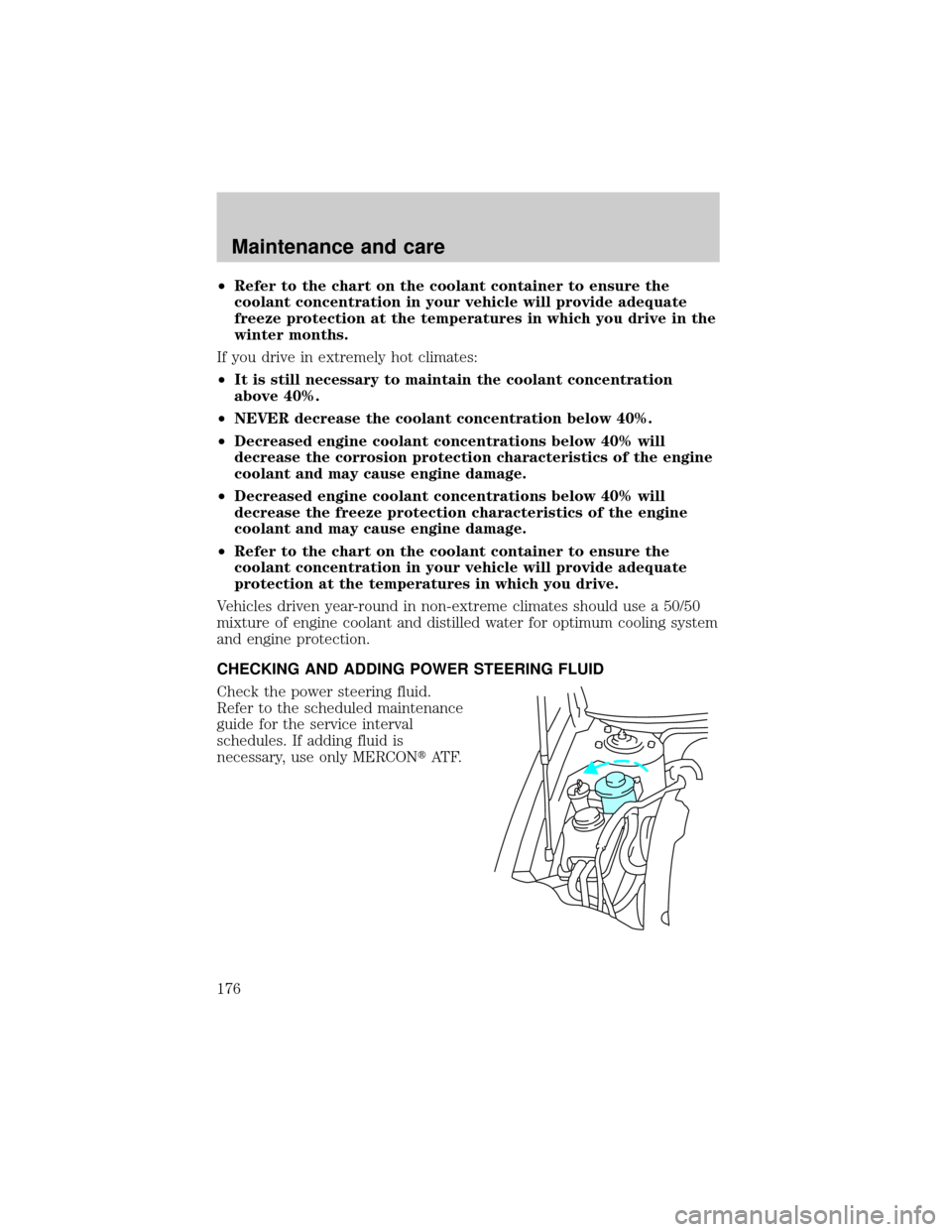
CHECKING AND ADDING POWER STEERING FLUID
Check the power steering fluid.
Refer to the scheduled maintenance
guide for the service interval
schedules. If adding fluid is
necessary, use only MERCONtAT F.
Maintenance and care
176
Page 177 of 256
1. Start the engine and let it run until it reaches normal operating
temperature (the engine coolant temperature gauge indicator will be
near the center of the normal area between H and C).
2. While the engine idles, turn the steering wheel left and right several
times.
3. Turn the engine off.
Perform steps 4 and 5 following the procedure for your engine.
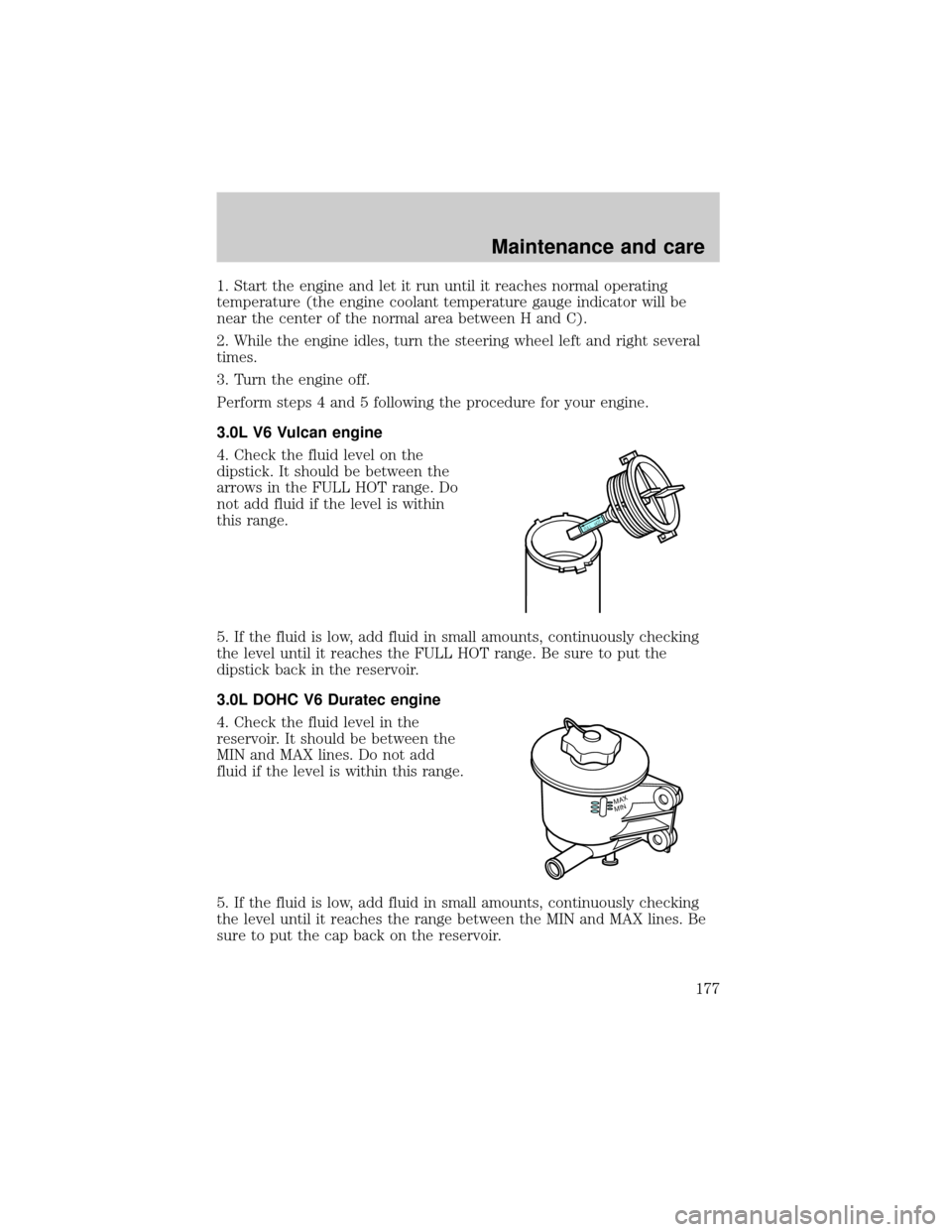
3.0L V6 Vulcan engine
4. Check the fluid level on the
dipstick. It should be between the
arrows in the FULL HOT range. Do
not add fluid if the level is within
this range.
5. If the fluid is low, add fluid in small amounts, continuously checking
the level until it reaches the FULL HOT range. Be sure to put the
dipstick back in the reservoir.
3.0L DOHC V6 Duratec engine
4. Check the fluid level in the
reservoir. It should be between the
MIN and MAX lines. Do not add
fluid if the level is within this range.
5. If the fluid is low, add fluid in small amounts, continuously checking
the level until it reaches the range between the MIN and MAX lines. Be
sure to put the cap back on the reservoir.
FULL HOT
MINMAX
Maintenance and care
177
Page 243 of 256

A
Accessory delay ..........................63
Air bag supplemental restraint
system ........................104, 106, 110
and child safety seats ............107
description ......................106, 110
disposal ....................................112
driver air bag ..........105, 109, 111
indicator light ...................13, 108
operation .................105, 109, 111
passenger air bag ...105, 109, 111
side air bag ..............................110
Air cleaner filter .......................222
Air conditioning ..........................19
automatic temperature
control system ..........................22
Air filter, cabin ..........................180
Antifreeze (see Engine
coolant) .....................................171
Anti-lock brake system (see
Brakes) ..............................127±128
Anti-theft system ........................73
arming the system ....................73
disarming a triggered system ..75
warning light .............................11
Audio system (see Radio) .........30
Automatic transaxle .................132
driving with .............................134
fluid, adding ............................178
fluid, checking ........................178
fluid, refill capacities ..............223
fluid, specification ..................226
Auxiliary power point .................29
Axle
lubricant specifications ..........224B
Battery .......................................185
acid, treating emergencies .....185
charging system
warning light .............................13
jumping a disabled battery ....156
maintenance-free ....................185
replacement, specifications ...222
servicing ..................................185
Belt minder ...............................100
Brakes ........................................127
anti-lock ...........................127±128
anti-lock brake system
(ABS) warning light .........12, 128
brake warning light ..................12
fluid, checking and adding ....169
fluid, refill capacities ..............223
fluid, specifications .........224, 226
lubricant specifications ..224, 226
parking ....................................129
pedals (see Power adjustable
foot pedals) ...............................51
shift interlock ..........................132
Break-in period .............................3
C
Capacities for refilling fluids ....223
Cargo area shade ........................68
Cargo cover .................................67
Cargo net .....................................67
CD changer .................................47
Cellular telephone
Wireless Interface Module .......60
Certification Label ....................228
Child safety restraints ..............113
child safety belts ....................113
Index
243
Page 245 of 256

idle speed control ...................185
lubrication
specifications ..................224, 226
refill capacities ........................223
service points ..................164±165
starting after a collision .........145
Engine block heater .................125
Engine oil ..................................166
checking and adding ..............166
dipstick ....................................166
filter, specifications ........168, 222
recommendations ...................168
refill capacities ........................223
specifications ..................224, 226
Exhaust fumes ..........................126
F
Flexible Fuel Vehicle (FFV) ....192
Floor mats ...................................65
Fluid capacities .........................223
Fuel ............................................192
calculating fuel economy .......199
cap .......................................9, 195
capacity ...................................223
choosing the right fuel ...........196
comparisons with EPA fuel
economy estimates .................202
detergent in fuel .....................198
filling your vehicle
with fuel ..................192, 195, 199
filter, specifications ........198, 222
fuel pump shut-off switch .....145
gauge .........................................16
improving fuel economy ........199
low fuel warning light ..............11
octane rating ...................196, 226
quality ......................................197
running out of fuel .................198safety information relating to
automotive fuels .....................192
Fuses ..................................147±148
G
Gas cap (see Fuel cap) ........9, 195
Gas mileage
(see Fuel economy) .................199
Gauges .........................................14
engine coolant temperature
gauge .........................................15
fuel gauge ..................................16
odometer ...................................16
speedometer .............................14
tachometer ................................15
trip odometer ............................16
GAWR (Gross Axle Weight
Rating) .......................................137
definition .................................137
driving with a heavy load ......137
location ....................................137
GVWR (Gross Vehicle Weight
Rating) .......................................137
calculating ...............................137
definition .................................137
driving with a heavy load ......137
location ....................................137
H
Hazard flashers .........................145
Head restraints ...........................84
Headlamps ...................................17
aiming ......................................214
autolamp system .......................18
bulb specifications ..................213
daytime running lights .............17
flash to pass ..............................17
Index
245