2001 FORD TAURUS seats
[x] Cancel search: seatsPage 115 of 256
²Put the safety belt in the automatic locking mode. Refer toAutomatic
locking mode.
Ford recommends the use of a child safety seat having a top tether
strap. Install the child safety seat in a seating position which is capable
of providing a tether anchorage. For more information on top tether
straps, refer toAttaching safety seats with tether strapsin this chapter.
Carefully follow all of the manufacturer's instructions included
with the safety seat you put in your vehicle. If you do not install
and use the safety seat properly, the child may be injured in a sudden
stop or collision.
Installing child safety seats in combination lap and shoulder belt
seating positions
Air bags can kill or injure a child in a child seat.NEVERplace a
rear-facing child seat in front of an active air bag. If you must
use a forward-facing child seat in the front seat, move the seat all the
way back.
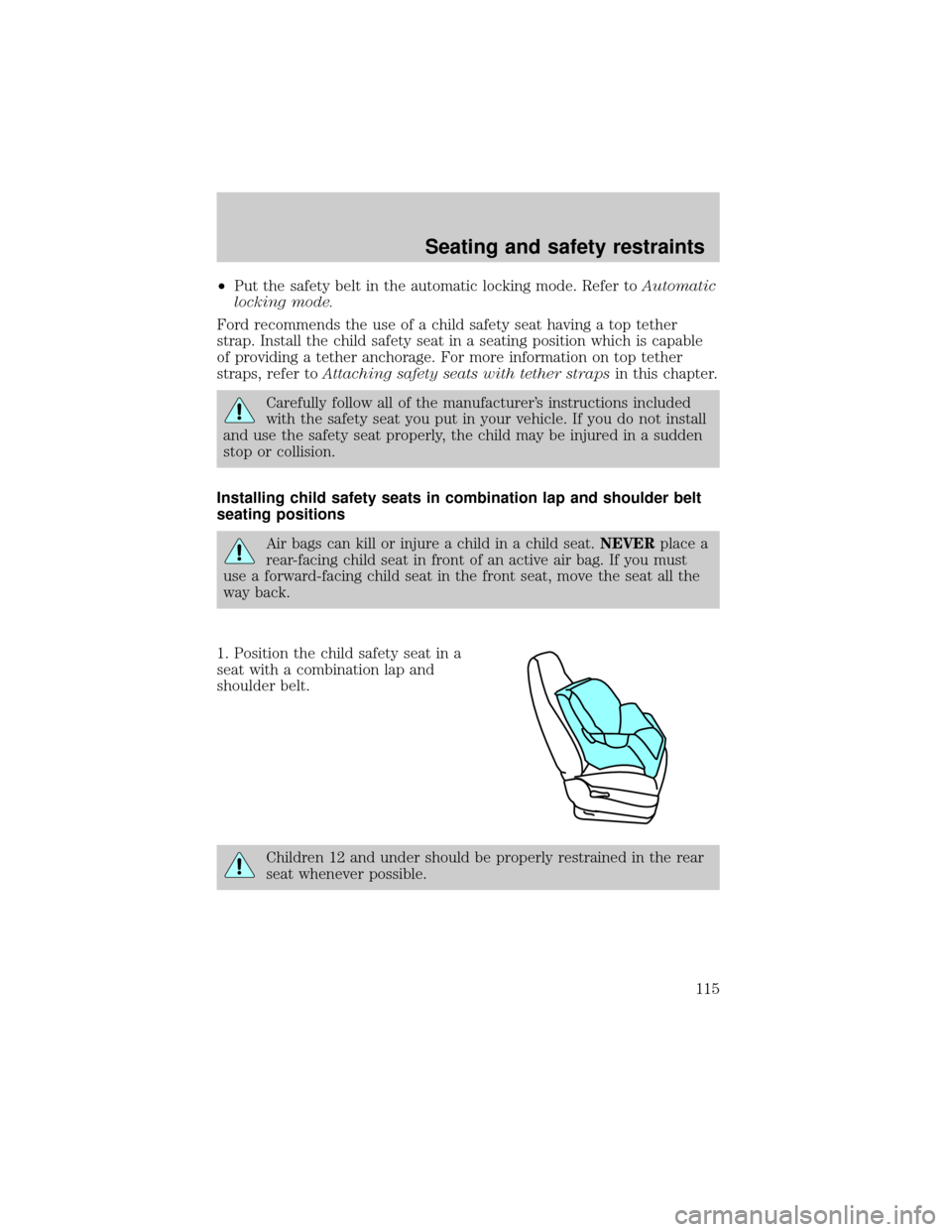
1. Position the child safety seat in a
seat with a combination lap and
shoulder belt.
Children 12 and under should be properly restrained in the rear
seat whenever possible.
Seating and safety restraints
115
Page 118 of 256
Installing child safety seats in the lap belt seating positions
1. Lengthen the lap belt. To lengthen the belt, hold the tongue so that its
bottom is perpendicular to the direction of webbing while sliding the
tongue up the webbing.
2. Place the child safety seat in the center seating position.
3. Route the tongue and webbing through the child seat according to the
child seat manufacturer's instructions.
4. Insert the belt tongue into the proper buckle for the center seating
position until you hear a snap and feel it latch. Make sure the tongue is
securely fastened to the buckle by pulling on tongue.
5. Push down on the child seat while pulling on the loose end of the lap
belt webbing to tighten the belt.
6. Before placing the child into the child seat, forcibly tilt the child seat
from side to side and in forward direction to make sure that the seat is
held securely in place. If the child seat moves excessively, repeat steps 5
through 6, or properly install the child seat in a different position.
Attaching child safety seats with tether straps
Most new forward-facing child safety seats include a tether strap which
goes over the back of the seat and hooks to an anchoring point. Tether
straps are available as an accessory for many older safety seats. Contact
the manufacturer of your child seat for information about ordering a
tether strap.
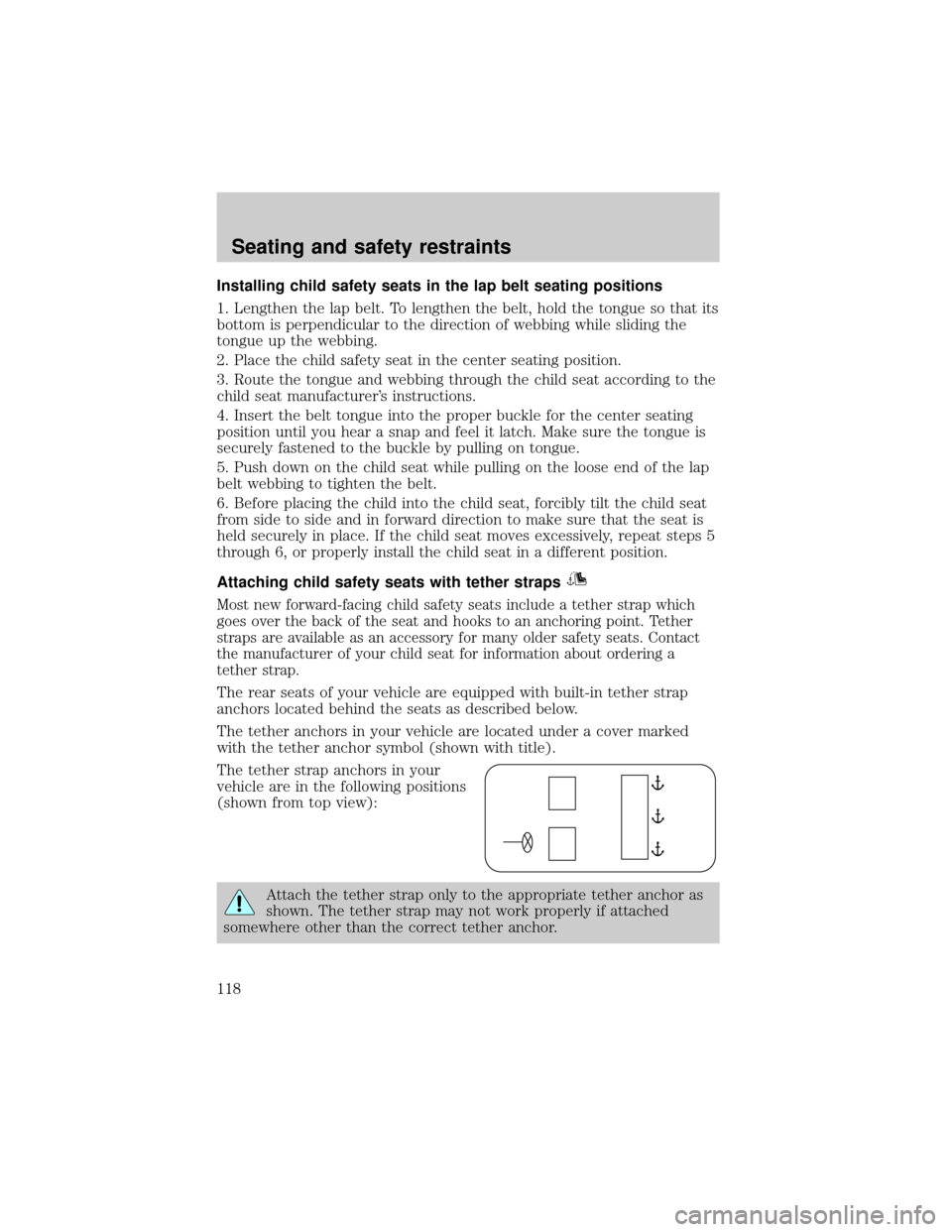
The rear seats of your vehicle are equipped with built-in tether strap
anchors located behind the seats as described below.
The tether anchors in your vehicle are located under a cover marked
with the tether anchor symbol (shown with title).
The tether strap anchors in your
vehicle are in the following positions
(shown from top view):
Attach the tether strap only to the appropriate tether anchor as
shown. The tether strap may not work properly if attached
somewhere other than the correct tether anchor.
Seating and safety restraints
118
Page 119 of 256
1. Position the child safety seat on the seat cushion.
2. Route the child safety seat tether strap over the back of the seat.
For vehicles with adjustable head restraints, route the tether strap under
the head restraint and between the head restraint posts, otherwise route
the tether strap over the top of the seatback.
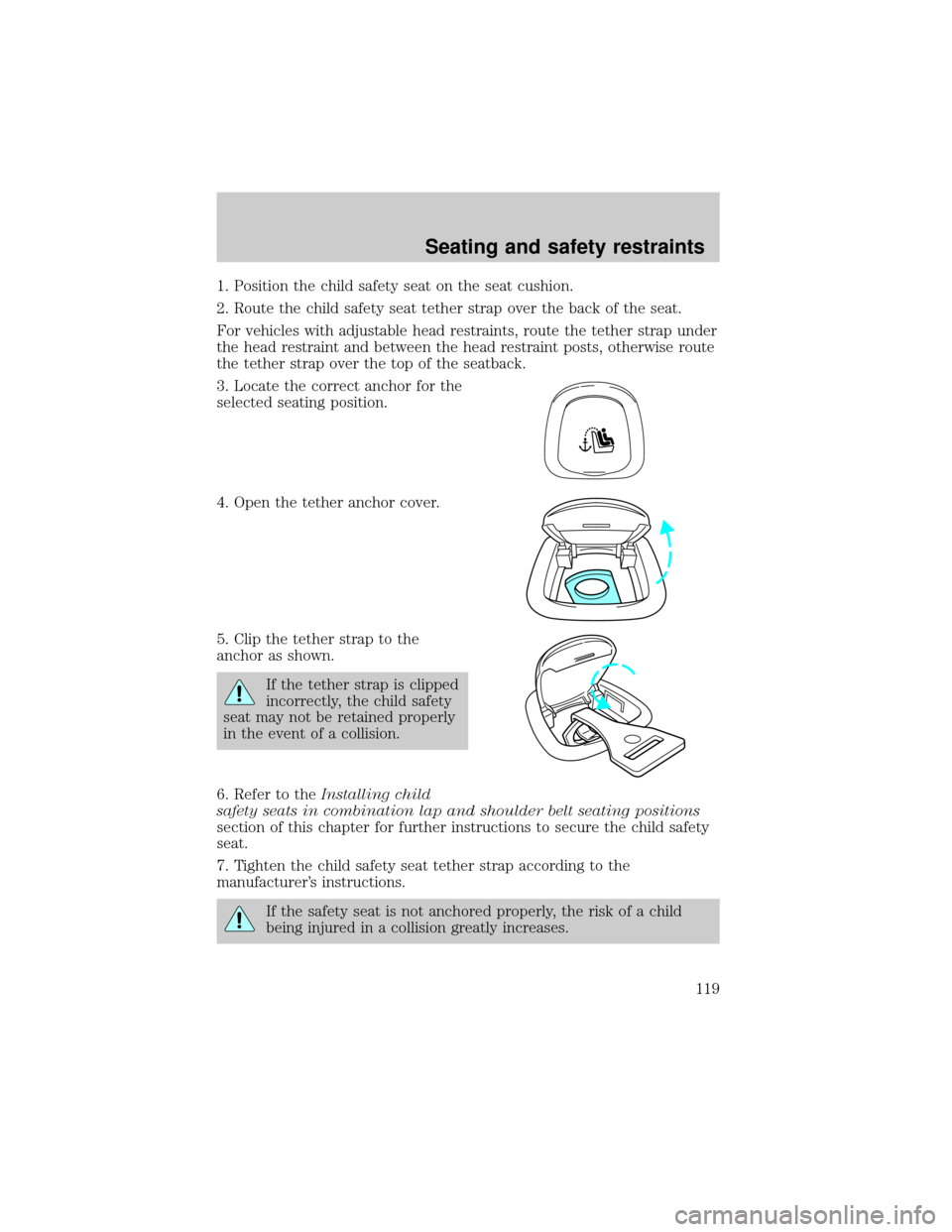
3. Locate the correct anchor for the
selected seating position.
4. Open the tether anchor cover.
5. Clip the tether strap to the
anchor as shown.
If the tether strap is clipped
incorrectly, the child safety
seat may not be retained properly
in the event of a collision.
6. Refer to theInstalling child
safety seats in combination lap and shoulder belt seating positions
section of this chapter for further instructions to secure the child safety
seat.
7. Tighten the child safety seat tether strap according to the
manufacturer's instructions.
If the safety seat is not anchored properly, the risk of a child
being injured in a collision greatly increases.
Seating and safety restraints
119
Page 120 of 256
Attaching child safety seats with LATCH attachments for child seat
anchors
Some child safety seats are labeled as LATCH or LATCH-compatible child
seats. These seats include two rigid or webbing mounted attachments
that connect to two anchors at specific seating positions in your vehicle.
This type of child seat eliminates the need to use seat belts to attach the
child seat. For forward-facing child seats, the tether strap must also be
attached to the proper tether anchor point. For information on using
tether straps with the child safety seats, refer toAttaching safety seats
with tether strapsin this chapter.
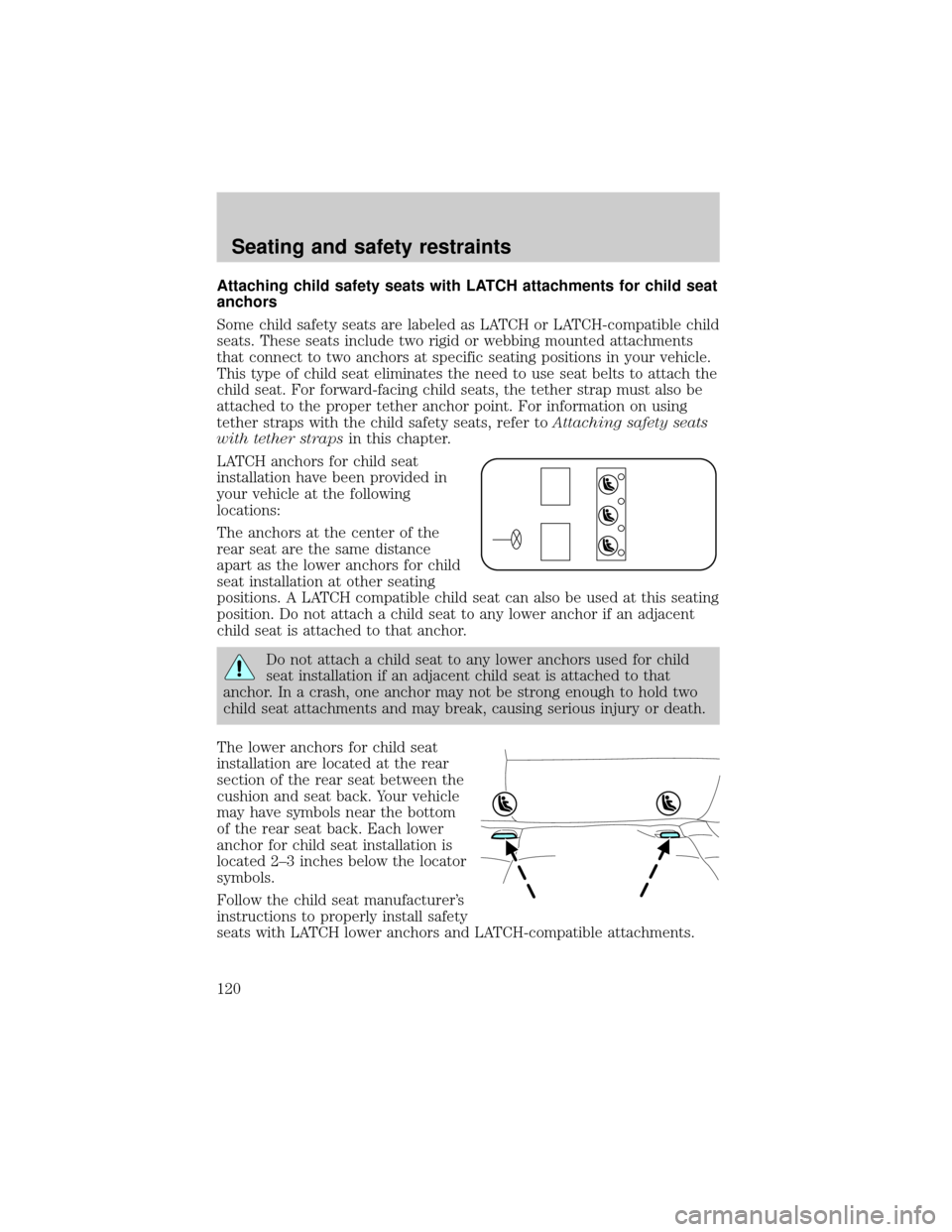
LATCH anchors for child seat
installation have been provided in
your vehicle at the following
locations:
The anchors at the center of the
rear seat are the same distance
apart as the lower anchors for child
seat installation at other seating
positions. A LATCH compatible child seat can also be used at this seating
position. Do not attach a child seat to any lower anchor if an adjacent
child seat is attached to that anchor.
Do not attach a child seat to any lower anchors used for child
seat installation if an adjacent child seat is attached to that
anchor. In a crash, one anchor may not be strong enough to hold two
child seat attachments and may break, causing serious injury or death.
The lower anchors for child seat
installation are located at the rear
section of the rear seat between the
cushion and seat back. Your vehicle
may have symbols near the bottom
of the rear seat back. Each lower
anchor for child seat installation is
located 2±3 inches below the locator
symbols.
Follow the child seat manufacturer's
instructions to properly install safety
seats with LATCH lower anchors and LATCH-compatible attachments.
Seating and safety restraints
120
Page 148 of 256
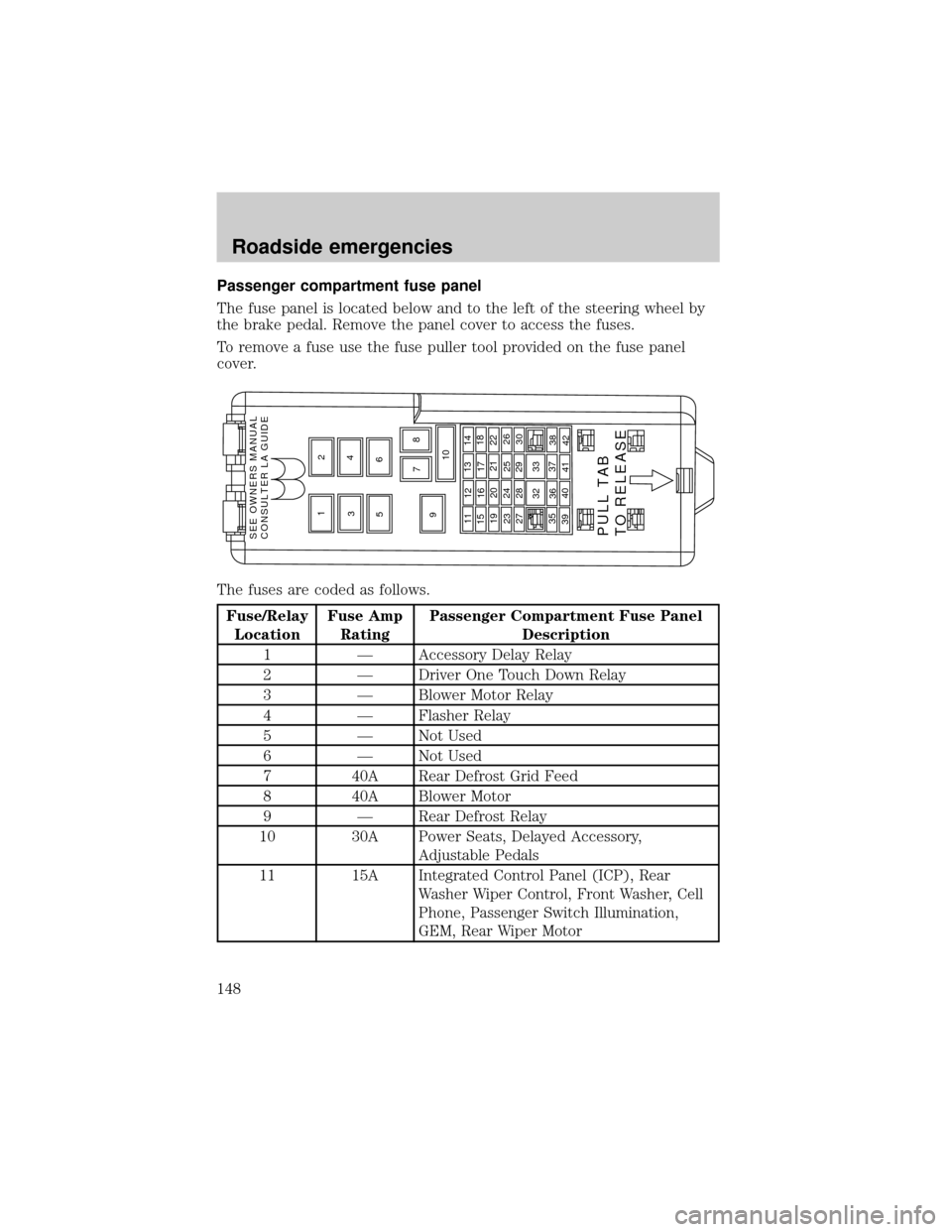
Passenger compartment fuse panel
The fuse panel is located below and to the left of the steering wheel by
the brake pedal. Remove the panel cover to access the fuses.
To remove a fuse use the fuse puller tool provided on the fuse panel
cover.
The fuses are coded as follows.
Fuse/Relay
LocationFuse Amp
RatingPassenger Compartment Fuse Panel
Description
1 Ð Accessory Delay Relay
2 Ð Driver One Touch Down Relay
3 Ð Blower Motor Relay
4 Ð Flasher Relay
5 Ð Not Used
6 Ð Not Used
7 40A Rear Defrost Grid Feed
8 40A Blower Motor
9 Ð Rear Defrost Relay
10 30A Power Seats, Delayed Accessory,
Adjustable Pedals
11 15A Integrated Control Panel (ICP), Rear
Washer Wiper Control, Front Washer, Cell
Phone, Passenger Switch Illumination,
GEM, Rear Wiper Motor
12
34
56
78
9
10
11 1213 14
15
16 1718
19 2021 22
2324
2526
27 2829
30
32 33
35
3637
38
39 40
41
42
PULL TAB
TO RELEASE SEE OWNERS MANUAL
CONSULTER LA GUIDE
Roadside emergencies
148
Page 220 of 256
Cleaning the instrument panel
Clean with a damp cloth, then dry with a dry cloth.
Avoid cleaner or polish that increases the gloss of the upper portion of
the instrument panel. The dull finish in this area helps protect the driver
from undesirable windshield reflection.
Do not use chemical solvents or strong detergents when cleaning
the steering wheel or instrument panel to avoid contamination of
the air bag system.
Cleaning the instrument cluster lens
Clean with a damp cloth, then dry with a dry cloth.
Do not use household or glass cleaners as these may damage the lens.
Cleaning seats equipped with side air bags
Remove dust and loose dirt with a whisk broom or a vacuum cleaner.
Remove fresh spots immediately. Follow the directions that come with
the cleaner. Do not saturate the seat cover with upholstery cleaner.
Do not use chemical solvents or strong detergents when cleaning
the seat mounted side air bag. Such products could contaminate
the side air bag system and affect performance of the side air bag in a
collision.
Woodtone trim
Wipe stains with a soft cloth and a multi-purpose cleaning solution.
Inside windows
Use Ultra-Clear Spray Glass Cleaner (E4AZ-19C507±AA) for the inside
windows if they become fogged.
Maintenance and care
220
Page 221 of 256

Cleaning and maintaining the safety belts
Clean the safety belts with a mild soap solution recommended for
cleaning upholstery or carpets. Do not bleach or dye the belts, because
these actions may weaken the belt webbing.
Check the safety belt system periodically to make sure there are no
nicks, tears or cuts. If your vehicle has been involved in an accident,
refer to theSafety belt maintenancesection in theSeating and safety
restraintschapter.
Cleaning leather seats (if equipped)
To clean, simply use a soft cloth dampened with water and a mild soap.
Wipe the leather again with a damp cloth to remove soap residue. Dry
with a soft cloth. For tougher soiling concerns, Ford recommends using
the Deluxe Leather Care Kit F8AZ-19G253±AA, which is available from
your Ford Dealer. This mild cleaner and special pad, cleans the leather
and maintains its natural beauty. Follow the instructions on the cleaner
label. Regular cleaning of your leather upholstery helps maintain its
resiliency and color.
Do not use household cleaning products, alcohol solutions,
solvents or cleaners intended for rubber, vinyl or plastics.
Cleaning the interior fabric
Remove dust and loose dirt with a whisk broom or a vacuum cleaner.
Remove fresh spots immediately. Do not use household or glass cleaners.
These agents can stain and discolor the fabric. Use a mild soap and
water solution if necessary.
Maintenance and care
221
Page 243 of 256

A
Accessory delay ..........................63
Air bag supplemental restraint
system ........................104, 106, 110
and child safety seats ............107
description ......................106, 110
disposal ....................................112
driver air bag ..........105, 109, 111
indicator light ...................13, 108
operation .................105, 109, 111
passenger air bag ...105, 109, 111
side air bag ..............................110
Air cleaner filter .......................222
Air conditioning ..........................19
automatic temperature
control system ..........................22
Air filter, cabin ..........................180
Antifreeze (see Engine
coolant) .....................................171
Anti-lock brake system (see
Brakes) ..............................127±128
Anti-theft system ........................73
arming the system ....................73
disarming a triggered system ..75
warning light .............................11
Audio system (see Radio) .........30
Automatic transaxle .................132
driving with .............................134
fluid, adding ............................178
fluid, checking ........................178
fluid, refill capacities ..............223
fluid, specification ..................226
Auxiliary power point .................29
Axle
lubricant specifications ..........224B
Battery .......................................185
acid, treating emergencies .....185
charging system
warning light .............................13
jumping a disabled battery ....156
maintenance-free ....................185
replacement, specifications ...222
servicing ..................................185
Belt minder ...............................100
Brakes ........................................127
anti-lock ...........................127±128
anti-lock brake system
(ABS) warning light .........12, 128
brake warning light ..................12
fluid, checking and adding ....169
fluid, refill capacities ..............223
fluid, specifications .........224, 226
lubricant specifications ..224, 226
parking ....................................129
pedals (see Power adjustable
foot pedals) ...............................51
shift interlock ..........................132
Break-in period .............................3
C
Capacities for refilling fluids ....223
Cargo area shade ........................68
Cargo cover .................................67
Cargo net .....................................67
CD changer .................................47
Cellular telephone
Wireless Interface Module .......60
Certification Label ....................228
Child safety restraints ..............113
child safety belts ....................113
Index
243