Page 148 of 256
Passenger compartment fuse panel
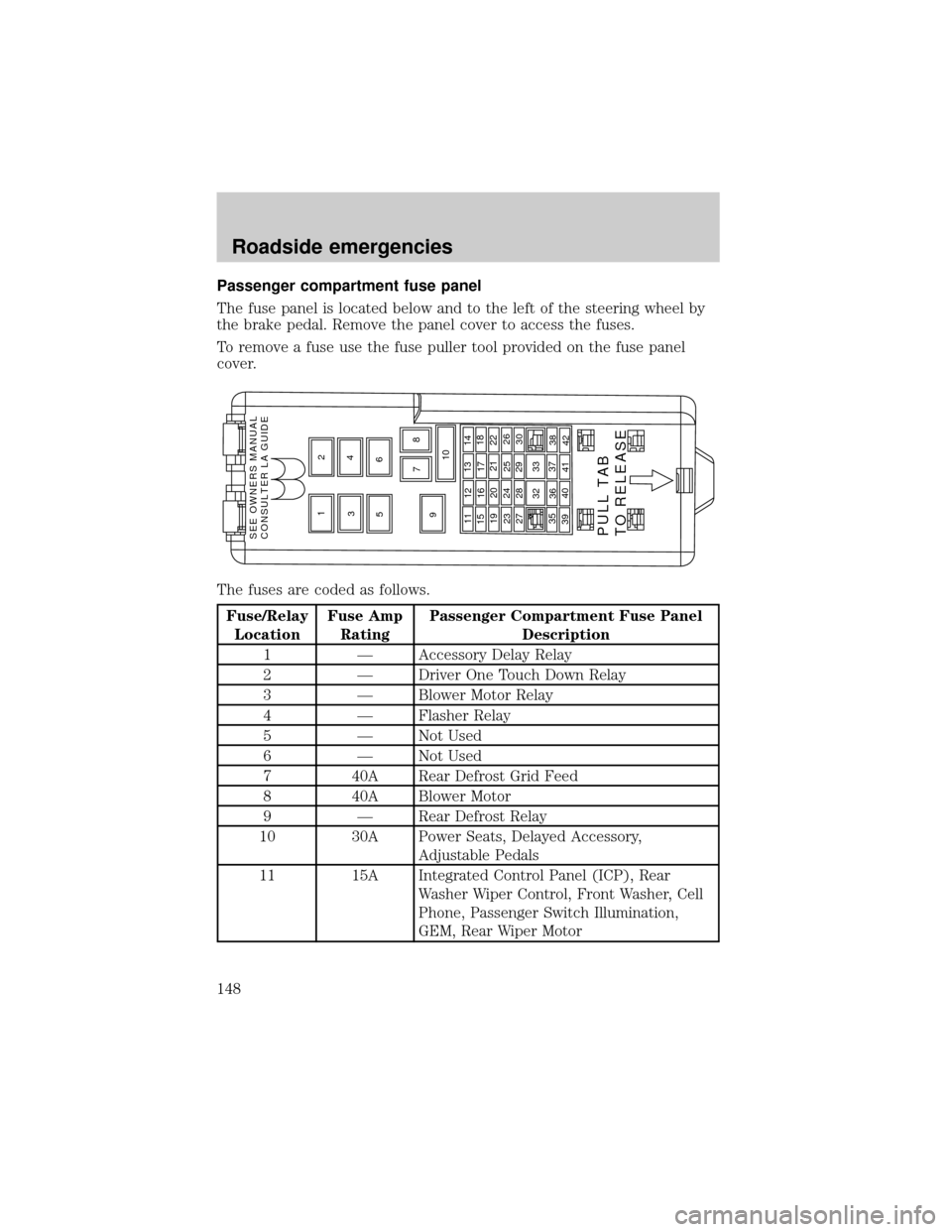
The fuse panel is located below and to the left of the steering wheel by
the brake pedal. Remove the panel cover to access the fuses.
To remove a fuse use the fuse puller tool provided on the fuse panel
cover.
The fuses are coded as follows.
Fuse/Relay
LocationFuse Amp
RatingPassenger Compartment Fuse Panel
Description
1 Ð Accessory Delay Relay
2 Ð Driver One Touch Down Relay
3 Ð Blower Motor Relay
4 Ð Flasher Relay
5 Ð Not Used
6 Ð Not Used
7 40A Rear Defrost Grid Feed
8 40A Blower Motor
9 Ð Rear Defrost Relay
10 30A Power Seats, Delayed Accessory,
Adjustable Pedals
11 15A Integrated Control Panel (ICP), Rear
Washer Wiper Control, Front Washer, Cell
Phone, Passenger Switch Illumination,
GEM, Rear Wiper Motor
12
34
56
78
9
10
11 1213 14
15
16 1718
19 2021 22
2324
2526
27 2829
30
32 33
35
3637
38
39 40
41
42
PULL TAB
TO RELEASE SEE OWNERS MANUAL
CONSULTER LA GUIDE
Roadside emergencies
148
Page 152 of 256

Fuse/Relay
LocationFuse Amp
RatingPower Distribution Box Description
21 15 A* Left Headlamp
22 10A* A/C Clutch Relay, PCM Keep Alive Power
23 Ð Starter Motor Relay
24 Ð Low Speed Fan Relay
25 Ð Wiper Speed Relay
26 10A* Generator
27 5A* Rear Control Unit, Antenna
28 15A* HEGO Sensor Transmission Shift Solenoid,
Canister Vent, A/C Clutch Relay,
Thermactor Bypass Solenoid
29 Ð Wiper Park Relay
30 Ð Fuel Pump Relay
31 Ð PCM Power Relay
32 Ð High Speed Fan Relay
33 Ð A/C Clutch Relay
* Mini Fuses ** Maxi Fuses
Relays
Relays are located in the power distribution box and should be replaced
by qualified technicians.
CHANGING THE TIRES
If you get a flat tire while driving, do not apply the brake heavily.
Instead, gradually decrease your speed. Hold the steering wheel firmly
and slowly move to a safe place on the side of the road.
Temporary spare tire information
The temporary spare tire for your vehicle is labeled as such. It is smaller
than a regular tire and is designed for emergency use only.
If you use the temporary spare tire continuously or do not follow
these precautions, the tire could fail, causing you to lose control
of the vehicle, possibly injuring yourself or others.
Roadside emergencies
152
Page 177 of 256
1. Start the engine and let it run until it reaches normal operating
temperature (the engine coolant temperature gauge indicator will be
near the center of the normal area between H and C).
2. While the engine idles, turn the steering wheel left and right several
times.
3. Turn the engine off.
Perform steps 4 and 5 following the procedure for your engine.
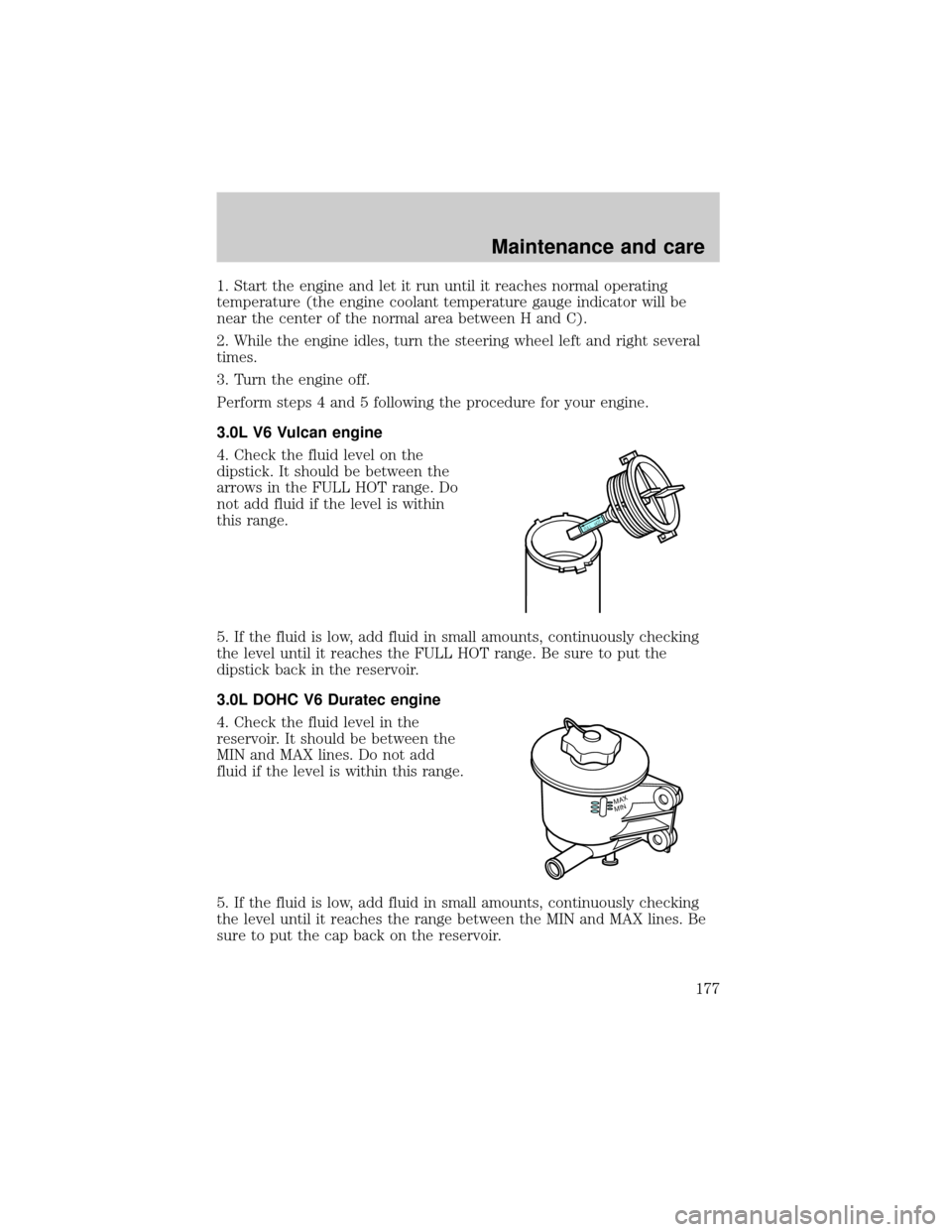
3.0L V6 Vulcan engine
4. Check the fluid level on the
dipstick. It should be between the
arrows in the FULL HOT range. Do
not add fluid if the level is within
this range.
5. If the fluid is low, add fluid in small amounts, continuously checking
the level until it reaches the FULL HOT range. Be sure to put the
dipstick back in the reservoir.
3.0L DOHC V6 Duratec engine
4. Check the fluid level in the
reservoir. It should be between the
MIN and MAX lines. Do not add
fluid if the level is within this range.
5. If the fluid is low, add fluid in small amounts, continuously checking
the level until it reaches the range between the MIN and MAX lines. Be
sure to put the cap back on the reservoir.
FULL HOT
MINMAX
Maintenance and care
177
Page 220 of 256
Cleaning the instrument panel
Clean with a damp cloth, then dry with a dry cloth.
Avoid cleaner or polish that increases the gloss of the upper portion of
the instrument panel. The dull finish in this area helps protect the driver
from undesirable windshield reflection.
Do not use chemical solvents or strong detergents when cleaning
the steering wheel or instrument panel to avoid contamination of
the air bag system.
Cleaning the instrument cluster lens
Clean with a damp cloth, then dry with a dry cloth.
Do not use household or glass cleaners as these may damage the lens.
Cleaning seats equipped with side air bags
Remove dust and loose dirt with a whisk broom or a vacuum cleaner.
Remove fresh spots immediately. Follow the directions that come with
the cleaner. Do not saturate the seat cover with upholstery cleaner.
Do not use chemical solvents or strong detergents when cleaning
the seat mounted side air bag. Such products could contaminate
the side air bag system and affect performance of the side air bag in a
collision.
Woodtone trim
Wipe stains with a soft cloth and a multi-purpose cleaning solution.
Inside windows
Use Ultra-Clear Spray Glass Cleaner (E4AZ-19C507±AA) for the inside
windows if they become fogged.
Maintenance and care
220
Page 248 of 256

Servicing your vehicle ..............162
Spark plugs,
specifications .....................222, 226
Specification chart,
lubricants ...........................224, 226
Speed control ..............................53
Speedometer ...............................14
Starting your vehicle ........122, 124
jump starting ..........................156
Steering wheel
tilting .........................................58
T
Tachometer .................................15
Tires ...........................152, 188±190
changing ..........................152±153
checking the pressure ............190
replacing ..................................191
rotating ....................................190
snow tires and chains ............191
tire grades ...............................189
treadwear ................................189
Towing .......................................139
recreational towing .................142
trailer towing ..........................139
wrecker ....................................161
Traction control ..................52, 130
active light ..................................8
Transaxle
automatic operation ...............132
fluid, refill capacities ..............223
lubricant specifications ..........226
Transmission
fluid, checking and adding
(automatic) .............................178lubricant specifications ..........224
Trip odometer .............................16
Trunk .........................67, 69, 71, 83
remote release ..........................66
Turn signal ..............................8, 56
V
Vehicle dimensions ...................226
Vehicle Identification Number
(VIN) ..........................................229
Vehicle loading ..........................137
Ventilating your vehicle ...........126
W
Warning chimes .....................13±14
Warning lights (see Lights) .........8
Washer fluid ..............................170
Water, Driving through .............138
Windows
power .........................................62
rear wiper/washer .....................57
Windshield washer fluid and
wipers
checking and adding fluid .....170
checking and cleaning ....187±188
liftgate reservoir .....................171
operation ...................................56
replacing wiper blades ...........188
Wrecker towing .........................161
Index
248