2001 FORD TAURUS fuel cap
[x] Cancel search: fuel capPage 195 of 256
The flow of fuel through a fuel pump nozzle can produce static
electricity, which can cause a fire if fuel is pumped into an
ungrounded fuel container.
Use the following guidelines to avoid static build-up when filling an
ungrounded fuel container:
²Place approved fuel container on the ground.
²DO NOT fill a fuel container while it is in the vehicle (including the
cargo area).
²Keep the fuel pump nozzle in contact with the fuel container while
filling.
²DO NOT use a device that would hold the fuel pump handle in the fill
position.
Fuel Filler Cap
Your fuel tank filler cap has an indexed design with a 1/8 turn on/off
feature.
When fueling your vehicle:
1. Turn the engine off.
2. Carefully turn the filler cap counterclockwise 1/8 of a turn until it
stops.
3. Pull to remove the cap from the fuel filler pipe.
4. To install the cap, align the tabs on the cap with the notches on the
filler pipe.
5. Turn the filler cap clockwise 1/8 of a turn until it stops.
If the ªCheck Fuel Capº
indicator comes on or if ªService Engine
Soon/Check Engineº indicator comes on and stays on when you start the
engine, the fuel filler cap may not be properly installed. Turn off the
engine, remove the fuel filler cap, align the cap properly and reinstall it.
If you must replace the fuel filler cap, replace it with a fuel filler
cap that is designed for your vehicle. The customer warranty may
be void for any damage to the fuel tank or fuel system if the
correct genuine Ford or Motorcraft fuel filler cap is not used.
Maintenance and care
195
Page 196 of 256
The fuel system may be under pressure. If the fuel filler cap is
venting vapor or if you hear a hissing sound, wait until it stops
before completely removing the fuel filler cap. Otherwise, fuel may
spray out and injure you or others.
If you do not use the proper fuel filler cap, excessive pressure or
vacuum in the fuel tank may damage the fuel system or cause
the fuel cap to disengage in a collision, which may result in possible
personal injury.
Choosing the right fuel
Use only UNLEADED FUEL. The use of leaded fuel is prohibited by law
and could damage your vehicle.
If your vehicle is a flexible fuel vehicle (FFV), use only UNLEADED
FUEL and ETHANOL(E85). The use of leaded fuel is prohibited by law
and could damage your vehicle.
Do not use fuel containing methanol. It can damage critical fuel system
components.
Your vehicle was not designed to use fuel or fuel additives with metallic
compounds, including manganese-based compounds containing MMT.
Repairs to correct the effects of using a fuel for which your vehicle was
not designed may not be covered by your warranty.
Octane recommendations
Do not be concerned if your engine
sometimes knocks lightly. However,
if it knocks heavily under most
driving conditions while you are
using fuel with the recommended
octane rating, see your dealer or a qualified service technician to prevent
any engine damage.
Unleaded Gasoline engines
Your vehicle is designed to use ªRegularº unleaded gasoline with an
(R+M)/2 octane rating of 87. We do not recommend the use of gasolines
labeled as ªRegularº that are sold with octane ratings of 86 or lower in
high altitude areas.
87(R+M)/2 METHOD
Maintenance and care
196
Page 199 of 256

ESSENTIALS OF GOOD FUEL ECONOMY
Measuring techniques
Your best source of information about actual fuel economy is you, the
driver. You must gather information as accurately and consistently as
possible. Fuel expense, frequency of fillups or fuel gauge readings are
NOT accurate as a measure of fuel economy. We do not recommend
taking fuel economy measurements during the first 1 600 km (1 000
miles) of driving (engine break-in period). You will get a more accurate
measurement after 3 000 km±5 000 km (2 000 miles-3 000 miles).
Filling the tank
The advertised fuel capacity of the fuel tank on your vehicle is equal to
the rated refill capacity of the fuel tank as listed in theRefill capacities
section ofthe Capacities and specificationschapter.
The advertised capacity is the amount of the indicated capacity and the
empty reserve combined. Indicated capacity is the difference in the
amount of fuel in a full tank and a tank when the fuel gauge indicates
empty. Empty reserve is the small amount of fuel remaining in the fuel
tank after the fuel gauge indicates empty.
The amount of usable fuel in the empty reserve varies and should
not be relied upon to increase driving range. When refueling your
vehicle after the fuel gauge indicates empty, you might not be
able to refuel the full amount of the advertised capacity of the
fuel tank due to the empty reserve still present in the tank.
For consistent results when filling the fuel tank:
²Turn the engine/ignition switch to the off position prior to refueling,
an error in the reading will result if the engine is left running.
²Use the same filling rate setting (low Ð medium Ð high) each time
the tank is filled.
²Allow no more than 2 automatic click-offs when filling.
²Always use fuel with the recommended octane rating.
²Use a known quality gasoline, preferably a national brand.
²Use the same side of the same pump and have the vehicle facing the
same direction each time you fill up.
²Have the vehicle loading and distribution the same every time.
Your results will be most accurate if your filling method is consistent.
Maintenance and care
199
Page 222 of 256

MOTORCRAFT PART NUMBERS
Component 3.0L V6 Vulcan
engine3.0L FFV V6
engine3.0L DOHC V6
Duratec engine
Air filter
element
1FA-1683 FA-1683 FA-1683
Fuel filter FG-1006 FG-1006 FG-1006
Battery
(standard)BXT-58R BXT-58R BXT-36R
Battery
(optional)BXT-36R N/A N/A
Oil filter FL-400-S FL-400-S FL-820-S
PCV valve EV-228 EV-228 EV-243
Spark plugs
2AWSF-32PP3AGSF-22PP3AWSF-32F
1Do not use oil-impregnated air filter elements. Failure to use the correct
air filter element may result in severe engine damage. The customer
warranty may be voided for any damage to the engine if the correct air
filter element is not used.
2Refer to Vehicle Emissions Control Information (VECI) decal for spark
plug gap information.
3If a spark plug is to be removed for inspection, it must be reinstalled in
the same cylinder. If a spark plug needs to be replaced, use only spark
plugs with the service part number suffix letter as shown on the engine
decal.
Capacities and specifications
222
Page 223 of 256
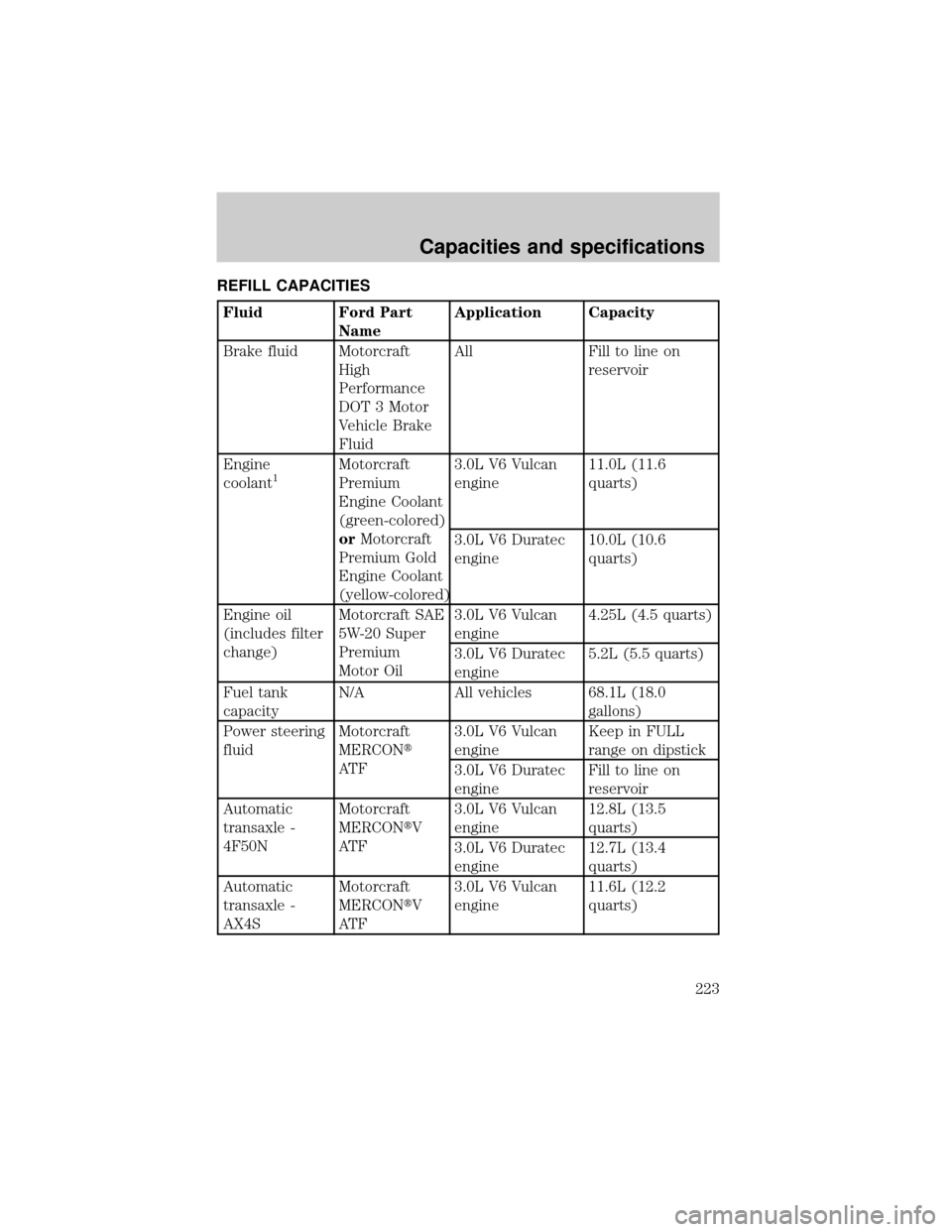
REFILL CAPACITIES
Fluid Ford Part
NameApplication Capacity
Brake fluid Motorcraft
High
Performance
DOT 3 Motor
Vehicle Brake
FluidAll Fill to line on
reservoir
Engine
coolant
1Motorcraft
Premium
Engine Coolant
(green-colored)
orMotorcraft
Premium Gold
Engine Coolant
(yellow-colored)3.0L V6 Vulcan
engine11.0L (11.6
quarts)
3.0L V6 Duratec
engine10.0L (10.6
quarts)
Engine oil
(includes filter
change)Motorcraft SAE
5W-20 Super
Premium
Motor Oil3.0L V6 Vulcan
engine4.25L (4.5 quarts)
3.0L V6 Duratec
engine5.2L (5.5 quarts)
Fuel tank
capacityN/A All vehicles 68.1L (18.0
gallons)
Power steering
fluidMotorcraft
MERCONt
AT F3.0L V6 Vulcan
engineKeep in FULL
range on dipstick
3.0L V6 Duratec
engineFill to line on
reservoir
Automatic
transaxle -
4F50NMotorcraft
MERCONtV
AT F3.0L V6 Vulcan
engine12.8L (13.5
quarts)
3.0L V6 Duratec
engine12.7L (13.4
quarts)
Automatic
transaxle -
AX4SMotorcraft
MERCONtV
AT F3.0L V6 Vulcan
engine11.6L (12.2
quarts)
Capacities and specifications
223
Page 226 of 256
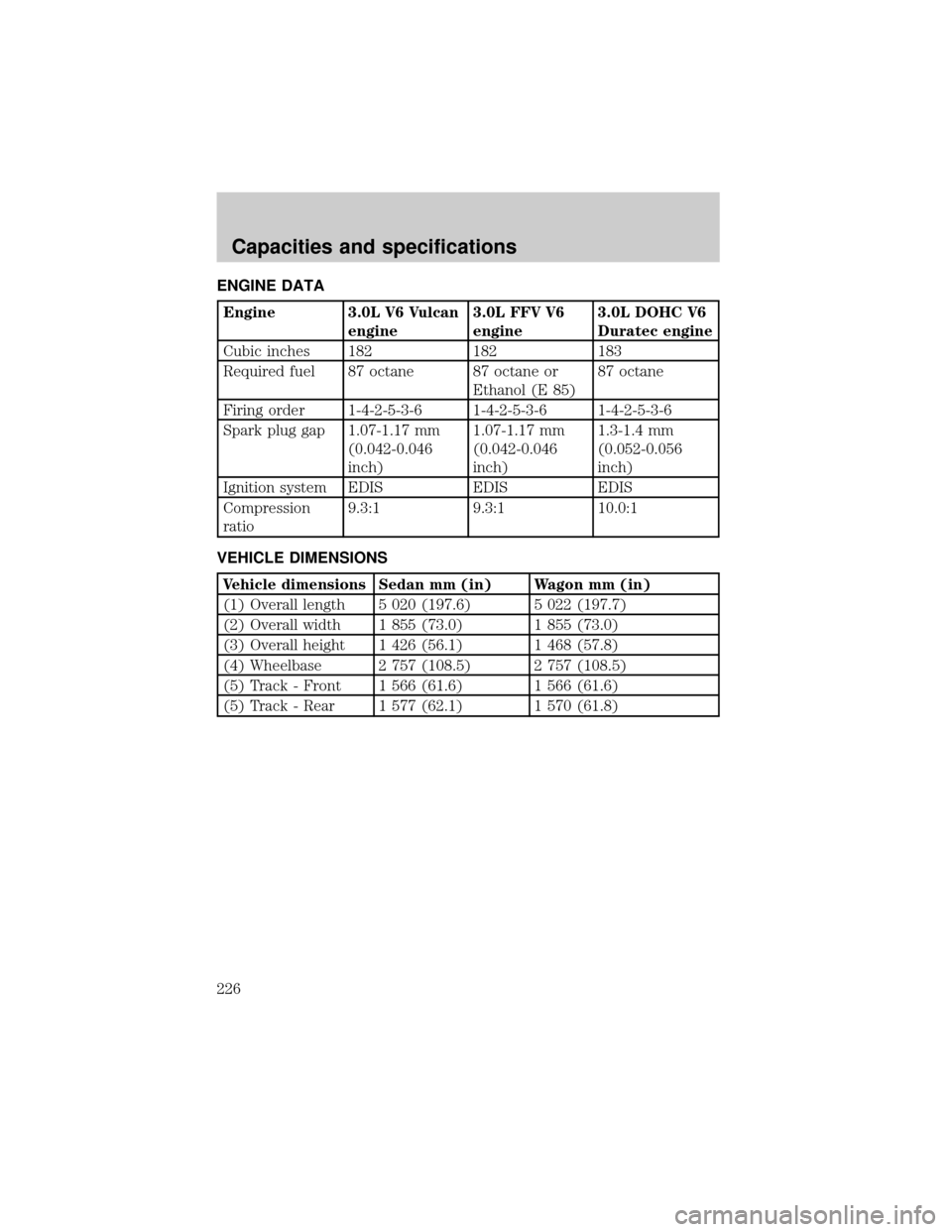
ENGINE DATA
Engine 3.0L V6 Vulcan
engine3.0L FFV V6
engine3.0L DOHC V6
Duratec engine
Cubic inches 182 182 183
Required fuel 87 octane 87 octane or
Ethanol (E 85)87 octane
Firing order 1-4-2-5-3-6 1-4-2-5-3-6 1-4-2-5-3-6
Spark plug gap 1.07-1.17 mm
(0.042-0.046
inch)1.07-1.17 mm
(0.042-0.046
inch)1.3-1.4 mm
(0.052-0.056
inch)
Ignition system EDIS EDIS EDIS
Compression
ratio9.3:1 9.3:1 10.0:1
VEHICLE DIMENSIONS
Vehicle dimensions Sedan mm (in) Wagon mm (in)
(1) Overall length 5 020 (197.6) 5 022 (197.7)
(2) Overall width 1 855 (73.0) 1 855 (73.0)
(3) Overall height 1 426 (56.1) 1 468 (57.8)
(4) Wheelbase 2 757 (108.5) 2 757 (108.5)
(5) Track - Front 1 566 (61.6) 1 566 (61.6)
(5) Track - Rear 1 577 (62.1) 1 570 (61.8)
Capacities and specifications
226
Page 245 of 256

idle speed control ...................185
lubrication
specifications ..................224, 226
refill capacities ........................223
service points ..................164±165
starting after a collision .........145
Engine block heater .................125
Engine oil ..................................166
checking and adding ..............166
dipstick ....................................166
filter, specifications ........168, 222
recommendations ...................168
refill capacities ........................223
specifications ..................224, 226
Exhaust fumes ..........................126
F
Flexible Fuel Vehicle (FFV) ....192
Floor mats ...................................65
Fluid capacities .........................223
Fuel ............................................192
calculating fuel economy .......199
cap .......................................9, 195
capacity ...................................223
choosing the right fuel ...........196
comparisons with EPA fuel
economy estimates .................202
detergent in fuel .....................198
filling your vehicle
with fuel ..................192, 195, 199
filter, specifications ........198, 222
fuel pump shut-off switch .....145
gauge .........................................16
improving fuel economy ........199
low fuel warning light ..............11
octane rating ...................196, 226
quality ......................................197
running out of fuel .................198safety information relating to
automotive fuels .....................192
Fuses ..................................147±148
G
Gas cap (see Fuel cap) ........9, 195
Gas mileage
(see Fuel economy) .................199
Gauges .........................................14
engine coolant temperature
gauge .........................................15
fuel gauge ..................................16
odometer ...................................16
speedometer .............................14
tachometer ................................15
trip odometer ............................16
GAWR (Gross Axle Weight
Rating) .......................................137
definition .................................137
driving with a heavy load ......137
location ....................................137
GVWR (Gross Vehicle Weight
Rating) .......................................137
calculating ...............................137
definition .................................137
driving with a heavy load ......137
location ....................................137
H
Hazard flashers .........................145
Head restraints ...........................84
Headlamps ...................................17
aiming ......................................214
autolamp system .......................18
bulb specifications ..................213
daytime running lights .............17
flash to pass ..............................17
Index
245
Page 246 of 256

high beam .............................8, 17
replacing bulbs .......................204
turning on and off ....................17
warning chime ..........................14
Heating ........................................19
heating and air conditioning
system .......................................19
Hood ..........................................163
I
Ignition .................................52, 226
Infant seats
(see Safety seats) .....................114
Inspection/maintenance (I/M)
testing ........................................203
Instrument panel
cleaning ...................................220
cluster ..................................8, 220
lighting up panel and interior .18
location of components ..............8
J
Jack ............................................152
positioning ...............................152
storage .....................................152
Jump-starting your vehicle ......156
K
Keyless entry system .................76
autolock .....................................78
keypad .......................................76
locking and unlocking doors ....77
programming entry code .........76
Keys .................................79±80, 82
key in ignition chime ...............14
positions of the ignition ...........52L
Lamps
autolamp system .......................18
bulb replacement
specifications chart ................213
cargo lamps ...............................18
daytime running light ...............17
headlamps .................................17
headlamps, flash to pass ..........17
instrument panel, dimming .....18
interior lamps .....................58±59
replacing
bulbs ........203±204, 207±209, 211
Lane change indicator
(see Turn signal) ........................56
Liftgate ..................................66, 71
Lights, warning and indicator ......8
air bag ........................................13
anti-lock brakes (ABS) ....12, 128
anti-theft ...................................11
brake ..........................................12
charging system ........................13
check coolant ............................12
cruise indicator .........................12
door ajar ......................................9
fuel cap light ...............................9
high beam ...................................8
low coolant ................................11
low fuel ......................................11
oil pressure ...............................13
safety belt ...................................9
service engine soon ..................10
speed control ............................56
traction control active ................8
turn signal indicator ...................8
Load limits .................................137
GAWR ......................................137
GVWR ......................................137
trailer towing ..........................137
Index
246