Page 192 of 272

²4.0L SOHC V6 engine
²Oil levels above the MAX mark may cause engine damage. Some oil
must be removed from the engine by a service technician.
7. Put the indicator back in and ensure it is fully seated.
Adding engine oil
1. Check the engine oil. For instructions, refer toChecking the engine
oilin this chapter.
2. If the engine oil level is not within the normal range, add only certified
engine oil of the recommended viscosity. Remove the engine oil filler cap
and use a funnel to pour the engine oil into the opening.
3. Recheck the engine oil level. Make sure the oil level is not above the
MAX mark or the letter F in FULL on the engine oil level indicator
(dipstick).
4. Install the indicator and ensure it is fully seated.
5. Fully install the engine oil filler cap by turning the filler cap clockwise
until three clicks can be heard.
To avoid possible oil loss, DO NOT operate the vehicle with the
engine oil level indicator and/or the engine oil filler cap removed.
Maintenance and care
192
Page 193 of 272
Engine Oil Recommendations
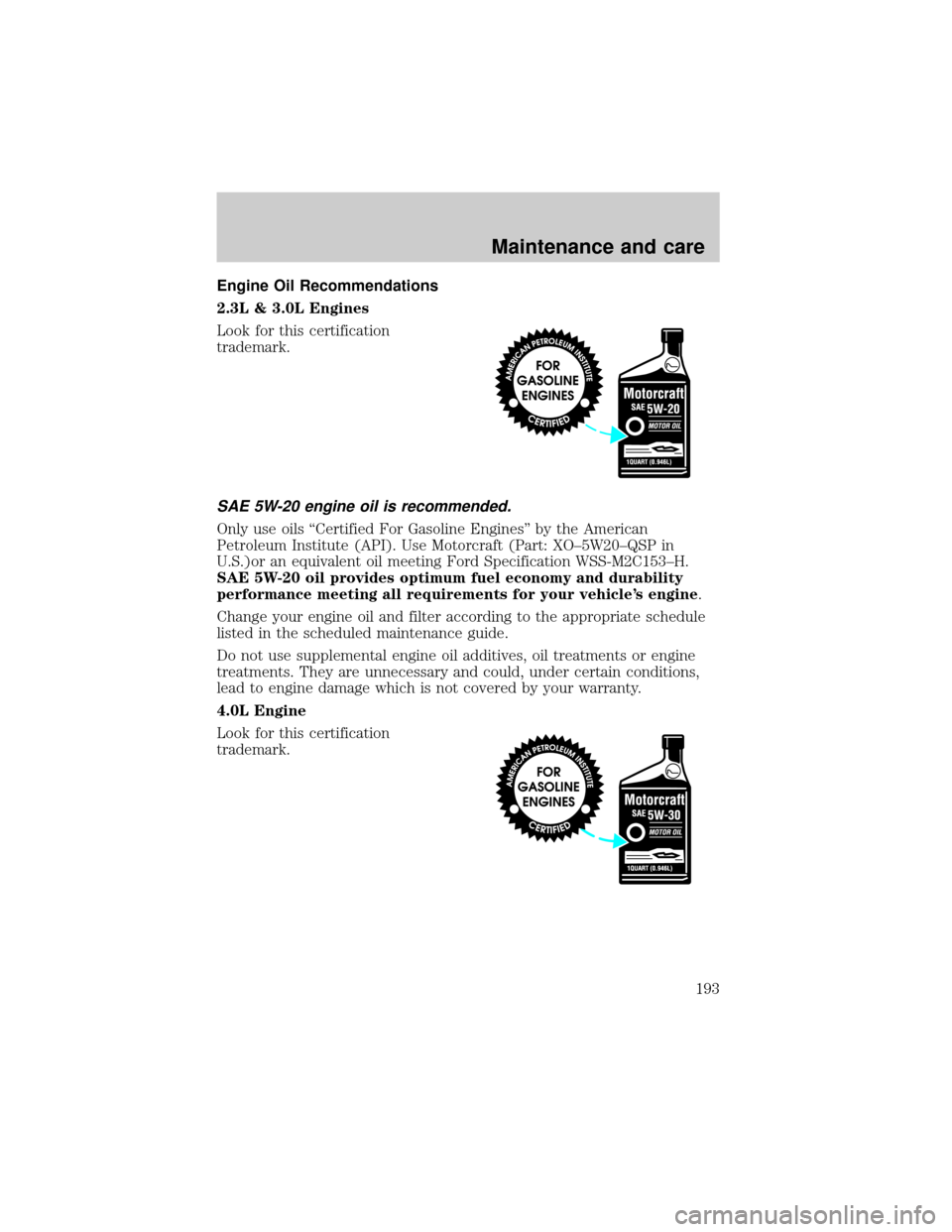
2.3L & 3.0L Engines
Look for this certification
trademark.
SAE 5W-20 engine oil is recommended.
Only use oils ªCertified For Gasoline Enginesº by the American
Petroleum Institute (API). Use Motorcraft (Part: XO±5W20±QSP in
U.S.)or an equivalent oil meeting Ford Specification WSS-M2C153±H.
SAE 5W-20 oil provides optimum fuel economy and durability
performance meeting all requirements for your vehicle's engine.
Change your engine oil and filter according to the appropriate schedule
listed in the scheduled maintenance guide.
Do not use supplemental engine oil additives, oil treatments or engine
treatments. They are unnecessary and could, under certain conditions,
lead to engine damage which is not covered by your warranty.
4.0L Engine
Look for this certification
trademark.
Maintenance and care
193
Page 194 of 272

SAE 5W-30 engine oil is recommended.
Only use oils ªCertified For Gasoline Enginesº by the American
Petroleum Institute (API). Use Motorcraft (Part: XO±5W30±QSP in U.S.)
or an equivalent oil meeting Ford Specification WSS-M2C153±G.
Do not use supplemental engine oil additives, oil treatments or engine
treatments. They are unnecessary and could, under certain conditions,
lead to engine damage which is not covered by your warranty.
Change your engine oil according to the appropriate schedule listed in
the scheduled maintenance guide.
Engine Oil Filter Recommendation
Change your engine oil filter according to the appropriate schedule listed
in the scheduled maintenance guide. Ford production and aftermarket
(Motorcraft) oil filters are designed for added engine protection and long
life. If a replacement oil filter is used that does not meet Ford Material
and design specifications, start-up engine noises or knock may be
experienced.
It is recommended you use the appropriate Motorcraft oil filter (or
another brand meeting Ford specifications) for your engine.
BRAKE FLUID
Checking and adding brake fluid
Brake fluid should be checked and
refilled as needed. Refer to the
scheduled maintenance guide for
the service interval schedules.
1. Clean the reservoir cap before
removal to prevent dirt or water
from entering the reservoir.
Maintenance and care
194
Page 197 of 272

Note:Do not put washer fluid in the engine coolant reservoir. Washer
fluid placed in the cooling system may harm engine and cooling system
components.
ENGINE COOLANT
Checking engine coolant
The concentration and level of engine coolant should be checked at the
mileage intervals listed in the scheduled maintenance guide. The coolant
concentration should be maintained at 50/50 coolant and water, which
equates to a freeze point of -36É C (-34É F). Coolant concentration
testing is possible with a hydrometer or antifreeze tester (such as the
Rotunda Battery and Antifreeze Tester, 014±R1060). The level of coolant
should be maintained at the ªcold fullº of ªcold fill rangeº level in the
coolant reservoir. If the level falls below, add coolant per the instructions
in theAdding Engine Coolantsection.
Your vehicle was factory-filled with a 50/50 engine coolant and water
concentration. If the concentration of coolant falls below 40% or above
60%, the engine parts could become damaged or not work properly.A
50±50 mixture of coolant and water provides the following:
²Freeze protection down to -36É C (-34É F).
²Boiling protection up to 129É C (265É F).
²Protection against rust and other forms of corrosion.
²Enables calibrated gauges to work properly.
²2.3L engines
Maintenance and care
197
Page 228 of 272

5. Remove the bulb retaining ring by
rotating it counterclockwise (when
viewed from the rear) to free it
from the bulb socket, and slide the
ring off the plastic base. Keep the
ring to retain the new bulb.
6. Without turning, remove the old
bulb by gently pulling it straight
back out of the lamp assembly.
To install the new bulb:
Handle a halogen headlamp bulb carefully and keep out of
children's reach. Grasp the bulb only by its plastic base and do
not touch the glass. The oil from your hand could cause the bulb to
break the next time the headlamps are operated.
1. With the flat side of the bulb's plastic base facing upward, insert the
glass end of the bulb into the lamp assembly. You may need to turn the
bulb left or right to align the grooves in the plastic base with the tabs in
the lamp assembly. When the grooves are aligned, push the bulb into the
lamp assembly until the plastic base contacts the rear of the lamp
assembly.
2. Install the bulb retaining ring over the plastic base until it contacts the
rear of the socket by rotating clockwise until you feel a ªstop.º
3. Install the electrical connector into the plastic base until it snaps,
locking it into position.
4. Install the headlamp on vehicle, push rearward and secure with two
retainer pins.
5. Install the cover with two screws (if equipped).
6. Turn the headlamps on and make sure they work properly. If the
headlamp was correctly aligned before you changed the bulb, you should
not need to align it again.
Maintenance and care
228
Page 238 of 272
Cleaning the exterior lamps
Wash with the same detergent as the exterior of your vehicle. If
necessary, use a tar remover such as Ford Extra Strength Tar and Road
Oil Remover (B7A-19520±AA).
To avoid scratching the lamps, do not use a dry paper towel, chemical
solvents or abrasive cleaners.
Cleaning the windshield, wiper blades and rear window
If the wiper blades do not wipe properly, clean the wiper blade rubber
element with undiluted windshield washer solution or a mild detergent.
To avoid damaging the blades, do not use fuel, kerosene, paint thinner or
other solvents.
If the wiper still does not wipe properly, this could be caused by
substances on the windshield or rear window such as tree sap and some
hot wax treatments used by commercial car washes. Clean the outside of
the windshield or rear window with a non-abrasive cleaner such as Ford
Ultra-Clear Spray Glass Cleaner, (E4AZ-19C507±AA), available from your
Ford Dealer.Do notuse abrasive cleansers on glass as they may cause
scratches. The windshield or rear window is clean if beads do not form
when you rinse it with water. The windshield, rear window and wiper
blades should be cleaned on a regular basis, and blades or rubber
elements replaced when worn.
Cleaning the instrument panel
Clean with a damp cloth, then dry with a dry cloth.
Avoid cleaner or polish that increases the gloss of the upper portion of
the instrument panel. The dull finish in this area helps protect the driver
from undesirable windshield reflection.
Do not use chemical solvents or strong detergents when cleaning
the steering wheel or instrument panel to avoid contamination of
the air bag system.
Cleaning the instrument cluster lens
Clean with a damp cloth, then dry with a dry cloth.
Do not use household or glass cleaners as these may damage the lens.
Maintenance and care
238
Page 240 of 272

MOTORCRAFT PART NUMBERS
Component 2.3L I4 engine 3.0L V6 engine 4.0L V6 engine
Air filter
elementFA-1658 FA-1658 FA-1658
Fuel filter FG±1002 FG±1002 FG±1002
Battery BXT-59 BXT-59 BXT-59
Oil filter FL-400S FL-400S FL-820S
PCV valve EV-227 EV-130 EV-225
Spark plugs* AWSF-32FEM** AWSF-32PP*** AGSF-34FP
* Refer to Vehicle Emissions Control Information (VECI) decal for spark
plug gap information.
** Two spark plugs per cylinder required (eight total).
*** If any spark plug needs to be removed for inspection, it must be
re-installed in the same cylinder. Cylinders No.1, 2 and 3 have a ªPGº
suffix. Cylinders No. 4, 5 and 6 have a ªPº suffix. If any spark plug needs
to be replaced, use only spark plugs with the service part number suffix
letters ªPPº as shown on the engine decal.
REFILL CAPACITIES
Fluid Ford Part
NameApplication Capacity
Engine oil
(includes filter
change)Motorcraft SAE
5W- 20 Super
Premium Motor
Oil2.3L engine 3.8L (4.0 quarts)
3.0L V6 engine 4.3L (4.5 quarts)
Motorcraft SAE
5W- 30 Super
Premium Motor
Oil4.0L V6 engine 4.7L (5.0 quarts)
Brake fluid and
Clutch fluidMotorcraft High
Performance
DOT 3 Motor
Vehicle Brake
FluidAll Fill to line or
step (for clutch)
on reservoir
Capacities and specifications
240
Page 244 of 272
ItemFord part
name or
equivalentFord part
numberFord
specification
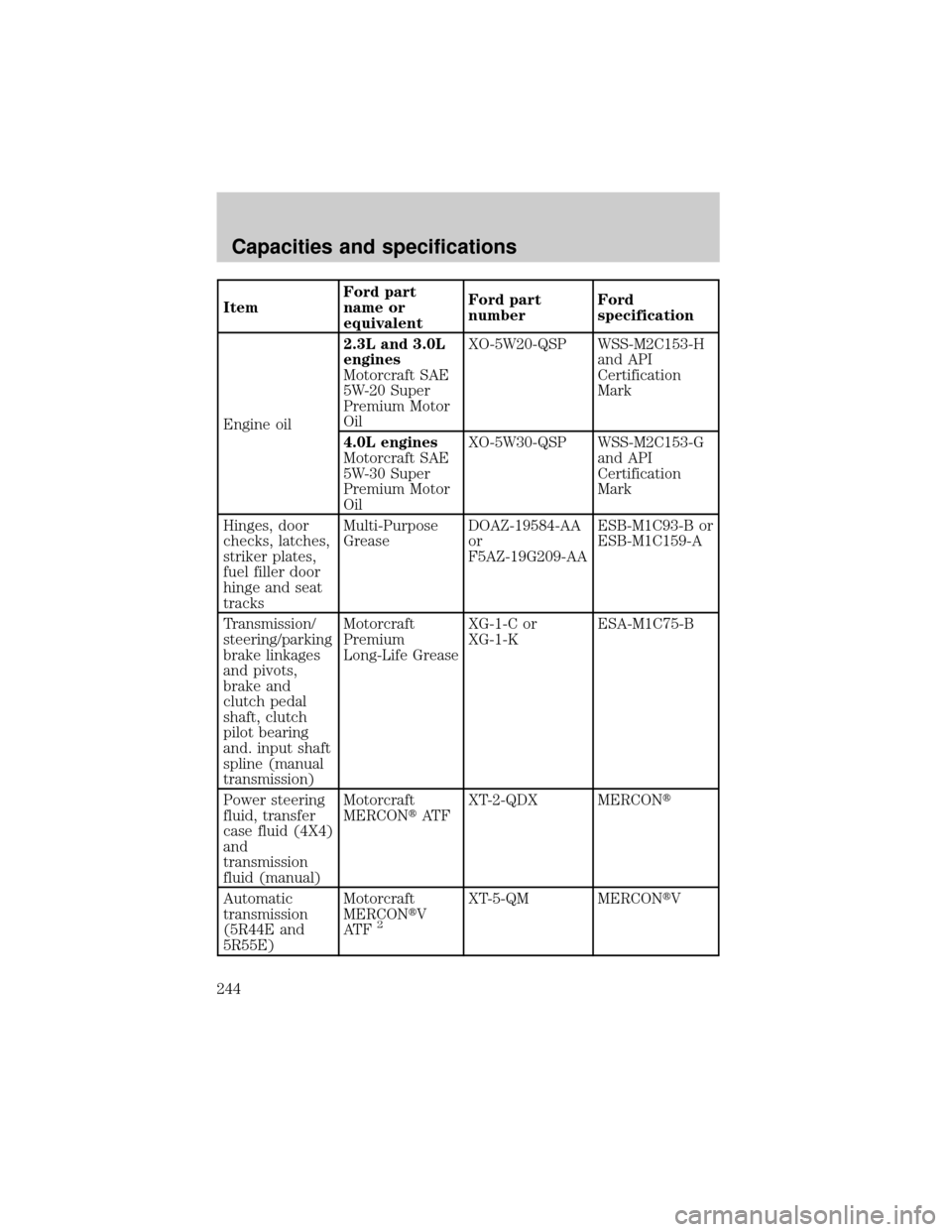
Engine oil2.3L and 3.0L
engines
Motorcraft SAE
5W-20 Super
Premium Motor
OilXO-5W20-QSP WSS-M2C153-H
and API
Certification
Mark
4.0L engines
Motorcraft SAE
5W-30 Super
Premium Motor
OilXO-5W30-QSP WSS-M2C153-G
and API
Certification
Mark
Hinges, door
checks, latches,
striker plates,
fuel filler door
hinge and seat
tracksMulti-Purpose
GreaseDOAZ-19584-AA
or
F5AZ-19G209-AAESB-M1C93-B or
ESB-M1C159-A
Transmission/
steering/parking
brake linkages
and pivots,
brake and
clutch pedal
shaft, clutch
pilot bearing
and. input shaft
spline (manual
transmission)Motorcraft
Premium
Long-Life GreaseXG-1-C or
XG-1-KESA-M1C75-B
Power steering
fluid, transfer
case fluid (4X4)
and
transmission
fluid (manual)Motorcraft
MERCONtAT FXT-2-QDX MERCONt
Automatic
transmission
(5R44E and
5R55E)Motorcraft
MERCONtV
AT F
2
XT-5-QM MERCONtV
Capacities and specifications
244