2001 FORD RANGER warning lights
[x] Cancel search: warning lightsPage 10 of 272

WARNING LIGHTS AND CHIMES
Check engine
Your vehicle is equipped with a
computer that monitors the engine's
emission control system. This
system is commonly known as the
On Board Diagnostics System (OBD
II). This OBD II system protects the environment by ensuring that your
vehicle continues to meet government emission standards. The OBD II
system also assists the service technician in properly servicing your
vehicle.
TheCheck Engineindicator light illuminates when the ignition is first
turned to the ON position to check the bulb. If it comes on after the
engine is started, one of the engine's emission control systems may be
malfunctioning. The light may illuminate without a driveability concern
being noted. The vehicle will usually be drivable and will not require
towing.
What you should do if the check engine light illuminates
Light turns on solid:
This means that the OBD II system has detected a malfunction.
Temporary malfunctions may cause yourCheck Enginelight to
illuminate. Examples are:
1. The vehicle has run out of fuel. (The engine may misfire or run
poorly.)
2. Poor fuel quality or water in the fuel.
CHECK
ENGINE
Instrumentation
10
Page 13 of 272
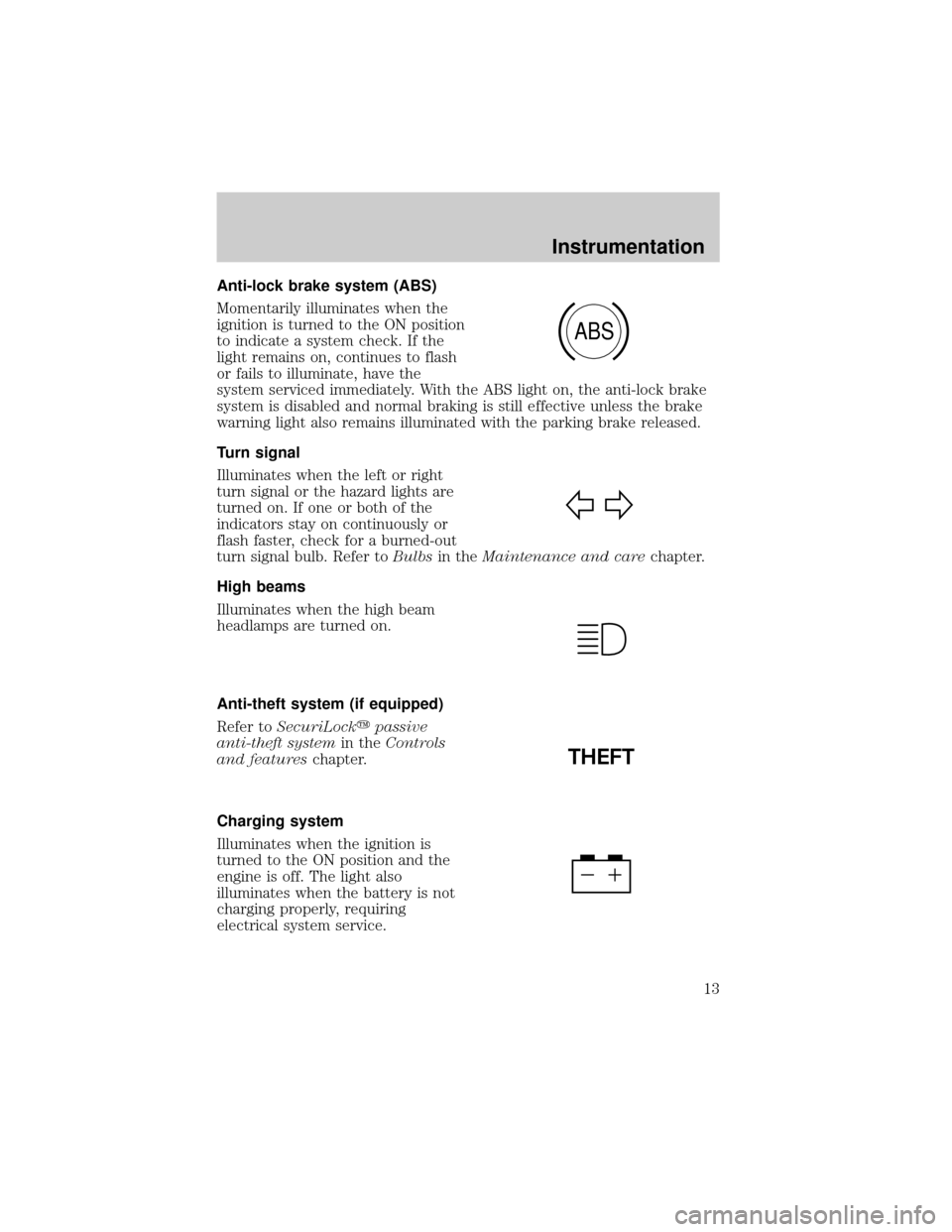
Anti-lock brake system (ABS)
Momentarily illuminates when the
ignition is turned to the ON position
to indicate a system check. If the
light remains on, continues to flash
or fails to illuminate, have the
system serviced immediately. With the ABS light on, the anti-lock brake
system is disabled and normal braking is still effective unless the brake
warning light also remains illuminated with the parking brake released.
Turn signal
Illuminates when the left or right
turn signal or the hazard lights are
turned on. If one or both of the
indicators stay on continuously or
flash faster, check for a burned-out
turn signal bulb. Refer toBulbsin theMaintenance and carechapter.
High beams
Illuminates when the high beam
headlamps are turned on.
Anti-theft system (if equipped)
Refer toSecuriLockypassive
anti-theft systemin theControls
and featureschapter.
Charging system
Illuminates when the ignition is
turned to the ON position and the
engine is off. The light also
illuminates when the battery is not
charging properly, requiring
electrical system service.
ABS
THEFT
Instrumentation
13
Page 65 of 272
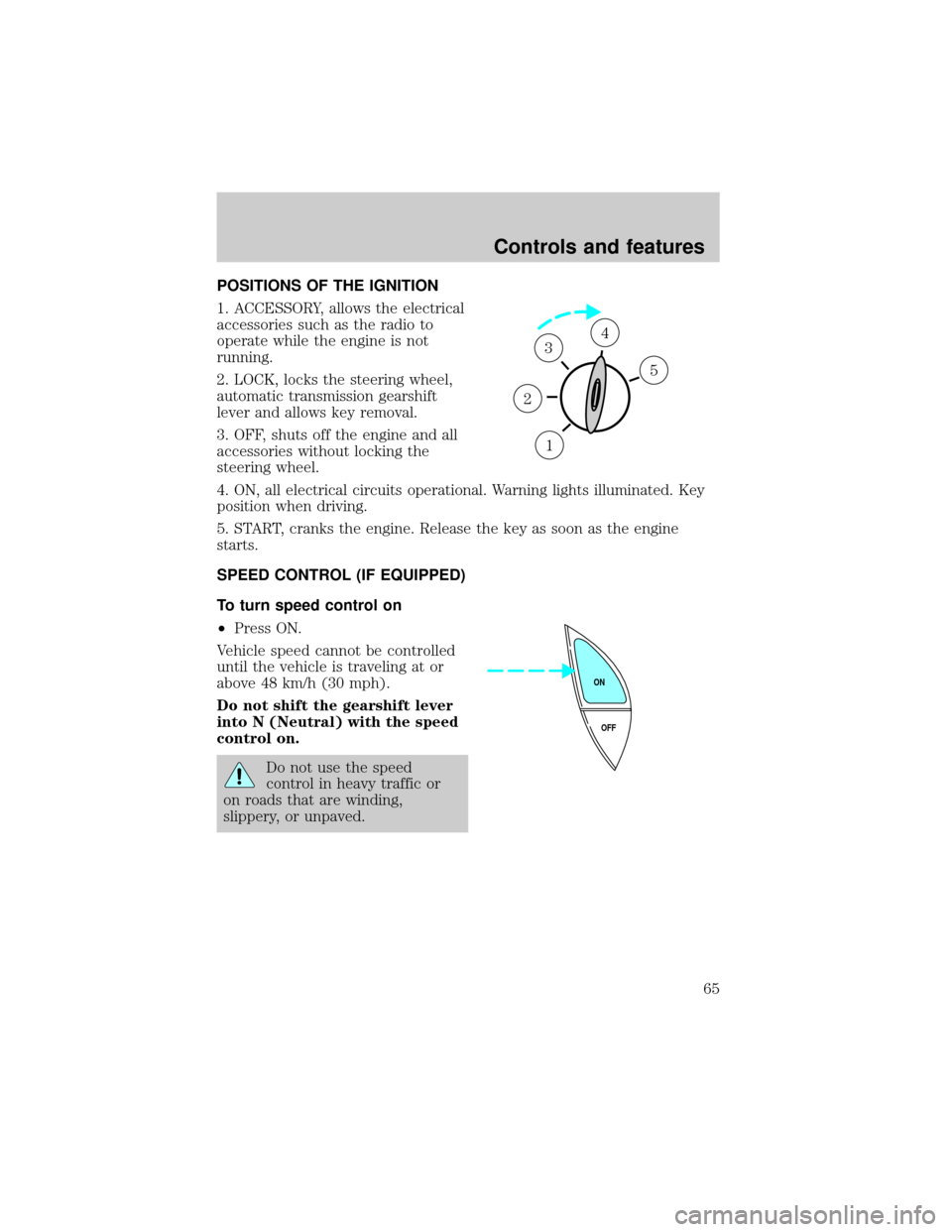
POSITIONS OF THE IGNITION
1. ACCESSORY, allows the electrical
accessories such as the radio to
operate while the engine is not
running.
2. LOCK, locks the steering wheel,
automatic transmission gearshift
lever and allows key removal.
3. OFF, shuts off the engine and all
accessories without locking the
steering wheel.
4. ON, all electrical circuits operational. Warning lights illuminated. Key
position when driving.
5. START, cranks the engine. Release the key as soon as the engine
starts.
SPEED CONTROL (IF EQUIPPED)
To turn speed control on
²Press ON.
Vehicle speed cannot be controlled
until the vehicle is traveling at or
above 48 km/h (30 mph).
Do not shift the gearshift lever
into N (Neutral) with the speed
control on.
Do not use the speed
control in heavy traffic or
on roads that are winding,
slippery, or unpaved.
1
2
34
5
OFF ON
Controls and features
65
Page 107 of 272

²and the electrical wiring which connects the components.
The RCM (restraints control module) monitors its own internal circuits
and the supplemental air bag electrical system warning (including the
passenger air bag deactivation switch, the impact sensors, the system
wiring, the air bag system readiness light, the air bag back up power and
the air bag ignitors).
Determining if the system is operational
The SRS uses readiness lights in the instrument cluster and the
passenger air bag deactivate switch or a tone to indicate the condition of
the system. Refer to theAir bag readinesssection in theInstrument
clusterchapter orPassenger air bag on/off switchsection in this
chapter. Routine maintenance of the air bag is not required.
A difficulty with the system is indicated by one or more of the following:
²The readiness lights will either
flash or stay lit.
²The readiness lights will not
illuminate immediately after
ignition is turned on.
²A series of five beeps will be heard. The tone pattern will repeat
periodically until the problem and/or light are repaired.
If any of these things happen, even intermittently, have the SRS serviced
at your dealership or by a qualified technician immediately. Unless
serviced, the system may not function properly in the event of a
collision.
Disposal of air bags and air bag equipped vehicles
(including pretensioners)
For disposal of air bags or air bag equipped vehicles, see your local
dealership or qualified technician. Air bags MUST BE disposed of by
qualified personnel.
Seating and safety restraints
107
Page 226 of 272

Illumination of the ªCheck Engineº light, charging system warning light
or the temperature warning light, fluid leaks, strange odors, smoke or
loss of engine power, could indicate that the emission control system is
not working properly.
Exhaust leaks may result in entry of harmful and potentially
lethal fumes into the passenger compartment.
Do not make any unauthorized changes to your vehicle or engine. By
law, vehicle owners and anyone who manufactures, repairs, services,
sells, leases, trades vehicles, or supervises a fleet of vehicles are not
permitted to intentionally remove an emission control device or prevent
it from working. Information about your vehicle's emission system is on
the Vehicle Emission Control Information Decal located on or near the
engine. This decal identifies engine displacement and gives some tune up
specifications.
Please consult your ªWarranty Guideº for complete emission warranty
information.
Readiness for Inspection/Maintenance (I/M) testing
In some localities, it may be a legal requirement to pass an I/M test of
the on-board diagnostics system. If your ªCheck Engine/Service Engine
Soonº light is on, refer to the description in theWarning lights and
chimessection of theInstrumentationchapter. Your vehicle may not
pass the I/M test with the ªCheck Engine/Service Engine Soonº light on.
If the vehicle's powertrain system or its battery has just been serviced,
the on-board diagnostics system is reset to a ªnot ready for I/M testº
condition. To ready the on-board diagnostics system for I/M testing, a
minimum of 30 minutes of city and highway driving is necessary as
described below:
²First, at least 10 minutes of driving on an expressway or highway.
²Next, at least 20 minutes driving in stop-and-go, city-type traffic with
at least four idle periods.
Allow the vehicle to sit for at least eight hours without starting the
engine. Then, start the engine and complete the above driving cycle. The
engine must warm up to its normal operating temperature. Once started,
do not turn off the engine until the above driving cycle is complete.
Maintenance and care
226
Page 266 of 272

H
Hazard flashers .........................159
Headlamps ...................................20
aiming ......................................233
bulb specifications ..................232
daytime running lights .............20
flash to pass ..............................21
high beam ...........................13, 21
replacing bulbs .......................227
turning on and off ....................20
warning chime ..........................15
Heating ........................................22
heater only system ...................22
Hood ..........................................185
I
Ignition .........................65, 245±246
Infant seats
(see Safety seats) .....................114
Inspection/maintenance (I/M)
testing ........................................226
Instrument panel
cleaning ...................................238
cluster ................................10, 238
lighting up panel and
interior .......................................21
location of components ............10
J
Jack ............................................171
positioning .......................171, 175
storage .....................171±173, 175
Jump-starting your vehicle ......178K
Keys .......................................85±87
key in ignition chime ...............15
positions of the ignition ...........65
L
Lamps
bulb replacement
specifications chart ................232
cargo lamps ...............................21
daytime running light ...............20
fog lamps ...................................20
headlamps .................................20
headlamps, flash to pass ..........21
instrument panel, dimming .....21
interior lamps ...................71, 233
replacing bulbs .......227, 229±232
Lane change indicator (see
Turn signal) .................................64
Lights, warning and indicator ....10
air bag ........................................12
anti-lock brakes (ABS) ....13, 129
anti-theft ...................................13
brake ..........................................12
charging system ........................13
check coolant ............................12
check engine .............................10
cruise indicator .........................15
door ajar ....................................14
fuel cap light .............................11
high beam .................................13
overdrive off ..............................14
safety belt .................................12
speed control ............................69
turn signal indicator .................13
Load limits .................................144
GAWR ......................................144
GVWR ......................................144
Index
266
Page 268 of 272

Servicing your vehicle ..............184
Snowplowing .................................4
Spark plugs,
specifications .............240, 245±246
Special notice ................................4
ambulance conversions ..............5
utility-type vehicles ....................4
Specification chart,
lubricants ...........................243, 245
Speed control ..............................65
Speedometer ...............................18
Starting your vehicle ........123, 126
jump starting ..........................178
Steering wheel
tilting .........................................70
T
Tachometer .................................17
Tires ...........................171, 210±212
changing ..................171±172, 175
checking the pressure ............212
replacing ..................................213
rotating ....................................212
snow tires and chains ............214
tire grades ...............................211
treadwear ................................211
Tonneau cover .............................76
Towing .......................................147
recreational towing .................156
trailer towing ..........................147
wrecker ....................................183
Traction-lok rear axle ...............144
Transfer case
fluid checking .........................206Transmission
automatic operation ...............132
fluid, checking and adding
(automatic) .............................203
fluid, checking and adding
(manual) .................................205
fluid, refill capacities ..............240
lubricant specifications ..243, 245
manual operation ....................136
Trip odometer .............................18
Trunk ...........................................80
Turn signal ............................13, 64
V
Vehicle dimensions ...................246
Vehicle Identification Number
(VIN) ..........................................248
Vehicle loading ..........................144
camper bodies ........................157
Ventilating your vehicle ...........127
W
Warning chimes ...........................15
Warning lights (see Lights) .......10
Washer fluid ..............................196
Water, Driving through .............144
Windows
power .........................................72
Windshield washer fluid and
wipers
checking and adding fluid .....196
checking and cleaning ............209
operation ...................................71
replacing wiper blades ...........210
Wrecker towing .........................183
Index
268