2001 FORD MUSTANG warning
[x] Cancel search: warningPage 109 of 240
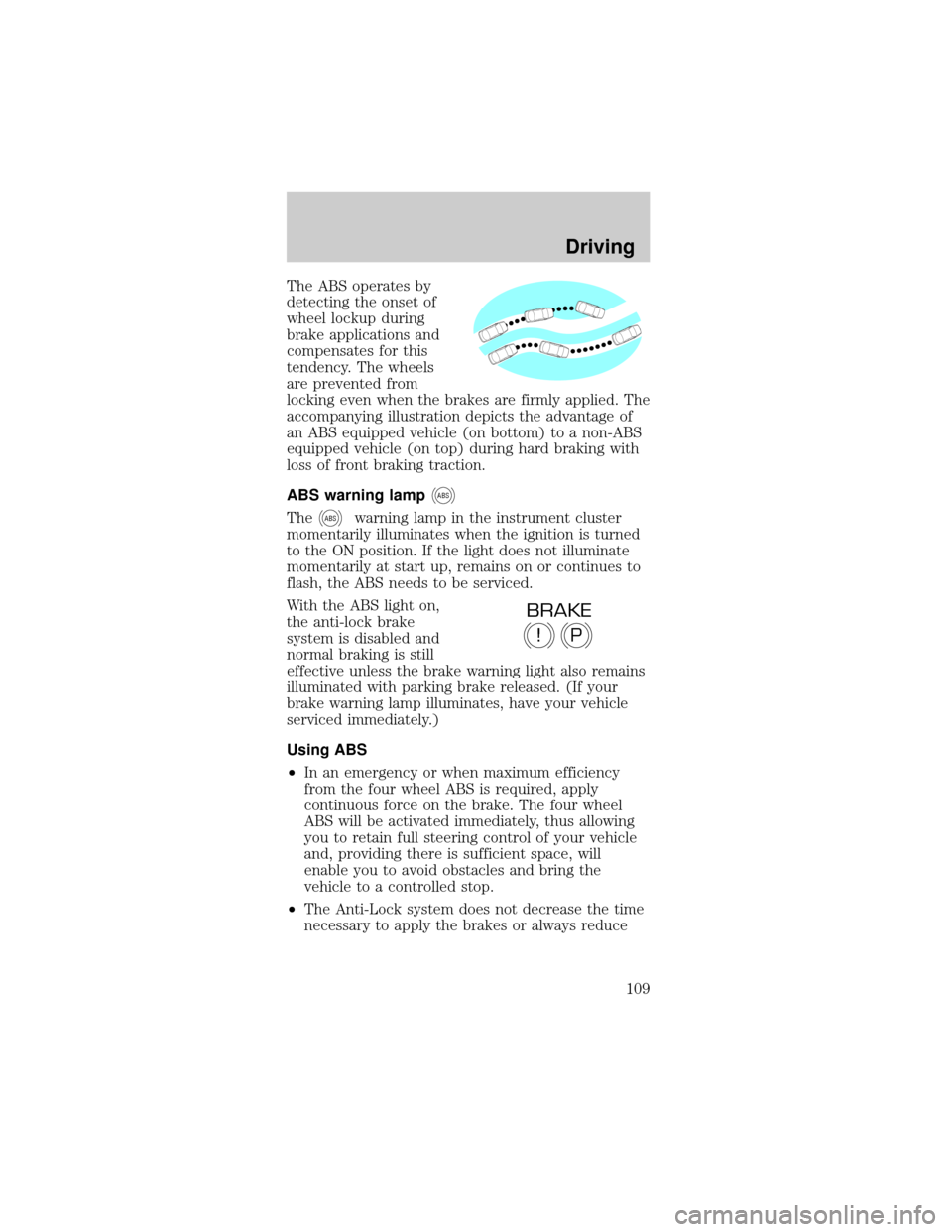
The ABS operates by
detecting the onset of
wheel lockup during
brake applications and
compensates for this
tendency. The wheels
are prevented from
locking even when the brakes are firmly applied. The
accompanying illustration depicts the advantage of
an ABS equipped vehicle (on bottom) to a non-ABS
equipped vehicle (on top) during hard braking with
loss of front braking traction.
ABS warning lamp
ABS
TheABSwarning lamp in the instrument cluster
momentarily illuminates when the ignition is turned
to the ON position. If the light does not illuminate
momentarily at start up, remains on or continues to
flash, the ABS needs to be serviced.
With the ABS light on,
the anti-lock brake
system is disabled and
normal braking is still
effective unless the brake warning light also remains
illuminated with parking brake released. (If your
brake warning lamp illuminates, have your vehicle
serviced immediately.)
Using ABS
²In an emergency or when maximum efficiency
from the four wheel ABS is required, apply
continuous force on the brake. The four wheel
ABS will be activated immediately, thus allowing
you to retain full steering control of your vehicle
and, providing there is sufficient space, will
enable you to avoid obstacles and bring the
vehicle to a controlled stop.
²The Anti-Lock system does not decrease the time
necessary to apply the brakes or always reduce
P!
BRAKE
Driving
109
Page 110 of 240

stopping distance. Always leave enough room
between your vehicle and the vehicle in front of
you to stop.
²We recommend that you familiarize yourself with
this braking technique. However, avoid taking any
unnecessary risks.
Hydraulic brake booster system (Hydroboost)
The Hydroboost system receives fluid pressure from
the power steering pump to provide power assist
during braking.
The sound of the pump operating may be heard by
the driver, but this is a normal characteristic of the
system.
For Hydroboost-equipped vehicles operating under
normal conditions, the noise of the fluid flowing
through the booster may be heard whenever the
brake is applied. This condition is normal. Vehicle
service is not required.
If braking performance or pedal response becomes
very poor, even when the pedal is strongly depressed,
it may indicate the presence of air in the hydraulic
system or leakage of fluid. Stop the vehicle safely as
soon as possible and seek service immediately.
Parking brake
Apply the parking
brake whenever the
vehicle is parked. To
set the parking brake,
apply the brake pedal
and pull the parking
brake handle up as far
as possible.
The BRAKE warning
lamp in the instrument
cluster illuminates and
remains illuminated
(when the ignition is turned ON) until the parking
brake is released.
P!
BRAKE
Driving
110
Page 114 of 240

2. Insert the key and turn it to OFF. Apply the brake
pedal and shift to N (Neutral).
3. Start the vehicle.
If it is necessary to use the above procedure to
move the gearshift lever, it is possible that a fuse
has blown or the vehicle's brakelamps are not
operating properly. Refer toFuses and relaysin the
Roadside emergencieschapter.
Do not drive your vehicle until you verify
that the brakelamps are working.
If your vehicle gets stuck in mud or snow it may be
rocked out by shifting from forward and reverse
gears, stopping between shifts, in a steady pattern.
Press lightly on the accelerator in each gear.
Do not rock the vehicle if the engine is not at
normal operating temperature or damage to
the transmission may occur.
Do not rock the vehicle for more than a few
minutes or damage to the transmission and
tires may occur or the engine may overheat.
Always set the parking brake fully and make
sure the gearshift is latched in P (Park).
Turn off the ignition whenever you leave your
vehicle.
If the parking brake is fully released, but the
brake warning lamp remains illuminated, the
brakes may not be working properly. See your
dealer or a qualified service technician.
Driving
114
Page 161 of 240

²Do not add extra inhibitors or additives to
the coolant.These can be harmful and
compromise the corrosion protection of the
engine coolant.
²Do not mix with recycled coolant unless from
a Ford-approved recycling process (seeUse of
Recycled Engine Coolantsection).
If equipped with the 3.8L V6 engine, to
avoid scalding hot steam or coolant from
being released from the engine cooling system,
never remove the radiator cap from the radiator
while the engine is running or hot. Failure to
follow this warning may result in damage to the
engine's cooling system and possible severe
personal injury.
If equipped with the 4.6L V8 engine, to
avoid scalding hot steam or coolant from
being released from the engine cooling system,
never remove the pressure relief cap from the
engine coolant reservoir while the engine is
running or hot. Failure to follow this warning may
result in damage to the engine's cooling system
and possible severe personal injury.
If you must remove the pressure relief cap or
radiator cap (depending upon engine application),
follow these steps to avoid personal injury:
1. Before you remove the cap, turn the engine off
and let it cool.
2. When the engine is cool, wrap a thick cloth
around the cap. Slowly turn cap counterclockwise
until pressure begins to release.
3. Step back while the pressure releases.
4. When you are sure that all the pressure has been
released, use the cloth to turn it counterclockwise
and remove the cap.
Maintenance and care
161
Page 162 of 240
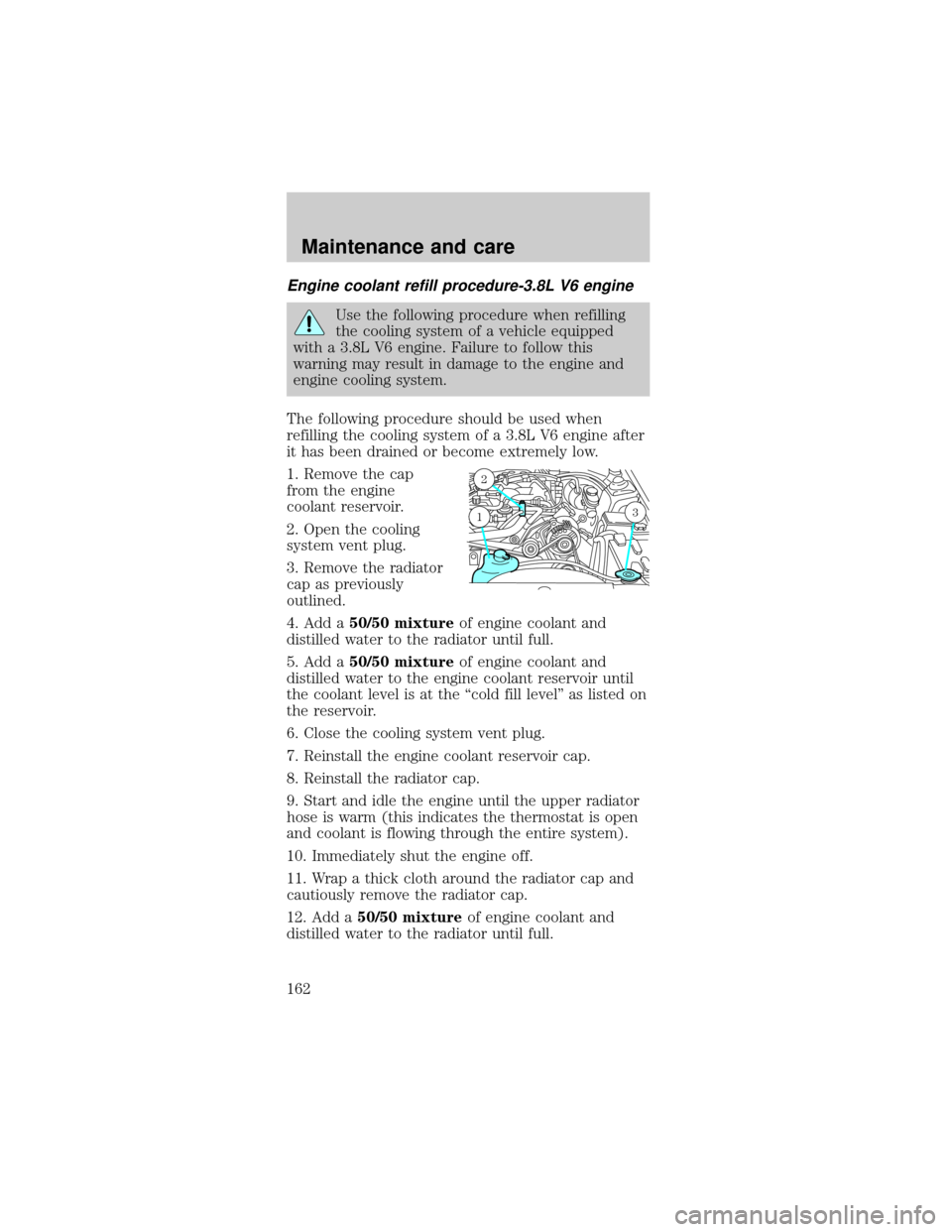
Engine coolant refill procedure-3.8L V6 engine
Use the following procedure when refilling
the cooling system of a vehicle equipped
with a 3.8L V6 engine. Failure to follow this
warning may result in damage to the engine and
engine cooling system.
The following procedure should be used when
refilling the cooling system of a 3.8L V6 engine after
it has been drained or become extremely low.
1. Remove the cap
from the engine
coolant reservoir.
2. Open the cooling
system vent plug.
3. Remove the radiator
cap as previously
outlined.
4. Add a50/50 mixtureof engine coolant and
distilled water to the radiator until full.
5. Add a50/50 mixtureof engine coolant and
distilled water to the engine coolant reservoir until
the coolant level is at the ªcold fill levelº as listed on
the reservoir.
6. Close the cooling system vent plug.
7. Reinstall the engine coolant reservoir cap.
8. Reinstall the radiator cap.
9. Start and idle the engine until the upper radiator
hose is warm (this indicates the thermostat is open
and coolant is flowing through the entire system).
10. Immediately shut the engine off.
11. Wrap a thick cloth around the radiator cap and
cautiously remove the radiator cap.
12. Add a50/50 mixtureof engine coolant and
distilled water to the radiator until full.
2
31
Maintenance and care
162
Page 183 of 240
ªCheck Fuel Capº illuminates when the ignition is
turned to the ON position to ensure your bulb is
working. When this light turns on, check the fuel
filler cap. Continuing to operate the vehicle with the
Check Fuel Cap light on, can activate the Service
Engine Soon warning. When the fuel filler cap is
properly re-installed, the light(s) will turn off after a
period of normal driving.It may take a long
period of time for the system to detect an
improperly installed fuel filler cap.
If you must replace the fuel filler cap, replace
it with a fuel filler cap that is designed for
your vehicle. The customer warranty may be
void for any damage to the fuel tank or fuel
system if the correct genuine Ford or
Motorcraft fuel filler cap is not used.
The fuel system may be under pressure. If
the fuel filler cap is venting vapor or if you
hear a hissing sound, wait until it stops before
completely removing the fuel filler cap. Otherwise,
fuel may spray out and injure you or others.
If you do not use the proper fuel filler cap,
excessive pressure or vacuum in the fuel
tank may damage the fuel system or cause the fuel
cap to disengage in a collision, which may result in
possible personal injury.
Choosing the right fuel
Use only UNLEADED FUEL. The use of leaded fuel
is prohibited by law and could damage your vehicle.
Do not use fuel containing methanol. It can damage
critical fuel system components.
Your vehicle was not designed to use fuel or fuel
additives with metallic compounds, including
manganese-based compounds containing MMT.
Maintenance and care
183
Page 191 of 240

Do not park, idle, or drive your vehicle in
dry grass or other dry ground cover. The
emission system heats up the engine compartment
and exhaust system, which can start a fire.
Illumination of the ªService Engine Soonº light,
charging system warning light or the temperature
warning light, fluid leaks, strange odors, smoke or
loss of engine power, could indicate that the
emission control system is not working properly.
Exhaust leaks may result in entry of harmful
and potentially lethal fumes into the
passenger compartment.
Do not make any unauthorized changes to your
vehicle or engine. By law, vehicle owners and anyone
who manufactures, repairs, services, sells, leases,
trades vehicles, or supervises a fleet of vehicles are
not permitted to intentionally remove an emission
control device or prevent it from working.
Information about your vehicle's emission system is
on the Vehicle Emission Control Information Decal
located on or near the engine. This decal identifies
engine displacement and gives some tune up
specifications.
Please consult yourWarranty Guidefor complete
emission warranty information.
Readiness for Inspection/Maintenance (I/M)
testing
In some localities, it may be a legal requirement to
pass an I/M test of the on-board diagnostics system.
If your ªCheck Engine/Service Engine Soonº light is
on, refer to the description in theWarning lights
and chimessection of theInstrumentation
chapter. Your vehicle may not pass the I/M test with
the ªCheck Engine/Service Engine Soonº light on.
Maintenance and care
191
Page 228 of 240

A
Air bag supplemental
restraint system ........ 88
and child safety
seats ......................... 90
description .............. 88
disposal .................... 93
driver air bag .......... 91
indicator light ..... 9, 92
operation ................. 91
passenger air bag ... 91
Air cleaner filter ..... 206
Air conditioning ........ 20
manual heating and air
conditioning
system ..................... 20
Antifreeze (see Engine
coolant) ................... 157
Anti-lock brake system
(see Brakes) .... 108±109
Anti-theft system
warning light ............. 9
Audio system (see
Radio) ........................ 24
Automatic
transmission ............ 113
driving an automatic
overdrive ............... 115
fluid, adding .......... 167
fluid, checking ...... 167
fluid, refill
capacities ............... 206
fluid,
specification .......... 209
Auxiliary power
point ........................... 60Axle
lubricant
specifications. 208±209
refill capacities ...... 206
traction lok ............ 122
B
Battery ..................... 171
acid, treating
emergencies .......... 171
charging system
warning light ............. 9
jumping a disabled
battery ................... 141
maintenance-free .. 171
replacement,
specifications ........ 206
servicing ................ 171
voltage gauge .......... 17
Belt minder ............... 83
Brakes .............. 108, 110
anti-lock ......... 108±109
anti-lock brake
system (ABS) warning
light .................. 12, 109
brake warning
light .......................... 13
fluid, checking and
adding .................... 155
fluid, refill
capacities ............... 206
fluid,
specifications 208±209
lubricant
specifications 208±209
parking .................. 110
shift interlock ........ 113
Break-in period ........... 3
Index
228