Page 87 of 240
Safety belt maintenance
Inspect the safety belt systems periodically to make
sure they work properly and are not damaged.
Inspect the safety belts to make sure there are no
nicks, tears or cuts. Replace if necessary. All safety
belt assemblies, including retractors, buckles, front
seat belt buckle assemblies, buckle support
assemblies (slide bar-if equipped), shoulder belt
height adjusters (if equipped), shoulder belt guide
on seatback (if equipped), child safety seat tether
bracket assemblies (if equipped), LATCH child seat
tether anchors and lower anchors (if equipped), and
attaching hardware, should be inspected after a
collision. Ford recommends that all safety belt
assemblies used in vehicles involved in a collision be
replaced. However, if the collision was minor and a
qualified technician finds that the belts do not show
damage and continue to operate properly, they do
not need to be replaced. Safety belt assemblies not
in use during a collision should also be inspected
and replaced if either damage or improper operation
is noted.
Failure to inspect and if necessary replace
the safety belt assembly under the above
conditions could result in severe personal injuries
in the event of a collision.
Refer toCleaning and maintaining the safety
beltsin theMaintenacne and Caresection.
Seating and safety restraints
87
Page 88 of 240
AIR BAG SUPPLEMENTAL RESTRAINT SYSTEM
(SRS)
Your vehicle is equipped with a crash sensing and
diagnostic module which records information about
the air bag and sensor systems. In the event of a
collision this module may save information related to
the collision including information about the air bag
system and impact severity. This information will
assist Ford in the servicing of your vehicle and may
help Ford better understand real world collisions
and further improve the safety of future vehicles.
Important supplemental restraint system (SRS)
precautions
The supplemental
restraint system is
designed to work with
the safety belt to help
protect the driver and
right front passenger
from certain upper
body injuries.
Air bags DO NOT
inflate slowly or gently
and the risk of injury
from a deploying air bag is greatest close to the trim
covering the air bag module.
Seating and safety restraints
88
Page 89 of 240
All occupants of the vehicle, including the
driver, should always properly wear their
safety belts, even when an air bag SRS is provided.
Always transport children 12 years old and
under in the back seat and always properly
use appropriate child restraints.
National Highway Traffic Safety
Administration (NHTSA) recommends a
minimum distance of at least 25 cm (10 inches)
between an occupant's chest and the driver air bag
module.
Never place your arm over the air bag
module as a deploying air bag can result in
serious arm fractures or other injuries.
Steps you can take to properly position yourself
away from the air bag:
²Move your seat to the rear as far as you can while
still reaching the pedals comfortably.
²Recline the seat slightly (one or two degrees)
from the upright position.
Do not put anything on or over the air bag
module. Placing objects on or over the air
bag inflation area may cause those objects to be
propelled by the air bag into your face and torso
causing serious injury.
Do not attempt to service, repair, or modify
the Air Bag Supplemental Restraint System
or its fuses. See your Ford or Lincoln Mercury
dealer.
Seating and safety restraints
89
Page 94 of 240

Never let a passenger hold a child on his or
her lap while the vehicle is moving. The
passenger cannot protect the child from injury in a
collision.
Always follow the instructions and warnings that
come with any infant or child restraint you might
use.
When possible, always place children under age 12
in the rear seat of your vehicle. Accident statistics
suggest that children are safer when properly
restrained in the rear seating positions than in the
front seating position.
Children and safety belts
If the child is the proper size, restrain the child in a
safety seat.
Children who are too large for child safety seats (as
specified by your child safety seat manufacturer)
should always wear safety belts.
Follow all the important safety restraint and air bag
precautions that apply to adult passengers in your
vehicle.
If the shoulder belt portion of a combination lap and
shoulder belt can be positioned so it does not cross
or rest in front of the child's face or neck, the child
should wear the lap and shoulder belt. Moving the
child closer to the center of the vehicle may help
provide a good shoulder belt fit.
Do not leave children, unreliable adults, or
pets unattended in your vehicle.
To improve the fit of lap and shoulder belts on
children who have outgrown child safety seats, Ford
recommends use of a belt-positioning booster seat
that is labelled as conforming to all applicable
Federal motor vehicle safety standards.
Belt-positioning booster seats raise the child and
Seating and safety restraints
94
Page 95 of 240
provide a shorter, firmer seating cushion that
encourages safer seating posture and better fit of lap
and shoulder belts on the child.
A belt-positioning booster should be used if the
shoulder belt rests in front of the child's face or
neck, or if the lap belt does not fit snugly on both
thighs, or if the thighs are too short to let the child
sit all the way back on the seat cushion when the
lower legs hang over the edge of the seat cushion.
You may wish to discuss the special needs of your
child with your pediatrician.
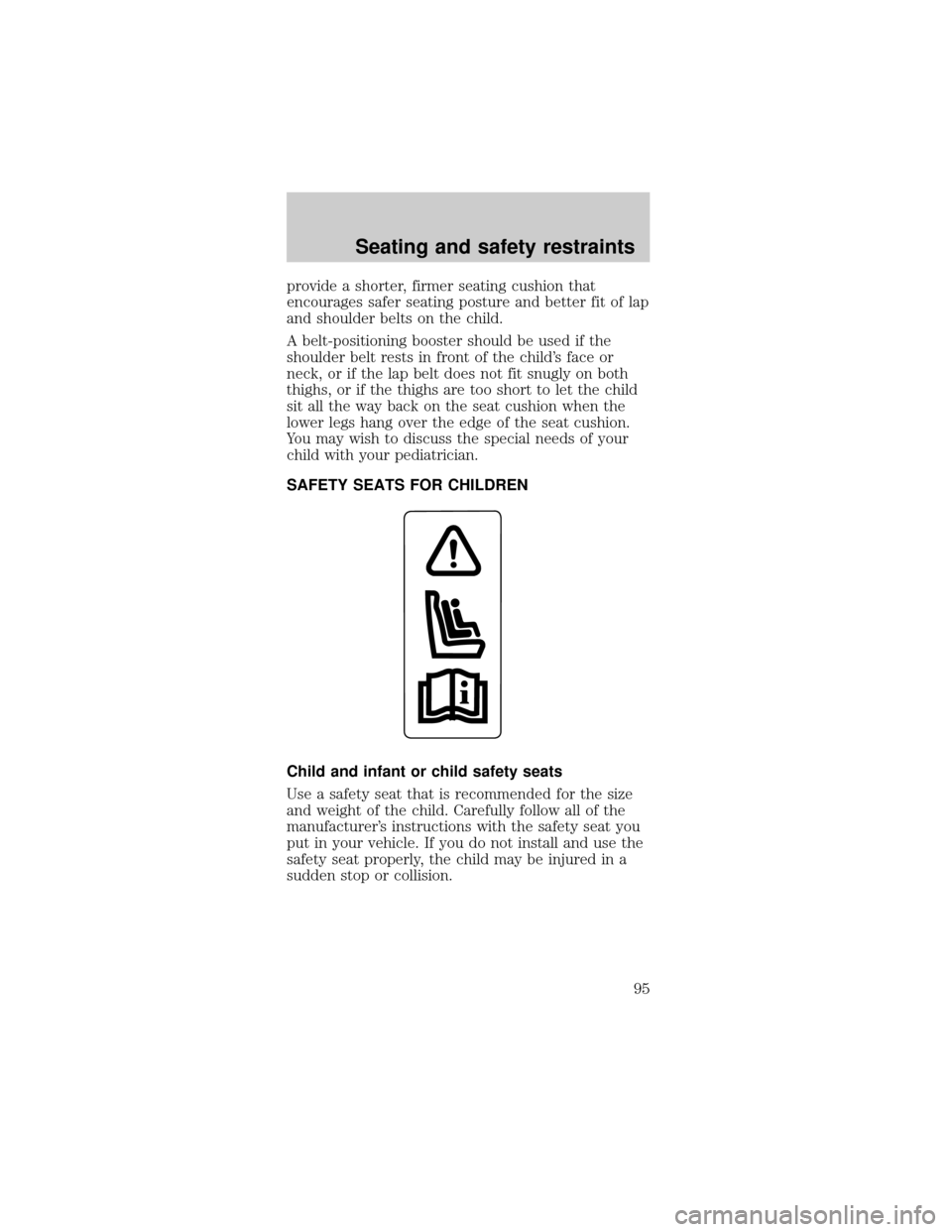
SAFETY SEATS FOR CHILDREN
Child and infant or child safety seats
Use a safety seat that is recommended for the size
and weight of the child. Carefully follow all of the
manufacturer's instructions with the safety seat you
put in your vehicle. If you do not install and use the
safety seat properly, the child may be injured in a
sudden stop or collision.
Seating and safety restraints
95
Page 96 of 240

When installing a child safety seat:
²Review and follow
the information
presented in theAir
Bag Supplemental
Restraint System
section in this
chapter.
²Use the correct
safety belt buckle for that seating position (the
buckle closest to the direction the tongue is
coming from).
²Insert the belt tongue into the proper buckle until
you hear a snap and feel it latch. Make sure the
tongue is securely fastened in the buckle.
²Keep the buckle release button pointing up and
away from the safety seat, with the tongue
between the child seat and the release button, to
prevent accidental unbuckling.
²Place seat back in upright position.
²Put the safety belt in the automatic locking mode.
Refer toAutomatic locking mode(passenger
side front and outboard rear seating positions) (if
equipped).
Ford recommends the use of a child safety seat
having a top tether strap. Install the child safety seat
in a seating position which is capable of providing a
tether anchorage. For more information on top
tether straps, refer toAttaching safety seats with
tether straps.
Carefully follow all of the manufacturer's
instructions included with the safety seat
you put in your vehicle. If you do not install and
use the safety seat properly, the child may be
injured in a sudden stop or collision.
Seating and safety restraints
96
Page 97 of 240
Installing child safety seats in combination lap
and shoulder belt seating positions
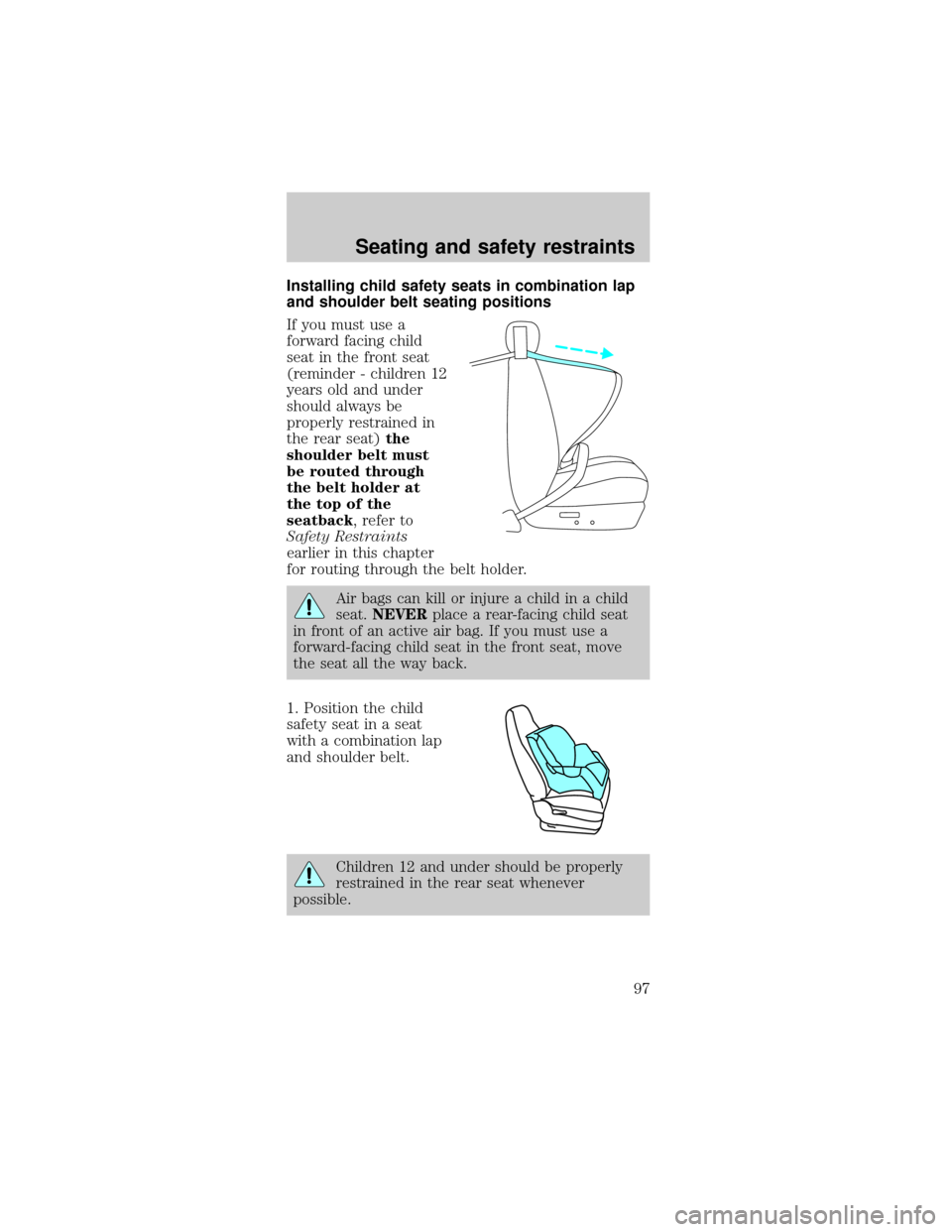
If you must use a
forward facing child
seat in the front seat
(reminder - children 12
years old and under
should always be
properly restrained in
the rear seat)the
shoulder belt must
be routed through
the belt holder at
the top of the
seatback, refer to
Safety Restraints
earlier in this chapter
for routing through the belt holder.
Air bags can kill or injure a child in a child
seat.NEVERplace a rear-facing child seat
in front of an active air bag. If you must use a
forward-facing child seat in the front seat, move
the seat all the way back.
1. Position the child
safety seat in a seat
with a combination lap
and shoulder belt.
Children 12 and under should be properly
restrained in the rear seat whenever
possible.
Seating and safety restraints
97
Page 98 of 240
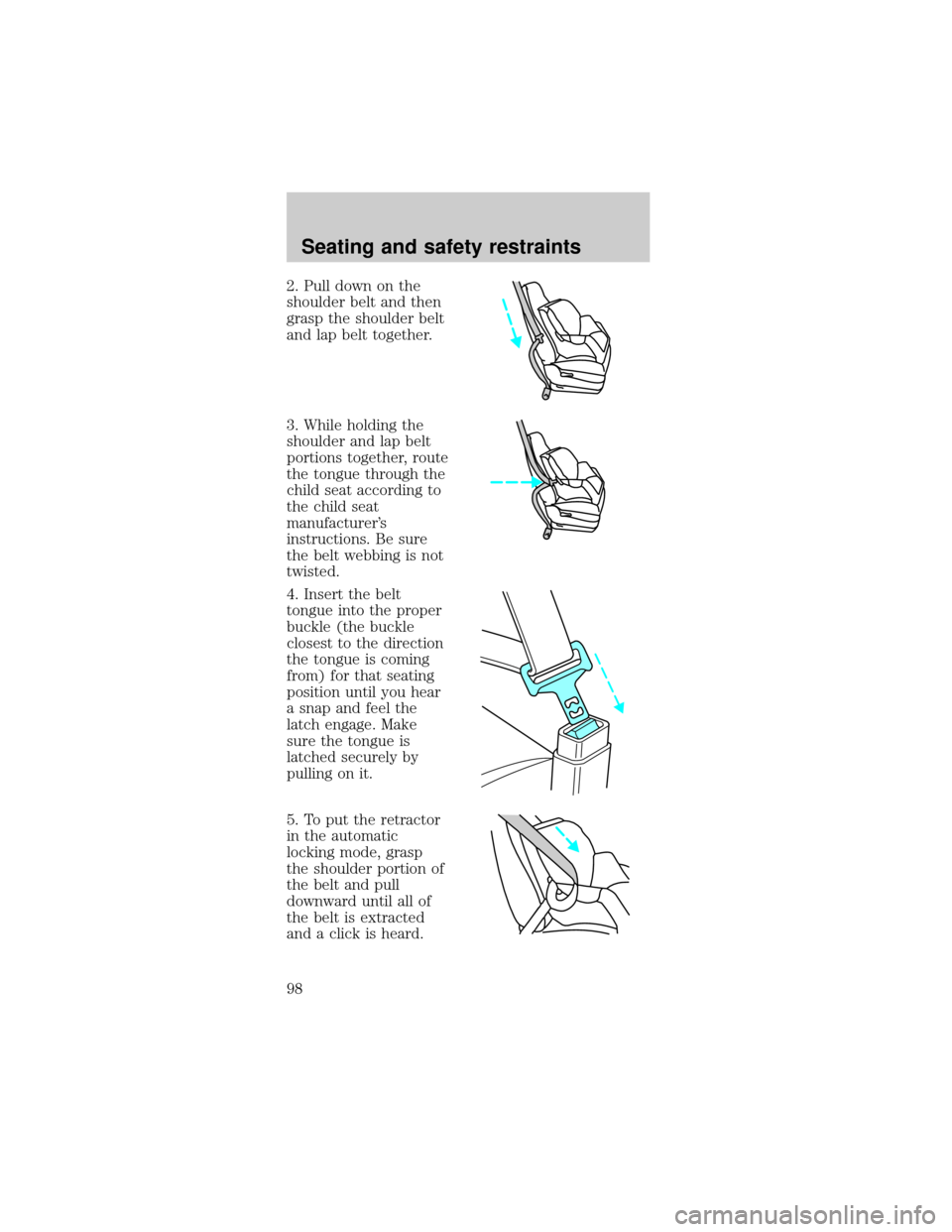
2. Pull down on the
shoulder belt and then
grasp the shoulder belt
and lap belt together.
3. While holding the
shoulder and lap belt
portions together, route
the tongue through the
child seat according to
the child seat
manufacturer's
instructions. Be sure
the belt webbing is not
twisted.
4. Insert the belt
tongue into the proper
buckle (the buckle
closest to the direction
the tongue is coming
from) for that seating
position until you hear
a snap and feel the
latch engage. Make
sure the tongue is
latched securely by
pulling on it.
5. To put the retractor
in the automatic
locking mode, grasp
the shoulder portion of
the belt and pull
downward until all of
the belt is extracted
and a click is heard.
Seating and safety restraints
98