2001 FORD EXPLORER SPORT TRAC battery
[x] Cancel search: batteryPage 191 of 264
ENGINE COOLANT
Checking engine coolant
The concentration and level of engine coolant should be checked at the
mileage intervals listed in the scheduled maintenance guide. The coolant
concentration should be maintained at 50/50 coolant and water, which
equates to a freeze point of -36É C (-34É F). Coolant concentration
testing is possible with a hydrometer or antifreeze tester (such as the
Rotunda Battery and Antifreeze Tester, 014±R1060). The level of coolant
should be maintained at the ªcold fullº of ªcold fill rangeº level in the
coolant reservoir. If the level falls below, add coolant per the instructions
in theAdding Engine Coolantsection.
Your vehicle was factory-filled with a 50/50 engine coolant and water
concentration. If the concentration of coolant falls below 40% or above
60%, the engine parts could become damaged or not work properly.A
50±50 mixture of coolant and water provides the following:
²Freeze protection down to -36É C (-34É F).
²Boiling protection up to 129É C (265É F).
²Protection against rust and other forms of corrosion.
²Enables calibrated gauges to work properly.
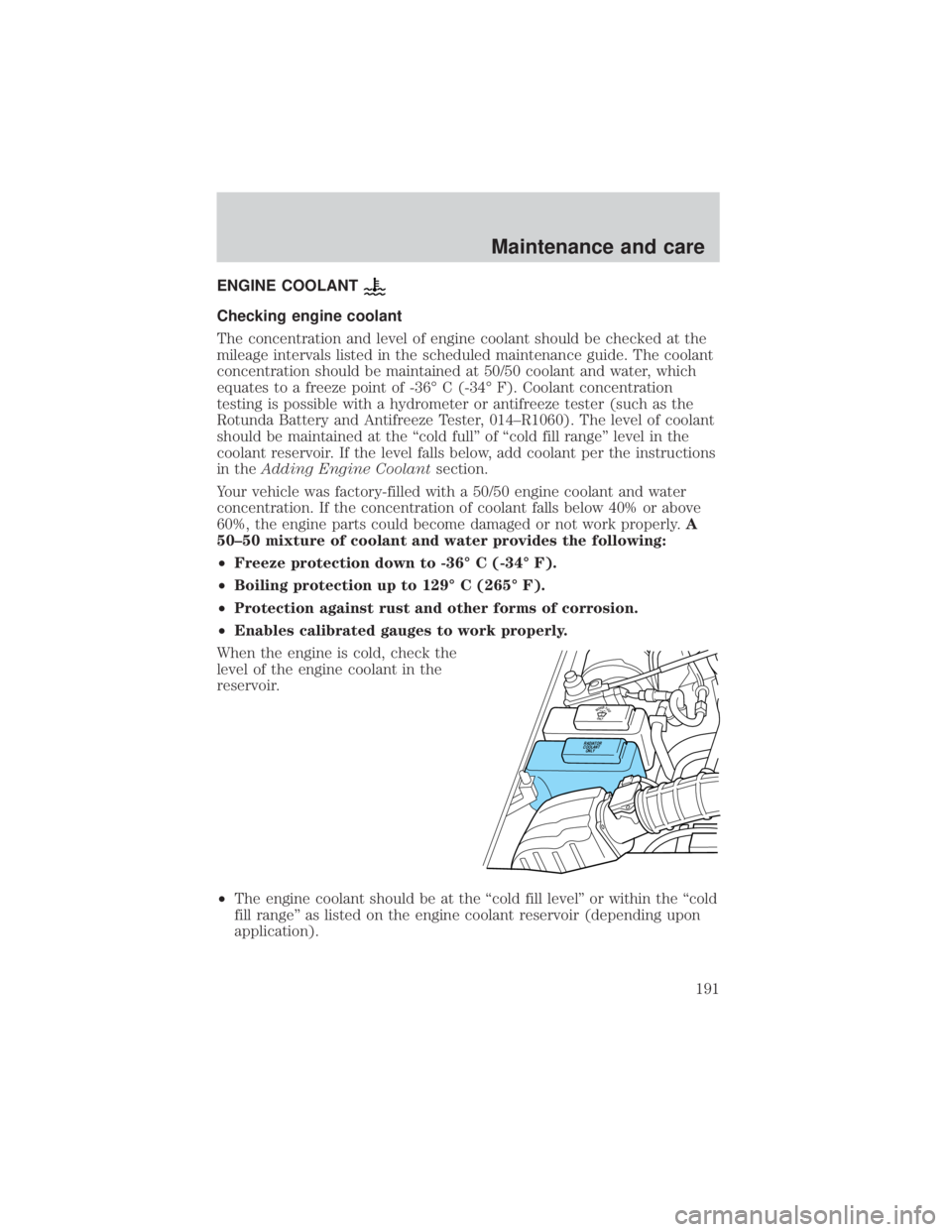
When the engine is cold, check the
level of the engine coolant in the
reservoir.
²The engine coolant should be at the ªcold fill levelº or within the ªcold
fill rangeº as listed on the engine coolant reservoir (depending upon
application).
RADIATOR
COOLANT
ONLY
WASHERFLUIDONLY
Maintenance and care
191
Page 200 of 264
BATTERY
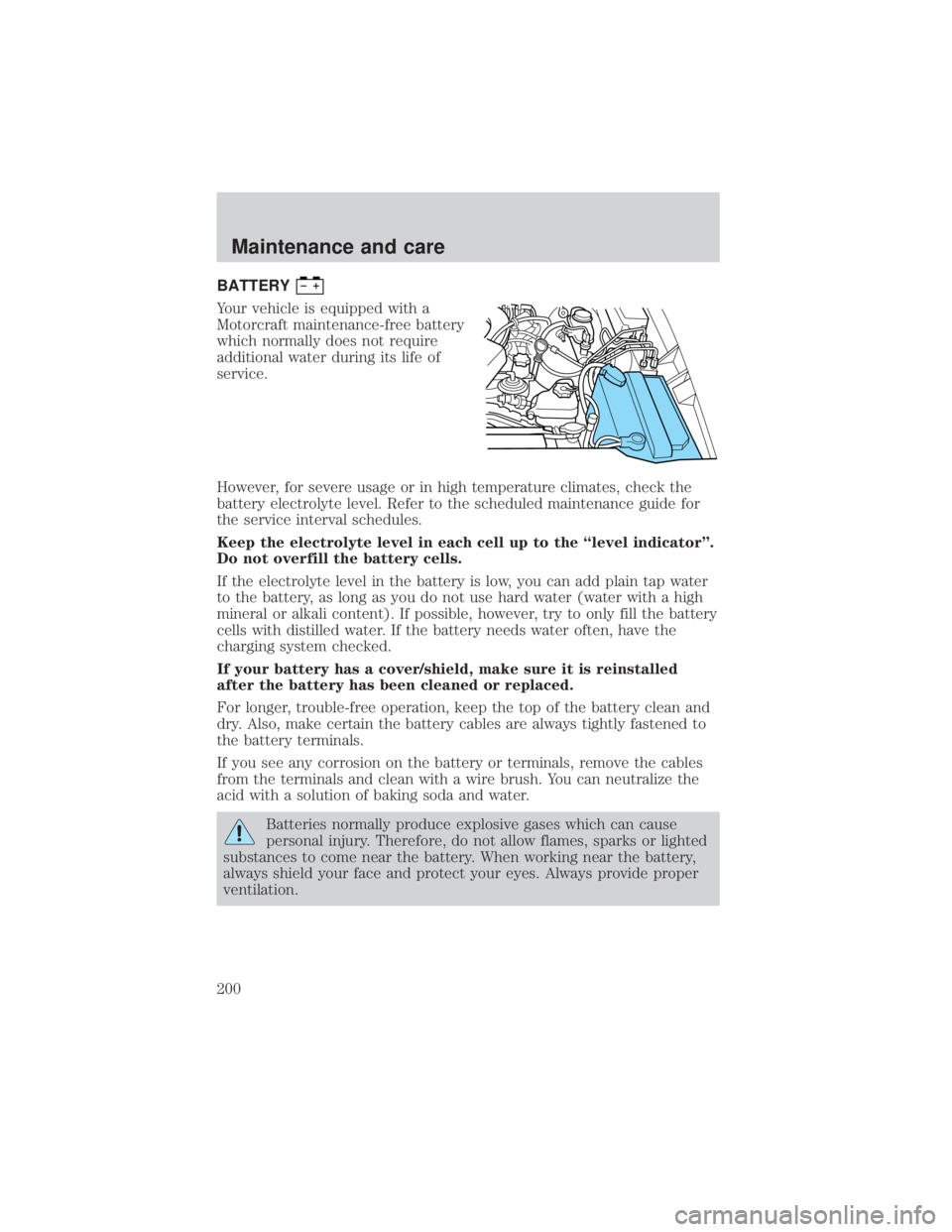
Your vehicle is equipped with a
Motorcraft maintenance-free battery
which normally does not require
additional water during its life of
service.
However, for severe usage or in high temperature climates, check the
battery electrolyte level. Refer to the scheduled maintenance guide for
the service interval schedules.
Keep the electrolyte level in each cell up to the ªlevel indicatorº.
Do not overfill the battery cells.
If the electrolyte level in the battery is low, you can add plain tap water
to the battery, as long as you do not use hard water (water with a high
mineral or alkali content). If possible, however, try to only fill the battery
cells with distilled water. If the battery needs water often, have the
charging system checked.
If your battery has a cover/shield, make sure it is reinstalled
after the battery has been cleaned or replaced.
For longer, trouble-free operation, keep the top of the battery clean and
dry. Also, make certain the battery cables are always tightly fastened to
the battery terminals.
If you see any corrosion on the battery or terminals, remove the cables
from the terminals and clean with a wire brush. You can neutralize the
acid with a solution of baking soda and water.
Batteries normally produce explosive gases which can cause
personal injury. Therefore, do not allow flames, sparks or lighted
substances to come near the battery. When working near the battery,
always shield your face and protect your eyes. Always provide proper
ventilation.
Maintenance and care
200
Page 201 of 264
When lifting a plastic-cased battery, excessive pressure on the
end walls could cause acid to flow through the vent caps,
resulting in personal injury and/or damage to the vehicle or battery.
Lift the battery with a battery carrier or with your hands on opposite
corners.
Keep batteries out of reach of children. Batteries contain sulfuric
acid. Avoid contact with skin, eyes or clothing. Shield your eyes
when working near the battery to protect against possible splashing of
acid solution. In case of acid contact with skin or eyes, flush
immediately with water for a minimum of 15 minutes and get prompt
medical attention. If acid is swallowed, call a physician immediately.
Battery posts, terminals and related accessories contain lead and
lead compounds.Wash hands after handling.
Because your vehicle's engine is electronically controlled by a computer,
some control conditions are maintained by power from the battery. When
the battery is disconnected or a new battery is installed, the engine must
relearn its idle and fuel trim strategy for optimum driveability and
performance. To begin this process:
1. With the vehicle at a complete stop, set the parking brake.
2. Put the gearshift in P (Park), turn off all accessories and start the
engine.
3. Run the engine until it reaches normal operating temperature.
4. Allow the engine to idle for at least one minute.
5. Turn the A/C on and allow the engine to idle for at least one minute.
6. Drive the vehicle to complete the relearning process.
²The vehicle may need to be driven 16 km (10 miles) or more to
relearn the idle and fuel trim strategy.
²If you do not allow the engine to relearn its idle trim, the idle
quality of your vehicle may be adversely affected until the idle
trim is eventually relearned.
If the battery has been disconnected or a new battery has been installed,
the clock and the preset radio stations must be reset once the battery is
reconnected.
Maintenance and care
201
Page 220 of 264

Readiness for Inspection/Maintenance (I/M) testing
In some localities, it may be a legal requirement to pass an I/M test of
the on-board diagnostics system. If your ªCheck Engine/Service Engine
Soonº light is on, refer to the description in theWarning lights and
chimessection of theInstrumentationchapter. Your vehicle may not
pass the I/M test with the ªCheck Engine/Service Engine Soonº light on.
If the vehicle's powertrain system or its battery has just been serviced,
the on-board diagnostics system is reset to a ªnot ready for I/M testº
condition. To ready the on-board diagnostics system for I/M testing, a
minimum of 30 minutes of city and highway driving is necessary as
described below:
²First, at least 10 minutes of driving on an expressway or highway.
²Next, at least 20 minutes driving in stop-and-go, city-type traffic with
at least four idle periods.
Allow the vehicle to sit for at least eight hours without starting the
engine. Then, start the engine and complete the above driving cycle. The
engine must warm up to its normal operating temperature. Once started,
do not turn off the engine until the above driving cycle is complete.
BULBS
Replacing exterior bulbs
Check the operation of the following lamps frequently:
²Headlamps
²Foglamps
²High-mount brakelamp
²Brakelamps
²Turn signals
²License plate lamp
²Tail lamps
²Back-up lamps
Do not remove lamp bulbs unless they can be replaced immediately with
new ones. If a bulb is removed for an extended period of time,
contaminants may enter the lamp housings and affect lamp performance.
Maintenance and care
220
Page 233 of 264

MOTORCRAFT PART NUMBERS
Component 4.0L SOHC V6 engine
Air filter element FA-1658
Fuel filter FG-986B
Battery BXT-65-650
Oil filter FL-820S
PCV valve EV-243
Spark plugs* AGSF-22PP
* Refer to Vehicle Emissions Control Information (VECI) decal for spark
plug gap information.
REFILL CAPACITIES
Fluid Ford Part
NameApplication
Capacity
Brake and
clutch fluidHigh
Performance
DOT 3 Motor
Vehicle Brake
FluidAll Fill to line on
reservoir
Engine oil
(including filter
change)Motorcraft SAE
5W-30 Super
Premium Motor
OilAll 4.7L (5.0
quarts)
Fuel tank N/A All 77.6L (20.5
gallons)
Power steering
fluidMotorcraft
MERCONtAT FAll Fill to line on
reservoir
Transmission
fluid
1Motorcraft
MERCONtV
AT F5R55E
Automatic (4x2)9.5L (10.0
quarts)2
5R55E
Automatic (4x4)9.8L (10.3
quarts)2
Transfer case Motorcraft
MERCONtAT F4WD 1.2L (1.3
quarts)3
Capacities and specifications
233
Page 249 of 264
Vehicle Security
Styled wheel protector locks
Vehicle security systems
Comfort and convenience
Celluar phone holder
Compass mirror
Compass mirror with temperature display
Engine block heaters
Seatback organizer
Tire step
Travel equipment
Cargo cage
Daytime running lights
Factory luggage rack (cross bars)
Factory luggage rack adaptors (bike, ski, luggage)
Fog lights
Front tow hooks
Heavy-duty battery
Pickup box dividers
Removable luggage rack Ð cross bars
Removable luggage rack adapters
Running boards and bars
Soft luggage cover
Speed control
Trailer hitch
Trailer hitch bars and balls
Trailer hitch wiring adaptor
Customer assistance
249
Page 254 of 264

A
Air bag supplemental restraint
system ........................................112
and child safety seats ............114
description ..............................112
disposal ....................................117
driver air bag ..........................115
indicator light ...................10, 117
operation .................................115
passenger air bag ...................115
Air cleaner filter ...............190, 233
Air conditioning ..........................20
rear seat controls .....................23
Ambulance packages ....................3
Antifreeze (see Engine
coolant) .....................................191
Anti-lock brake system (see
Brakes) ..............................132±133
Anti-theft system
warning light .............................11
Audio system (see Radio) .........27
Automatic transmission ............136
driving an automatic
overdrive .................................137
fluid, adding ............................196
fluid, checking ........................196
fluid, refill capacities ..............233
fluid, specification ..................238
Auxiliary power point .................73
Axle
lubricant specifications ..235, 238
refill capacities ........................233
traction lok ..............................135
B
Battery .......................................200acid, treating emergencies .....200
charging system
warning light .............................11
jumping a disabled battery ....174
maintenance-free ....................200
replacement, specifications ...233
servicing ..................................200
voltage gauge ............................16
Belt minder ...............................108
Brakes ........................................132
anti-lock ...........................132±133
anti-lock brake system
(ABS) warning light .........10, 133
brake warning light ..................10
fluid, checking and adding ....188
fluid, refill capacities ..............233
fluid, specifications .........235, 238
lubricant specifications ..235, 238
parking ....................................133
shift interlock ..........................136
Break-in period .............................3
C
Capacities for refilling fluids ....233
Cargo cage ...................................76
Cassette tape player ...................37
Certification Label ....................240
Child safety restraints ..............118
child safety belts ....................118
Child safety seats ......................119
attaching with tether straps ..124
in front seat ............................121
in rear seat ......................121, 123
Cleaning your vehicle ...............227
engine compartment ..............229
exterior ............................228, 232
exterior lamps .........................230
Index
254
Page 256 of 264

lubrication
specifications ..................235, 238
refill capacities ........................233
service points ..........................184
starting after a collision .........159
Engine block heater .................130
Engine oil ..................................185
checking and adding ..............185
dipstick ....................................185
filter, specifications ........187, 233
recommendations ...................187
refill capacities ........................233
specifications ..................235, 238
Exhaust fumes ..........................131
F
Flexible Fuel Vehicle (FFV) ....208
Floor mats ...................................74
Fluid capacities .........................233
Foglamps .....................................18
Four-Wheel Drive
vehicles ................................12, 142
control trac ...............................27
description ..............................143
driving off road .......................145
electronic shift ..................27, 143
indicator light .........................143
preparing to drive your
vehicle .....................................135
Fuel ............................................208
calculating fuel economy .......215
cap .......................................9, 214
capacity ...................................233
choosing the right fuel ...........211
comparisons with EPA fuel
economy estimates .................218
detergent in fuel .....................213filling your vehicle
with fuel ..................208, 214±215
filter, specifications ........215, 233
fuel pump shut-off switch .....159
gauge .........................................17
improving fuel economy ........215
octane rating ...................211, 238
quality ......................................212
running out of fuel .................213
safety information relating to
automotive fuels .....................208
Fuses ..................................161±162
G
Garage door opener ....................63
Gas cap (see Fuel cap) ........9, 214
Gas mileage (see Fuel
economy) ...................................215
Gauges .........................................14
battery voltage gauge ...............16
engine coolant temperature
gauge .........................................15
engine oil pressure gauge ........16
fuel gauge ..................................17
odometer ...................................15
speedometer .............................14
tachometer ................................16
trip odometer ............................15
GAWR (Gross Axle Weight
Rating) .......................................148
calculating ...............................150
definition .................................148
driving with a heavy load ......148
location ....................................148
GVWR (Gross Vehicle Weight
Rating) .......................................148
calculating .......................148, 150
definition .................................148
Index
256