2001 FORD EXPLORER SPORT wheel
[x] Cancel search: wheelPage 209 of 256

²Resting your foot on the brake pedal while driving may reduce fuel
economy.
²Combine errands and minimize stop-and-go driving.
Maintenance
²Keep tires properly inflated and use only recommended size.
²Operating a vehicle with the wheels out of alignment will reduce fuel
economy.
²Perform all regularly scheduled maintenance items. Follow the
recommended maintenance schedule and owner maintenance checks
found in your vehicle scheduled maintenance guide.
Conditions
²Heavily loading a vehicle or towing a trailer may reduce fuel economy
at any speed.
²Carrying unnecessary weight may reduce fuel economy (approximately
0.4 km/L [1 mpg] is lost for every 180 kg [400 lb] of weight carried).
²Adding certain accessories to your vehicle (for example bug
deflectors, rollbars/light bars, running boards, ski/luggage racks) may
reduce fuel economy.
²Using fuel blended with alcohol may lower fuel economy.
²Fuel economy may decrease with lower temperatures during the first
12±16 km (8±10 miles) of driving.
²Driving on flat terrain offers improved fuel economy as compared to
driving on hilly terrain.
²Transmissions give their best fuel economy when operated in the top
cruise gear and with steady pressure on the gas pedal.
²Four-wheel-drive operation (if equipped) is less fuel efficient than
two-wheel-drive operation.
²Close windows for high speed driving.
EPA window sticker
Every new vehicle should have the EPA window sticker. Contact your
dealer if the window sticker is not supplied with your vehicle. The EPA
window sticker should be your guide for the fuel economy comparisons
with other vehicles.
Maintenance and care
209
Page 220 of 256
Remove particles such as bird droppings, tree sap, insect remains, tar
spots, road salt and industrial fallout immediately.
Cleaning the engine
Engines are more efficient when they are clean because grease and dirt
buildup keep the engine warmer than normal. When washing:
²Take care when using a power washer to clean the engine. The high
pressure fluid could penetrate the sealed parts and cause damage.
²Do not spray with cold water to avoid cracking the engine block or
other engine components.
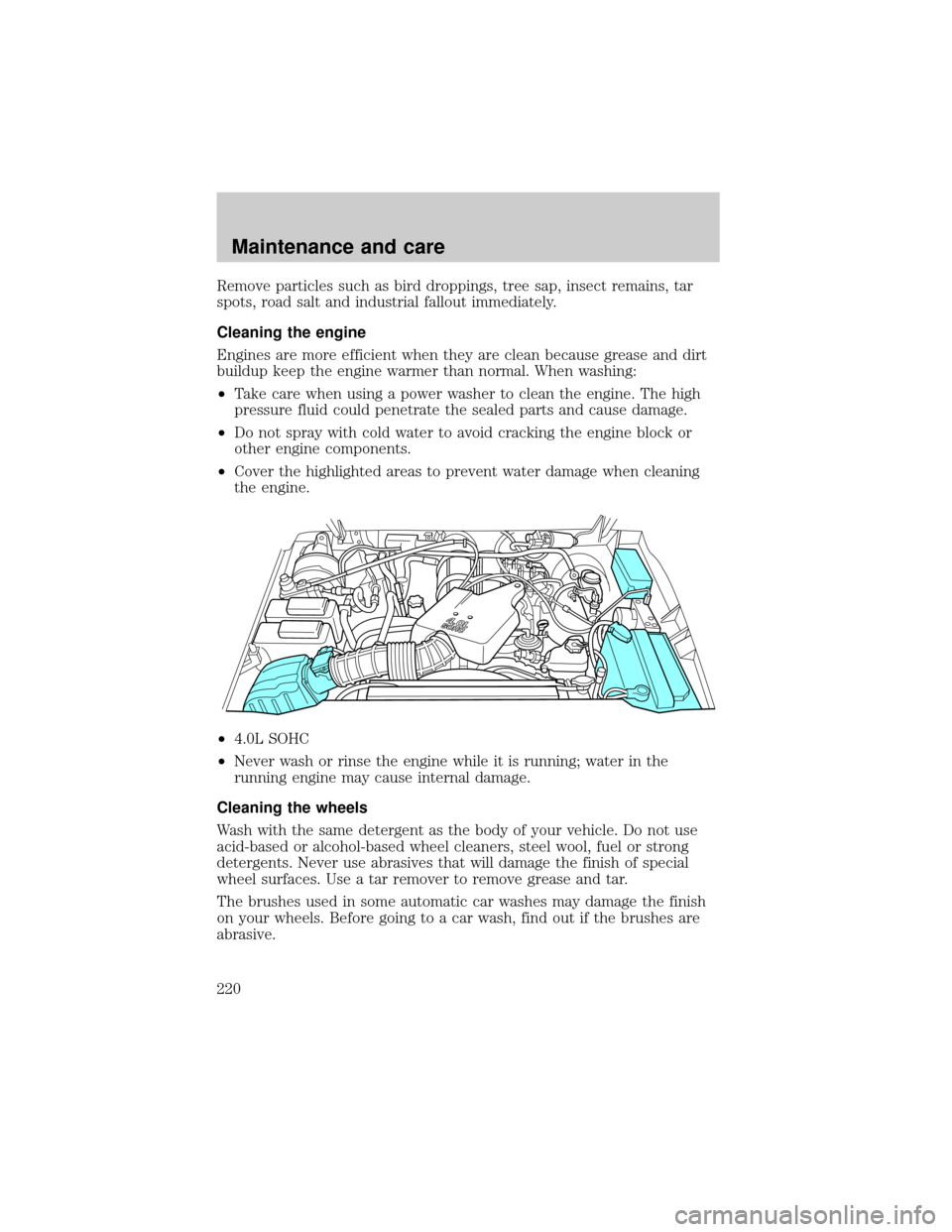
²Cover the highlighted areas to prevent water damage when cleaning
the engine.
²4.0L SOHC
²Never wash or rinse the engine while it is running; water in the
running engine may cause internal damage.
Cleaning the wheels
Wash with the same detergent as the body of your vehicle. Do not use
acid-based or alcohol-based wheel cleaners, steel wool, fuel or strong
detergents. Never use abrasives that will damage the finish of special
wheel surfaces. Use a tar remover to remove grease and tar.
The brushes used in some automatic car washes may damage the finish
on your wheels. Before going to a car wash, find out if the brushes are
abrasive.
Maintenance and care
220
Page 221 of 256
Cleaning non-painted plastic exterior parts
Use vinyl cleaner for routine cleaning. Clean with a tar remover if
necessary. Do not clean plastic parts with thinners, solvents or
petroleum-based cleaners.
Cleaning the exterior lamps
Wash with the same detergent as the exterior of your vehicle. If
necessary, use a tar remover such as Ford Extra Strength Tar and Road
Oil Remover (B7A-19520±AA).
To avoid scratching the lamps, do not use a dry paper towel, chemical
solvents or abrasive cleaners.
Cleaning the windshield, wiper blades and rear window
If the wiper blades do not wipe properly, clean the wiper blade rubber
element with undiluted windshield washer solution or a mild detergent.
To avoid damaging the blades, do not use fuel, kerosene, paint thinner or
other solvents.
If the wiper still does not wipe properly, this could be caused by
substances on the windshield or rear window such as tree sap and some
hot wax treatments used by commercial car washes. Clean the outside of
the windshield or rear window with a non-abrasive cleaner such as Ford
Ultra-Clear Spray Glass Cleaner, (E4AZ-19C507±AA), available from your
Ford Dealer.Do notuse abrasive cleansers on glass as they may cause
scratches. The windshield or rear window is clean if beads do not form
when you rinse it with water. The windshield, rear window and wiper
blades should be cleaned on a regular basis, and blades or rubber
elements replaced when worn.
Cleaning the instrument panel
Clean with a damp cloth, then dry with a dry cloth.
Avoid cleaner or polish that increases the gloss of the upper portion of
the instrument panel. The dull finish in this area helps protect the driver
from undesirable windshield reflection.
Do not use chemical solvents or strong detergents when cleaning
the steering wheel or instrument panel to avoid contamination of
the air bag system.
Maintenance and care
221
Page 229 of 256
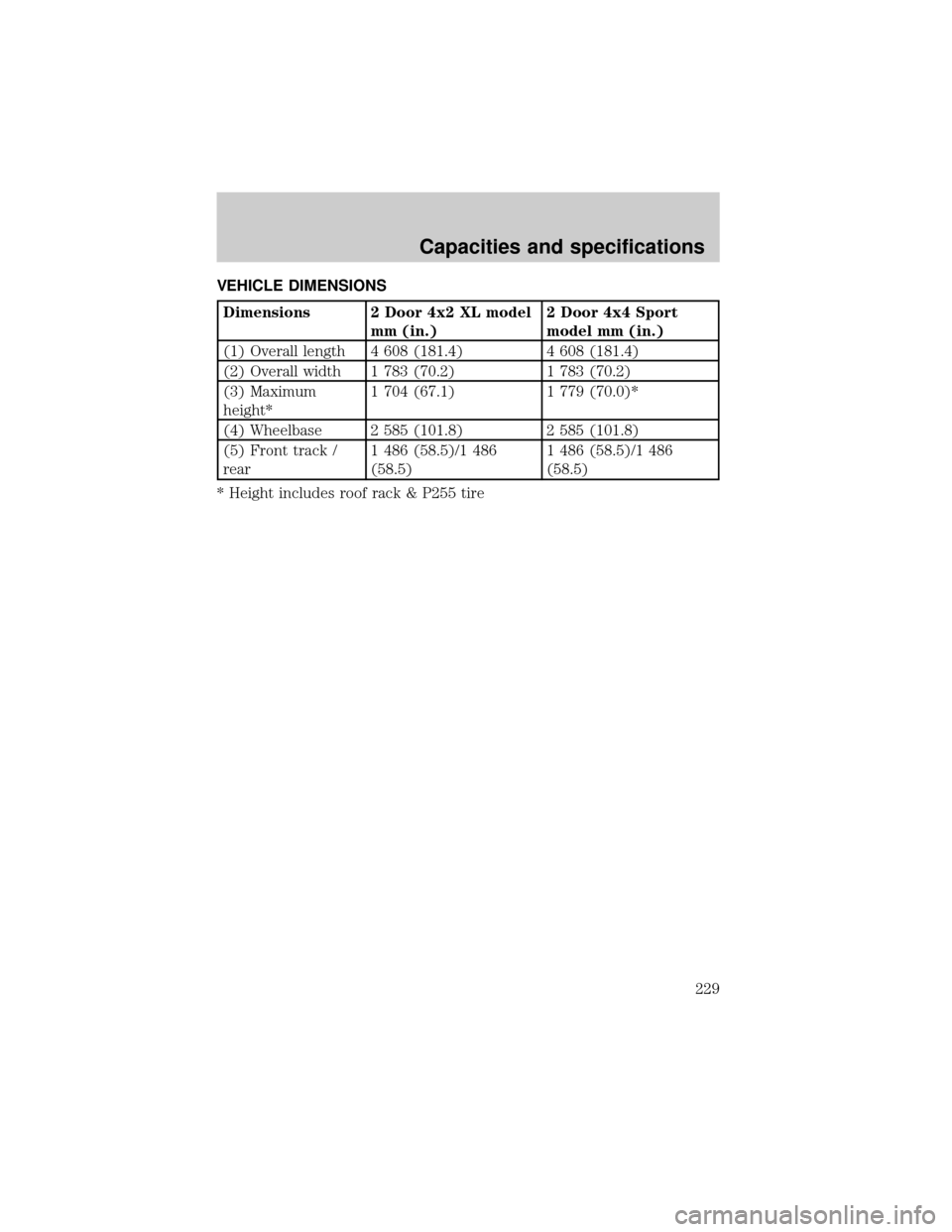
VEHICLE DIMENSIONS
Dimensions 2 Door 4x2 XL model
mm (in.)2 Door 4x4 Sport
model mm (in.)
(1) Overall length 4 608 (181.4) 4 608 (181.4)
(2) Overall width 1 783 (70.2) 1 783 (70.2)
(3) Maximum
height*1 704 (67.1) 1 779 (70.0)*
(4) Wheelbase 2 585 (101.8) 2 585 (101.8)
(5) Front track /
rear1 486 (58.5)/1 486
(58.5)1 486 (58.5)/1 486
(58.5)
* Height includes roof rack & P255 tire
Capacities and specifications
229
Page 240 of 256

Not all accessories are available for all models.
Vehicle Security
Styled wheel protector locks
Vehicle security systems
Comfort and convenience
Cargo nets
Cargo organizers
Cargo shades
Cargo trays
Compass mirror
Compass mirror with temperature display
Engine block heaters
Pet net
Seatback organizer
Tire step
Travel equipment
Auto headlamps
Cellular phone holder
Daytime running lights
Factory luggage rack (cross bars)
Factory luggage rack adaptors (bike, ski, cargo)
Fog lights
Heavy-duty battery
Removable luggage rack- cross bars (round)
Removable luggage rack adapters (bike, ski, etc.)
Running boards and bars
Soft luggage cover
Speed control
Trailer hitch
Customer assistance
240
Page 246 of 256

Cleaning your vehicle ...............218
engine compartment ..............220
exterior ....................................219
exterior lamps .........................221
instrument cluster lens ..........222
instrument panel ....................221
interior .....................................222
mirrors .....................................223
plastic parts ............................221
safety belts ..............................223
washing ....................................218
waxing .....................................219
wheels ......................................220
windows ..................................223
wiper blades ............................221
Climate control (see Air
conditioning or Heating) ............22
Clock ......................................35, 50
Clutch
fluid ..........................................181
operation while driving ..........133
recommended shift speeds ....134
Compass, electronic ....................66
calibration .................................68
set zone adjustment .................67
Console ........................................71
overhead ....................................64
Controls
power seat .................................89
Coolant
checking and adding ..............183
refill capacities ................187, 224
specifications ..................226, 228
Cruise control (see Speed
control) ........................................57
Customer Assistance ................151
Ford accessories for your
vehicle .....................................240Ford Extended Service
Plan ..........................................232
Getting assistance outside the
U.S. and Canada .....................238
Getting roadside assistance ...151
Getting the service you
need .........................................232
Ordering additional owner's
literature .................................242
The Dispute Settlement
Board .......................................235
Utilizing the
Mediation/Arbitration
Program ...................................238
D
Daytime running lamps (see
Lamps) .........................................20
Defrost
rear window ..............................26
Dipstick
automatic transmission
fluid ..........................................188
engine oil .................................177
Doors
door ajar warning .....................14
lubricant specifications ..........226
Driving under special
conditions ..........................139±140
mud ..........................................139
sand .........................................139
snow and ice ...........................140
through water .................139, 143
E
Emergencies, roadside
jump-starting ..........................166
Emission control system ..........210
Index
246
Page 247 of 256

Engine ................................228±229
check engine/service engine
soon light ..................................10
cleaning ...................................220
coolant .....................................183
idle speed control ...................192
lubrication
specifications ..................226, 228
refill capacities ........................224
service points ..........................176
starting after a collision .........152
Engine block heater .................123
Engine oil ..................................177
checking and adding ..............177
dipstick ....................................177
filter, specifications ........179, 224
recommendations ...................179
refill capacities ........................224
specifications ..................226, 228
Exhaust fumes ..........................124
F
Flexible Fuel Vehicle (FFV) ....200
Floor mats ...................................73
Fluid capacities .........................224
Foglamps .....................................20
Four-Wheel Drive
vehicles ................................14, 135
control trac ...............................27
description ..............................136
driving off road .......................138
electronic shift ..................27, 136
indicator light .........................136
preparing to drive your
vehicle .....................................128
Fuel ............................................200
calculating fuel economy .......206
cap .....................................11, 205capacity ...................................224
choosing the right fuel ...........203
comparisons with EPA fuel
economy estimates .................209
detergent in fuel .....................205
filling your vehicle with
fuel ...........................200, 205, 207
filter, specifications ........206, 224
fuel pump shut-off switch .....152
gauge .........................................19
improving fuel economy ........206
octane rating ...........203, 228±229
quality ......................................204
running out of fuel .................205
safety information relating to
automotive fuels .....................200
Fuses ..................................154±155
G
Garage door opener ....................64
Gas cap (see Fuel cap) ......11, 205
Gas mileage (see Fuel
economy) ...................................206
Gauges .........................................16
battery voltage gauge ...............18
engine coolant temperature
gauge .........................................17
engine oil pressure gauge ........18
fuel gauge ..................................19
odometer ...................................17
speedometer .............................16
tachometer ................................18
trip odometer ............................17
GAWR (Gross Axle Weight
Rating) .......................................141
calculating ...............................143
definition .................................141
driving with a heavy load ......141
location ....................................141
Index
247
Page 250 of 256

Safety restraints ....................93±98
belt minder ...............................99
cleaning the safety belts .......102,
223
extension assembly ..................98
for adults .............................94±97
for children .............................112
warning light and chime ...12, 15,
98±99
Safety seats for children ..........113
Seat belts (see Safety
restraints) ....................................93
Seats
child safety seats ....................113
cleaning ...................................222
SecuriLock passive anti-theft
system ....................................83±85
Servicing your vehicle ..............174
Snowplowing .................................4
Spark plugs, specifications ......224,
228±229
Special notice ................................4
ambulance conversions ..............4
utility-type vehicles ....................5
Specification chart,
lubricants ...........................226, 228
Speed control ..............................57
Speedometer ...............................16
Starting your vehicle ........120, 122
jump starting ..........................166
Steering wheel
tilting .........................................62T
Tachometer .................................18
Tires ...........................161, 195±196
changing ..........................161, 163
checking the pressure ............196
replacing ..................................198
rotating ....................................197
snow tires and chains ............199
tire grades ...............................196
treadwear ................................195
Towing .......................................143
recreational towing .................149
trailer towing ..........................143
wrecker ....................................172
Traction-lok rear axle ...............128
Transfer case
fluid checking .........................191
Transmission
automatic operation ...............129
fluid, checking and adding
(automatic) .............................188
fluid, refill capacities ..............224
lubricant specifications ..226, 228
manual operation ....................133
Trip odometer .............................17
Turn signal ............................13, 56
V
Vehicle dimensions ...................229
Vehicle Identification Number
(VIN) ..........................................231
Vehicle loading ..........................141
Ventilating your vehicle ...........124
Index
250