2001 FORD EXPLORER SPORT tow
[x] Cancel search: towPage 194 of 256
²Always dispose of automotive
batteries in a responsible manner.
Follow your local authorized
standards for disposal. Call your
local authorized recycling center
to find out more about recycling
automotive batteries.
WINDSHIELD WIPER BLADES
Check the wiper blades at least twice a year or when they seem less
effective. Substances such as tree sap and some hot wax treatments used
by commercial car washes reduce the effectiveness of wiper blades.
Checking the wiper blades
If the wiper blades do not wipe properly, clean both the windshield and
wiper blades using undiluted windshield wiper solution or a mild
detergent. Rinse thoroughly with clean water. To avoid damaging the
blades, do not use fuel, kerosene, paint thinner or other solvents.
Changing the wiper blades
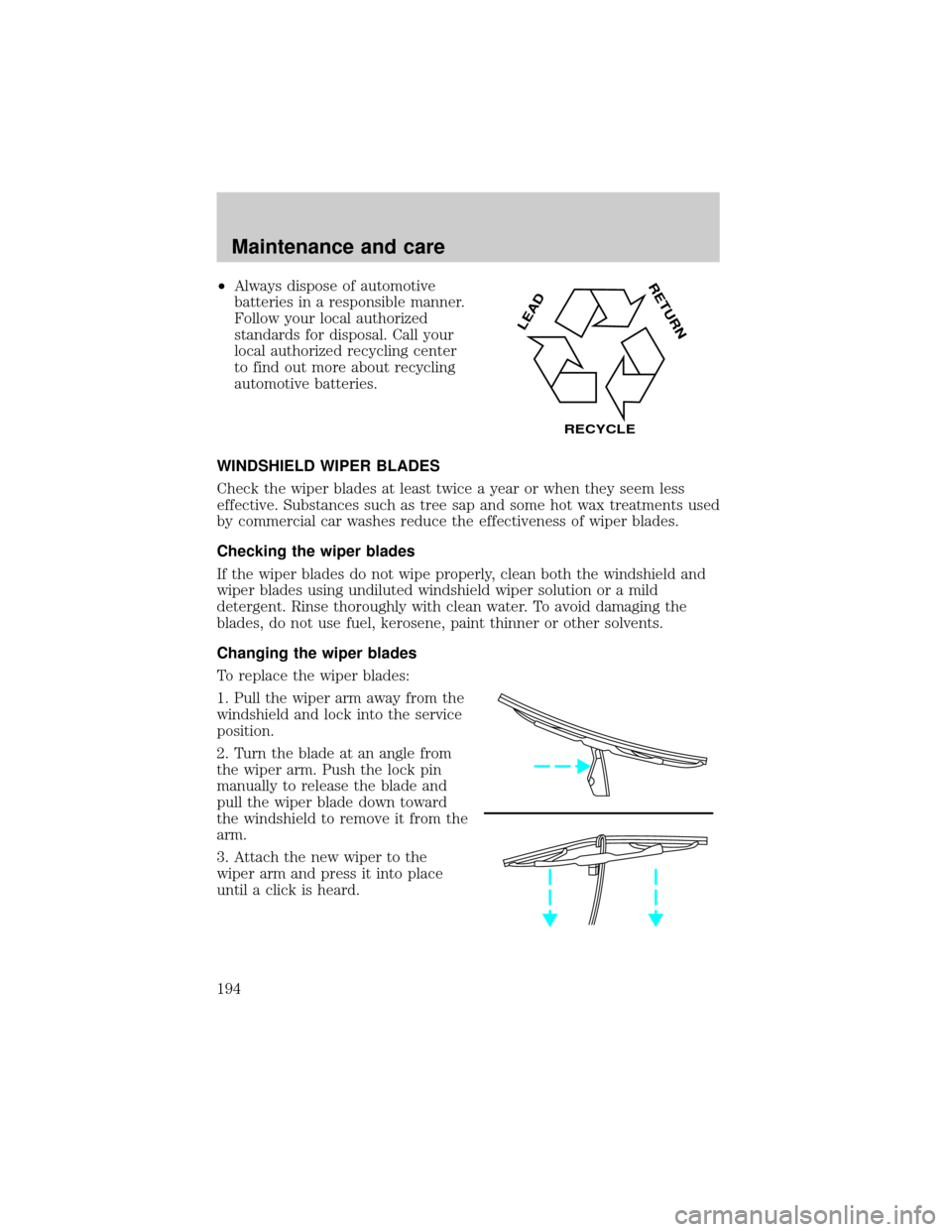
To replace the wiper blades:
1. Pull the wiper arm away from the
windshield and lock into the service
position.
2. Turn the blade at an angle from
the wiper arm. Push the lock pin
manually to release the blade and
pull the wiper blade down toward
the windshield to remove it from the
arm.
3. Attach the new wiper to the
wiper arm and press it into place
until a click is heard.
LEAD
RETURN
RECYCLE
Maintenance and care
194
Page 195 of 256
Rear window wiper blades
Refer toWindshield wiper bladesin this section for more information
on rear wiper blades.
INFORMATION ABOUT UNIFORM TIRE QUALITY GRADING
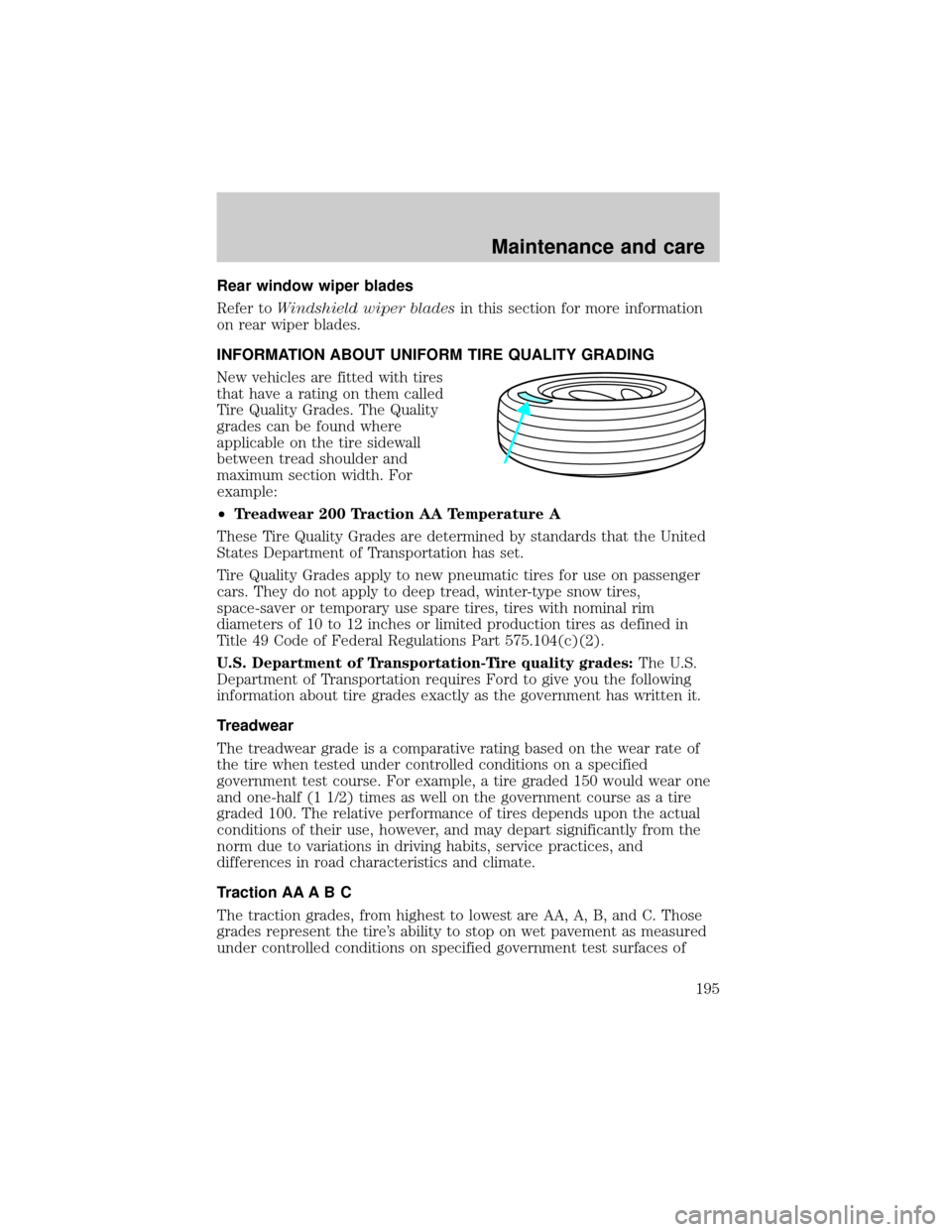
New vehicles are fitted with tires
that have a rating on them called
Tire Quality Grades. The Quality
grades can be found where
applicable on the tire sidewall
between tread shoulder and
maximum section width. For
example:
²Treadwear 200 Traction AA Temperature A
These Tire Quality Grades are determined by standards that the United
States Department of Transportation has set.
Tire Quality Grades apply to new pneumatic tires for use on passenger
cars. They do not apply to deep tread, winter-type snow tires,
space-saver or temporary use spare tires, tires with nominal rim
diameters of 10 to 12 inches or limited production tires as defined in
Title 49 Code of Federal Regulations Part 575.104(c)(2).
U.S. Department of Transportation-Tire quality grades:The U.S.
Department of Transportation requires Ford to give you the following
information about tire grades exactly as the government has written it.
Treadwear
The treadwear grade is a comparative rating based on the wear rate of
the tire when tested under controlled conditions on a specified
government test course. For example, a tire graded 150 would wear one
and one-half (1 1/2) times as well on the government course as a tire
graded 100. The relative performance of tires depends upon the actual
conditions of their use, however, and may depart significantly from the
norm due to variations in driving habits, service practices, and
differences in road characteristics and climate.
Traction AA A B C
The traction grades, from highest to lowest are AA, A, B, and C. Those
grades represent the tire's ability to stop on wet pavement as measured
under controlled conditions on specified government test surfaces of
Maintenance and care
195
Page 209 of 256

²Resting your foot on the brake pedal while driving may reduce fuel
economy.
²Combine errands and minimize stop-and-go driving.
Maintenance
²Keep tires properly inflated and use only recommended size.
²Operating a vehicle with the wheels out of alignment will reduce fuel
economy.
²Perform all regularly scheduled maintenance items. Follow the
recommended maintenance schedule and owner maintenance checks
found in your vehicle scheduled maintenance guide.
Conditions
²Heavily loading a vehicle or towing a trailer may reduce fuel economy
at any speed.
²Carrying unnecessary weight may reduce fuel economy (approximately
0.4 km/L [1 mpg] is lost for every 180 kg [400 lb] of weight carried).
²Adding certain accessories to your vehicle (for example bug
deflectors, rollbars/light bars, running boards, ski/luggage racks) may
reduce fuel economy.
²Using fuel blended with alcohol may lower fuel economy.
²Fuel economy may decrease with lower temperatures during the first
12±16 km (8±10 miles) of driving.
²Driving on flat terrain offers improved fuel economy as compared to
driving on hilly terrain.
²Transmissions give their best fuel economy when operated in the top
cruise gear and with steady pressure on the gas pedal.
²Four-wheel-drive operation (if equipped) is less fuel efficient than
two-wheel-drive operation.
²Close windows for high speed driving.
EPA window sticker
Every new vehicle should have the EPA window sticker. Contact your
dealer if the window sticker is not supplied with your vehicle. The EPA
window sticker should be your guide for the fuel economy comparisons
with other vehicles.
Maintenance and care
209
Page 221 of 256
Cleaning non-painted plastic exterior parts
Use vinyl cleaner for routine cleaning. Clean with a tar remover if
necessary. Do not clean plastic parts with thinners, solvents or
petroleum-based cleaners.
Cleaning the exterior lamps
Wash with the same detergent as the exterior of your vehicle. If
necessary, use a tar remover such as Ford Extra Strength Tar and Road
Oil Remover (B7A-19520±AA).
To avoid scratching the lamps, do not use a dry paper towel, chemical
solvents or abrasive cleaners.
Cleaning the windshield, wiper blades and rear window
If the wiper blades do not wipe properly, clean the wiper blade rubber
element with undiluted windshield washer solution or a mild detergent.
To avoid damaging the blades, do not use fuel, kerosene, paint thinner or
other solvents.
If the wiper still does not wipe properly, this could be caused by
substances on the windshield or rear window such as tree sap and some
hot wax treatments used by commercial car washes. Clean the outside of
the windshield or rear window with a non-abrasive cleaner such as Ford
Ultra-Clear Spray Glass Cleaner, (E4AZ-19C507±AA), available from your
Ford Dealer.Do notuse abrasive cleansers on glass as they may cause
scratches. The windshield or rear window is clean if beads do not form
when you rinse it with water. The windshield, rear window and wiper
blades should be cleaned on a regular basis, and blades or rubber
elements replaced when worn.
Cleaning the instrument panel
Clean with a damp cloth, then dry with a dry cloth.
Avoid cleaner or polish that increases the gloss of the upper portion of
the instrument panel. The dull finish in this area helps protect the driver
from undesirable windshield reflection.
Do not use chemical solvents or strong detergents when cleaning
the steering wheel or instrument panel to avoid contamination of
the air bag system.
Maintenance and care
221
Page 232 of 256

Ford Extended Service Plan
You can get more protection for your new car or light truck by
purchasing Ford Extended Service Plan (Ford ESP) coverage. Ford ESP
is an optional service contract which is backed by Ford Motor Company
or Ford Motor Service Company (in the U.S.) and Ford of Canada (in
Canada). It provides the following:
²Benefits during the warranty period depending on the plan you
purchase (such as: reimbursement for rentals; coverage for certain
maintenance and wear items).
²Protection against covered repair costs after your Bumper-to-Bumper
Warranty expires.
You may purchase Ford ESP from any participating Ford and Lincoln
Mercury and Ford of Canada dealer. There are several plans available in
various time, distance and deductible combinations which can be tailored
to fit your own driving needs. Ford ESP also offers reimbursement
benefits for towing and rental coverage.
When you buy Ford ESP, you receive Peace-of-Mind protection
throughout the United States and Canada, provided by a network of
more than 5,000 participating Ford or Lincoln Mercury and Ford of
Canada dealers.
If you did not take advantage of the Ford Extended Service Plan at the
time of purchasing your vehicle, you may still be eligible. Please contact
your dealer for further information. Since this information is subject to
change, please ask your dealer for complete details about Ford Extended
Service Plan coverage options, or visit the Ford ESP website at
www.ford-esp.com.
GETTING THE SERVICES YOU NEED
At home
Ford Motor Company and Ford of Canada have authorized dealerships to
service your vehicle. It is preferred that you return to the Ford dealer
where your vehicle was purchased when warranty repairs are needed.
However, you may also take your vehicle to another Ford Motor
Company or Ford of Canada dealership authorized for warranty repairs.
Certain warranty repairs require special training though, so not all
dealers are authorized to perform all warranty repairs. That means that
depending on the warranty repair needed, the vehicle may need to be
taken to another dealer. If a particular dealership can not assist you,
then contact the Customer Relationship Center.
Customer assistance
232
Page 241 of 256

Trailer hitch bars and balls
Trailer hitch wiring adaptor
Protection and appearance equipment
Air bag anti-theft locks
Cargo liners, interior (hard and soft)
Carpet floor mats
Cleaners, waxes and polishes
Door edge guards
Front end covers (full and mini)
Front tow hooks
Hood deflectors
Locking gas cap
Lubricants and oils
Molded splash guards
Molded vinyl floor mats
Rear air deflectors
Side window air deflectors
Skid plates
Touch-up paint
Universal floor mats
For maximum vehicle performance, keep the following information in
mind when adding accessories or equipment to your vehicle:
²When adding accessories, equipment, passengers and luggage to your
vehicle, do not exceed the total weight capacity of the vehicle or of
the front or rear axle (GVWR or GAWR as indicated on the Safety
compliance certification label). Consult your dealer for specific weight
information.
Customer assistance
241
Page 249 of 256

charging system ........................13
check coolant ............................13
check engine .............................10
cruise indicator .........................15
door ajar ....................................14
fuel cap light .............................11
high beam .................................13
overdrive off ..............................14
safety belt .................................12
speed control ............................61
turn signal indicator .................13
Load limits .................................141
GAWR ......................................141
GVWR ......................................141
trailer towing ..........................141
Loading instructions .................142
Locks
autolock .....................................82
doors ..........................................70
Lubricant specifications ...226, 228
Lumbar support, seats ...............90
M
Manual transmission .................133
fluid capacities ........................224
lubricant specifications ..........228
reverse .....................................134
Mirrors
cleaning ...................................223
fold away ...................................71
side view mirrors (power) .......70
Moon roof ....................................65
Motorcraft parts ................206, 224
O
Octane rating ............................203Odometer .....................................17
Oil (see Engine oil) ..................177
Overdrive .....................................63
P
Panic alarm feature, remote
entry system ................................77
Parking brake ............................126
Parts (see Motorcraft parts) ....224
Power distribution box (see
Fuses) ........................................158
Power door locks ........................70
Power steering ..........................127
fluid, checking and adding ....188
fluid, refill capacity ................224
fluid, specifications .........226, 228
Preparing to drive your vehicle 128
R
Radio ............................................28
Rear window defroster ...............26
Relays ........................................154
Remote entry system ...........75, 77
illuminated entry ......................79
locking/unlocking doors .....76, 79
panic alarm ...............................77
replacement/additional
transmitters ...............................78
replacing the batteries .............77
S
Safety belts (see Safety
restraints) ........................15, 93±98
Safety defects, reporting ..........244
Index
249
Page 250 of 256

Safety restraints ....................93±98
belt minder ...............................99
cleaning the safety belts .......102,
223
extension assembly ..................98
for adults .............................94±97
for children .............................112
warning light and chime ...12, 15,
98±99
Safety seats for children ..........113
Seat belts (see Safety
restraints) ....................................93
Seats
child safety seats ....................113
cleaning ...................................222
SecuriLock passive anti-theft
system ....................................83±85
Servicing your vehicle ..............174
Snowplowing .................................4
Spark plugs, specifications ......224,
228±229
Special notice ................................4
ambulance conversions ..............4
utility-type vehicles ....................5
Specification chart,
lubricants ...........................226, 228
Speed control ..............................57
Speedometer ...............................16
Starting your vehicle ........120, 122
jump starting ..........................166
Steering wheel
tilting .........................................62T
Tachometer .................................18
Tires ...........................161, 195±196
changing ..........................161, 163
checking the pressure ............196
replacing ..................................198
rotating ....................................197
snow tires and chains ............199
tire grades ...............................196
treadwear ................................195
Towing .......................................143
recreational towing .................149
trailer towing ..........................143
wrecker ....................................172
Traction-lok rear axle ...............128
Transfer case
fluid checking .........................191
Transmission
automatic operation ...............129
fluid, checking and adding
(automatic) .............................188
fluid, refill capacities ..............224
lubricant specifications ..226, 228
manual operation ....................133
Trip odometer .............................17
Turn signal ............................13, 56
V
Vehicle dimensions ...................229
Vehicle Identification Number
(VIN) ..........................................231
Vehicle loading ..........................141
Ventilating your vehicle ...........124
Index
250