2001 FORD CROWN VICTORIA heater
[x] Cancel search: heaterPage 136 of 248
STARTING THE ENGINE
NOTE:Whenever you start your vehicle, release the key as soon as the
engine starts. Excessive cranking could damage the starter.
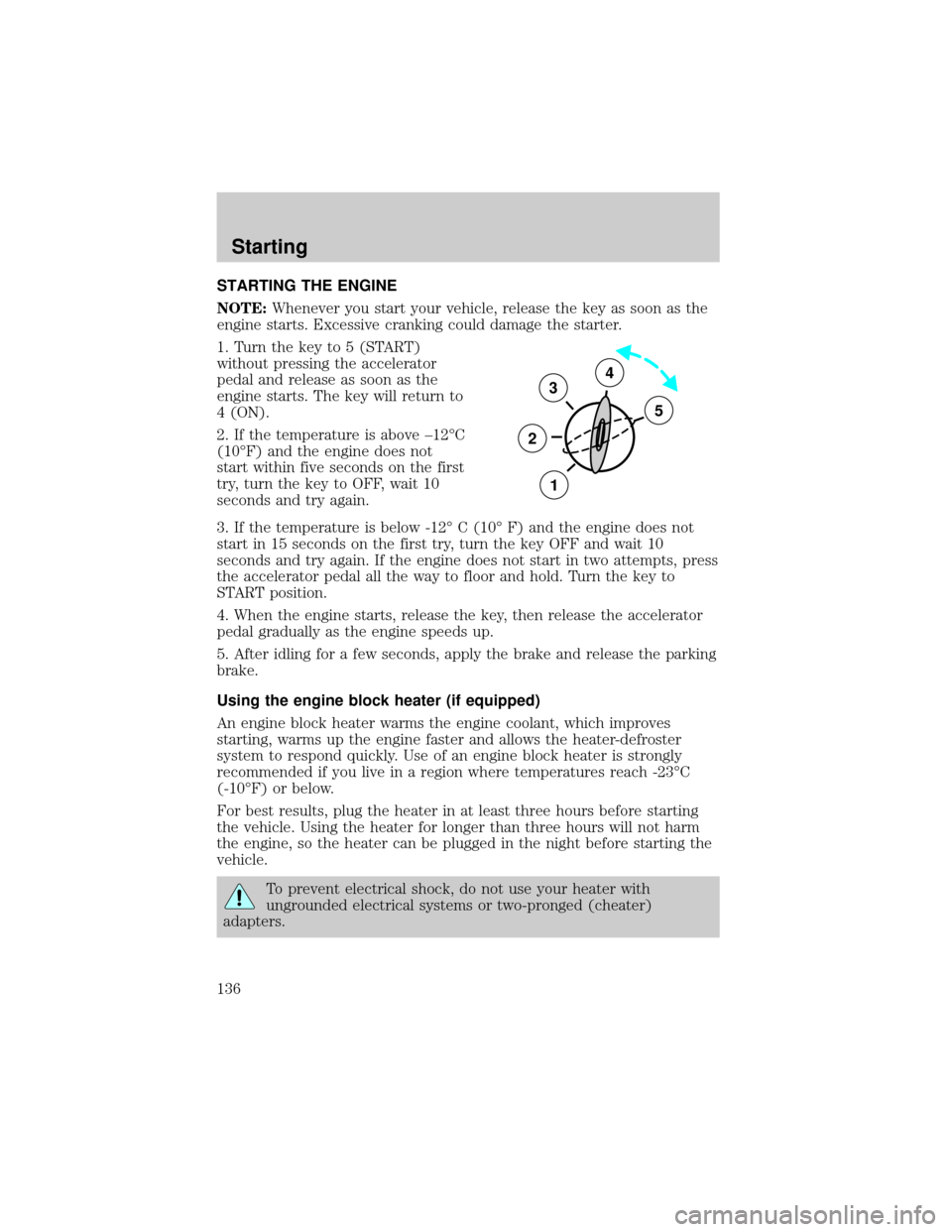
1. Turn the key to 5 (START)
without pressing the accelerator
pedal and release as soon as the
engine starts. The key will return to
4 (ON).
2. If the temperature is above ±12ÉC
(10ÉF) and the engine does not
start within five seconds on the first
try, turn the key to OFF, wait 10
seconds and try again.
3. If the temperature is below -12É C (10É F) and the engine does not
start in 15 seconds on the first try, turn the key OFF and wait 10
seconds and try again. If the engine does not start in two attempts, press
the accelerator pedal all the way to floor and hold. Turn the key to
START position.
4. When the engine starts, release the key, then release the accelerator
pedal gradually as the engine speeds up.
5. After idling for a few seconds, apply the brake and release the parking
brake.
Using the engine block heater (if equipped)
An engine block heater warms the engine coolant, which improves
starting, warms up the engine faster and allows the heater-defroster
system to respond quickly. Use of an engine block heater is strongly
recommended if you live in a region where temperatures reach -23ÉC
(-10ÉF) or below.
For best results, plug the heater in at least three hours before starting
the vehicle. Using the heater for longer than three hours will not harm
the engine, so the heater can be plugged in the night before starting the
vehicle.
To prevent electrical shock, do not use your heater with
ungrounded electrical systems or two-pronged (cheater)
adapters.
3
2
1
5
4
Starting
136
Page 158 of 248
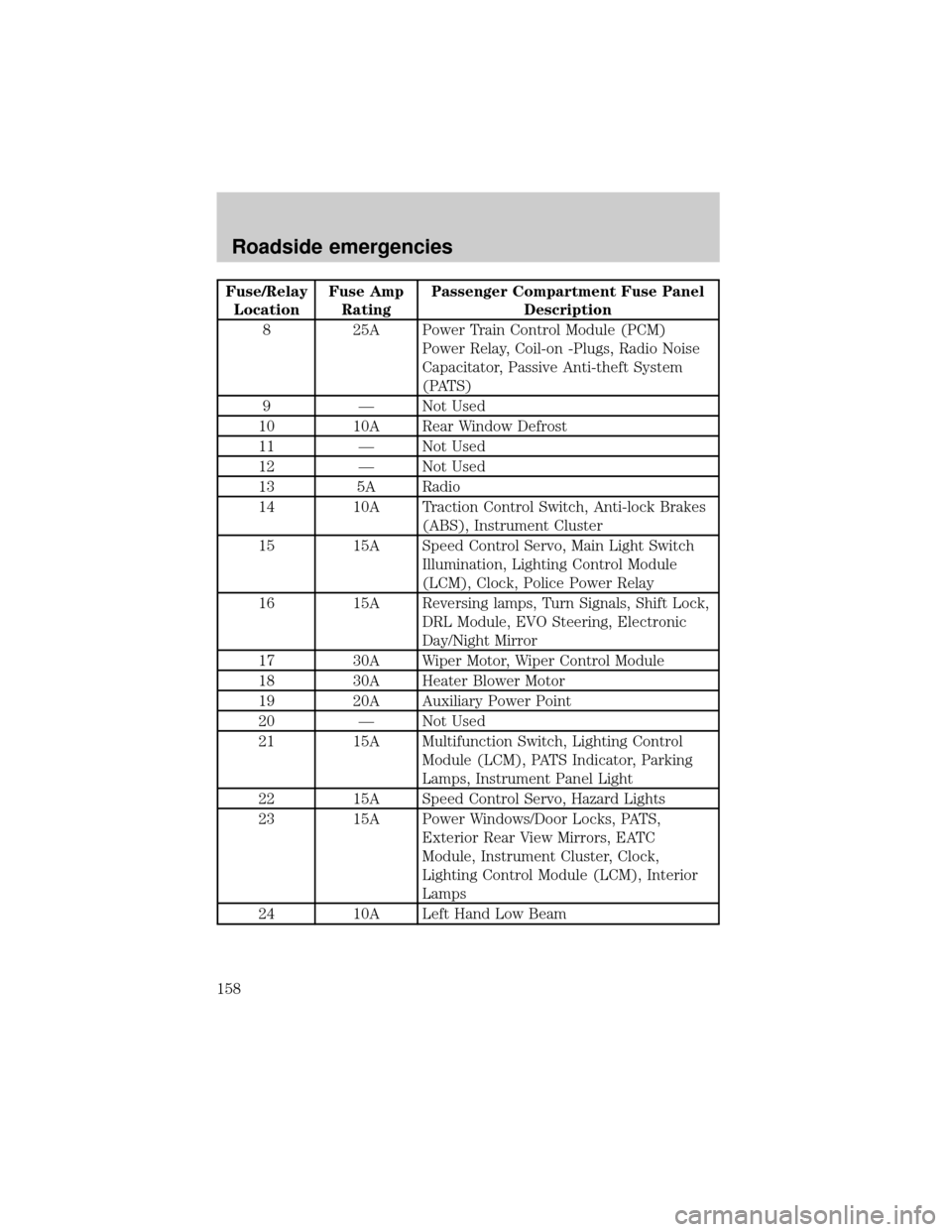
Fuse/Relay
LocationFuse Amp
RatingPassenger Compartment Fuse Panel
Description
8 25A Power Train Control Module (PCM)
Power Relay, Coil-on -Plugs, Radio Noise
Capacitator, Passive Anti-theft System
(PATS)
9 Ð Not Used
10 10A Rear Window Defrost
11 Ð Not Used
12 Ð Not Used
13 5A Radio
14 10A Traction Control Switch, Anti-lock Brakes
(ABS), Instrument Cluster
15 15A Speed Control Servo, Main Light Switch
Illumination, Lighting Control Module
(LCM), Clock, Police Power Relay
16 15A Reversing lamps, Turn Signals, Shift Lock,
DRL Module, EVO Steering, Electronic
Day/Night Mirror
17 30A Wiper Motor, Wiper Control Module
18 30A Heater Blower Motor
19 20A Auxiliary Power Point
20 Ð Not Used
21 15A Multifunction Switch, Lighting Control
Module (LCM), PATS Indicator, Parking
Lamps, Instrument Panel Light
22 15A Speed Control Servo, Hazard Lights
23 15A Power Windows/Door Locks, PATS,
Exterior Rear View Mirrors, EATC
Module, Instrument Cluster, Clock,
Lighting Control Module (LCM), Interior
Lamps
24 10A Left Hand Low Beam
Roadside emergencies
158
Page 166 of 248

Do not attempt to push-start your vehicle. Automatic
transmissions do not have push-start capability; also, the
catalytic conveter may become damaged.
Preparing your vehicle
When the battery is disconnected or a new battery is installed, the
transmission must relearn its adaptive strategy. As a result of this, the
transmission may shift firmly. This operation is considered normal and
will not affect function or durability of the transmission. Over time, the
adaptive learning process will fully update transmission operation to its
optimum shift feel.
1.Use only a 12±volt supply to start your vehicle.
2. Do not disconnect the battery of the disabled vehicle as this could
damage the vehicle's electrical system.
3. Park the booster vehicle close to the hood of the disabled vehicle
making sure the two vehiclesdo nottouch. Set the parking brake on
both vehicles and stay clear of the engine cooling fan and other moving
parts.
4. Check all battery terminals and remove any excessive corrosion before
you attach the battery cables. Ensure that vent caps are tight and level.
5. Turn the heater fan on in both vehicles to protect any electrical
surges. Turn all other accessories off.
Roadside emergencies
166
Page 237 of 248

Vehicle Security
Keyless entry
Wheel locks for styled wheels
Vehicle security systems
Comfort and convenience
Cargo nets
Engine block heaters
Travel equipment
Daytime running lights
HomeLinkt
Rear view mirror with tire pressure sensor
Trunk organizer
Protection and appearance equipment
Air bag anti-theft locks
Carpet floor mats
Electrochromic compass mirror
Electrochromic compass mirror with temperature display
Emergency kit
Door edge guards
First aid kit
Flat splash guards
Front end covers
Locking gas cap
Molded splash guards
Styled hood deflector
Underbody security lighting
Universal floor mats
Customer assistance
237
Page 243 of 248

idle speed control ...................190
lubrication
specifications ..................223±224
refill capacities ........................221
service points ..........................174
starting after a collision .........154
Engine block heater .................136
Engine oil ..................................175
change oil soon warning,
message center .......................175
checking and adding ..............175
dipstick ....................................175
filter, specifications ........177, 220
recommendations ...................177
refill capacities ........................221
specifications ..................223±224
Exhaust fumes ..........................137
F
Fail safe cooling ........................184
Floor mats ...................................89
Fluid capacities .........................221
Fuel ............................................199
calculating fuel economy .......204
cap .....................................10, 201
capacity ...................................221
choosing the right fuel ...........202
comparisons with EPA fuel
economy estimates .................207
detergent in fuel .....................203
filling your vehicle with
fuel ...........................199, 201, 204
filter, specifications ........203, 220
fuel filler door override ............85
fuel filler door release ..............85
fuel pump shut-off switch .....154
gauge .........................................17
improving fuel economy ........204low fuel warning light ................8
octane rating ...........202, 224±225
quality ......................................202
running out of fuel .................203
safety information relating to
automotive fuels .....................199
Fuses ..................................156±157
G
Garage door opener ....................79
Gas cap (see Fuel cap) ......10, 201
Gas mileage (see Fuel
economy) ...................................204
Gauges .........................................17
battery voltage gauge ...............21
engine coolant temperature
gauge .........................................20
engine oil pressure gauge ........22
fuel gauge ..................................17
odometer ...................................19
speedometer .............................18
trip odometer ............................20
GAWR (Gross Axle Weight
Rating) .......................................147
definition .................................147
driving with a heavy load ......147
location ....................................147
GVWR (Gross Vehicle Weight
Rating) .......................................147
calculating ...............................147
definition .................................147
driving with a heavy load ......147
location ....................................147
H
Hazard flashers .........................154
Head restraints .........................103
Index
243