Page 148 of 460

2-35
If any of these conditions occur, the power sliding door
will need to be reset. If your vehicle has the optional
dual power sliding doors, both doors will have to be
reset. To do this, follow the directions listed here.
It will be easier if you read through them once before
beginning this procedure.
1. Check to be sure the power sliding door is unlocked
and securely closed.
2. Turn the ignition key to OFF.
3. If on, turn the power sliding door override
switch off.
4. Remove fuse 29 from the underhood fuse and relay
center. Leave it out for 30 seconds.
5. Reinstall the fuse and wait 10 seconds.
6. Turn the power sliding door override switch on.7. Push either of the power door buttons to open the
power sliding door.
8. Open the door.
9. Wait five seconds and close the door by pushing
either power door button.
10. Wait five seconds and repeat Steps 7 through 9.
If the door does not rest in the fully open position
after repeating Step 7, repeat Steps 7 through 9 again.
If the door still does not operate correctly, see your
dealer for service.
Canceling the Sliding Door Security Lock
1. Unlock the sliding door and open the door from
the outside.
2. Move the security lock lever all the way down.
The sliding door lock will now work normally.
Page 322 of 460
5-5
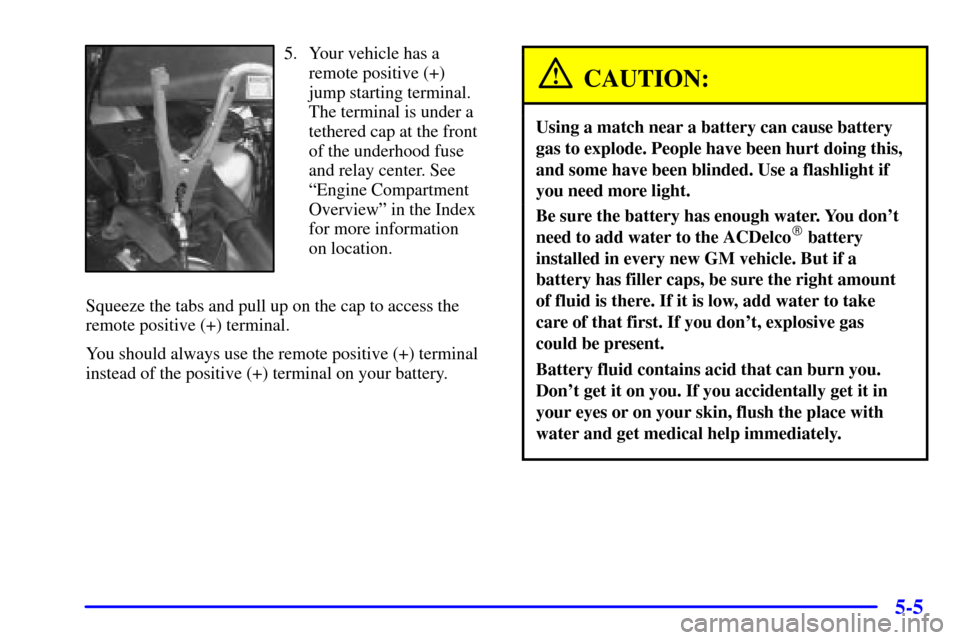
5. Your vehicle has a
remote positive (+)
jump starting terminal.
The terminal is under a
tethered cap at the front
of the underhood fuse
and relay center. See
ªEngine Compartment
Overviewº in the Index
for more information
on location.
Squeeze the tabs and pull up on the cap to access the
remote positive (+) terminal.
You should always use the remote positive (+) terminal
instead of the positive (+) terminal on your battery.
CAUTION:
Using a match near a battery can cause battery
gas to explode. People have been hurt doing this,
and some have been blinded. Use a flashlight if
you need more light.
Be sure the battery has enough water. You don't
need to add water to the ACDelco� battery
installed in every new GM vehicle. But if a
battery has filler caps, be sure the right amount
of fluid is there. If it is low, add water to take
care of that first. If you don't, explosive gas
could be present.
Battery fluid contains acid that can burn you.
Don't get it on you. If you accidentally get it in
your eyes or on your skin, flush the place with
water and get medical help immediately.
Page 362 of 460
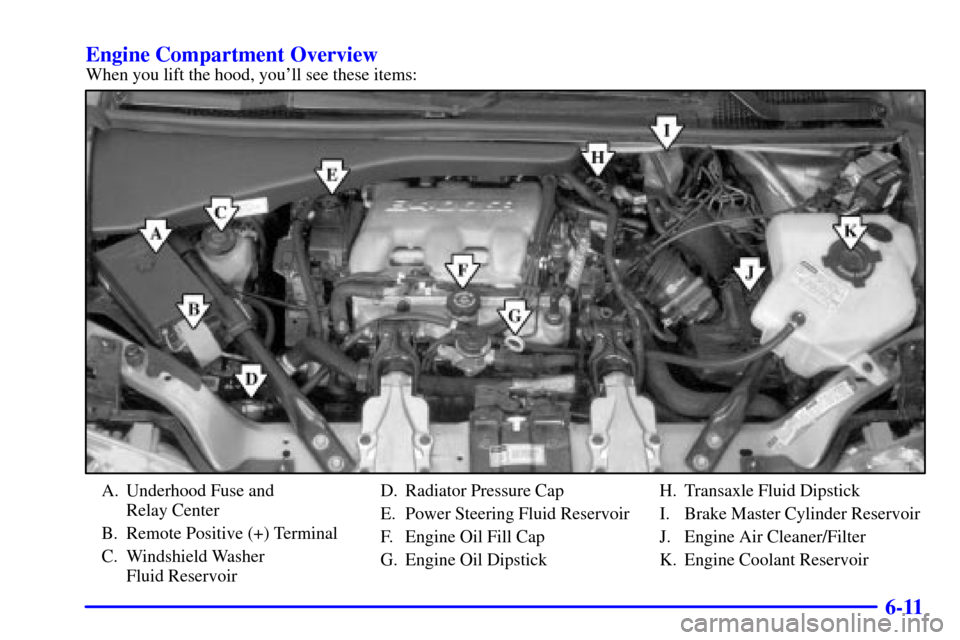
6-11 Engine Compartment Overview
When you lift the hood, you'll see these items:
A. Underhood Fuse and
Relay Center
B. Remote Positive (+) Terminal
C. Windshield Washer
Fluid ReservoirD. Radiator Pressure Cap
E. Power Steering Fluid Reservoir
F. Engine Oil Fill Cap
G. Engine Oil DipstickH. Transaxle Fluid Dipstick
I. Brake Master Cylinder Reservoir
J. Engine Air Cleaner/Filter
K. Engine Coolant Reservoir
Page 379 of 460
6-28
Windshield Washer Fluid
What to Use
When you need windshield washer fluid, be sure to read
the manufacturer's instructions before use. If you will be
operating your vehicle in an area where the temperature
may fall below freezing, use a fluid that has sufficient
protection against freezing.
Adding Washer Fluid
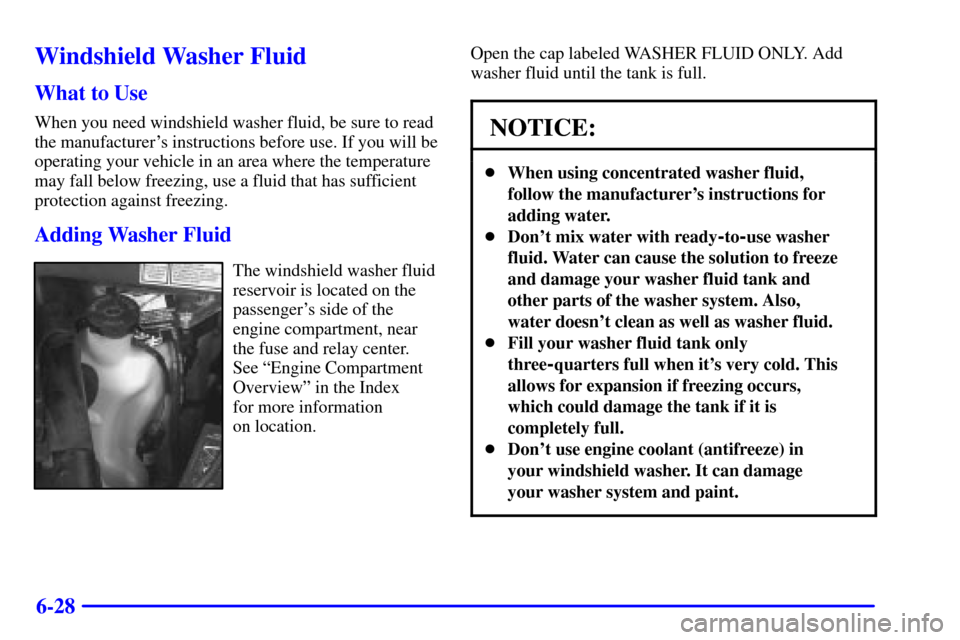
The windshield washer fluid
reservoir is located on the
passenger's side of the
engine compartment, near
the fuse and relay center.
See ªEngine Compartment
Overviewº in the Index
for more information
on location.Open the cap labeled WASHER FLUID ONLY. Add
washer fluid until the tank is full.
NOTICE:
�When using concentrated washer fluid,
follow the manufacturer's instructions for
adding water.
�Don't mix water with ready
-to-use washer
fluid. Water can cause the solution to freeze
and damage your washer fluid tank and
other parts of the washer system. Also,
water doesn't clean as well as washer fluid.
�Fill your washer fluid tank only
three
-quarters full when it's very cold. This
allows for expansion if freezing occurs,
which could damage the tank if it is
completely full.
�Don't use engine coolant (antifreeze) in
your windshield washer. It can damage
your washer system and paint.
Page 413 of 460
6-62 Fuses and Circuit Breakers
The wiring circuits in your vehicle are protected from
short circuits by a combination of fuses, circuit breakers
and fusible thermal links.
Look at the silver
-colored band inside the fuse. If the
band is broken or melted, replace the fuse. Be sure you
replace a bad fuse with a new one of the identical size
and rating.
If you ever have a problem on the road and don't have a
spare fuse, you can borrow one that has the same
amperage or use one of the spare fuses in the underhood
fuse and relay center. Just pick some feature of your
vehicle that you can get along without
-- like the radio
or cigarette lighter
-- and use its fuse, if it is the right
amperage. Replace it as soon as you can.
There are two fuse blocks in your vehicle: the
instrument panel fuse block and the underhood fuse and
relay center.Instrument Panel Fuse Block
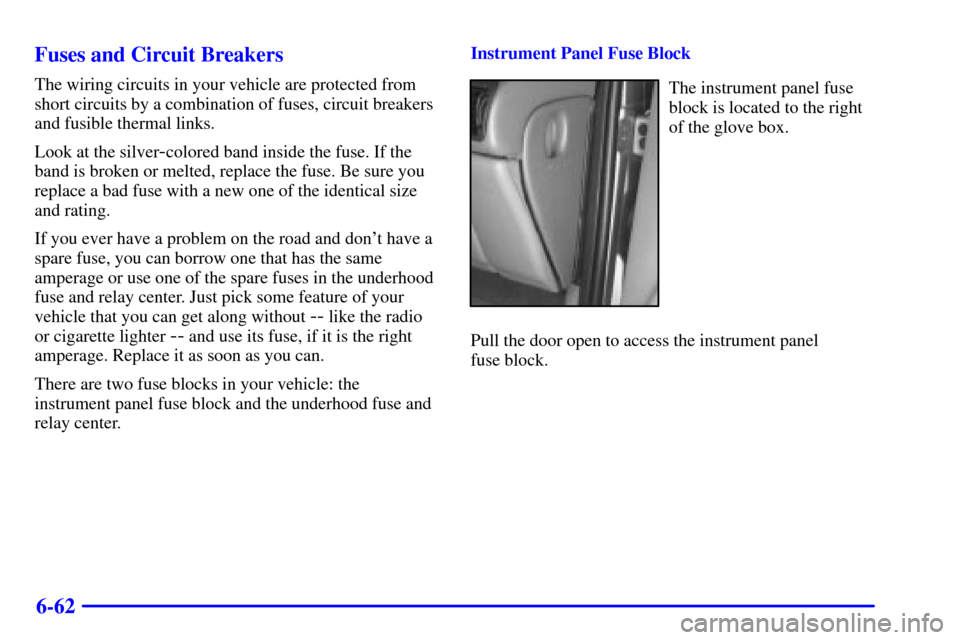
The instrument panel fuse
block is located to the right
of the glove box.
Pull the door open to access the instrument panel
fuse block.
Page 414 of 460
6-63
Circuit
BreakersUsage
1 Daytime Running Lamps (DRL)
Control Module, Headlamp and
Instrument Panel Dimmer Switch
2 Power Sliding Door
3 Front Power Windows
46
-Way Power Seat and Rear Side
Door Actuator Motor
5 Blower Motor Hi Speed
Relay ModuleFuses Usage
6 Steering Wheel Radio Control
Switches (Illumination)
7 Instrument Cluster to
PRNDL Indicators
8 Power Remote Control
Mirror Switch
9 Cruise Control Module,
Switch and Release Switch
10 Not Used
11 Power Control Module (PCM),
Ignition Crank
12 PASS
-Key� III System
13 Body Control Module (BCM)
14 Heated Mirrors
15 Not Used
16 Not Used
17 Cigarette Lighter, DIC, Front
Auxiliary Power Outlets
18 Turn Signal Switch
19 Interior Lamp and Multifunction
Switch (Power Vent Switch)
Page 415 of 460
6-64
Fuses Usage
20 Windshield Wiper/Washer Motor
and Switch
21 Turn Signal Switch
22 Rear Electric Accessory
Plug Housing
23 DRL Control Module
24 Not Used
25 Rear Window Defogger Relay,
Heated Mirrors
26 OnStar
�
27 Inflatable Restraint
Control Module
28 Heater
-A/C Control
29 Instrument Cluster, BCM,
Electronic Level Control (ELC)
Sensor and Relay
30 Stoplamp Switch
31 Module/Electronic Brake Control
Module/Electronic Brake Traction
Control Module (EBCM/EBTCM)Fuses Usage
32 Evaporative Emissions (EVAP)
Canister Vent Solenoid Valve
33 Not Used
34 ELC Air Compressor and ELC
Relay, Trailer Harness
35 Courtesy Lamp
36 BCM, Electronic Brake Control
Indicator Lamp Driver Module,
Instrument Panel Cluster, Rear
Side Door Actuator Control
Module, Rear Windows
37 Rear HVAC
-A/C Control
38 Rear Window Wiper Motor, Rear
Window Wiper/Washer and
Multifunction Switch (Rear
Window Wiper/Washer Switch)
39 Not Used
40 Not Used
41 Not Used
42 Not Used
Page 416 of 460
6-65
Fuses Usage
43 Not Used
44 Retained Accessory Power
(RAP) Relay
45 Not Used
46 Air Inlet Actuator, DIC Display,
DRL Control Module, Heater
-A/C
Control, Temperature Door
Actuator (Front) and Rear
Window Defogger Relay
47 BCM Programming
48 Not Used
49 Not Used
50 IGN MAIN Relay and PCM,
Electronic Break Control ModuleUnderhood Fuse and Relay Center
This fuse and relay center is
located in the engine
compartment, in front of the
windshield washer fluid
reservoir. See ªEngine
Compartment Overviewº in
the Index for more
information on location.
The fuses marked spare are available if a replacement
fuse is needed.
To remove the cover, turn the knob counterclockwise
and lift up. Remove the cover.
When finished, put the cover back on and turn the knob
clockwise. Make sure that the remote positive (+)
terminal cover is on correctly.