Page 163 of 460
2-50
AUTOMATIC OVERDRIVE (D): This position is
for normal driving. If you need more power for passing,
and you're:
�Going less than 35 mph (55 km/h), push your
accelerator pedal about halfway down.
�Going about 35 mph (55 km/h) or more, push the
accelerator all the way down.
You'll shift down to the next gear and have more power.
NOTICE:
If your vehicle seems to start up rather slowly, or
if it seems not to shift gears as you go faster,
something may be wrong with a transaxle system
sensor. If you drive very far that way, your
vehicle can be damaged. So, if this happens, have
your vehicle serviced right away. Until then, you
can use SECOND (2) when you are driving less
than 35 mph (55 km/h) and AUTOMATIC
OVERDRIVE (D) for higher speeds.
Warm-Up Shift
Your vehicle has a computer controlled transaxle designed
to warm up the engine faster when the outside temperature
is 35�F (2�C) or colder. You may notice that the transaxle
will shift at a higher vehicle speed until the engine is
warmed up. This is a normal condition designed to provide
heat to the passenger compartment and defrost the
windows more quickly. See ªComfort Controls, Heatingº
in the Index for more information.
THIRD (3): This position is also used for normal
driving, but it offers more power and lower fuel
economy than AUTOMATIC OVERDRIVE (D).
Here are some times you might choose THIRD (3)
instead of AUTOMATIC OVERDRIVE (D):
�When driving on hilly, winding roads.
�When towing a trailer (so there is less shifting
between gears).
�When going down a steep hill.
Page 164 of 460
2-51
SECOND (2): This position gives you more power, but
lower fuel economy. You can use SECOND (2) on hills.
It can help control your speed as you go down steep
mountain roads, but then you would also want to use
your brakes off and on.
NOTICE:
Don't drive in SECOND (2) for more than 25 miles
(40 km), or at speeds over 55 mph (90 km/h), or
you can damage your transaxle. Use THIRD (3) or
AUTOMATIC OVERDRIVE (D) as much as
possible. Don't shift into SECOND (2) unless you
are going slower than 65 mph (105 km/h) or you
can damage your engine.
NOTICE:
If your vehicle seems to start up rather slowly, or
if it seems not to shift gears as you go faster,
something may be wrong with a transaxle system
sensor. If you drive very far that way, your
vehicle can be damaged. So, if this happens, have
your vehicle serviced right away. Until then, you
can use SECOND (2) when you are driving less
than 35 mph (55 km/h) and THIRD (3) for
higher speeds.
Page 165 of 460
2-52
FIRST (1): This position gives you even more
power (but lower fuel economy) than SECOND (2).
You can use it on very steep hills, or in deep snow or
mud. If the selector lever is put in FIRST (1), the
transaxle won't downshift into first gear until the vehicle
is going slow enough.
NOTICE:
If your front wheels can't turn, don't try to drive.
This might happen if you were stuck in very deep
sand or mud or were up against a solid object.
You could damage your transaxle.
Also, if you stop when going uphill, don't hold
your vehicle there with only the accelerator
pedal. This could overheat and damage the
transaxle. Use your brakes or shift into PARK (P)
to hold your vehicle in position on a hill.
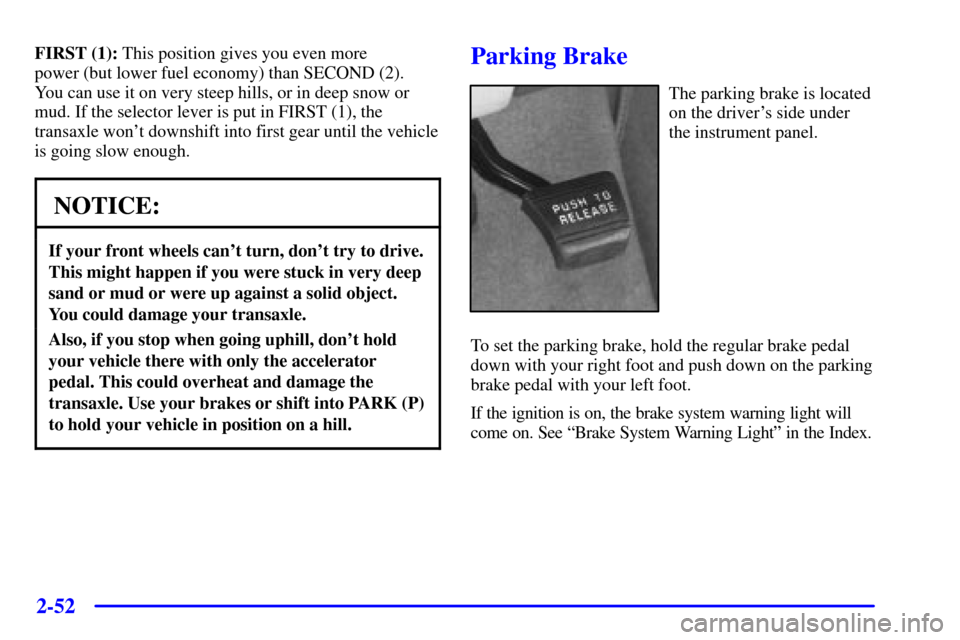
Parking Brake
The parking brake is located
on the driver's side under
the instrument panel.
To set the parking brake, hold the regular brake pedal
down with your right foot and push down on the parking
brake pedal with your left foot.
If the ignition is on, the brake system warning light will
come on. See ªBrake System Warning Lightº in the Index.
Page 209 of 460
2-96 Instrument Panel Cluster
Your instrument panel cluster is designed to let you know at a glance how your vehicle is running. You'll know how
fast you're going, how much fuel you're using, and many other things you'll need to drive safely and economically.
The indicator warning lights and gages are explained on the following pages.
United States shown, Canada similar
Page 210 of 460

2-97
Speedometer and Tamper
Resistant Odometer
Your speedometer lets you see your speed in both miles
per hour (mph) and kilometers per hour (km/h). Your
odometer shows how far your vehicle has been driven,
in either miles (used in the United States) or
kilometers (used in Canada).
Your vehicle has a tamper
-resistant odometer.
You may wonder what happens if your vehicle needs a
new odometer installed. If the new one can be set to the
mileage total of the old odometer, then that will be done.
If it can't, then it's set at zero and a label must be put on
the driver's door to show the old mileage reading when
the new odometer was installed.
Dual Trip Odometers
In addition to the standard odometer, the cluster can also
display two separate trip odometers (designated by the
letter ªAº or ªBº in the display window) as well as your
vehicle's Engine Oil Life (designated by the word OIL in
the display window). The display can be toggled between
the odometer, the trip odometers and engine oil life by
quickly pressing and releasing the trip/reset button located
to the right of the temperature gage. The display toggles
once each time the trip/reset button is pressed for less
than 1.5 seconds. The display toggles in the following
sequence: Odometer
- Trip Odometer A - Trip Odometer
B
- Engine Oil Life. If the engine oil life is left on the
display, it will automatically toggle back to the odometer
after approximately 15 seconds. Each of the two trip
odometers can be used to keep track of different trip
distances (for example, the mileage of a long trip and the
mileage driven on the current tank of fuel). The trip
odometers will continue to keep track of miles (kilometers)
driven even if they are not currently displayed. To reset the
odometer to zero (0), push and hold the trip/reset button
for at least 1.5 seconds, but less than three seconds.
Only the trip odometer that is showing in the display
will be reset.
Page 217 of 460
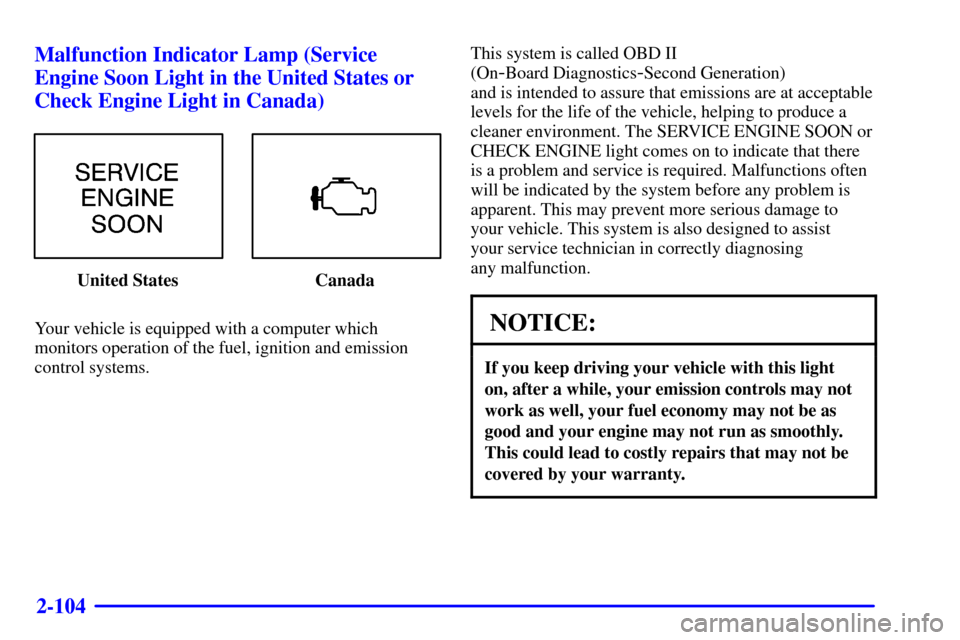
2-104 Malfunction Indicator Lamp (Service
Engine Soon Light in the United States or
Check Engine Light in Canada)
United States Canada
Your vehicle is equipped with a computer which
monitors operation of the fuel, ignition and emission
control systems.This system is called OBD II
(On
-Board Diagnostics-Second Generation)
and is intended to assure that emissions are at acceptable
levels for the life of the vehicle, helping to produce a
cleaner environment. The SERVICE ENGINE SOON or
CHECK ENGINE light comes on to indicate that there
is a problem and service is required. Malfunctions often
will be indicated by the system before any problem is
apparent. This may prevent more serious damage to
your vehicle. This system is also designed to assist
your service technician in correctly diagnosing
any malfunction.
NOTICE:
If you keep driving your vehicle with this light
on, after a while, your emission controls may not
work as well, your fuel economy may not be as
good and your engine may not run as smoothly.
This could lead to costly repairs that may not be
covered by your warranty.
Page 218 of 460
2-105
NOTICE:
Modifications made to the engine, transaxle,
exhaust, intake or fuel system of your vehicle or
the replacement of the original tires with other
than those of the same Tire Performance Criteria
(TPC) can affect your vehicle's emission controls
and may cause the SERVICE ENGINE
SOON or CHECK ENGINE light to come on.
Modifications to these systems could lead to
costly repairs not covered by your warranty.
This may also result in a failure to pass a
required Emission Inspection/Maintenance test.
This light should come on, as a check to show you it is
working, when the ignition is on and the engine is not
running. If the light doesn't come on, have it repaired.
This light will also come on during a malfunction in one
of two ways:
�Light Flashing
-- A misfire condition has been
detected. A misfire increases vehicle emissions and
may damage the emission control system on your
vehicle. Dealer or qualified service center diagnosis
and service may be required.�Light On Steady
-- An emission control system
malfunction has been detected on your vehicle.
Dealer or qualified service center diagnosis and
service may be required.
If the Light Is Flashing
The following may prevent more serious damage to
your vehicle:
�Reducing vehicle speed.
�Avoiding hard accelerations.
�Avoiding steep uphill grades.
�If you are towing a trailer, reduce the amount of
cargo being hauled as soon as it is possible.
If the light stops flashing and remains on steady, see
ªIf the Light Is On Steadyº following.
If the light continues to flash, when it is safe to do so,
stop the vehicle. Find a safe place to park your vehicle.
Turn the key off, wait at least 10 seconds and restart the
engine. If the light remains on steady, see ªIf the Light
Is On Steadyº following. If the light is still flashing,
follow the previous steps, and drive the vehicle to your
dealer or qualified service center for service.
Page 219 of 460

2-106
If the Light Is On Steady
You may be able to correct the emission system
malfunction by considering the following:
Did you recently put fuel into your vehicle?
If so, reinstall the fuel cap, making sure to fully install
the cap. See ªFilling Your Tankº in the Index. The
diagnostic system can determine if the fuel cap has been
left off or improperly installed. A loose or missing fuel
cap will allow fuel to evaporate into the atmosphere. A
few driving trips with the cap properly installed should
turn the light off.
Did you just drive through a deep puddle of water?
If so, your electrical system may be wet. The condition
will usually be corrected when the electrical system
dries out. A few driving trips should turn the light off.
Are you low on fuel?
As your engine starts to run out of fuel, your engine may
not run as efficiently as designed since small amounts of
air are sucked into the fuel line causing a misfire. The
system can detect this. Adding fuel should correct this
condition. Make sure to install the fuel cap properly. See
ªFilling Your Tankº in the Index. It will take a few
driving trips to turn the light off.Have you recently changed brands of fuel?
If so, be sure to fuel your vehicle with quality fuel. See
ªFuelº in the Index. Poor fuel quality will cause your
engine not to run as efficiently as designed. You may
notice this as stalling after start
-up, stalling when you put
the vehicle into gear, misfiring, hesitation on acceleration
or stumbling on acceleration. (These conditions may go
away once the engine is warmed up.) This will be detected
by the system and cause the light to turn on.
If you experience one or more of these conditions,
change the fuel brand you use. It will require at least one
full tank of the proper fuel to turn the light off.
If none of the above steps have made the light turn off,
have your dealer or qualified service center check the
vehicle. Your dealer has the proper test equipment and
diagnostic tools to fix any mechanical or electrical
problems that may have developed.