Page 171 of 468

2-88
Readings in the low warning zone may occur when a
large number of electrical accessories are operating in
the vehicle and the engine is left at an idle for an
extended period. This condition is normal since the
charging system is not able to provide full power at
engine idle. As engine speeds are increased, this
condition should correct itself as higher engine speeds
allow the charging system to create maximum power.
You can only drive for a short time with the reading in
either warning zone. If you must drive, turn off all
unnecessary accessories.
Readings in either warning zone indicate a possible
problem in the electrical system. Have the vehicle
serviced as soon as possible.
Shift Light (If Equipped)
This light is used on
some models with
manual transmissions.
The SHIFT indicator light will help you get the best fuel
economy. See ªShift Lightº or ªShift Speedsº in the
index for more information.
Brake System Warning Light
With the ignition on, the brake system warning light will
flash when you set the parking brake. The light will flash
if the parking brake doesn't release fully. If you try to
drive with the parking brake engaged, a chime will sound
when the vehicle speed is greater than 3 mph (5 km/h).
Your vehicle's hydraulic brake system is divided into
two parts. If one part isn't working, the other part can
still work and stop you. For good braking, though, you
need both parts working well.
If the warning light comes on, there could be a brake
problem. Have your brake system inspected right away.
United States Canada
Page 173 of 468
2-90
Engine Coolant Temperature Gage
United States Canada
This gage shows the engine coolant temperature.
It also provides an indicator of how hard your vehicle is
working. During a majority of the operation, the gage
will read 210�F (100�C) or less. If you are pulling a
load or going up hills, it is normal for the temperature to
fluctuate and approach the 250�F (122�C) mark. If the
gage reaches the 260�F (125�C) mark, it indicates that
the cooling system is working beyond its capacity.
See ªEngine Overheatingº in the Index.
Transmission Temperature Gage
(If Equipped)
United States Canada
Your vehicle may be equipped with a transmission
temperature gage.
When your ignition is on, the gage shows the temperature
of the transmission fluid. The normal operating range is
from 100�F (38�C) to about 265�F (130�C).
Page 174 of 468
2-91
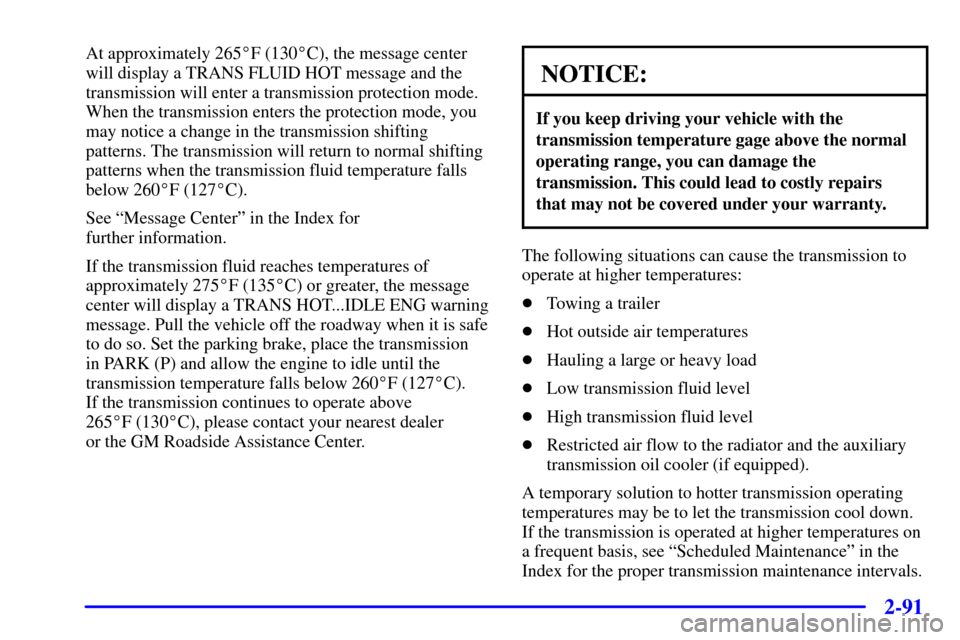
At approximately 265�F (130�C), the message center
will display a TRANS FLUID HOT message and the
transmission will enter a transmission protection mode.
When the transmission enters the protection mode, you
may notice a change in the transmission shifting
patterns. The transmission will return to normal shifting
patterns when the transmission fluid temperature falls
below 260�F (127�C).
See ªMessage Centerº in the Index for
further information.
If the transmission fluid reaches temperatures of
approximately 275�F (135�C) or greater, the message
center will display a TRANS HOT...IDLE ENG warning
message. Pull the vehicle off the roadway when it is safe
to do so. Set the parking brake, place the transmission
in PARK (P) and allow the engine to idle until the
transmission temperature falls below 260�F (127�C).
If the transmission continues to operate above
265�F (130�C), please contact your nearest dealer
or the GM Roadside Assistance Center.
NOTICE:
If you keep driving your vehicle with the
transmission temperature gage above the normal
operating range, you can damage the
transmission. This could lead to costly repairs
that may not be covered under your warranty.
The following situations can cause the transmission to
operate at higher temperatures:
�Towing a trailer
�Hot outside air temperatures
�Hauling a large or heavy load
�Low transmission fluid level
�High transmission fluid level
�Restricted air flow to the radiator and the auxiliary
transmission oil cooler (if equipped).
A temporary solution to hotter transmission operating
temperatures may be to let the transmission cool down.
If the transmission is operated at higher temperatures on
a frequent basis, see ªScheduled Maintenanceº in the
Index for the proper transmission maintenance intervals.
Page 177 of 468
2-94
NOTICE:
If you keep driving your vehicle with this light
on, after a while, your emission controls may not
work as well, your fuel economy may not be as
good and your engine may not run as smoothly.
This could lead to costly repairs that may not be
covered by your warranty.
NOTICE:
Modifications made to the engine, transmission,
exhaust or fuel system of your vehicle or the
replacement of the original tires with other than
those of the same Tire Performance Criteria
(TPC) can affect your vehicle's emission controls
and may cause the SERVICE ENGINE SOON
or CHECK ENGINE light to come on.
Modifications to these systems could lead to
costly repairs not covered by your warranty. This
may also result in a failure to pass a required
Emission Inspection/Maintenance test.
This light should come on, as a check to show you it is
working, when the ignition is on and the engine is not
running. If the light doesn't come on, have it repaired.
This light will also come on during a malfunction in one
of two ways:
�Light Flashing
-- A misfire condition has been
detected. A misfire increases vehicle emissions and
may damage the emission control system on your
vehicle. Dealer or qualified service center diagnosis
and service may be required.
�Light On Steady
-- An emission control system
malfunction has been detected on your vehicle.
Dealer or qualified service center diagnosis and
service may be required.
If the Light Is Flashing
The following may prevent more serious damage to
your vehicle:
�Reducing vehicle speed.
�Avoiding hard accelerations.
�Avoiding steep uphill grades.
�If you are towing a trailer, reduce the amount of
cargo being hauled as soon as it is possible.
Page 181 of 468

2-98
Tow/Haul Light
(Automatic Transmissions Only)
This message is displayed
when the tow/haul mode has
been activated.
For more information see, ªTow/Haul Modeº in the Index.
Fuel Gage
United States CanadaWhen the ignition is on, the fuel gage tells you about
how much fuel you have left in your tank.
The gage will first indicate E (Empty) before you are out
of fuel, and you should get more fuel as soon as possible.
Here are some situations you may experience with your fuel
gage. None of these indicate a problem with the fuel gage.
�At the gas station, the fuel pump shuts off before the
gage reads F (Full).
�It takes a little more or less fuel to fill up than the
fuel gage indicated. For example, the gage may have
indicated the tank was half full, but it actually took a
little more or less than half the tank's capacity to fill
the tank.
�The gage goes back to E (Empty) when you turn off
the ignition.
If you have a diesel engine, see ªFuel Gageº in the
Diesel Engine Supplement.
Page 182 of 468

2-99
Message Center
The message center is located on the left side of the
instrument panel cluster. It gives you important safety
and maintenance facts. When you turn the ignition on,
the entire center lights up for just a few seconds.
As needed, the message center will display one of the
following messages. The message center is capable of
alternating among different messages if needed.
Battery
If this message is displayed
when the engine is running,
you may have a problem
with your charging system.
The battery display will also stay on while the key is in
RUN until the engine is started.If the message stays on after starting the engine it could
indicate a problem with the generator drive belt, or some
other charging system problem. Have it checked right
away. Driving with this message displayed could drain
your battery.
If you must drive a short distance with this message
displayed, it helps to turn off all your accessories, such
as the radio and the air conditioner.
Trans Fluid Hot
If you have an automatic transmission, you have a
transmission temperature warning display contained in
the message center.
If the transmission fluid
temperature becomes high,
the message center will
display this message.
Page 183 of 468
2-100
When the transmission enters the protection mode you
may notice a change in the transmission shifting
patterns. When the transmission fluid temperature
returns to normal, the display will turn off and the
transmission shifting patterns will return to normal.
NOTICE:
If you keep driving your vehicle with the
transmission TRANS FLUID HOT message
displayed, you can damage the transmission.
This could lead to costly repairs that may not be
covered under your warranty.
The following situations can cause the transmission to
operate at higher temperatures:
�Towing a trailer
�Hot outside air temperatures
�Hauling a large or heavy load
�Low transmission fluid level
�High transmission fluid level
�Restricted air flow to the radiator and the auxiliary
transmission oil cooler (if equipped).
A temporary solution to hotter transmission operating
temperatures may be to let the transmission cool down.
If the transmission is operated at higher temperatures on
a frequent basis, see ªScheduled Maintenanceº in the
Index for the proper transmission maintenance intervals.
Page 184 of 468
2-101
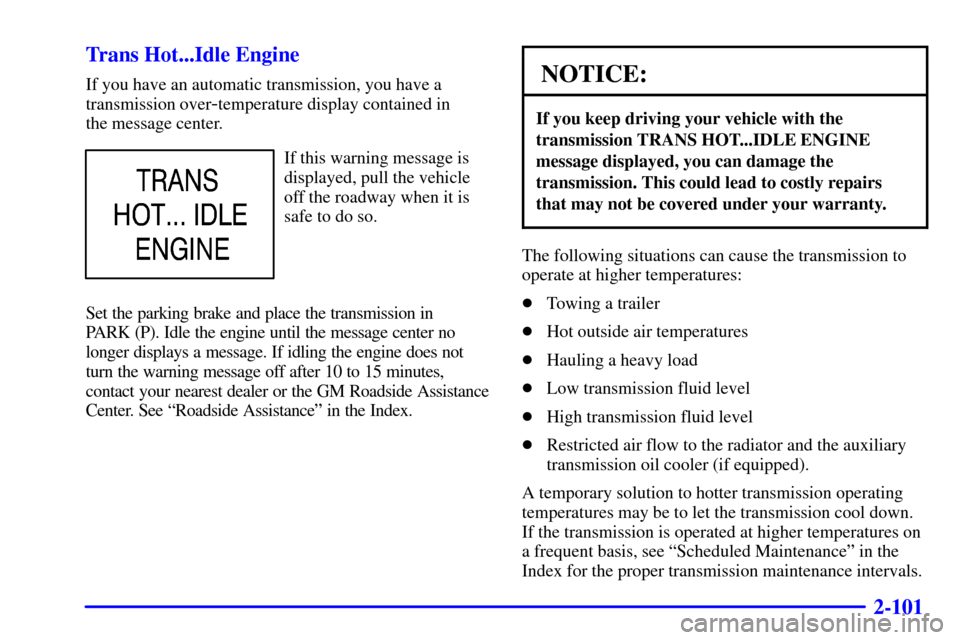
Trans Hot...Idle Engine
If you have an automatic transmission, you have a
transmission over
-temperature display contained in
the message center.
If this warning message is
displayed, pull the vehicle
off the roadway when it is
safe to do so.
Set the parking brake and place the transmission in
PARK (P). Idle the engine until the message center no
longer displays a message. If idling the engine does not
turn the warning message off after 10 to 15 minutes,
contact your nearest dealer or the GM Roadside Assistance
Center. See ªRoadside Assistanceº in the Index.
NOTICE:
If you keep driving your vehicle with the
transmission TRANS HOT...IDLE ENGINE
message displayed, you can damage the
transmission. This could lead to costly repairs
that may not be covered under your warranty.
The following situations can cause the transmission to
operate at higher temperatures:
�Towing a trailer
�Hot outside air temperatures
�Hauling a heavy load
�Low transmission fluid level
�High transmission fluid level
�Restricted air flow to the radiator and the auxiliary
transmission oil cooler (if equipped).
A temporary solution to hotter transmission operating
temperatures may be to let the transmission cool down.
If the transmission is operated at higher temperatures on
a frequent basis, see ªScheduled Maintenanceº in the
Index for the proper transmission maintenance intervals.