Page 130 of 468
2-47
Parking Your Vehicle
(Manual Transmission Models Only)
CAUTION:
Shifting the transfer case to NEUTRAL can
cause your vehicle to roll even if the manual
transmission is in gear. You or someone else could
be seriously injured. Be sure to set the parking
brake before placing the transfer case in
NEUTRAL. See ªParking Brakeº in the Index.
Before you get out of your vehicle, move the shift lever
into REVERSE (R), and firmly apply the parking brake.
Once the shift lever has been placed into REVERSE (R)
with the clutch pedal pressed in, you can turn the ignition
key to OFF, remove the key and release the clutch.
If you are parking on a hill, or if you are pulling a
trailer, see ªTowing a Trailerº in the Index.
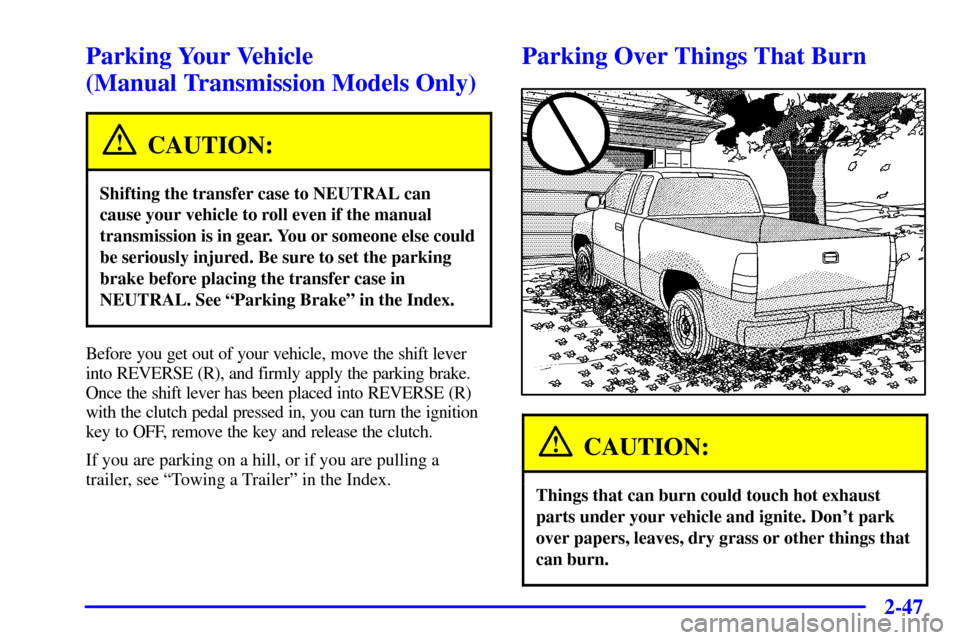
Parking Over Things That Burn
CAUTION:
Things that can burn could touch hot exhaust
parts under your vehicle and ignite. Don't park
over papers, leaves, dry grass or other things that
can burn.
Page 131 of 468
2-48
Engine Exhaust
CAUTION:
Engine exhaust can kill. It contains the gas
carbon monoxide (CO), which you can't see or
smell. It can cause unconsciousness and death.
You might have exhaust coming in if:
�Your exhaust system sounds strange
or different.
�Your vehicle gets rusty underneath.
�Your vehicle was damaged in a collision.
�Your vehicle was damaged when driving over
high points on the road or over road debris.
�Repairs weren't done correctly.
�Your vehicle or exhaust system had been
modified improperly.
If you ever suspect exhaust is coming into
your vehicle:
�Drive it only with all the windows down to
blow out any CO; and
�Have your vehicle fixed immediately.
Running Your Engine While You're
Parked (Automatic Transmission)
It's better not to park with the engine running. But if
ever you have to, here are some things to know.
CAUTION:
Idling the engine with the climate control system
off could allow dangerous exhaust into
your vehicle. See the earlier Caution
under ªEngine Exhaust.º
Also, idling in a closed-in place can let deadly
carbon monoxide (CO) into your vehicle even if
the fan switch is at the highest setting. One place
this can happen is a garage. Exhaust
-- with
CO
-- can come in easily. NEVER park in a
garage with the engine running.
Another closed-in place can be a blizzard.
See ªBlizzardº in the Index.
Page 142 of 468

2-59
To idle your vehicle with the automatic headlamp
system off, set the parking brake while the ignition is
off. Then start your vehicle. The automatic headlamp
system will stay off until you release the parking brake.
You may be able to turn off your automatic headlamp
system. See ªDaytime Running Lamps (DRL)º later in
this section for more information.
As with any vehicle, you should turn on the regular
headlamp system when you need it.
Lamps On Reminder
A reminder chime will sound when your headlamps or
parking lamps are manually turned on and your ignition
is in OFF, LOCK or ACCESSORY. To disable the
chime, turn the thumbwheel all the way down. In the
automatic mode, the headlamps turn off once the
ignition key is in OFF.
Daytime Running Lamps
Daytime Running Lamps (DRL) can make it easier for
others to see the front of your vehicle during the day.
DRL can be helpful in many different driving
conditions, but they can be especially helpful in the
short periods after dawn and before sunset.
Fully functional daytime running lights are required
on all vehicles first sold in Canada.The DRL system will come on when the following
conditions are met:
�the ignition is on,
�the headlamp switch is in automatic headlamp mode,
�the automatic transmission is not in PARK (P),
�the light sensor determines it is daytime and
�the parking brake is released.
When the DRL are on, only your DRL lamps will be on.
The taillamps, sidemarker and other lamps won't be on.
The instrument panel won't be lit up either.
When it begins to get dark, the automatic headlamp
system will switch from DRL to the headlamps or the
last chosen headlamp setting that was used.
When you turn the headlamp switch off, the headlamps
will go off, and your DRL lamps will illuminate,
provided it is not dark outside.
To idle an automatic transmission equipped vehicle with
the DRL off, set the parking brake. Shifting the
transmission into PARK (P) will also allow you to idle
the vehicle with the DRL off. The DRL will stay off
until you release the parking brake or shift the
transmission out of PARK (P).
Page 143 of 468
2-60
To idle a manual transmission equipped vehicle with the
DRL off, set the parking brake. The DRL will stay off
until you release the parking brake.
The following procedure applies only to vehicles first
sold in the United States.
When necessary, you may turn off the Automatic
Headlamp System and the Daytime Running
Lamps (DRL) feature by following these steps:
1. Turn the ignition to RUN.
2. Press the DOME OVERRIDE button four times
within six seconds. After the fourth press of the
button, a chime will sound informing you the system
is off. The system will revert back to the automatic
mode when the ignition is turned off and on again.
3. To return to the automatic mode, push the DOME
OVERRIDE button four times within six seconds
(the chime will sound), or turn the ignition off
and on again.
As with any vehicle, you should turn on the regular
headlamp system when you need it.Fog Lamps (If Equipped)
If your vehicle has fog lamps, use them for better vision in
foggy or misty conditions. Your parking lamps and/or
low
-beam headlamps must be on for your fog lamps to work.
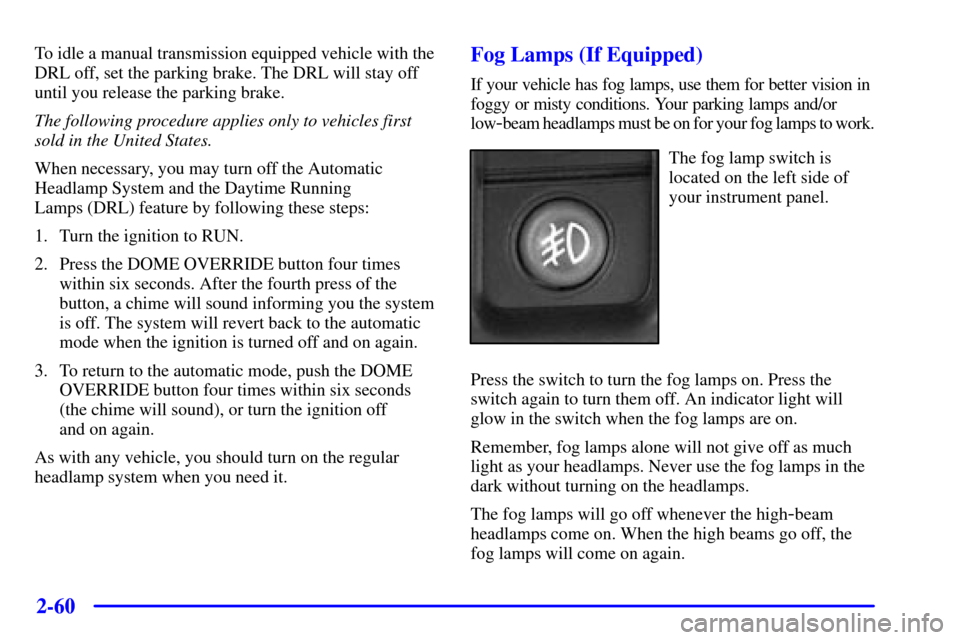
The fog lamp switch is
located on the left side of
your instrument panel.
Press the switch to turn the fog lamps on. Press the
switch again to turn them off. An indicator light will
glow in the switch when the fog lamps are on.
Remember, fog lamps alone will not give off as much
light as your headlamps. Never use the fog lamps in the
dark without turning on the headlamps.
The fog lamps will go off whenever the high
-beam
headlamps come on. When the high beams go off, the
fog lamps will come on again.
Page 155 of 468
2-72
Center Console Storage Area (If Equipped)
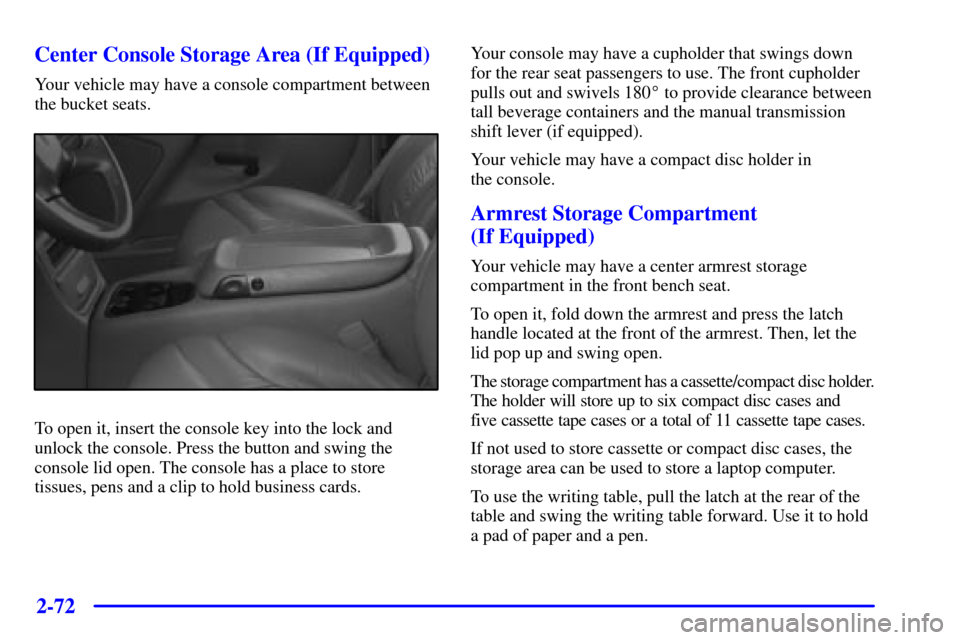
Your vehicle may have a console compartment between
the bucket seats.
To open it, insert the console key into the lock and
unlock the console. Press the button and swing the
console lid open. The console has a place to store
tissues, pens and a clip to hold business cards.Your console may have a cupholder that swings down
for the rear seat passengers to use. The front cupholder
pulls out and swivels 180� to provide clearance between
tall beverage containers and the manual transmission
shift lever (if equipped).
Your vehicle may have a compact disc holder in
the console.
Armrest Storage Compartment
(If Equipped)
Your vehicle may have a center armrest storage
compartment in the front bench seat.
To open it, fold down the armrest and press the latch
handle located at the front of the armrest. Then, let the
lid pop up and swing open.
The storage compartment has a cassette/compact disc holder.
The holder will store up to six compact disc cases and
five cassette tape cases or a total of 11 cassette tape cases.
If not used to store cassette or compact disc cases, the
storage area can be used to store a laptop computer.
To use the writing table, pull the latch at the rear of the
table and swing the writing table forward. Use it to hold
a pad of paper and a pen.
Page 164 of 468
2-81
The main components of your instrument panel are the following:
A. Dome Lamp Switch
B. Lamp Controls
C. Air Outlets
D. Automatic Transfer Case (If Equipped)/Electronic
Transfer Case (If Equipped)/Traction Assist
System (If Equipped)
E. Multifunction Lever
F. Instrument Cluster
G. Gearshift Lever (Automatic Transmission)
H. Tow/Haul Selector Switch
I. Audio System
J. Comfort Control SystemK. Glove Box
L. Passenger Air Bag Off Switch
M. Manual Selectable Ride Control (If Equipped)
N. Ashtray
O. Storage Area or Compact Disc Player (If Equipped)
P. Rear Window Defogger Switch (If Equipped)
Q. Lighter and Accessory Power Outlets
R. Parking Brake Release
S. Tilt Lever (If Equipped)
T. Center Instrument Panel Utility Block
U. Hood Release
V. Instrument Panel Fuse Block
Page 165 of 468
2-82
Instrument Panel Cluster
United States Heavy Duty Automatic Transmission version shown.
Canada, Light Duty Automatic and Manual Transmission clusters similar.
Page 166 of 468
2-83
Your instrument cluster is designed to let you know at a
glance how your vehicle is running. You'll know how
fast you're going, about how much fuel you have and
many other things you'll need to know to drive safely
and economically.
Speedometer and Odometer
Your speedometer lets you see your speed in both miles
per hour (mph) and kilometers per hour (km/h). Your
odometer shows how far your vehicle has been driven,
in either miles (used in the United States) or
kilometers (used in Canada).
Trip Odometer
The trip odometer can tell you how far your vehicle has
been driven since you last set the trip odometer to zero.
Press the reset button to toggle between the trip
odometer and the regular odometer. Holding the reset
button for two seconds while the trip odometer is
displayed will reset it.
To display the odometer reading with the ignition off,
press the reset button.Engine Hour Meter Display
The odometer can also display the number of hours the
engine has run. To display the hour meter, turn the
ignition off, press and hold the reset button for at least
four seconds. The hour meter will be displayed for up to
30 seconds, or until the ignition is turned on.Tachometer
Your tachometer displays the engine speed in
revolutions per minute (rpm).
NOTICE:
On vehicles with a manual transmission, if you
operate the engine with the tachometer in the
red area, your engine or other parts could
be damaged.
Damage to your engine or vehicle caused by
operating the engine in the red area isn't covered
by your vehicle warranty. Don't operate the
engine with the tachometer in the red area.