Page 370 of 468
6-28 How to Add Fluid
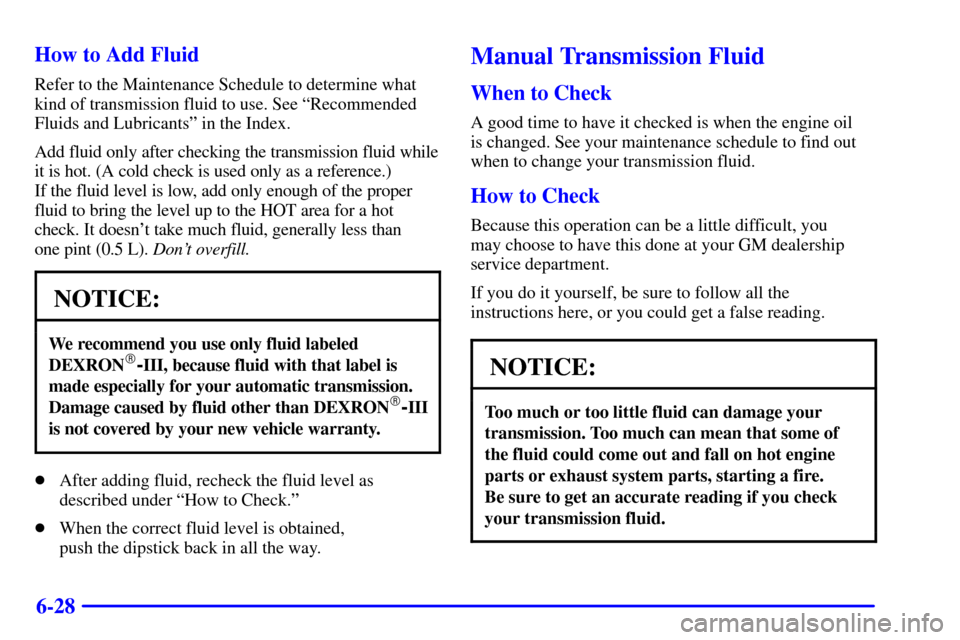
Refer to the Maintenance Schedule to determine what
kind of transmission fluid to use. See ªRecommended
Fluids and Lubricantsº in the Index.
Add fluid only after checking the transmission fluid while
it is hot. (A cold check is used only as a reference.)
If the fluid level is low, add only enough of the proper
fluid to bring the level up to the HOT area for a hot
check. It doesn't take much fluid, generally less than
one pint (0.5 L). Don't overfill.
NOTICE:
We recommend you use only fluid labeled
DEXRON�-III, because fluid with that label is
made especially for your automatic transmission.
Damage caused by fluid other than DEXRON
�-III
is not covered by your new vehicle warranty.
�After adding fluid, recheck the fluid level as
described under ªHow to Check.º
�When the correct fluid level is obtained,
push the dipstick back in all the way.
Manual Transmission Fluid
When to Check
A good time to have it checked is when the engine oil
is changed. See your maintenance schedule to find out
when to change your transmission fluid.
How to Check
Because this operation can be a little difficult, you
may choose to have this done at your GM dealership
service department.
If you do it yourself, be sure to follow all the
instructions here, or you could get a false reading.
NOTICE:
Too much or too little fluid can damage your
transmission. Too much can mean that some of
the fluid could come out and fall on hot engine
parts or exhaust system parts, starting a fire.
Be sure to get an accurate reading if you check
your transmission fluid.
Page 376 of 468
6-34 What to Use
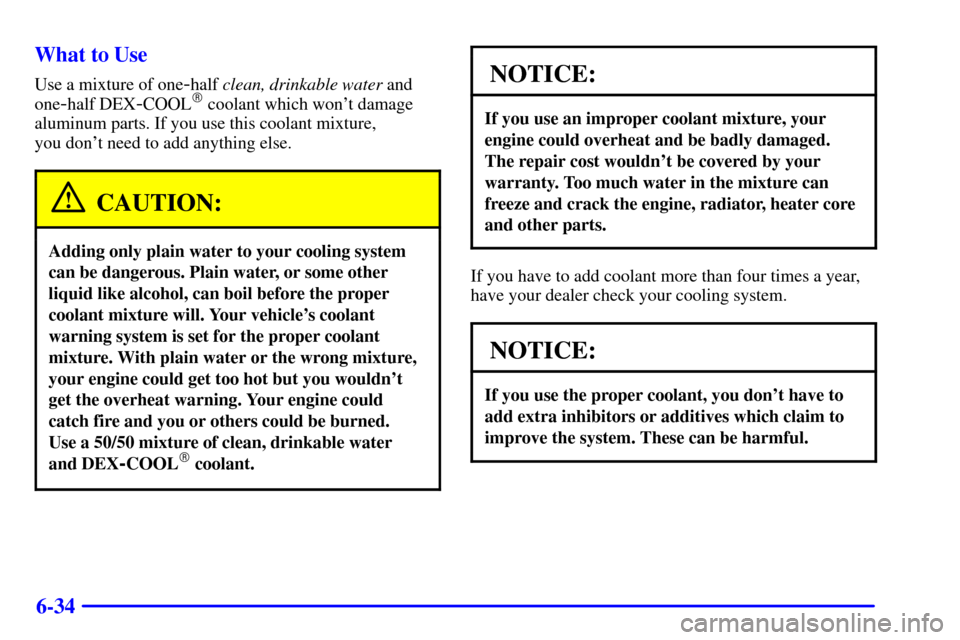
Use a mixture of one-half clean, drinkable water and
one
-half DEX-COOL� coolant which won't damage
aluminum parts. If you use this coolant mixture,
you don't need to add anything else.
CAUTION:
Adding only plain water to your cooling system
can be dangerous. Plain water, or some other
liquid like alcohol, can boil before the proper
coolant mixture will. Your vehicle's coolant
warning system is set for the proper coolant
mixture. With plain water or the wrong mixture,
your engine could get too hot but you wouldn't
get the overheat warning. Your engine could
catch fire and you or others could be burned.
Use a 50/50 mixture of clean, drinkable water
and DEX
-COOL� coolant.
NOTICE:
If you use an improper coolant mixture, your
engine could overheat and be badly damaged.
The repair cost wouldn't be covered by your
warranty. Too much water in the mixture can
freeze and crack the engine, radiator, heater core
and other parts.
If you have to add coolant more than four times a year,
have your dealer check your cooling system.
NOTICE:
If you use the proper coolant, you don't have to
add extra inhibitors or additives which claim to
improve the system. These can be harmful.
Page 423 of 468
6-81 Cooling System Capacity
After refill, the level must be rechecked. See ªCooling Systemº in the Index.
Engine Transmission Quantity
VORTEC 4300 V6 Automatic 12.6 quarts (11.9 L)
VORTEC 4300 V6 Manual 12.9 quarts (12.2 L)
VORTEC 4800 V8 Automatic 13.4 quarts (12.7 L)
VORTEC 4800 V8 Manual 13.7 quarts (13.0 L)
VORTEC 5300 V8 Automatic 13.4 quarts (12.7 L)
VORTEC 5300 V8** Automatic 14.9 quarts (14.1 L)
VORTEC 6000 V8 Automatic 14.8 quarts (14.0 L)
VORTEC 6000 V8* Automatic 14.4 quarts (13.6 L)
VORTEC 6000 V8 Manual 15.2 quarts (14.4 L)
VORTEC 6000 V8* Manual 14.8 quarts (14.0 L)
VORTEC 6600 V8 Manual 20.7 quarts (19.6 L)
VORTEC 6600 V8 Automatic 20.3 quarts (19.2 L)
VORTEC 8100 V8 Manual 21.1 quarts (20.0 L)
VORTEC 8100 V8 Automatic 20.7 quarts (19.6 L)
* Vehicles equipped with the optional engine oil cooler.
** Vehicles equipped with the optional air conditioner.
Page 424 of 468
6-82 Crankcase Capacity
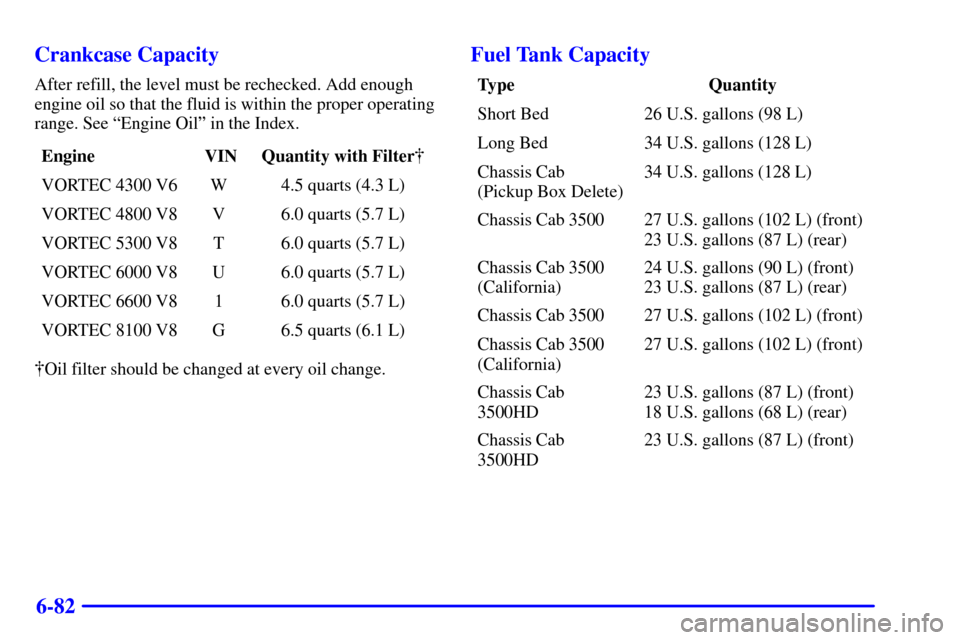
After refill, the level must be rechecked. Add enough
engine oil so that the fluid is within the proper operating
range. See ªEngine Oilº in the Index.
Engine VIN
Quantity with Filter�
VORTEC 4300 V6 W 4.5 quarts (4.3 L)
VORTEC 4800 V8 V 6.0 quarts (5.7 L)
VORTEC 5300 V8 T 6.0 quarts (5.7 L)
VORTEC 6000 V8 U 6.0 quarts (5.7 L)
VORTEC 6600 V8 1 6.0 quarts (5.7 L)
VORTEC 8100 V8 G 6.5 quarts (6.1 L)
�Oil filter should be changed at every oil change.
Fuel Tank Capacity
Type Quantity
Short Bed 26 U.S. gallons (98 L)
Long Bed 34 U.S. gallons (128 L)
Chassis Cab
(Pickup Box Delete)34 U.S. gallons (128 L)
Chassis Cab 3500 27 U.S. gallons (102 L) (front)
23 U.S. gallons (87 L) (rear)
Chassis Cab 3500
(California)24 U.S. gallons (90 L) (front)
23 U.S. gallons (87 L) (rear)
Chassis Cab 3500 27 U.S. gallons (102 L) (front)
Chassis Cab 3500
(California)27 U.S. gallons (102 L) (front)
Chassis Cab
3500HD23 U.S. gallons (87 L) (front)
18 U.S. gallons (68 L) (rear)
Chassis Cab
3500HD23 U.S. gallons (87 L) (front)
Page 443 of 468
7-18
Part B: Owner Checks and Services
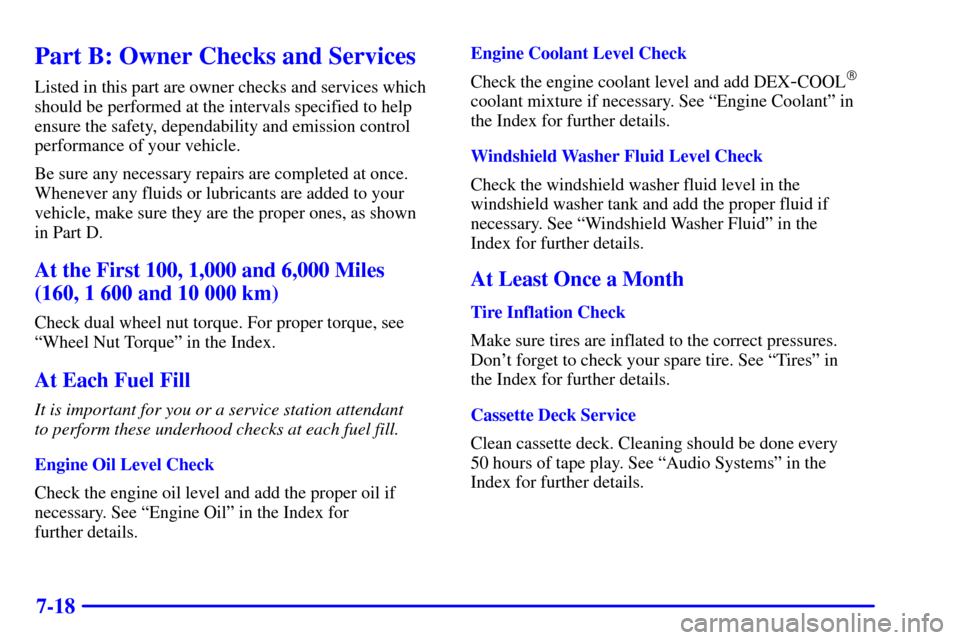
Listed in this part are owner checks and services which
should be performed at the intervals specified to help
ensure the safety, dependability and emission control
performance of your vehicle.
Be sure any necessary repairs are completed at once.
Whenever any fluids or lubricants are added to your
vehicle, make sure they are the proper ones, as shown
in Part D.
At the First 100, 1,000 and 6,000 Miles
(160, 1 600 and 10 000 km)
Check dual wheel nut torque. For proper torque, see
ªWheel Nut Torqueº in the Index.
At Each Fuel Fill
It is important for you or a service station attendant
to perform these underhood checks at each fuel fill.
Engine Oil Level Check
Check the engine oil level and add the proper oil if
necessary. See ªEngine Oilº in the Index for
further details.Engine Coolant Level Check
Check the engine coolant level and add DEX
-COOL�
coolant mixture if necessary. See ªEngine Coolantº in
the Index for further details.
Windshield Washer Fluid Level Check
Check the windshield washer fluid level in the
windshield washer tank and add the proper fluid if
necessary. See ªWindshield Washer Fluidº in the
Index for further details.
At Least Once a Month
Tire Inflation Check
Make sure tires are inflated to the correct pressures.
Don't forget to check your spare tire. See ªTiresº in
the Index for further details.
Cassette Deck Service
Clean cassette deck. Cleaning should be done every
50 hours of tape play. See ªAudio Systemsº in the
Index for further details.
Page 444 of 468
7-19 At Least Twice a Year
Restraint System Check
Make sure the safety belt reminder light and all your
belts, buckles, latch plates, retractors and anchorages are
working properly. Look for any other loose or damaged
safety belt system parts. If you see anything that might
keep a safety belt system from doing its job, have it
repaired. Have any torn or frayed safety belts replaced.
Also look for any opened or broken air bag coverings,
and have them repaired or replaced. (The air bag system
does not need regular maintenance.)
Wiper Blade Check
Inspect wiper blades for wear or cracking. Replace blade
inserts that appear worn or damaged or that streak or
miss areas of the windshield. Also see ªWiper Blades,
Cleaningº in the Index.Spare Tire Check
At least twice a year, after the monthly inflation check
of the spare tire determines that the spare is inflated to
the correct tire inflation pressure, make sure that the
spare tire is stored securely. Push, pull, and then try
to rotate or turn the tire. If it moves, use the wheel
wrench/ratchet to tighten the cable. See ªStoring the
Spare Tire and Toolsº in the Index.
Engine Air Cleaner Filter Restriction Indicator Check
Your vehicle has an indicator located on the air cleaner
in the engine compartment that lets you know when the
air cleaner filter is dirty and needs to be changed. Check
indicator at least twice a year or when your engine oil is
changed, whichever occurs first. See ªAir Cleanerº in
the Index for more information. Inspect your air cleaner
filter restriction indicator more often if the vehicle is
used in dusty areas or under off road conditions.
Page 449 of 468
7-24 Throttle System Inspection
Inspect the throttle system for interference or binding,
and for damaged or missing parts. Replace parts as
needed. Replace any components that have high effort
or excessive wear. Do not lubricate accelerator and
cruise control cables.
Transfer Case and Front Axle
(Four-Wheel Drive) Inspection
Every 12 months or at engine oil change intervals,
check front axle and transfer case and add lubricant
when necessary. A fluid loss could indicate a problem;
check and have it repaired, if needed. On manual
shift transfer case, oil the control lever pivot point.
Check vent hose at transfer case for kinks and proper
installation. More frequent lubrication may be required
on off
-road use.
Brake System Inspection
Inspect the complete system. Inspect brake lines and
hoses for proper hook
-up, binding, leaks, cracks,
chafing, etc. Inspect disc brake pads for wear and
rotors for surface condition. Inspect other brake parts,
including calipers, parking brake, etc. You may need to
have your brakes inspected more often if your driving
habits or conditions result in frequent braking.
Page:
< prev 1-8 9-16 17-24