Page 201 of 351
4-29
4. To prevent your battery from draining while the
vehicle is being towed, remove the following fuses
from the driver's side instrument panel fuse block:
A) Wiper, G) Powertrain Control Module and
J) Body Function Control Module/Cluster.
See ªInstrument Panel Fuse Block
-Driver's Sideº
in the Index for location of these fuses.
5. Turn the ignition switch to ACC.
6. Shift your transaxle to NEUTRAL (N).
7. Release the parking brake.
Remember to reinstall the fuses once you reach your
destination. To reinstall a fuse:
1. Set the parking brake.
2. Remove the key from the ignition switch.
3. Reinstall the fuse.
NOTICE:
Make sure that the towing speed does not exceed
65 mph (110 km/h), or your vehicle could be
badly damaged.
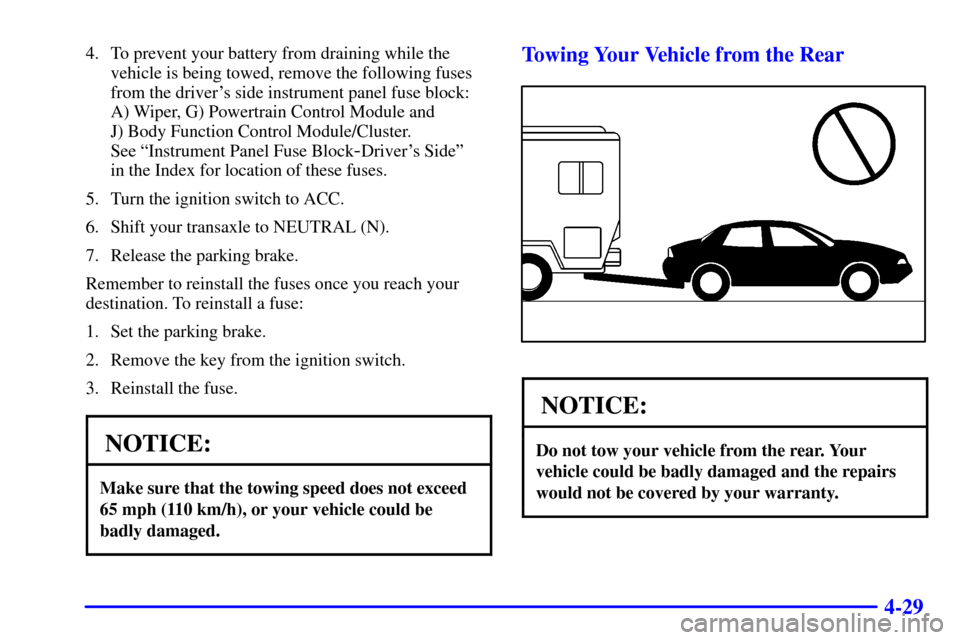
Towing Your Vehicle from the Rear
NOTICE:
Do not tow your vehicle from the rear. Your
vehicle could be badly damaged and the repairs
would not be covered by your warranty.
Page 215 of 351
5-4
2. Get the vehicles close enough so the jumper cables
can reach, but be sure the vehicles aren't touching
each other. If they are, it could cause a ground
connection you don't want. You wouldn't be able
to start your vehicle, and the bad grounding could
damage the electrical systems.
To avoid the possibility of the vehicles rolling, set
the parking brake firmly on both vehicles involved in
the jump start procedure. Put an automatic transaxle
in PARK (P) or a manual transaxle in NEUTRAL
before setting the parking brake.
3. Turn off the ignition on both vehicles. Unplug
unnecessary accessories plugged into the cigarette
lighter or the accessory power outlet. Turn off all
lamps that aren't needed, as well as radios. This
will avoid sparks and help save both batteries. In
addition, it could save your radio!
NOTICE:
If you leave your radio on, it could be badly
damaged. The repairs wouldn't be covered by
your warranty.
4. Open the hoods and locate the batteries. See ªEngine
Compartment Overviewº in the Index for more
information on location.
CAUTION:
An electric fan can start up even when the engine
is not running and can injure you. Keep hands,
clothing and tools away from any underhood
electric fan.
5. Find the positive (+) and negative (-) terminals on
each battery.
Page 298 of 351
6-59
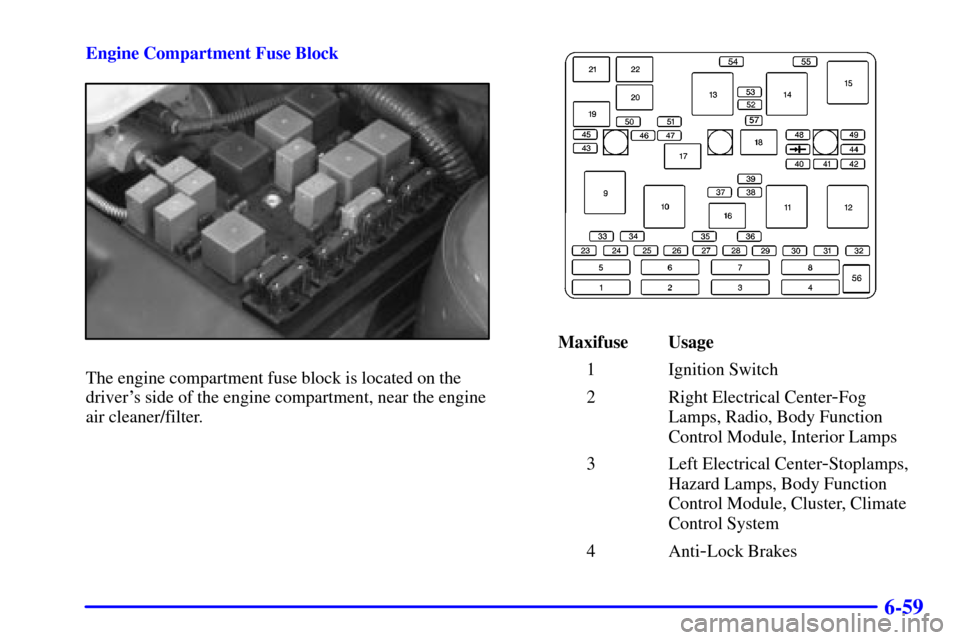
Engine Compartment Fuse Block
The engine compartment fuse block is located on the
driver's side of the engine compartment, near the engine
air cleaner/filter.
Maxifuse Usage
1 Ignition Switch
2 Right Electrical Center
-Fog
Lamps, Radio, Body Function
Control Module, Interior Lamps
3 Left Electrical Center
-Stoplamps,
Hazard Lamps, Body Function
Control Module, Cluster, Climate
Control System
4 Anti
-Lock Brakes
Page 299 of 351
6-60
Maxifuse Usage
5 Ignition Switch
6 Not Used
7 Left Electrical Center
-Power
Seats, Power Mirrors, Door Locks,
Trunk Release and Remote
Lock Control
8 Cooling Fan #1
Mini Relay Usage
9 Rear Defog
10 Not Used
11 Not Used
12 Cooling Fan #1
13 HVAC Blower (Climate Control)
14 Cooling Fan #2
15 Cooling Fan
Mirco Relay Usage
16 Air Conditioning Compressor
17 Not Used
18 Fuel PumpMirco Relay Usage
19 Automatic Light Control
20 Automatic Light Control
21 Horn
22 Daytime Running Lamps
Minifuse Usage
23
- 32Spare Fuse Holder
33 Rear Defog
34 Accessory Power Outlets,
Cigar Lighter
35 Generator
36 Not Used
37 Air Conditioning Compressor,
Body Function Control Module
38 Automatic Transaxle
39 Powertrain Control
Module, Ignition
40 Anti
-Lock Brakes
41 Ignition System
Page 330 of 351
7-28
Ignition Transaxle Lock Check
While parked, and with the parking brake set, try to
turn the ignition key to OFF in each shift lever position.
The key should turn to OFF only when the shift lever
is in PARK (P).
On all vehicles, the key should come out only in OFF.
Parking Brake and Automatic Transaxle PARK (P)
Mechanism Check
CAUTION:
When you are doing this check, your vehicle
could begin to move. You or others could be
injured and property could be damaged. Make
sure there is room in front of your vehicle in case
it begins to roll. Be ready to apply the regular
brake at once should the vehicle begin to move.
Park on a fairly steep hill, with the vehicle facing
downhill. Keeping your foot on the regular brake, set the
parking brake.
�To check the parking brake's holding ability: With
the engine running and transaxle in NEUTRAL (N),
slowly remove foot pressure from the regular brake
pedal. Do this until the vehicle is held by the parking
brake only.
�To check the PARK (P) mechanism's holding
ability: With the engine running, shift to PARK (P).
Then release the parking brake followed by the
regular brake.
Underbody Flushing Service
At least every spring, use plain water to flush any
corrosive materials from the underbody. Take care to
clean thoroughly any areas where mud and other debris
can collect.