Page 201 of 351
4-29
4. To prevent your battery from draining while the
vehicle is being towed, remove the following fuses
from the driver's side instrument panel fuse block:
A) Wiper, G) Powertrain Control Module and
J) Body Function Control Module/Cluster.
See ªInstrument Panel Fuse Block
-Driver's Sideº
in the Index for location of these fuses.
5. Turn the ignition switch to ACC.
6. Shift your transaxle to NEUTRAL (N).
7. Release the parking brake.
Remember to reinstall the fuses once you reach your
destination. To reinstall a fuse:
1. Set the parking brake.
2. Remove the key from the ignition switch.
3. Reinstall the fuse.
NOTICE:
Make sure that the towing speed does not exceed
65 mph (110 km/h), or your vehicle could be
badly damaged.
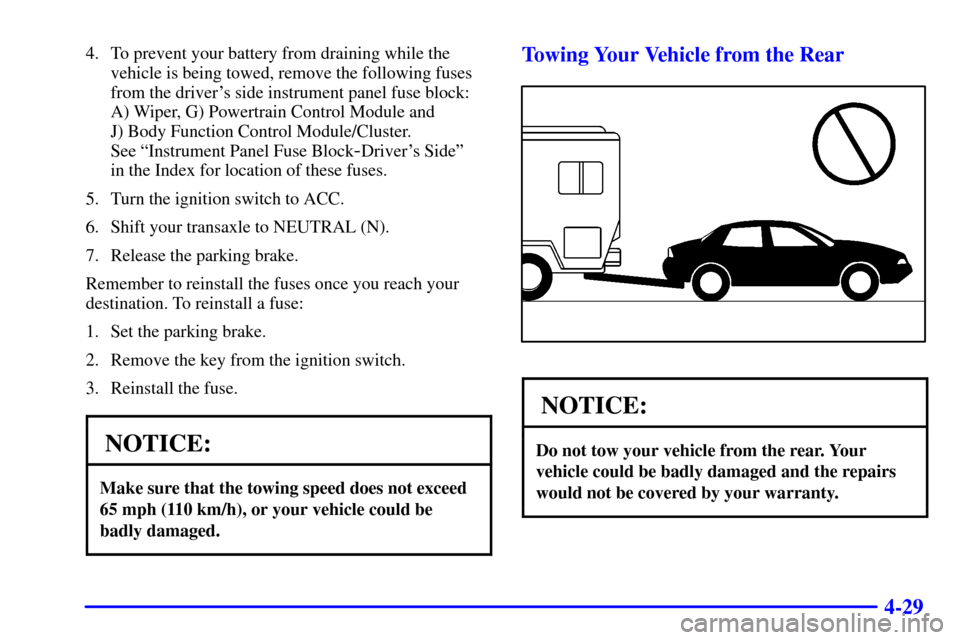
Towing Your Vehicle from the Rear
NOTICE:
Do not tow your vehicle from the rear. Your
vehicle could be badly damaged and the repairs
would not be covered by your warranty.
Page 207 of 351

4-35 Hitches
It's important to have the correct hitch equipment.
Crosswinds, large trucks going by and rough roads are a
few reasons why you'll need the right hitch. Here are
some rules to follow:
�The rear bumper on your vehicle is not intended for
hitches. Do not attach rental hitches or other
bumper
-type hitches to it. Use only a frame-mounted
hitch that does not attach to the bumper.
�Will you have to make any holes in the body of your
vehicle when you install a trailer hitch? If you do,
then be sure to seal the holes later when you remove
the hitch. If you don't seal them, deadly carbon
monoxide (CO) from your exhaust can get into your
vehicle. See ªCarbon Monoxideº in the Index. Dirt
and water can, too.
Safety Chains
You should always attach chains between your vehicle
and your trailer. Cross the safety chains under the tongue
of the trailer so that the tongue will not drop to the road
if it becomes separated from the hitch. Instructions
about safety chains may be provided by the hitch
manufacturer or by the trailer manufacturer. Follow the
manufacturer's recommendation for attaching safety
chains and do not attach them to the bumper. Always
leave just enough slack so you can turn with your rig.
And, never allow safety chains to drag on the ground.
Trailer Brakes
Does your trailer have its own brakes?
Be sure to read and follow the instructions for the trailer
brakes so you'll be able to install, adjust and maintain
them properly. And because you have anti
-lock brakes,
do not try to tap into your vehicle's brake system. If you
do, both systems won't work well, or at all.
Page 226 of 351
5-15
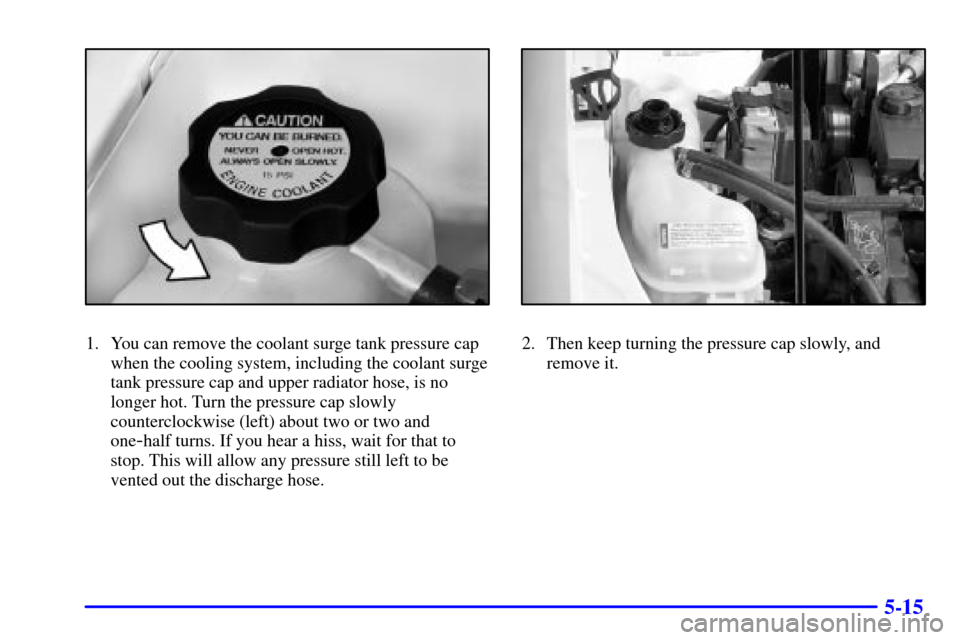
1. You can remove the coolant surge tank pressure cap
when the cooling system, including the coolant surge
tank pressure cap and upper radiator hose, is no
longer hot. Turn the pressure cap slowly
counterclockwise (left) about two or two and
one
-half turns. If you hear a hiss, wait for that to
stop. This will allow any pressure still left to be
vented out the discharge hose.
2. Then keep turning the pressure cap slowly, and
remove it.
Page 229 of 351
5-18
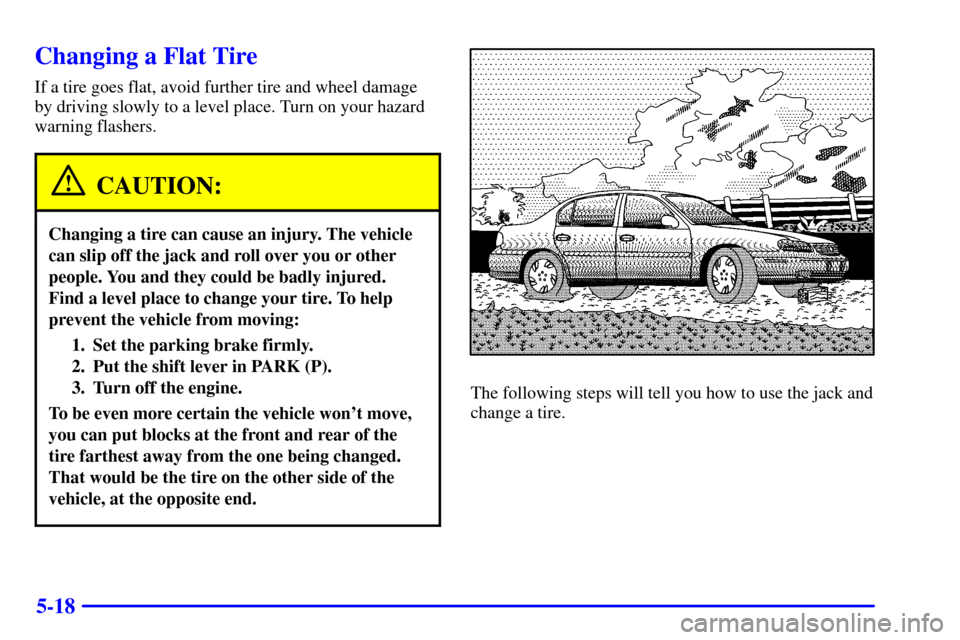
Changing a Flat Tire
If a tire goes flat, avoid further tire and wheel damage
by driving slowly to a level place. Turn on your hazard
warning flashers.
CAUTION:
Changing a tire can cause an injury. The vehicle
can slip off the jack and roll over you or other
people. You and they could be badly injured.
Find a level place to change your tire. To help
prevent the vehicle from moving:
1. Set the parking brake firmly.
2. Put the shift lever in PARK (P).
3. Turn off the engine.
To be even more certain the vehicle won't move,
you can put blocks at the front and rear of the
tire farthest away from the one being changed.
That would be the tire on the other side of the
vehicle, at the opposite end.
The following steps will tell you how to use the jack and
change a tire.
Page 230 of 351
5-19 Removing the Spare Tire and Tools
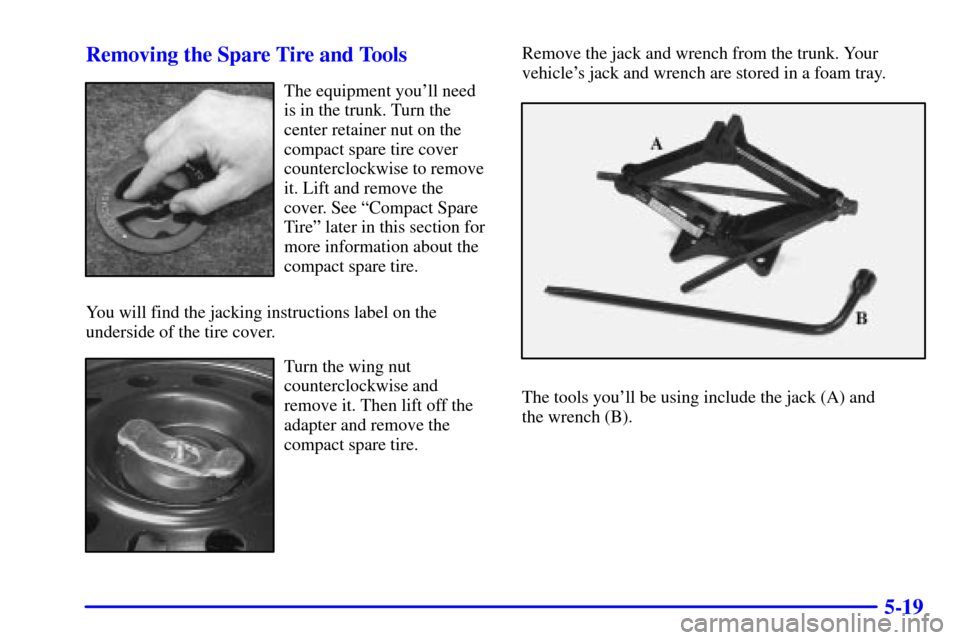
The equipment you'll need
is in the trunk. Turn the
center retainer nut on the
compact spare tire cover
counterclockwise to remove
it. Lift and remove the
cover. See ªCompact Spare
Tireº later in this section for
more information about the
compact spare tire.
You will find the jacking instructions label on the
underside of the tire cover.
Turn the wing nut
counterclockwise and
remove it. Then lift off the
adapter and remove the
compact spare tire.Remove the jack and wrench from the trunk. Your
vehicle's jack and wrench are stored in a foam tray.
The tools you'll be using include the jack (A) and
the wrench (B).
Page 233 of 351
5-22
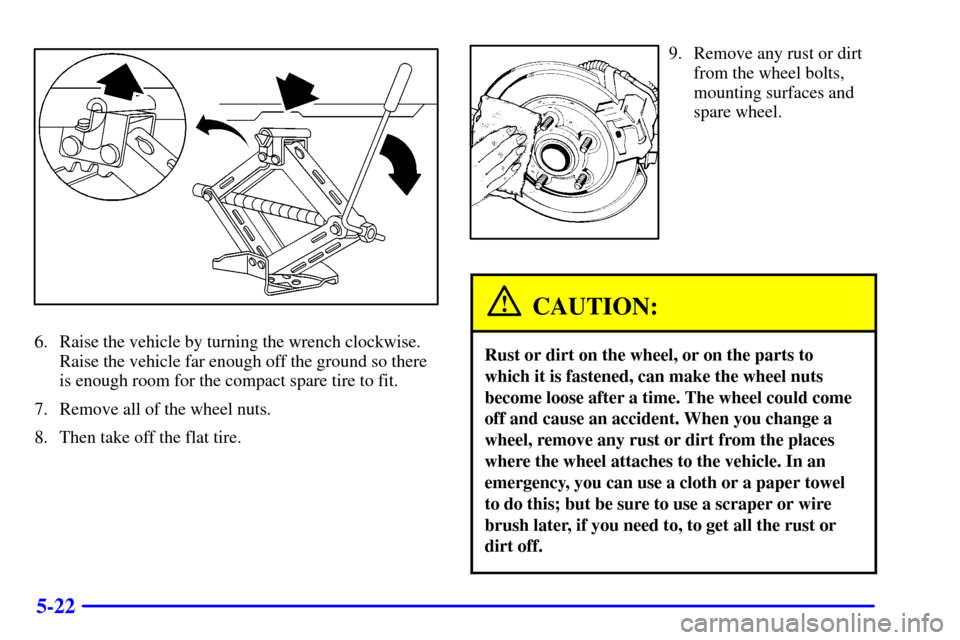
6. Raise the vehicle by turning the wrench clockwise.
Raise the vehicle far enough off the ground so there
is enough room for the compact spare tire to fit.
7. Remove all of the wheel nuts.
8. Then take off the flat tire.
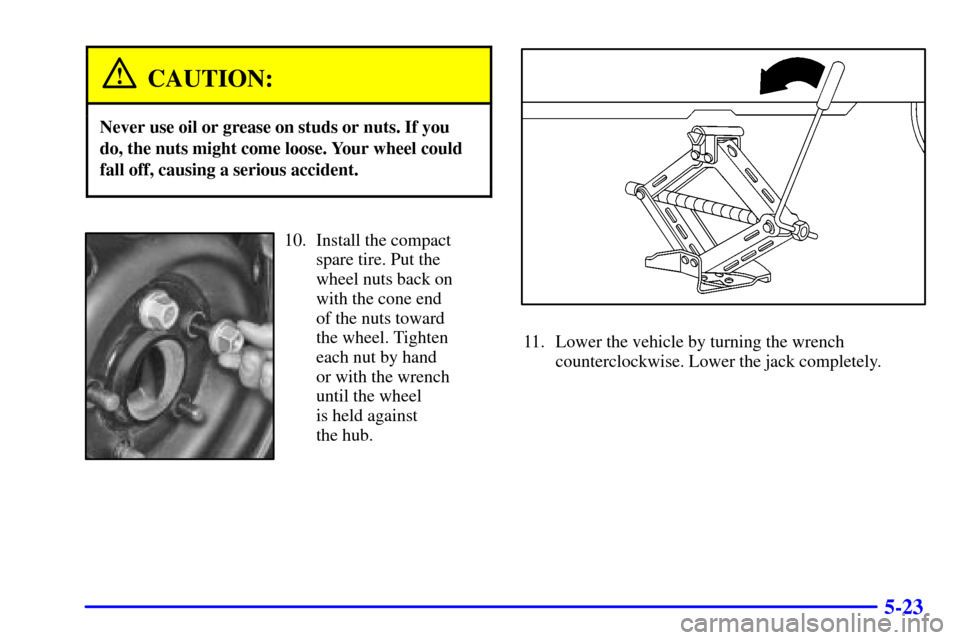
9. Remove any rust or dirt
from the wheel bolts,
mounting surfaces and
spare wheel.
CAUTION:
Rust or dirt on the wheel, or on the parts to
which it is fastened, can make the wheel nuts
become loose after a time. The wheel could come
off and cause an accident. When you change a
wheel, remove any rust or dirt from the places
where the wheel attaches to the vehicle. In an
emergency, you can use a cloth or a paper towel
to do this; but be sure to use a scraper or wire
brush later, if you need to, to get all the rust or
dirt off.
Page 234 of 351
5-23
CAUTION:
Never use oil or grease on studs or nuts. If you
do, the nuts might come loose. Your wheel could
fall off, causing a serious accident.
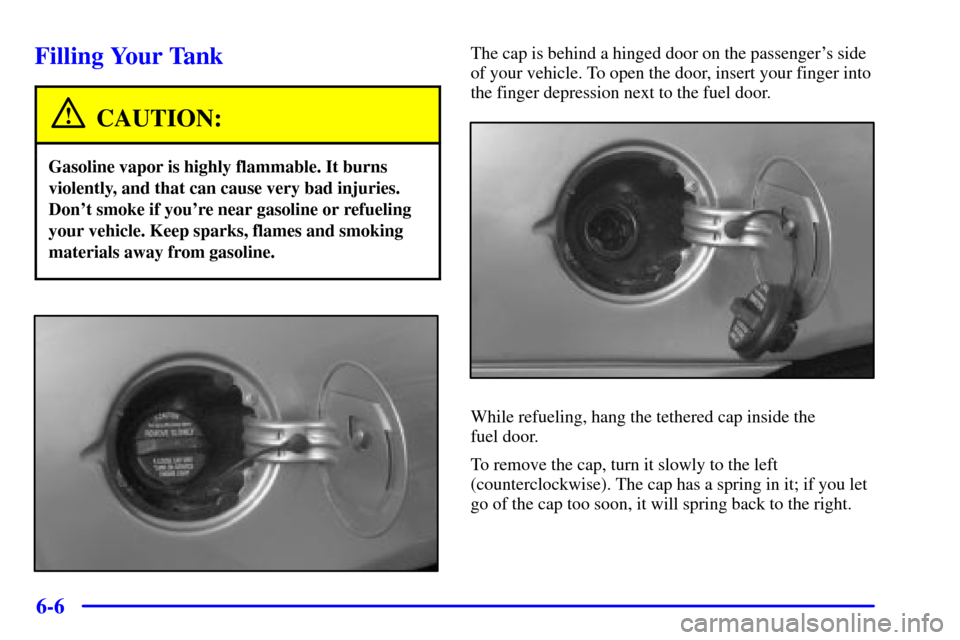
10. Install the compact
spare tire. Put the
wheel nuts back on
with the cone end
of the nuts toward
the wheel. Tighten
each nut by hand
or with the wrench
until the wheel
is held against
the hub.
11. Lower the vehicle by turning the wrench
counterclockwise. Lower the jack completely.
Page 245 of 351
6-6
Filling Your Tank
CAUTION:
Gasoline vapor is highly flammable. It burns
violently, and that can cause very bad injuries.
Don't smoke if you're near gasoline or refueling
your vehicle. Keep sparks, flames and smoking
materials away from gasoline.
The cap is behind a hinged door on the passenger's side
of your vehicle. To open the door, insert your finger into
the finger depression next to the fuel door.
While refueling, hang the tethered cap inside the
fuel door.
To remove the cap, turn it slowly to the left
(counterclockwise). The cap has a spring in it; if you let
go of the cap too soon, it will spring back to the right.