Page 2 of 392
Courtesy
Transportation
Every
2001 Impala
under warranty is
backed with the
following
services:
Free lockout assistance
Free dead-battery assistance
Free out-of-fuel assistance
Free flat-tire change
Emergency towing
1-800-CHEV-USA
(For vehicles purchased in Canada,
call
1-800-268-6800)
that provides in an emergency:
1-800-CHEV-USA
(For vehicles purchased in Canada,
call
1-800-268-6800)
®
Page 5 of 392
Comfort Controls and Audio Systems
Table of Contents (cont'd)
Defensive Driving
Drunken Driving
Control of a Vehicle
Braking
SteeringDriving Tips for Various Road Conditions
Recreational Vehicle Towing
Loading Your Vehicle
Towing a Trailer Heating and Air Conditioning
Setting the Radio Clock
Radio/Cassette Player/CD PlayerRadio Theft-Deterrent Feature
Steering Wheel Controls (Option)
Hazard Warning Flashers
Jump Starting
Towing Your VehicleEngine Overheating
Changing a Flat Tire
If You're Stuck
Problems on the Road
iii
Section
3
Section
4
Section
5
Your Driving and the Road
Page 15 of 392
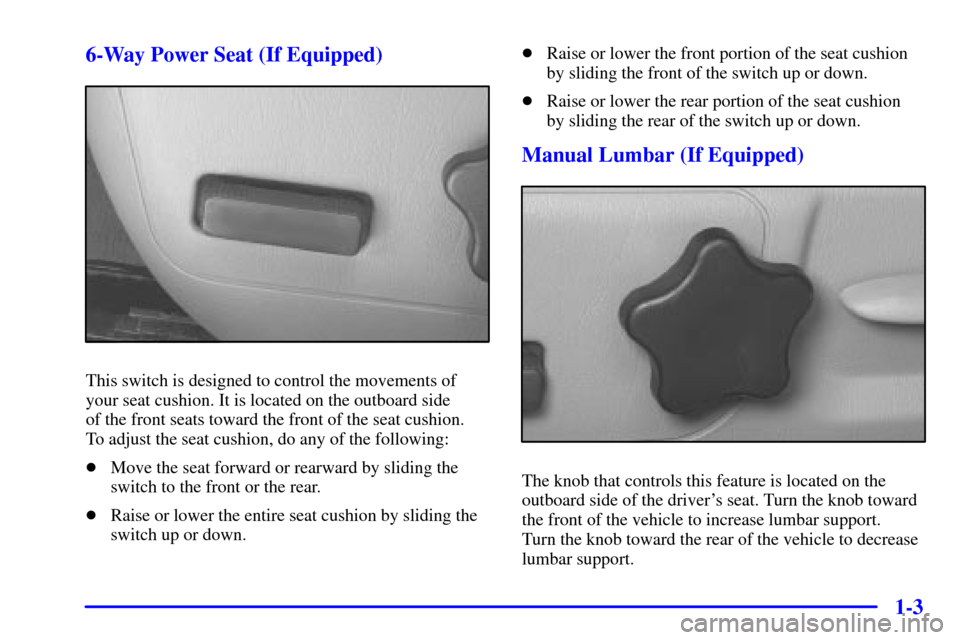
1-3 6-Way Power Seat (If Equipped)
This switch is designed to control the movements of
your seat cushion. It is located on the outboard side
of the front seats toward the front of the seat cushion.
To adjust the seat cushion, do any of the following:
�Move the seat forward or rearward by sliding the
switch to the front or the rear.
�Raise or lower the entire seat cushion by sliding the
switch up or down.�Raise or lower the front portion of the seat cushion
by sliding the front of the switch up or down.
�Raise or lower the rear portion of the seat cushion
by sliding the rear of the switch up or down.
Manual Lumbar (If Equipped)
The knob that controls this feature is located on the
outboard side of the driver's seat. Turn the knob toward
the front of the vehicle to increase lumbar support.
Turn the knob toward the rear of the vehicle to decrease
lumbar support.
Page 41 of 392

1-29
In any particular crash, no one can say whether an air
bag should have inflated simply because of the damage
to a vehicle or because of what the repair costs were.
For frontal air bags, inflation is determined by the angle
of the impact and how quickly the vehicle slows down
in frontal and near
-frontal impacts. For the side impact
air bag, inflation is determined by the location and
severity of the impact.
What makes an air bag inflate?
In an impact of sufficient severity, the air bag sensing
system detects that the vehicle is in a crash. For both
frontal and side impact air bags, the sensing system
triggers a release of gas from the inflator, which inflates
the air bag. The inflator, air bag and related hardware
are all part of the air bag modules inside the steering
wheel, instrument panel and the side of the driver's
seatback closest to the door.
How does an air bag restrain?
In moderate to severe frontal or near frontal collisions,
even belted occupants can contact the steering wheel
or the instrument panel. In moderate to severe side
collisions, even belted occupants can contact the inside
of the vehicle. The air bag supplements the protectionprovided by safety belts. Air bags distribute the force of
the impact more evenly over the occupant's upper body,
stopping the occupant more gradually. But the frontal
air bags would not help you in many types of collisions,
including rollovers, rear impacts, and side impacts,
primarily because an occupant's motion is not toward
the air bag. The side impact air bag would not help you
in many types of collisions, including frontal or near
frontal collisions, rollovers, and rear impacts, primarily
because the occupant's motion is not toward that air bag.
Air bags should never be regarded as anything more
than a supplement to safety belts, and then only in
moderate to severe frontal or near
-frontal collisions for
the driver's and right front passenger's frontal air bags,
and only in moderate to severe side collisions for the
driver's side impact air bag.
What will you see after an air bag inflates?
After an air bag inflates, it quickly deflates, so
quickly that some people may not even realize the
air bag inflated. Some components of the air bag
module
-- the steering wheel hub for the driver's air
bag, the instrument panel for the right front passenger's
bag, the side of the seatback closest to the door for
the driver's side impact air bag
-- will be hot for a
short time.
Page 55 of 392
1-43
Restraint Systems for Children
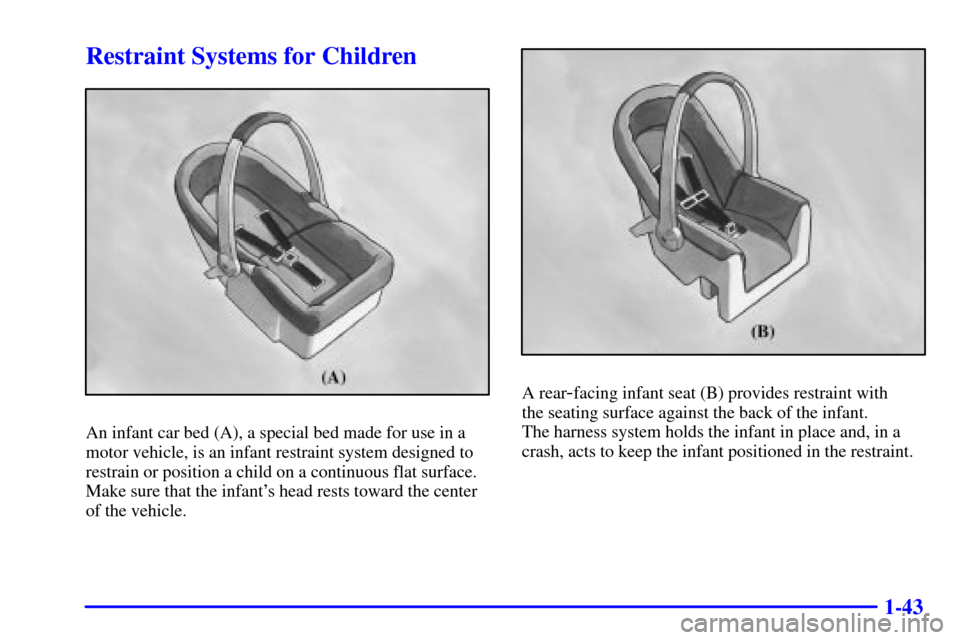
An infant car bed (A), a special bed made for use in a
motor vehicle, is an infant restraint system designed to
restrain or position a child on a continuous flat surface.
Make sure that the infant's head rests toward the center
of the vehicle.
A rear-facing infant seat (B) provides restraint with
the seating surface against the back of the infant.
The harness system holds the infant in place and, in a
crash, acts to keep the infant positioned in the restraint.
Page 68 of 392
1-56
CAUTION:
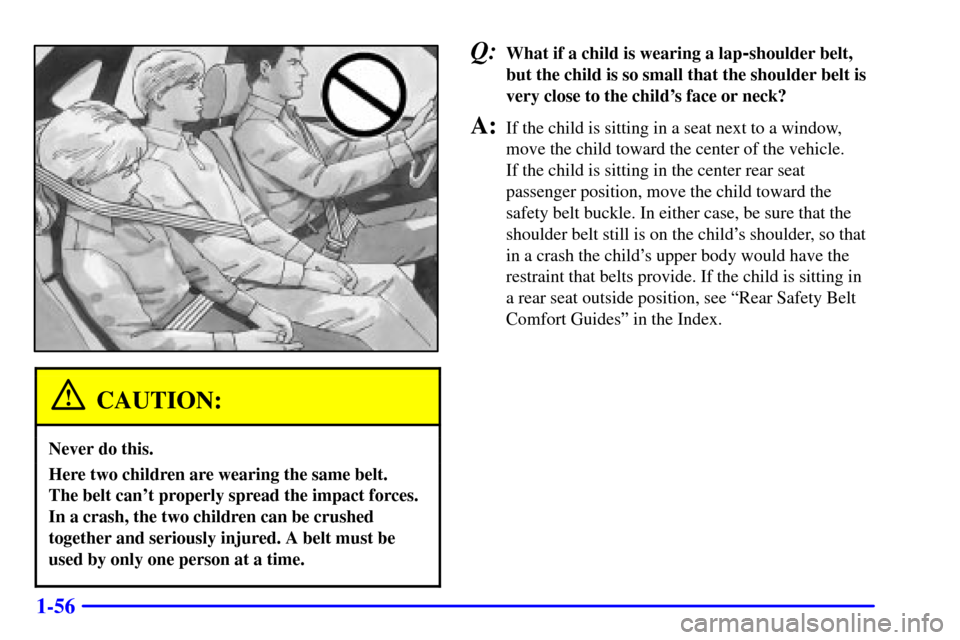
Never do this.
Here two children are wearing the same belt.
The belt can't properly spread the impact forces.
In a crash, the two children can be crushed
together and seriously injured. A belt must be
used by only one person at a time.
Q:What if a child is wearing a lap-shoulder belt,
but the child is so small that the shoulder belt is
very close to the child's face or neck?
A:If the child is sitting in a seat next to a window,
move the child toward the center of the vehicle.
If the child is sitting in the center rear seat
passenger position, move the child toward the
safety belt buckle. In either case, be sure that the
shoulder belt still is on the child's shoulder, so that
in a crash the child's upper body would have the
restraint that belts provide. If the child is sitting in
a rear seat outside position, see ªRear Safety Belt
Comfort Guidesº in the Index.
Page 84 of 392
2-14 Trunk Assist Handle
NOTICE:
The trunk assist handle was not designed to be
used to tie down the trunk lid or as an anchor
point when securing items in the trunk. Improper
use of the trunk assist handle could damage it.
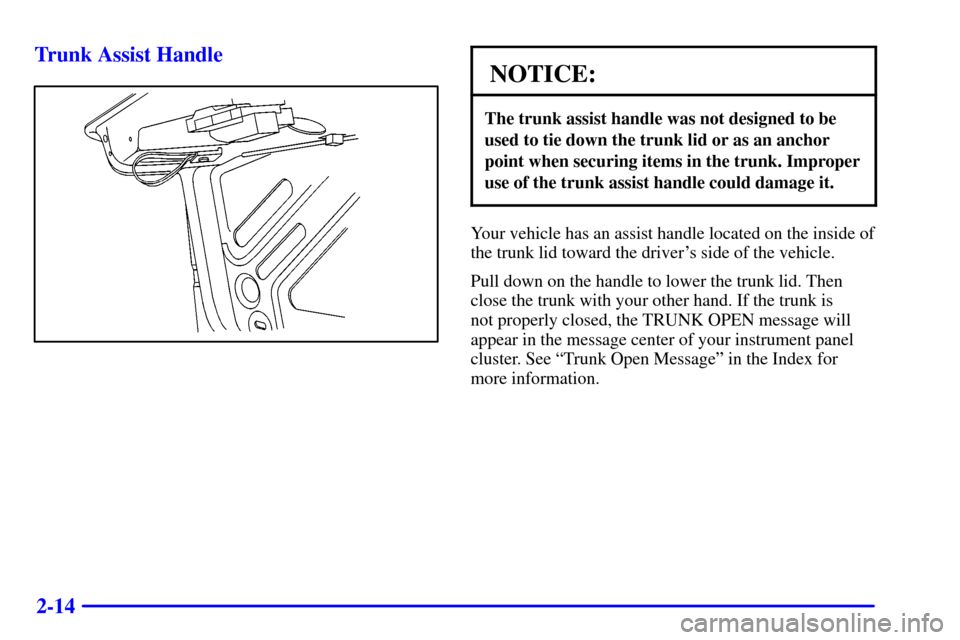
Your vehicle has an assist handle located on the inside of
the trunk lid toward the driver's side of the vehicle.
Pull down on the handle to lower the trunk lid. Then
close the trunk with your other hand. If the trunk is
not properly closed, the TRUNK OPEN message will
appear in the message center of your instrument panel
cluster. See ªTrunk Open Messageº in the Index for
more information.
Page 87 of 392

2-17
Disabling the Trunk Release Sensor
A. Sensor Lens
B. Disable Switch
Because the sensor detects motion, there are times when
you may want to turn off the trunk sensor so that the
motion of your vehicle or items in the trunk won't cause
the trunk to open, such as the following:
�when your vehicle is transported on a car ferry,
�when your vehicle is towed, or
�when you will be loading items through the opening
in the split folding rear seat (if equipped).Next to the sensor lens, there is a disable switch you can
use to turn off the trunk release sensor. To turn off the
sensor, turn the ignition to ON and press the switch next
to the lens for two seconds. The horn will chirp once
when the sensor is turned off. When the sensor is off,
the light in the switch will flash. The TRUNK OPEN
message in the message center will flash for one minute
each time the ignition is turned on as a reminder that
the sensor is turned off. See ªTrunk Open Messageº in
the Index.
To turn the sensor on again, press the switch again or
open the trunk. When the trunk is opened, the sensor is
automatically turned back on. If the sensor is turned back
on with the disable switch, the horn will chirp once.
Servicing the Trunk Release Sensor
The sensor lens should be inspected periodically.
If the lens is dirty, wipe it gently with a clean, soft
cotton cloth.
If there is an electrical problem with the sensor, the
SERVICE VEHICLE SOON message will appear in the
message center. There are other possible reasons for this
message to appear. Be sure to see your dealer as soon as
possible. See ªService Vehicle Soon Messageº in the
Index for more information.