Page 301 of 392
6-14
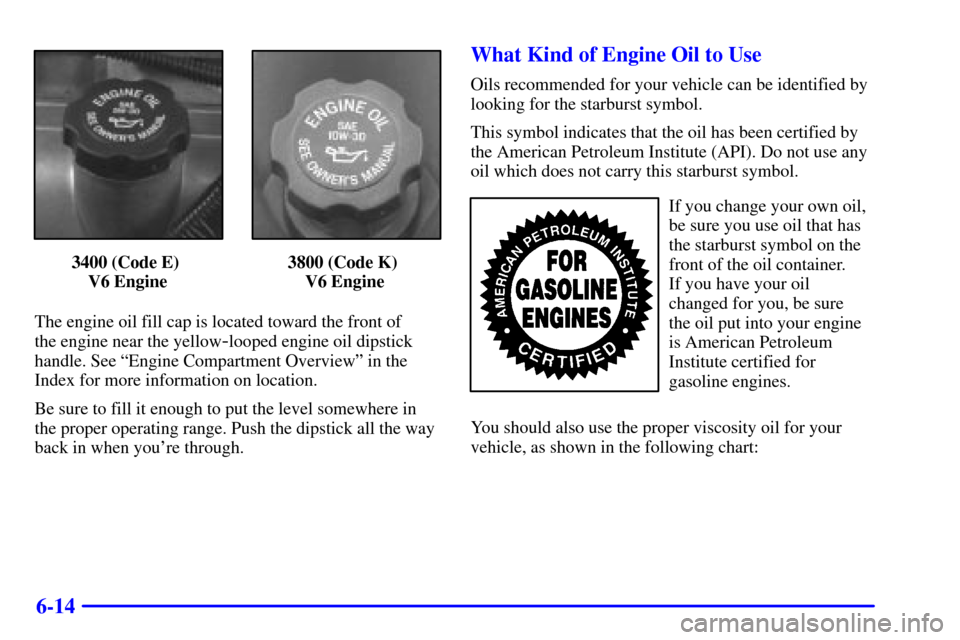
3400 (Code E)
V6 Engine3800 (Code K)
V6 Engine
The engine oil fill cap is located toward the front of
the engine near the yellow
-looped engine oil dipstick
handle. See ªEngine Compartment Overviewº in the
Index for more information on location.
Be sure to fill it enough to put the level somewhere in
the proper operating range. Push the dipstick all the way
back in when you're through.
What Kind of Engine Oil to Use
Oils recommended for your vehicle can be identified by
looking for the starburst symbol.
This symbol indicates that the oil has been certified by
the American Petroleum Institute (API). Do not use any
oil which does not carry this starburst symbol.
If you change your own oil,
be sure you use oil that has
the starburst symbol on the
front of the oil container.
If you have your oil
changed for you, be sure
the oil put into your engine
is American Petroleum
Institute certified for
gasoline engines.
You should also use the proper viscosity oil for your
vehicle, as shown in the following chart:
Page 306 of 392
6-19
Engine Air Cleaner/Filter
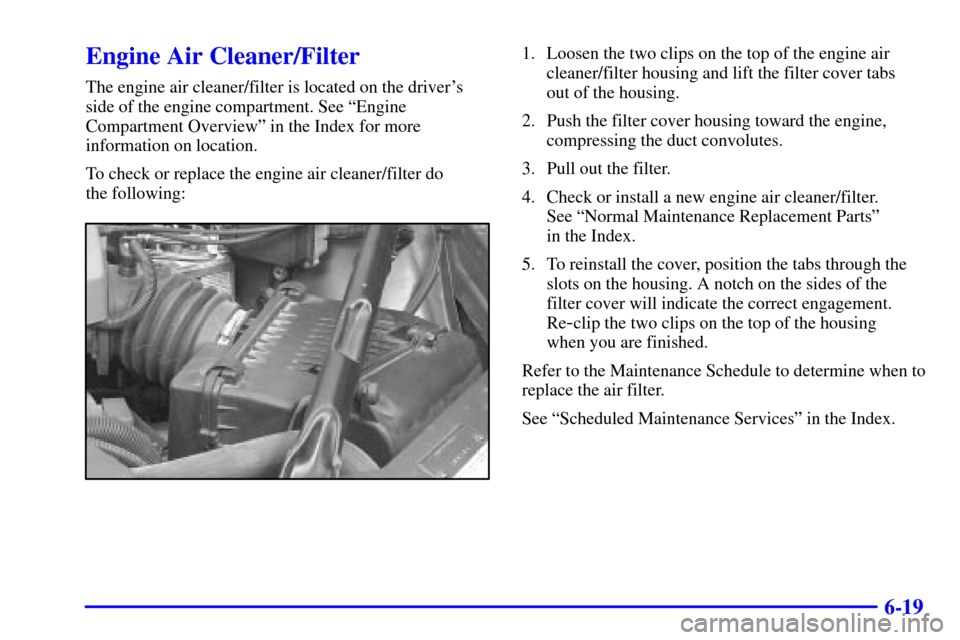
The engine air cleaner/filter is located on the driver's
side of the engine compartment. See ªEngine
Compartment Overviewº in the Index for more
information on location.
To check or replace the engine air cleaner/filter do
the following:
1. Loosen the two clips on the top of the engine air
cleaner/filter housing and lift the filter cover tabs
out of the housing.
2. Push the filter cover housing toward the engine,
compressing the duct convolutes.
3. Pull out the filter.
4. Check or install a new engine air cleaner/filter.
See ªNormal Maintenance Replacement Partsº
in the Index.
5. To reinstall the cover, position the tabs through the
slots on the housing. A notch on the sides of the
filter cover will indicate the correct engagement.
Re
-clip the two clips on the top of the housing
when you are finished.
Refer to the Maintenance Schedule to determine when to
replace the air filter.
See ªScheduled Maintenance Servicesº in the Index.
Page 308 of 392

6-21
To change the passenger compartment air filter, use the
following steps:
1. Turn off the ignition when the windshield wipers are
in the up position.
2. Raise the hood.
3. Disconnect the windshield washer pump hose from
the fender rail and air inlet grille.
4. Reposition the hood weatherstrip from the
passenger's side of the vehicle (peel back halfway
to center).
5. Remove the air inlet grille retainers.
6. Remove the air inlet grille.
7. Remove the air deflector grille in the compartment.
8. Remove the old passenger compartment air filter.
9. Then reverse the steps to install the new air filter.
For the type of filter to use, see ªNormal Maintenance
Replacement Partsº in the Index.Automatic Transaxle Fluid
When to Check and Change
A good time to check your automatic transaxle fluid
level is when the engine oil is changed.
Change both the fluid and filter every 50,000 miles
(83 000 km) if the vehicle is mainly driven under one or
more of these conditions:
�In heavy city traffic where the outside temperature
regularly reaches 90�F (32�C) or higher.
�In hilly or mountainous terrain.
�When doing frequent trailer towing.
�Uses such as found in taxi, police or delivery service.
If you do not use your vehicle under any of these conditions,
change the fluid and filter at 100,000 miles (166 000 km).
See ªScheduled Maintenance Servicesº in the Index.
Page 310 of 392
6-23
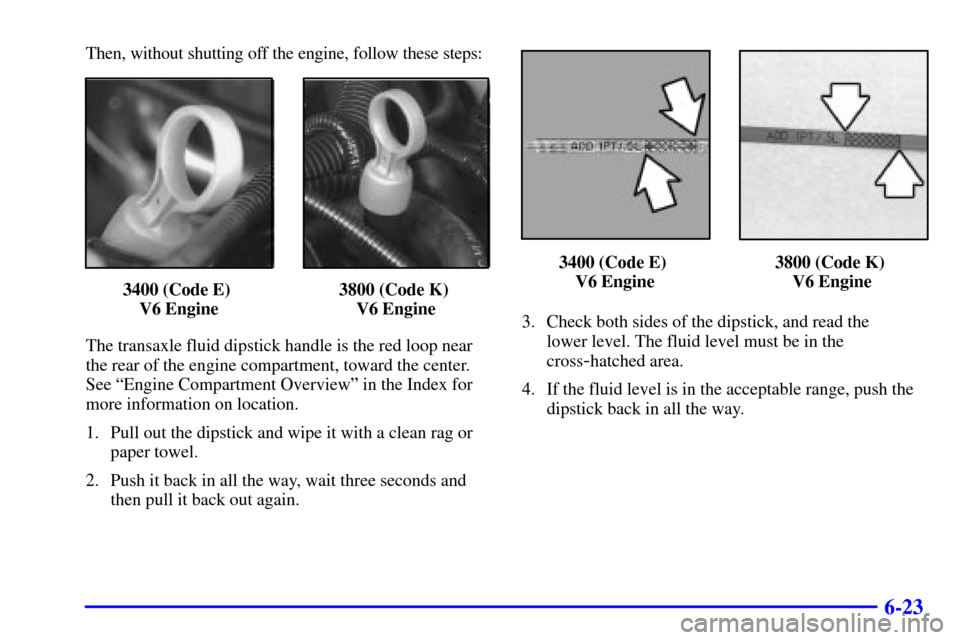
Then, without shutting off the engine, follow these steps:
3400 (Code E)
V6 Engine3800 (Code K)
V6 Engine
The transaxle fluid dipstick handle is the red loop near
the rear of the engine compartment, toward the center.
See ªEngine Compartment Overviewº in the Index for
more information on location.
1. Pull out the dipstick and wipe it with a clean rag or
paper towel.
2. Push it back in all the way, wait three seconds and
then pull it back out again.
3400 (Code E)
V6 Engine3800 (Code K)
V6 Engine
3. Check both sides of the dipstick, and read the
lower level. The fluid level must be in the
cross
-hatched area.
4. If the fluid level is in the acceptable range, push the
dipstick back in all the way.
Page 315 of 392
6-28
Radiator Pressure Cap
The radiator pressure cap is located in the front of
the engine compartment on the passenger's side,
near the diagonal cross brace. See ªEngine
Compartment Overviewº in the Index for more
information on location.
NOTICE:
Your radiator cap is a 15 psi (105 kPa)
pressure
-type cap and must be tightly installed to
prevent coolant loss and possible engine damage
from overheating. Be sure the arrows on the cap
line up with the overflow tube on the radiator
filler neck.
Power Steering Fluid
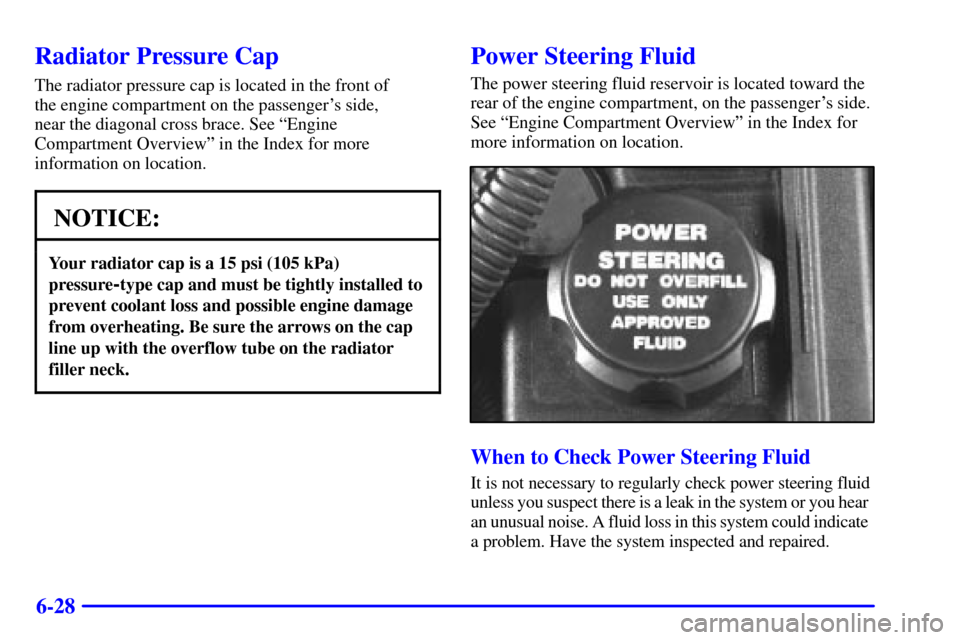
The power steering fluid reservoir is located toward the
rear of the engine compartment, on the passenger's side.
See ªEngine Compartment Overviewº in the Index for
more information on location.
When to Check Power Steering Fluid
It is not necessary to regularly check power steering fluid
unless you suspect there is a leak in the system or you hear
an unusual noise. A fluid loss in this system could indicate
a problem. Have the system inspected and repaired.
Page 327 of 392
6-40
Windshield Wiper Blade Replacement
Windshield wiper blades should be inspected at least
twice a year for wear or cracking. See ªWindshield
Wipers, Blade Checkº in the Index for
more information.
Replacement blades come in different types and are
removed in different ways. For proper type and length,
see ªNormal Maintenance Replacement Partsº in the
Index. Here's how to remove the wiper blades:
1. Turn on the wipers to the low wipe setting.
2. Turn off the ignition while the wipers are at the
outer positions of the wiper pattern. The blades are
more accessible for removal/replacement while in
this position.
3. Pull the windshield wiper arm away from
the windshield.
4. While holding the wiper arm away from the glass,
push the release clip from under the blade
connecting point and pull the old blade assembly
down toward the glass to remove it from the
wiper arm.
5. Push the new wiper blade securely on the wiper arm
until you hear the release clip ªclickº into place.
Page 332 of 392
6-45
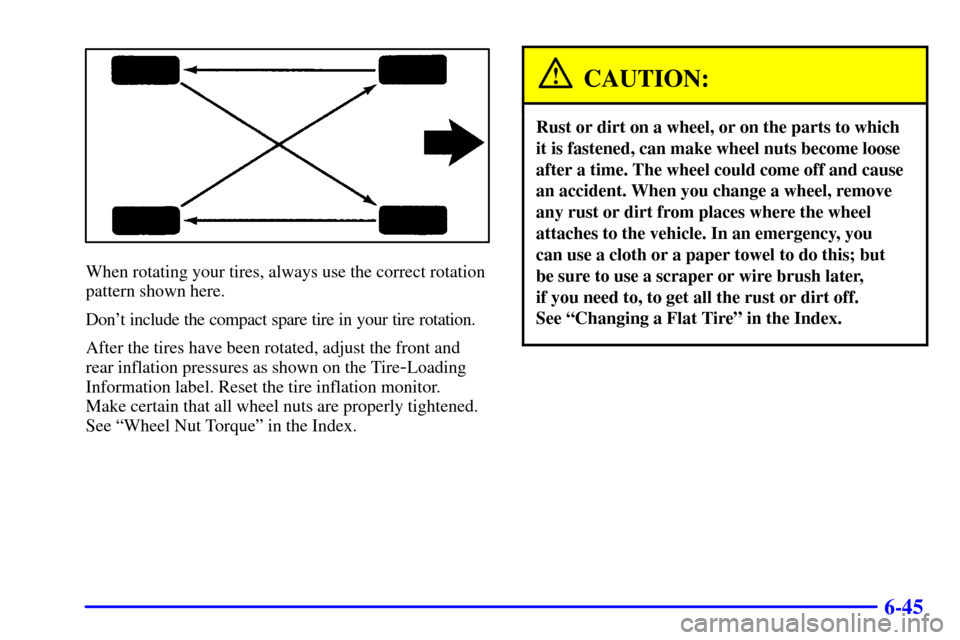
When rotating your tires, always use the correct rotation
pattern shown here.
Don't include the compact spare tire in your tire rotation.
After the tires have been rotated, adjust the front and
rear inflation pressures as shown on the Tire
-Loading
Information label. Reset the tire inflation monitor.
Make certain that all wheel nuts are properly tightened.
See ªWheel Nut Torqueº in the Index.
CAUTION:
Rust or dirt on a wheel, or on the parts to which
it is fastened, can make wheel nuts become loose
after a time. The wheel could come off and cause
an accident. When you change a wheel, remove
any rust or dirt from places where the wheel
attaches to the vehicle. In an emergency, you
can use a cloth or a paper towel to do this; but
be sure to use a scraper or wire brush later,
if you need to, to get all the rust or dirt off.
See ªChanging a Flat Tireº in the Index.
Page 339 of 392

6-52
Here are some cleaning tips:
�Always read the instructions on the cleaner label.
�Clean up stains as soon as you can
-- before they set.
�Carefully scrape off any excess stain.
�Use a clean cloth or sponge, and change to a clean area
often. A soft brush may be used if stains are stubborn.
�If a ring forms on fabric after spot cleaning, clean the
entire area immediately or it will set.
Using Multi-Purpose Interior Cleaner
on Fabric
1. Vacuum and brush the area to remove any loose dirt.
2. Always clean a whole trim panel or section.
Mask surrounding trim along stitch or welt lines.
3. Mix powdered cleaner following the directions on
the container label to form thick suds.
4. Use suds only and apply with a clean sponge.
Don't saturate the material and don't rub it roughly.
5. As soon as you've cleaned the section, use a sponge
to remove the suds.
6. Wipe cleaned area with a clean, damp towel or cloth.
7. Wipe with a clean cloth and let dry.
Special Fabric Cleaning Problems
Stains caused by such things as catsup, coffee (black),
egg, fruit, fruit juice, milk, soft drinks, vomit, urine and
blood can be removed as follows:
1. Carefully scrape off excess stain, then sponge the
soiled area with cool water.
2. If a stain remains, follow the Multi
-Purpose
Interior Cleaner instructions described earlier.
3. If an odor lingers after cleaning vomit or urine,
treat the area with a water/baking soda solution:
1 teaspoon (5 ml) of baking soda to 1 cup (250 ml)
of lukewarm water.
4. Let dry.
Stains caused by candy, ice cream, mayonnaise, chili
sauce and unknown stains can be removed as follows:
1. Carefully scrape off excess stain.
2. First, clean with cool water and allow to
dry completely.
3. If a stain remains, follow instructions for
Multi
-Purpose Interior Cleaner.