Page 249 of 392

4-33
That's the reason for this part. In it are many
time
-tested, important trailering tips and safety rules.
Many of these are important for your safety and that
of your passengers. So please read this section carefully
before you pull a trailer.
Load
-pulling components such as the engine, transaxle,
wheel assemblies and tires are forced to work harder
against the drag of the added weight. The engine is
required to operate at relatively higher speeds and under
greater loads, generating extra heat. What's more, the
trailer adds considerably to wind resistance, increasing
the pulling requirements.
If You Do Decide To Pull A Trailer
If you do, here are some important points:
�There are many different laws, including speed limit
restrictions, having to do with trailering. Make sure
your rig will be legal, not only where you live but
also where you'll be driving. A good source for this
information can be state or provincial police.
�Consider using a sway control. You can ask a hitch
dealer about sway controls.
�Don't tow a trailer at all during the first 1,000 miles
(1 600 km) your new vehicle is driven. Your engine,
axle or other parts could be damaged.�Then, during the first 500 miles (800 km) that you
tow a trailer, don't drive over 50 mph (80 km/h) and
don't make starts at full throttle. This helps your
engine and other parts of your vehicle wear in at the
heavier loads.
�Obey speed limit restrictions when towing a trailer.
Don't drive faster than the maximum posted speed
for trailers, or no more than 55 mph (90 km/h), to
save wear on your vehicle's parts.
Three important considerations have to do with weight:
�the weight of the trailer,
�the weight of the trailer tongue
�and the total weight on your vehicle's tires.
Weight of the Trailer
How heavy can a trailer safely be?
It should never weigh more than 1,000 lbs. (454 kg).
But even that can be too heavy.
It depends on how you plan to use your rig.
For example, speed, altitude, road grades, outside
temperature and how much your vehicle is used to
pull a trailer are all important. And, it can also depend
on any special equipment that you have on your vehicle.
Page 252 of 392
4-36
�Will the trailer brake parts take 3,000 psi
(20 650 kPa) of pressure? If not, the trailer brake
system must not be used with your vehicle.
�If everything checks out this far, then make the
brake fluid tap at the upper rear master cylinder port.
But don't use copper tubing for this. If you do, it
will bend and break off. Use steel brake tubing.
Driving with a Trailer
Towing a trailer requires a certain amount of experience.
Before setting out for the open road, you'll want to get
to know your rig. Acquaint yourself with the feel of
handling and braking with the added weight of the
trailer. And always keep in mind that the vehicle you
are driving is now a good deal longer and not nearly
as responsive as your vehicle is by itself.
Before you start, check the trailer hitch and platform
(and attachments), safety chains, electrical connector,
lamps, tires and mirror adjustment. If the trailer has
electric brakes, start your vehicle and trailer moving and
then apply the trailer brake controller by hand to be
sure the brakes are working. This lets you check your
electrical connection at the same time.
During your trip, check occasionally to be sure that the
load is secure, and that the lamps and any trailer brakes
are still working.
Following Distance
Stay at least twice as far behind the vehicle ahead as you
would when driving your vehicle without a trailer. This
can help you avoid situations that require heavy braking
and sudden turns.
Passing
You'll need more passing distance up ahead when
you're towing a trailer. And, because you're a good deal
longer, you'll need to go much farther beyond the
passed vehicle before you can return to your lane.
Backing Up
Hold the bottom of the steering wheel with one hand.
Then, to move the trailer to the left, just move that
hand to the left. To move the trailer to the right, move
your hand to the right. Always back up slowly and,
if possible, have someone guide you.
Page 254 of 392
4-38 Parking on Hills
CAUTION:
You really should not park your vehicle, with a
trailer attached, on a hill. If something goes
wrong, your rig could start to move. People can
be injured, and both your vehicle and the trailer
can be damaged.
But if you ever have to park your rig on a hill, here's
how to do it:
1. Apply your regular brakes, but don't shift into
PARK (P) yet.
2. Have someone place chocks under the trailer wheels.
3. When the wheel chocks are in place, release the
regular brakes until the chocks absorb the load.
4. Reapply the regular brakes. Then apply your parking
brake, and then shift to PARK (P).
5. Release the regular brakes.
When You Are Ready to Leave After
Parking on a Hill
1. Apply your regular brakes and hold the pedal down
while you:
�Start your engine;
�Shift into a gear; and
�Release the parking brake.
2. Let up on the brake pedal.
3. Drive slowly until the trailer is clear of the chocks.
4. Stop and have someone pick up and store the chocks.
Maintenance When Trailer Towing
Your vehicle will need service more often when you're
pulling a trailer. See the Maintenance Schedule for more
on this. Things that are especially important in trailer
operation are automatic transaxle fluid (don't overfill),
engine oil, drive belts, cooling system and brake system.
Each of these is covered in this manual, and the Index will
help you find them quickly. If you're trailering, it's a good
idea to review this information before you start your trip.
Check periodically to see that all hitch nuts and bolts are tight.
Engine Cooling When Trailer Towing
Your cooling system may temporarily overheat during
severe operating conditions. See ªEngine Overheatingº
in the Index.
Page 275 of 392
5-21
12. Then replace the pressure cap. At any time during
this procedure if coolant begins to flow out of the
filler neck, reinstall the pressure cap. Be sure the
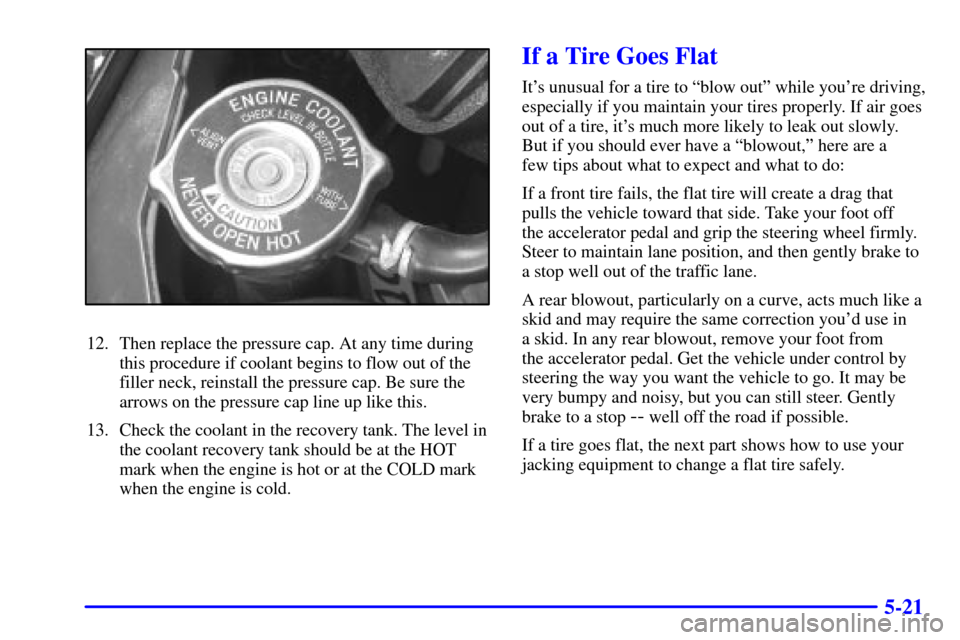
arrows on the pressure cap line up like this.
13. Check the coolant in the recovery tank. The level in
the coolant recovery tank should be at the HOT
mark when the engine is hot or at the COLD mark
when the engine is cold.
If a Tire Goes Flat
It's unusual for a tire to ªblow outº while you're driving,
especially if you maintain your tires properly. If air goes
out of a tire, it's much more likely to leak out slowly.
But if you should ever have a ªblowout,º here are a
few tips about what to expect and what to do:
If a front tire fails, the flat tire will create a drag that
pulls the vehicle toward that side. Take your foot off
the accelerator pedal and grip the steering wheel firmly.
Steer to maintain lane position, and then gently brake to
a stop well out of the traffic lane.
A rear blowout, particularly on a curve, acts much like a
skid and may require the same correction you'd use in
a skid. In any rear blowout, remove your foot from
the accelerator pedal. Get the vehicle under control by
steering the way you want the vehicle to go. It may be
very bumpy and noisy, but you can still steer. Gently
brake to a stop
-- well off the road if possible.
If a tire goes flat, the next part shows how to use your
jacking equipment to change a flat tire safely.
Page 276 of 392
5-22
Changing a Flat Tire
If a tire goes flat, avoid further tire and wheel damage
by driving slowly to a level place. Turn on your hazard
warning flashers.
CAUTION:
Changing a tire can cause an injury. The vehicle
can slip off the jack and roll over you or other
people. You and they could be badly injured.
Find a level place to change your tire. To help
prevent the vehicle from moving:
1. Set the parking brake firmly.
2. Put the shift lever in PARK (P).
3. Turn off the engine.
To be even more certain the vehicle won't move,
you can put blocks at the front and rear of the
tire farthest away from the one being changed.
That would be the tire on the other side of the
vehicle, at the opposite end.
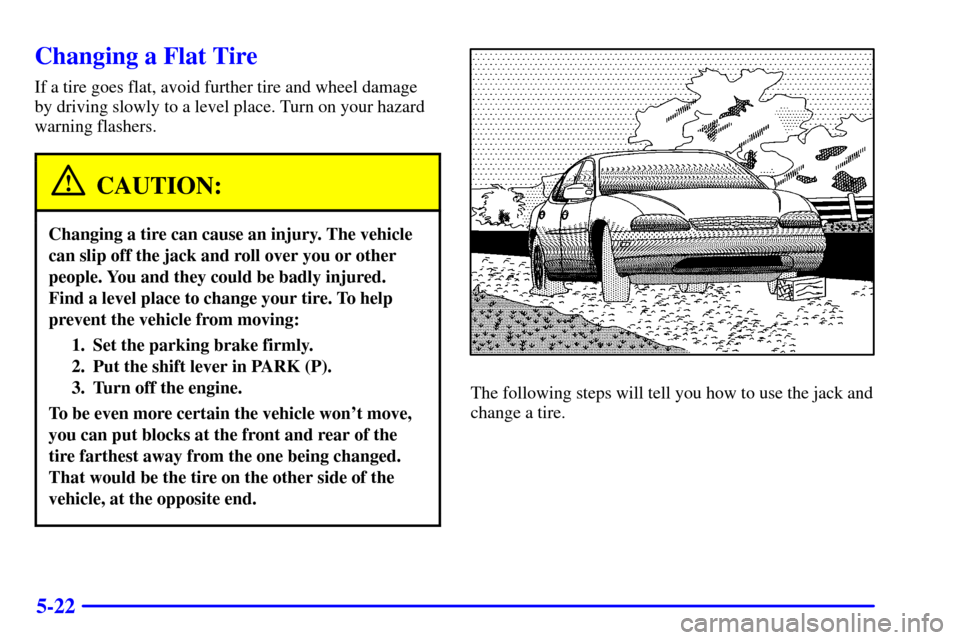
The following steps will tell you how to use the jack and
change a tire.
Page 278 of 392
5-24
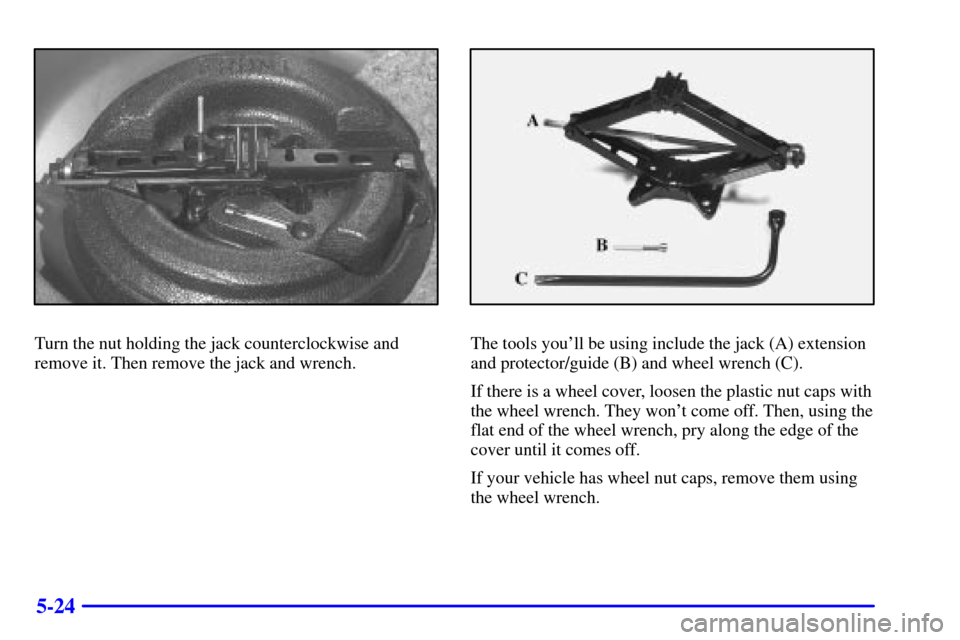
Turn the nut holding the jack counterclockwise and
remove it. Then remove the jack and wrench.The tools you'll be using include the jack (A) extension
and protector/guide (B) and wheel wrench (C).
If there is a wheel cover, loosen the plastic nut caps with
the wheel wrench. They won't come off. Then, using the
flat end of the wheel wrench, pry along the edge of the
cover until it comes off.
If your vehicle has wheel nut caps, remove them using
the wheel wrench.
Page 279 of 392
5-25 Removing the Flat Tire and Installing the
Spare Tire
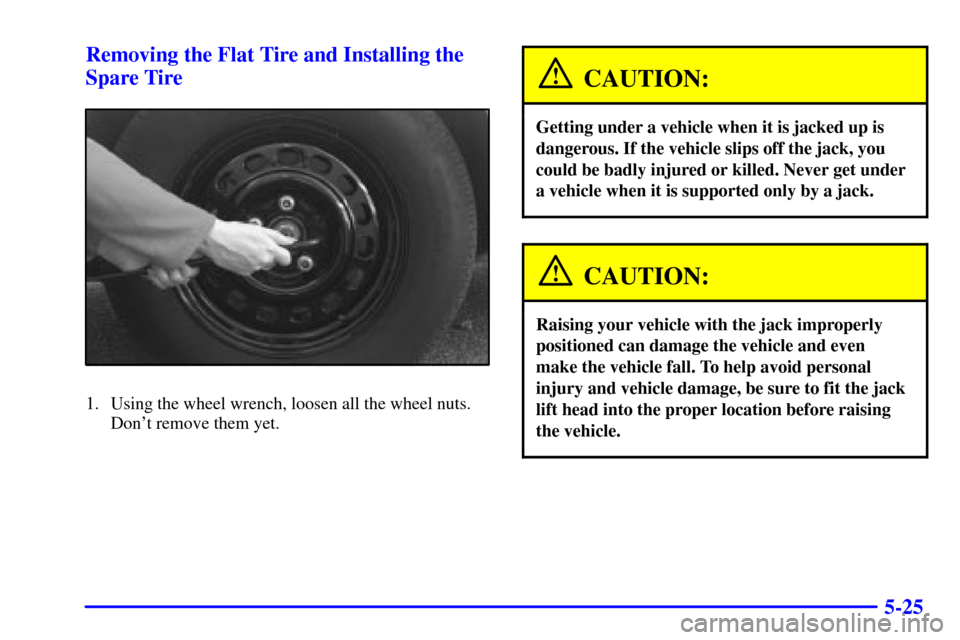
1. Using the wheel wrench, loosen all the wheel nuts.
Don't remove them yet.
CAUTION:
Getting under a vehicle when it is jacked up is
dangerous. If the vehicle slips off the jack, you
could be badly injured or killed. Never get under
a vehicle when it is supported only by a jack.
CAUTION:
Raising your vehicle with the jack improperly
positioned can damage the vehicle and even
make the vehicle fall. To help avoid personal
injury and vehicle damage, be sure to fit the jack
lift head into the proper location before raising
the vehicle.
Page 280 of 392
5-26
The diagram shows you where you should place
your jack. Use the bolts (A) as a guide when
positioning the jack lift head (C) near the rear edge
of the front wheel opening (B).
For jacking at the vehicle's front location, put jack
lift about 8.5 inches (21.5 cm) from the rear edge of
the front wheel opening in the cutout of the rocker
panel molding.
Put the compact spare tire near you.The diagram shows you where to place your jack.
Use the notch (B) as a guide when positioning the
jack lift head (A) near the front edge of the rear
wheel opening (C).
For jacking at the vehicle's rear location, put the jack
lift head about 4 inches (10 cm) from the front edge
of the rear wheel opening in the cutout of the rocker
panel molding.
Put the compact spare tire near you.