Page 5 of 383
Table of Contents (cont'd)
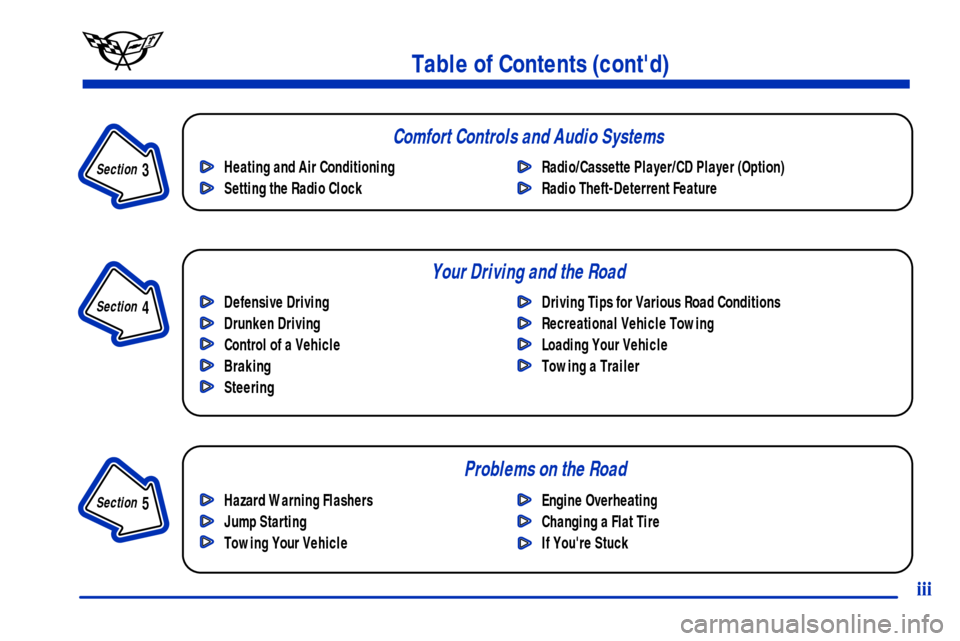
Defensive Driving
Drunken Driving
Control of a Vehicle
Braking
SteeringDriving Tips for Various Road Conditions
Recreational Vehicle Towing
Loading Your Vehicle
Towing a Trailer Heating and Air Conditioning
Setting the Radio ClockRadio/Cassette Player/CD Player (Option)
Radio Theft-Deterrent Feature
Hazard Warning Flashers
Jump Starting
Towing Your VehicleEngine Overheating
Changing a Flat Tire
If You're Stuck
Problems on the Road
Section
3
Section
4
Section
5
iii
Your Driving and the Road Comfort Controls and Audio Systems
Page 6 of 383
Table of Contents (cont'd)
Maintenance Schedule Service and Appearance Care
Section
7
Section
6
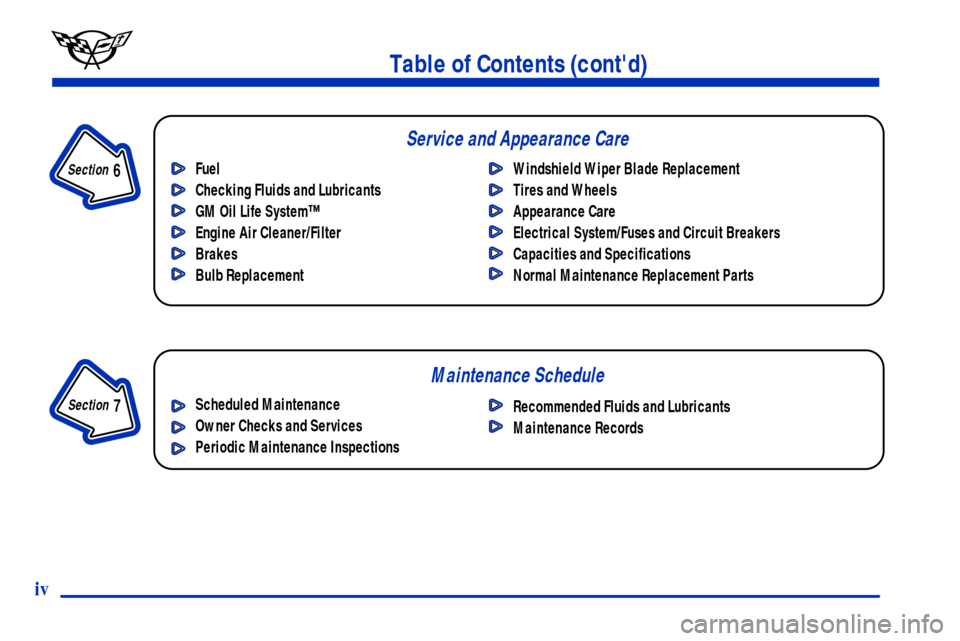
Scheduled Maintenance
Owner Checks and Services
Periodic Maintenance InspectionsRecommended Fluids and Lubricants
Maintenance Records Fuel
Checking Fluids and Lubricants
GM Oil Life System™
Engine Air Cleaner/Filter
Brakes
Bulb ReplacementWindshield Wiper Blade Replacement
Tires and Wheels
Appearance Care
Electrical System/Fuses and Circuit Breakers
Capacities and Specifications
Normal Maintenance Replacement Parts
iv
Page 9 of 383
vii
Corvette: The American
Dream Machine
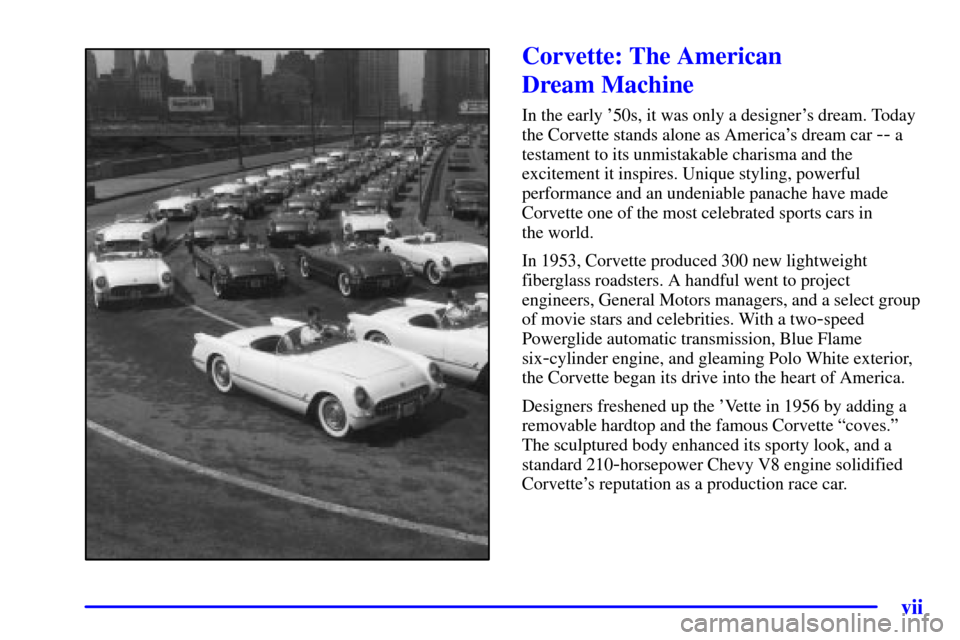
In the early '50s, it was only a designer's dream. Today
the Corvette stands alone as America's dream car
-- a
testament to its unmistakable charisma and the
excitement it inspires. Unique styling, powerful
performance and an undeniable panache have made
Corvette one of the most celebrated sports cars in
the world.
In 1953, Corvette produced 300 new lightweight
fiberglass roadsters. A handful went to project
engineers, General Motors managers, and a select group
of movie stars and celebrities. With a two
-speed
Powerglide automatic transmission, Blue Flame
six
-cylinder engine, and gleaming Polo White exterior,
the Corvette began its drive into the heart of America.
Designers freshened up the 'Vette in 1956 by adding a
removable hardtop and the famous Corvette ªcoves.º
The sculptured body enhanced its sporty look, and a
standard 210
-horsepower Chevy V8 engine solidified
Corvette's reputation as a production race car.
Page 12 of 383

x
In 1984, the fourth generation of America's favorite
sports car anticipated the future with a sleek look and
advanced technology that provided superior handling
and performance. Windshield angle was the sheerest of
any domestic vehicle, cornering ability the tightest of
any production car. In short, the 1984 redesign enhanced
the Corvette's reputation as a leader in the world sports
car market.
After 44 years of production, Corvette only got better.
The fifth
-generation Corvette arrived in 1997, featuring
a completely restyled body and a new, all
-aluminum,
5.7 Liter, 345
-horsepower LS1 V8 engine.The structure of the fifth
-generation redesign is the
stiffest ever developed in 44 years of Corvette
production, resulting in unparalleled ride quality and
outstanding handling. Also unique to the new Corvette
is a rear
-mounted transmission.
Available as a Coupe for 1997, the new Corvette offered
such standard features as extended
-mobility tires, a
Bose� audio system, and a new, latch-operated roof
designed for easy removal.
With many design cues inspired by the classic models
of the 1960s, the new fifth-generation Corvette is an
impressive combination of sleek styling and world
-class
sports car performance. For 1998, in addition to the
Coupe, a convertible was reintroduced. The
fifth-generation Corvette rollout was completed in 1999
with the introduction of the hardtop model.
For 2001, all hardtop models become the higher
performance Z06. The Z06 model features the
performance enhanced LS6 engine, specific suspension
components and exterior/interior differentiation.
Page 16 of 383

xiv
For example,
these symbols
are used on an
original battery:
CAUTION
POSSIBLE
INJURY
PROTECT
EYES BY
SHIELDING
CAUSTIC
BATTERY
ACID COULD
CAUSE
BURNS
AVOID
SPARKS OR
FLAMES
SPARK OR
FLAME
COULD
EXPLODE
BATTERY
These symbols
are important for
you and your
passengers
whenever your
vehicle is driven:
CHILD
RESTRAINT
TOP STRAP
ANCHOR
DOOR LOCK
UNLOCK
FASTEN
SEAT
BELTS
POWER
WINDOW
AIR BAG
These symbols
have to do with
your lamps:
MASTER
LIGHTING
SWITCH
TURN
SIGNALS
PARKING
LAMPS
HAZARD
WARNING
FLASHER
DAYTIME
RUNNING
LAMPS
FOG LAMPS
These symbols
are on some of
your controls:
WINDSHIELD
WIPER
WINDSHIELD
WASHER
WINDSHIELD
DEFROSTER
REAR
WINDOW
DEFOGGER
VENTILATING
FAN
These symbols
are used on
warning and
indicator lights:
ENGINE
COOLANT
TEMP
BATTERY
CHARGING
SYSTEM
BRAKE
COOLANT
ENGINE OIL
PRESSURE
ANTI-LOCK
BRAKES
Here are some
other symbols
you may see:
FUSE
LIGHTER
HORN
FUEL
Vehicle Symbols
These are some of the symbols you may find on your vehicle. Also see ªWarning Lights and Gagesº in the Index.
Page 18 of 383
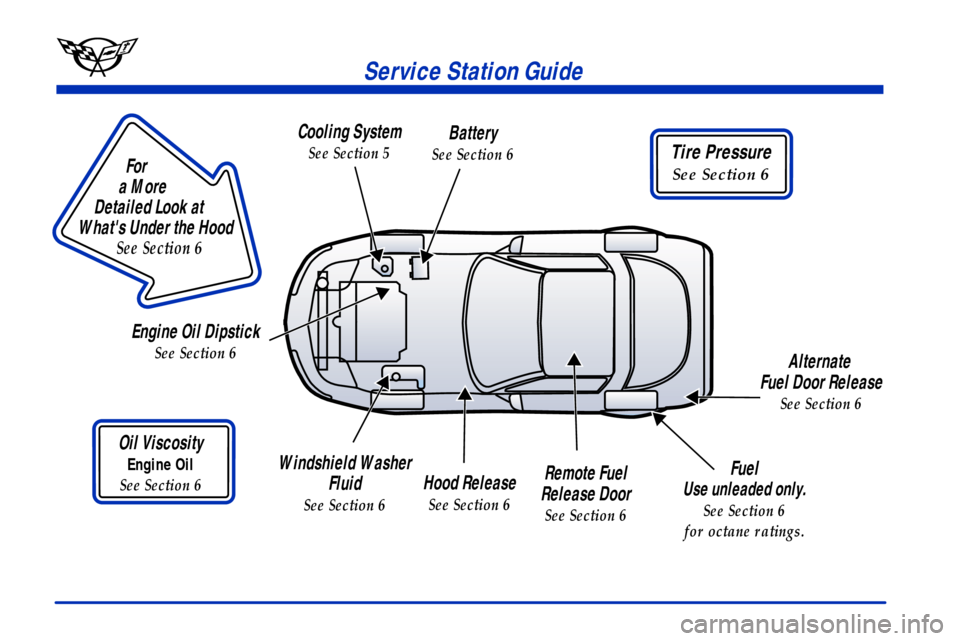
Service Station Guide
Oil Viscosity
Engine Oil
See Section 6
Tire Pressure
See Section 6
Engine Oil Dipstick
See Section 6
Cooling System
See Section 5
Battery
See Section 6
Windshield Washer
Fluid
See Section 6
Hood Release
See Section 6
Remote Fuel
Release Door
See Section 6
For
a More
Detailed Look at
What's Under the Hood
See Section 6
Alternate
Fuel Door Release
See Section 6
Fuel
Use unleaded only.
See Section 6
for octane ratings.
Page 42 of 383
1-24
�Your vehicle is equipped with a diagnostic module,
which records information about the air bag system.
The module records information about the readiness
of the system, when the system commands air bag
inflation and driver's safety belt usage at
deployment. The module also records speed, engine
rpm, brake and throttle data.
�Let only qualified technicians work on your air bag
system. Improper service can mean that your air
bag system won't work properly. See your dealer
for service.
NOTICE:
If you damage the covering for the driver's or the
passenger's air bag, the bag may not work
properly. You may have to replace the air bag
module in the steering wheel or both the air bag
module and the instrument panel for the
passenger's air bag. Do not open or break the air
bag coverings.
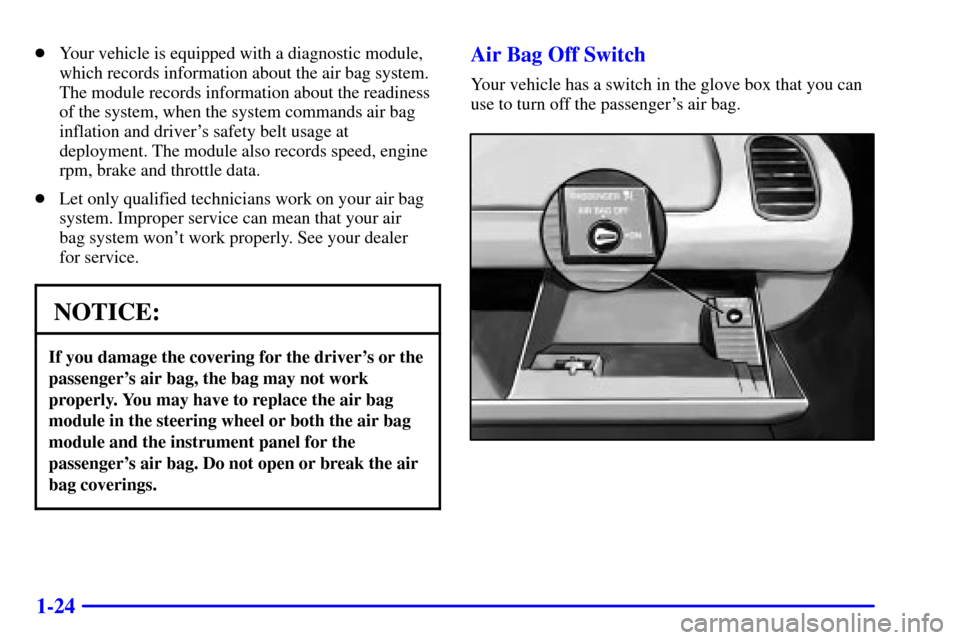
Air Bag Off Switch
Your vehicle has a switch in the glove box that you can
use to turn off the passenger's air bag.
Page 63 of 383
2-
2-1
Section 2 Features and Controls
Here you can learn about the many standard and optional features on your vehicle, and information on starting,
shifting and braking. Also explained are the instrument panel and the warning systems that tell you if everything is
working properly
-- and what to do if you have a problem.
2
-2 Windows
2
-4 Keys
2
-6 Door Locks
2
-7 Memory (Option)
2
-9 Remote Keyless Entry (RKE) System
2
-14 Hatch/Trunk Lid Release
2
-19 Theft-Deterrent System
2
-20 PASS-Key�
2-21 New Vehicle ªBreak-Inº
2
-22 Ignition Switch
2
-24 Starting Your Engine
2
-26 Engine Coolant Heater (Canada Only)
2
-28 Automatic Transmission Operation
2
-31 Manual Transmission Operation
2
-35 Parking Brake
2
-36 Shifting Into PARK (P)
(Automatic Transmission Only)
2
-38 Shifting Out of PARK (P)
(Automatic Transmission)2
-38 Parking Your Vehicle (Manual Transmission
Models Only)
2
-39 Parking Over Things That Burn
2
-39 Engine Exhaust
2
-40 Running Your Engine While You're Parked
(Automatic Transmission)
2
-40 Limited-Slip Rear Axle
2
-41 Selective Real Time Damping (SRTD) (Option)
2
-43 Turn Signal/Multifunction Lever
2
-51 Exterior Lamps
2
-53 Interior Lamps
2
-54 Mirrors
2
-57 Storage Compartments
2
-62 Roof Panel (If Equipped)
2
-69 Convertible Top (Option)
2
-76 The Instrument Panel -- Your
Information System
2
-80 Warning Lights, Gages and Messages
2
-93 Driver Information Center (DIC)