Page 102 of 383
2-40
Running Your Engine While You're
Parked (Automatic Transmission)
It's better not to park with the engine running. But if you
ever have to, here are some things to know.
CAUTION:
Idling the engine with the climate control system
off could allow dangerous exhaust into your
vehicle. See the earlier Caution under
ªEngine Exhaust.º
Also, idling in a closed-in place can let deadly
carbon monoxide (CO) into your vehicle even if
the fan switch is at the highest setting. One place
this can happen is a garage. Exhaust
-- with
CO
-- can come in easily. NEVER park in a
garage with the engine running.
Another closed-in place can be a blizzard.
See ªBlizzardº in the Index.
CAUTION:
It can be dangerous to get out of your vehicle if
the shift lever is not fully in PARK (P) with the
parking brake firmly set. Your vehicle can roll.
Don't leave your vehicle when the engine is
running unless you have to. If you've left the
engine running, the vehicle can move suddenly.
You or others could be injured. To be sure your
vehicle won't move, even when you're on fairly
level ground, always set your parking brake and
move the shift lever to PARK (P).
Follow the proper steps to be sure your vehicle won't
move. See ªShifting Into PARK (P)º in the Index.
Limited-Slip Rear Axle
Your limited-slip rear axle can give you additional traction
on snow, mud, ice, sand or gravel. It works like a standard
axle most of the time, but when one of the rear wheels has
no traction and the other does, this feature will allow the
wheel with traction to move the vehicle.
Page 110 of 383
2-48
When using cruise control, the accelerator pedal will
return to its fully
-released position and will not move
while cruise control is engaged.
The Driver Information Center (DIC) will display the
cruise set speed in a digital number. For example, the
DIC will say CRUISE SET 60 mph (97 km/h). The
cruise set speed and the speedometer indicated speed
may not always be exactly the same. When you
apply the brakes or push the clutch pedal, the cruise
control disengages. The DIC will show CRUISE
DISENGAGED. See ªDIC Warnings and Messagesº
in the Index.CAUTION:
�Cruise control can be dangerous where you
can't drive safely at a steady speed. So,
don't use your cruise control on winding
roads or in heavy traffic.
�Cruise control can be dangerous on
slippery roads. On such roads, fast changes
in tire traction can cause needless wheel
spinning, and you could lose control.
Don't use cruise control on slippery roads.
If your vehicle is in cruise control when the Traction
Control System begins to limit wheel spin, the cruise
control will automatically disengage. See ªTraction
Control Systemº in the Index. When road conditions
allow you to safely use it again, you may turn the cruise
control back on.
Page 111 of 383
2-49
Setting Cruise Control
CAUTION:
If you leave your cruise control switch on when
you're not using cruise, you might hit a button
and go into cruise when you don't want to. You
could be startled and even lose control. Keep the
cruise control switch off until you want to use
cruise control.
1. Move the cruise control switch to ON.
2. Get up to the speed you want.
3. Push the SET button at the end of the lever and
release it. The cruise set speed will be displayed by
the Driver Information Center (DIC).
4. Take your foot off the accelerator pedal. The pedal
will return to an ªidleº position.Resuming a Set Speed
Suppose you set the cruise control at a desired speed and
then you apply the brake or clutch pedal. This, of
course, disengages the cruise control. But you don't
need to reset it.
Once you're going about 25 mph (40 km/h)
or more, you can move the cruise control switch to
R/A (Resume/Accelerate) briefly. The Driver Information
Center (DIC) will display the cruise set speed.
You'll go right back up to your chosen speed and
stay there.
Increasing Speed While Using Cruise Control
There are two ways to go to a higher speed:
�Use the accelerator pedal to get to the higher speed. The
speed will not begin to increase until sufficient pedal
travel is achieved. Push the SET button at the end of the
lever, then release the button and the accelerator pedal.
You'll now cruise at the higher speed.
Page 112 of 383

2-50
�Move the cruise switch to R/A. Hold it there until
you get up to the speed you want, then release the
switch. (To increase your speed in very small
amounts, move the switch to R/A briefly, then
release it. Each time you do this, the vehicle will go
about 1 mph (1.6 km/h) faster.)
The Driver Information Center (DIC) will display the
cruise set speed.
Reducing Speed While Using Cruise Control
There are two ways to reduce speed while using
cruise control:
�Push in the SET button at the end of the lever until
you reach the lower speed you want, then release it.
�To slow down in very small amounts, push the
SET button briefly. Each time you do this, you'll
go about 1 mph (1.6 km/h) slower.
The Driver Information Center (DIC) will display the
cruise set speed.Passing Another Vehicle While Using Cruise Control
Use the accelerator pedal to increase speed. When you
take your foot off the pedal, the vehicle will slow down
to the cruise control speed you set earlier.
Using Cruise Control on Hills
How well your cruise control will work on hills depends
upon your speed, load and the steepness of the hills.
When going downhill, you may have to brake or shift to
a lower gear to keep your speed down. Of course,
applying the brake takes you out of cruise control.
Many drivers find this to be too much trouble and don't
use cruise control on steep hills.
Ending Cruise Control
There are two ways to turn off the cruise control:
�Step lightly on the brake pedal or push the clutch
pedal, if you have a manual transmission vehicle.
�Move the cruise switch to OFF.
The Driver Information Center (DIC) will display the
message ªCRUISE DISENGAGED.º
Erasing Speed Memory
When you turn off the cruise control or the ignition,
cruise control set speed memory is erased.
Page 113 of 383
2-51
Exterior Lamps
Daytime Running Lamps
Daytime Running Lamps (DRL) can make it easier for
others to see the front of your vehicle during the day.
DRL can be helpful in many different driving
conditions, but they can be especially helpful in the
short periods after dawn and before sunset. Fully
functional daytime running lights are required on all
vehicles first sold in Canada.
The DRL system will make the front turn signal lamps
come on when the following conditions are met:
�The ignition is on,
�the headlamp switch is off and
�the parking brake is released.
When the DRL are on, only the front turn signal lamps
will be on. The headlamps, taillamps, sidemarker and
other lamps won't be on. Your instrument panel won't
be lit up either.
To idle the vehicle with the DRL off, set the parking
brake while the ignition is in OFF. Then start the
vehicle. The DRL, headlamps and parking lamps will
stay off until you release the parking brake.
As with any vehicle, you should turn on the regular
headlamp system when you need it.
Fog Lamps (If Equipped)
Use the fog lamps for better vision in foggy or misty
conditions. Your parking lamps or low
-beam headlamps
must be on or the fog lamps won't work.
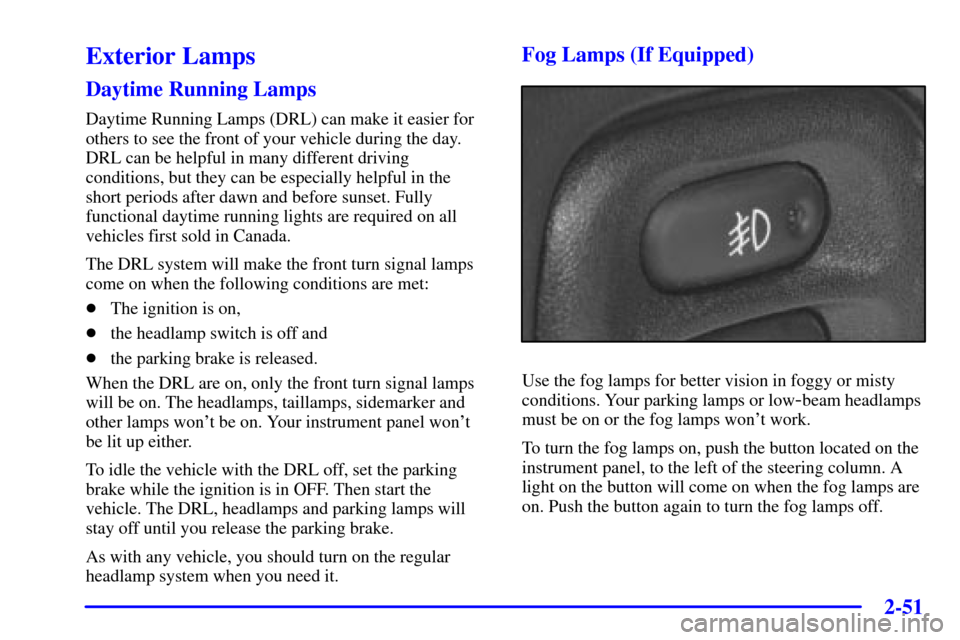
To turn the fog lamps on, push the button located on the
instrument panel, to the left of the steering column. A
light on the button will come on when the fog lamps are
on. Push the button again to turn the fog lamps off.
Page 114 of 383

2-52
Twilight Sentinel� Automatic Lamp
Control (Optional, Standard in Canada)
Twilight Sentinel can turn your lamps on and off for
you. A light sensor on top of the instrument panel makes
the Twilight Sentinel work, so be sure it isn't covered.
You can customize your vehicle to turn Twilight
Sentinel on or off (except for vehicles first sold in
Canada). See ªDriver Information Center (DIC)º in the
Index to turn this feature on or off.
When Twilight Sentinel is turned on, you will see the
following happen:
�When it's dark enough outside, the front turn signal
lamps (DRL) will go off, and the headlamps and
parking lamps will come on. The other lamps that
come on with headlamps will also come on.
�When it's bright enough outside, the headlamps will
go off, and the front turn signal lamps (DRL) will
come on, as long as the headlamp switch is in the
OFF position.
With Twilight Sentinel turned on, you can idle the
vehicle with the lamps off, even when it's dark outside.
First set the parking brake while the ignition is in OFF.
Then start the vehicle. The lamps will stay off until you
release the parking brake.Twilight Sentinel also provides exterior illumination as
you leave the vehicle. If Twilight Sentinel has turned on
the lamps when you turn off the ignition, your lamps
will remain on until:
�The headlamp switch is moved from OFF to the
parking lamp position, or
�a delay time that you select has elapsed.
See ªDriver Information Center (DIC)º in the Index to
select the delay time that you want. You can also select
no delay time.
If you turn off the ignition with the headlamp switch in
the parking lamp or headlamp position, the Twilight
Sentinel delay will not occur. The lamps will turn off as
soon as the switch is turned off.
As with any vehicle, you should turn on the regular
headlamp system when you need it.
Page 125 of 383
2-63
NOTICE:
To avoid damage to the roof panel, paint and
weatherstripping, do not drop or rest it on its
edges. Place the roof panel in the egg
-shaped
stowage receivers after removing it from
the vehicle.
1. Park on a level surface, set the parking brake firmly
and shift an automatic transmission into PARK (P).
Shift a manual transmission into REVERSE (R).
2. Turn the ignition key to OFF. Lower both sun visors
and turn them toward the door glass.
3. Open the rear liftgate and remove any items that may
interfere with proper storage of the roof panel.
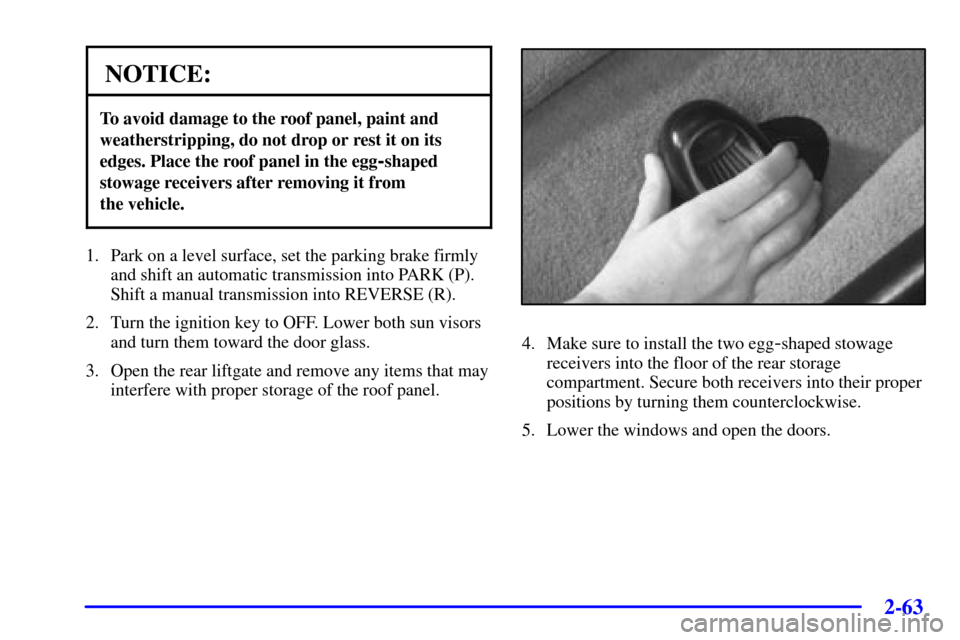
4. Make sure to install the two egg-shaped stowage
receivers into the floor of the rear storage
compartment. Secure both receivers into their proper
positions by turning them counterclockwise.
5. Lower the windows and open the doors.
Page 132 of 383
2-70
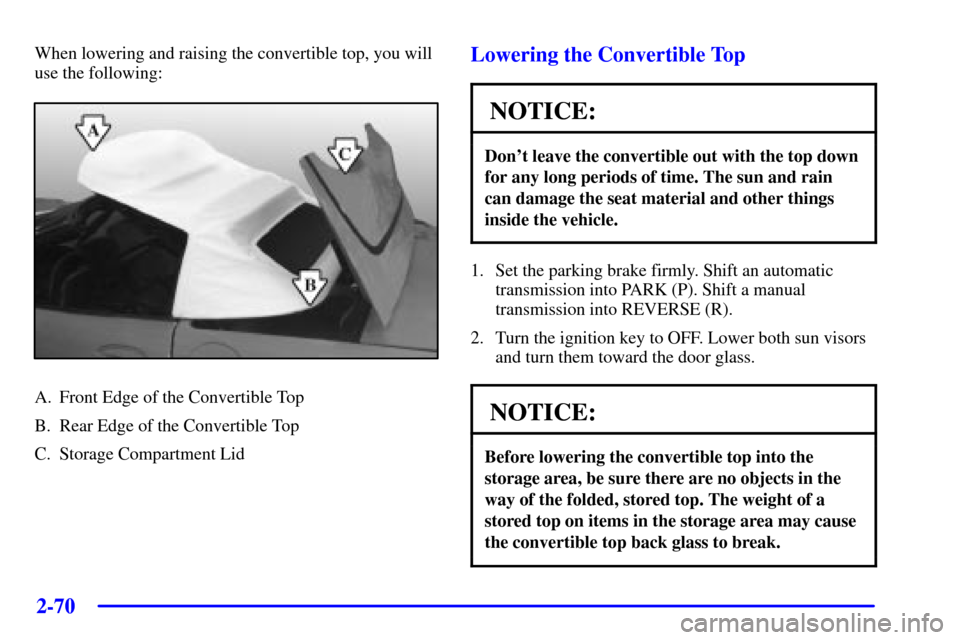
When lowering and raising the convertible top, you will
use the following:
A. Front Edge of the Convertible Top
B. Rear Edge of the Convertible Top
C. Storage Compartment Lid
Lowering the Convertible Top
NOTICE:
Don't leave the convertible out with the top down
for any long periods of time. The sun and rain
can damage the seat material and other things
inside the vehicle.
1. Set the parking brake firmly. Shift an automatic
transmission into PARK (P). Shift a manual
transmission into REVERSE (R).
2. Turn the ignition key to OFF. Lower both sun visors
and turn them toward the door glass.
NOTICE:
Before lowering the convertible top into the
storage area, be sure there are no objects in the
way of the folded, stored top. The weight of a
stored top on items in the storage area may cause
the convertible top back glass to break.