Page 196 of 357
4-30
Run your engine only as long as you must. This saves
fuel. When you run the engine, make it go a little faster
than just idle. That is, push the accelerator slightly. This
uses less fuel for the heat that you get and it keeps the
battery charged. You will need a well
-charged battery to
restart the vehicle, and possibly for signaling later on
with your headlamps. Let the heater run for a while.
Then, shut the engine off and close the window almost
all the way to preserve the heat. Start the engine again
and repeat this only when you feel really uncomfortable
from the cold. But do it as little as possible. Preserve the
fuel as long as you can. To help keep warm, you can get
out of the vehicle and do some fairly vigorous exercises
every half hour or so until help comes.
Recreational Vehicle Towing
You can tow your vehicle behind another vehicle for use
at your destination. Be sure to use the proper towing
equipment designed for recreational towing. Follow the
instructions for towing equipment.
If your vehicle is equipped with a remote keyless entry
system, it also has the content theft feature. If the
vehicle is towed as recommended, with the ignition in
OFF, or if necessary, with the ignition off and the key
out, it may be necessary to do one of the following:
�Prior to towing do not lock your car doors with the
remote keyless entry transmitter. Do not enable the
content theft feature.
�Remove the BCM/CLU fuse in the instrument panel
fuse block. This is located under the driver's side
instrument panel cover. After towing, remember to
reinstall the fuse to restore normal vehicle operation.
If the vehicle is towed at a large angle, or if the vehicle
experiences significant braking forces, the trunk ªopenº
sensor may be actuated, enabling content theft and
sounding the horn (while in tow).
Page 197 of 357
4-31 Towing Your Vehicle From the Front
3-Speed Automatic Transaxle
(With a Dolly)
You may tow your vehicle using a towing dolly if you
have a three
-speed automatic transaxle. Follow these steps:
1. Put the front wheels on a dolly.
2. Set the parking brake.
3. Turn the ignition key to OFF to unlock the steering
wheel. See ªIgnition Positionsº in the Index.
4. Clamp the steering wheel in a straight
-ahead position
with a clamping device designed for towing.
5. Release the parking brake.
Page 198 of 357
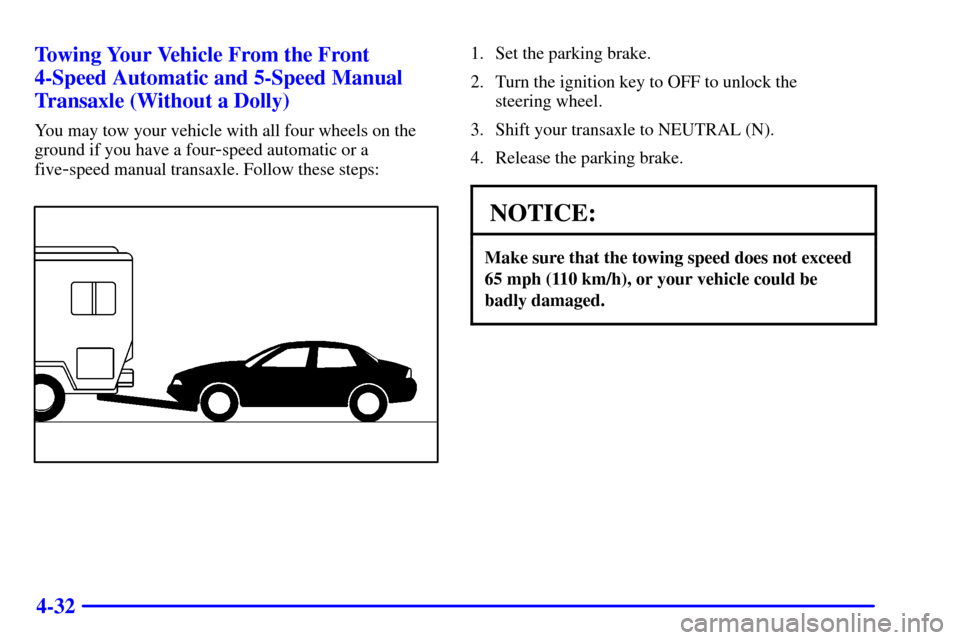
4-32 Towing Your Vehicle From the Front
4-Speed Automatic and 5-Speed Manual
Transaxle (Without a Dolly)
You may tow your vehicle with all four wheels on the
ground if you have a four
-speed automatic or a
five
-speed manual transaxle. Follow these steps:
1. Set the parking brake.
2. Turn the ignition key to OFF to unlock the
steering wheel.
3. Shift your transaxle to NEUTRAL (N).
4. Release the parking brake.
NOTICE:
Make sure that the towing speed does not exceed
65 mph (110 km/h), or your vehicle could be
badly damaged.
Page 199 of 357
4-33 Towing Your Vehicle from the Rear
(All Transaxles)
NOTICE:
Do not tow your vehicle from the rear. Your
vehicle could be badly damaged and the repairs
would not be covered by your warranty.
Loading Your Vehicle
Two labels on your vehicle show how much weight it
may properly carry. The Tire
-Loading Information label
found on the rear edge of the driver's door tells you the
proper size, speed rating and recommended inflation
pressures for the tires on your vehicle. It also gives you
important information about the number of people that
can be in your vehicle and the total weight that you can
carry. This weight is called the Vehicle Capacity Weight,
and includes the weight of all occupants, cargo and all
nonfactory
-installed options.
Page 201 of 357
4-35
CAUTION:
Things you put inside your vehicle can strike and
injure people in a sudden stop or turn, or in a crash.
�Put things in the trunk or rear area of your
vehicle. In a trunk, put them as far forward
as you can. Try to spread the weight evenly.
If you have fold
-down rear seats, you'll
find four anchors on the back wall of your
trunk. You can use these anchors to tie
down lighter loads. They're not strong
enough for heavy things, however, so put
them as far forward as you can in the trunk
or rear area.
�Never stack heavier things, like suitcases,
inside the vehicle so that some of them are
above the tops of the seats.
�Don't leave an unsecured child restraint in
your vehicle.
�When you carry something inside the
vehicle, secure it whenever you can.
�Don't leave a seat folded down unless you
need to.
Towing a Trailer (Models with
2.4L L4 Engine and 4
-Speed
Automatic Transaxle)
CAUTION:
If you don't use the correct equipment and drive
properly, you can lose control when you pull a
trailer. For example, if the trailer is too heavy, the
brakes may not work well
-- or even at all. You
and your passengers could be seriously injured.
You may also damage your vehicle; the resulting
repairs would not be covered by your warranty.
Pull a trailer only if you have followed all the
steps in this section. Ask your dealer for advice
and information about towing a trailer with
your vehicle.
Page 202 of 357

4-36
Your vehicle can tow a trailer if it is equipped with a
2.4L L4 engine and four
-speed automatic transaxle and
the proper trailer towing equipment. If your vehicle is
not equipped as stated above, do not tow a trailer. To
identify what the vehicle trailering capacity is for your
vehicle, you should read the information in ªWeight of
the Trailerº that appears later in this section. But
trailering is different than just driving your vehicle by
itself. Trailering means changes in handling, durability
and fuel economy. Successful, safe trailering takes
correct equipment, and it has to be used properly.
That's the reason for this part. In it are many
time
-tested, important trailering tips and safety rules.
Many of these are important for your safety and that of
your passengers. So please read this section carefully
before you pull a trailer.
Load
-pulling components such as the engine, transaxle,
wheel assemblies and tires are forced to work harder
against the drag of the added weight. The engine is
required to operate at relatively higher speeds and under
greater loads, generating extra heat. What's more, the
trailer adds considerably to wind resistance, increasing
the pulling requirements.
If You Do Decide To Pull A Trailer
If you do, here are some important points:
�There are many different laws, including speed limit
restrictions, having to do with trailering. Make sure
your rig will be legal, not only where you live but
also where you'll be driving. A good source for this
information can be state or provincial police.
�Consider using a sway control. You can ask a hitch
dealer about sway controls.
�Don't tow a trailer at all during the first 1,000 miles
(1 600 km) your new vehicle is driven. Your engine,
axle or other parts could be damaged.
�Then, during the first 500 miles (800 km) that you
tow a trailer, don't drive over 50 mph (80 km/h) and
don't make starts at full throttle. This helps your
engine and other parts of your vehicle wear in at the
heavier loads.
�Obey speed limit restrictions when towing a trailer.
Don't drive faster than the maximum posted speed
for trailers, or no more than 55 mph (90 km/h), to
save wear on your vehicle's parts.
�Do not tow when the outside air temperature is
above 100�F (38�C).
�Do not tow more than 1,000 miles (1 600 km)
per year.
Page 203 of 357

4-37
Three important considerations have to do with weight:
�the weight of the trailer,
�the weight of the trailer tongue
�and the total weight on your vehicle's tires.
Weight of the Trailer
How heavy can a trailer safely be?
It should never weigh more than 1,000 lbs. (450 kg).
But even that can be too heavy.
It depends on how you plan to use your rig. For example,
speed, altitude, road grades, outside temperature and
how much your vehicle is used to pull a trailer are all
important. And, it can also depend on any special
equipment that you have on your vehicle.
You can ask your dealer for our trailering information or
advice, or you can write us at:
Chevrolet Motor Division
Customer Assistance Center
P.O. Box 33170
Detroit, MI 48232
-5170In Canada, write to:
General Motors of Canada Limited
Customer Communication Centre, 163
-005
1908 Colonel Sam Drive
Oshawa, Ontario L1H 8P7
Weight of the Trailer Tongue
The tongue load (A) of any trailer is an important
weight to measure because it affects the total or gross
weight of your vehicle. The Gross Vehicle Weight
(GVW) includes the curb weight of the vehicle, any
cargo you may carry in it, and the people who will be
riding in the vehicle. And if you tow a trailer, you must
add the tongue load to the GVW because your vehicle
will be carrying that weight, too. See ªLoading Your
Vehicleº in the Index for more information about your
vehicle's maximum load capacity.
Page 205 of 357

4-39 Safety Chains
You should always attach chains between your vehicle
and your trailer. Cross the safety chains under the tongue
of the trailer so that the tongue will not drop to the road
if it becomes separated from the hitch. Instructions
about safety chains may be provided by the hitch
manufacturer or by the trailer manufacturer. Follow the
manufacturer's recommendation for attaching safety
chains and do not attach them to the bumper. Always
leave just enough slack so you can turn with your rig.
And, never allow safety chains to drag on the ground.
Trailer Brakes
Does your trailer have its own brakes? Be sure to read
and follow the instructions for the trailer brakes so
you'll be able to install, adjust and maintain them
properly. Because you have anti
-lock brakes, do not try
to tap into your vehicle's brake system. If you do, both
brake systems won't work well, or at all.
Driving with a Trailer
Towing a trailer requires a certain amount of experience.
Before setting out for the open road, you'll want to get
to know your rig. Acquaint yourself with the feel of
handling and braking with the added weight of the
trailer. And always keep in mind that the vehicle you are
driving is now a good deal longer and not nearly as
responsive as your vehicle is by itself.
Before you start, check the trailer hitch and platform
(and attachments), safety chains, electrical connector,
lamps, tires and mirror adjustment. If the trailer has
electric brakes, start your vehicle and trailer moving and
then apply the trailer brake controller by hand to be sure
the brakes are working. This lets you check your
electrical connection at the same time.
During your trip, check occasionally to be sure that the
load is secure, and that the lamps and any trailer brakes
are still working.
Following Distance
Stay at least twice as far behind the vehicle ahead as you
would when driving your vehicle without a trailer. This
can help you avoid situations that require heavy braking
and sudden turns.