Page 161 of 357

3-26
FWD (4): Press and hold this button to advance quickly
within a track. Press and hold this button for less than
two seconds to advance at six times the normal playing
speed. Press and hold it for more than two seconds to
advance at 17 times the normal playing speed. Release it
to play the passage. The display will show ET and the
elapsed time.
RDM (6): Press this button to hear the tracks in random,
rather than sequential, order. RDM ON will show on the
display. RDM T and the track number will appear on the
display when each track starts to play. Press RDM again
to turn off random play. RDM OFF will appear on
the display.
SEEK: Press the SEEK (left arrow) button to go to the
start of the current or previous track. Press the SEEK
(right arrow) button to go to the start of the next track.
If either of the SEEK buttons is held or pressed more
then once, the player will continue moving backward or
forward through the CD.
DISP: Press this button to see how long the current
track has been playing. ET and the elapsed time will
appear on the display. To change what is normally
shown on the display (track or elapsed time), press the
button until you see the display you want, then hold
the button for two seconds. The radio will produce
one beep.AM FM: Press this button to play the radio when
a disc is in the player. The disc will stop but remain in
the player.
TAPE CD: With a CD in the player and the radio
playing, press this button to play a CD. Press AM FM to
return to the radio when a CD is playing. Press TAPE
CD to switch between the tape and compact disc if both
are loaded. The inactive tape or CD will remain safely
inside the radio for future listening.
EJT: Press this button located below the CD slot
to remove the disc. The radio will play. EJT may be
activated with either the ignition or radio off. CDs may
be loaded with the radio and ignition off if this button is
pressed first.
CAL ERR: This message is displayed when the
radio has not been calibrated properly for the vehicle.
You must return to the dealership for service.
LOCKED: This message is displayed when the
THEFTLOCK
� system has locked up. You must
return to the dealership for service.
Page 165 of 357

3-30
If your vehicle is equipped with the AM-FM Stereo with
Cassette Tape and Compact Disc Player with Radio Data
System and Programmable Equalization:
1. Turn the ignition to RUN or ACCESSORY.
2. Turn the radio off.
3. Press and hold the TAPE CD button for five seconds.
READY will appear on the display for five seconds.
4. Insert the scrubbing action cleaning cassette.
5. Eject the cleaning cassette after the manufacturer's
recommended cleaning time.
When the cleaning cassette has been ejected, the broken
tape detection feature is active again.
You may also choose a non
-scrubbing action, wet-type
cleaner which uses a cassette with a fabric belt to clean
the tape head. This type of cleaning cassette will not
eject on its own. A non
-scrubbing action cleaner may
not clean as thoroughly as the scrubbing type cleaner.
The use of a non
-scrubbing action, dry-type cleaning
cassette is not recommended.After you clean the player, press and hold the cassette
eject symbol or EJT button for five seconds to reset the
CLEAN or CLN indicator. The radio will display
CLEANED or
--- to show the indicator was reset.
Cassettes are subject to wear and the sound quality
may degrade over time. Always make sure the cassette
tape is in good condition before you have your tape
player serviced.
Care of Your Compact Discs
Handle discs carefully. Store them in their original cases
or other protective cases and away from direct sunlight
and dust. If the surface of a disc is soiled, dampen a
clean, soft cloth in a mild, neutral detergent solution and
clean it, wiping from the center to the edge.
Be sure never to touch the side without writing when
handling discs. Pick up discs by grasping the outer
edges or the edge of the hole and the outer edge.
Page 189 of 357

4-23
The exit speed is usually posted.
Reduce your speed according to your speedometer, not
to your sense of motion. After driving for any distance
at higher speeds, you may tend to think you are going
slower than you actually are.
Before Leaving on a Long Trip
Make sure you're ready. Try to be well rested. If you
must start when you're not fresh
-- such as after a day's
work
-- don't plan to make too many miles that first part
of the journey. Wear comfortable clothing and shoes you
can easily drive in.
Is your vehicle ready for a long trip? If you keep it
serviced and maintained, it's ready to go. If it needs
service, have it done before starting out. Of course,
you'll find experienced and able service experts in
Chevrolet dealerships all across North America.
They'll be ready and willing to help if you need it.Here are some things you can check before a trip:
�Windshield Washer Fluid: Is the reservoir full?
Are all windows clean inside and outside?
�Wiper Blades: Are they in good shape?
�Fuel, Engine Oil, Other Fluids: Have you checked
all levels?
�Lamps: Are they all working? Are the lenses clean?
�Tires: They are vitally important to a safe,
trouble-free trip. Is the tread good enough for
long
-distance driving? Are the tires all inflated to the
recommended pressure?
�Weather Forecasts: What's the weather outlook
along your route? Should you delay your trip a short
time to avoid a major storm system?
�Maps: Do you have up
-to-date maps?
Page 190 of 357
4-24
Highway Hypnosis
Is there actually such a condition as ªhighway
hypnosisº? Or is it just plain falling asleep at the
wheel? Call it highway hypnosis, lack of awareness,
or whatever.
There is something about an easy stretch of road with
the same scenery, along with the hum of the tires on the
road, the drone of the engine, and the rush of the wind
against the vehicle that can make you sleepy. Don't let it
happen to you! If it does, your vehicle can leave the
road in less than a second, and you could crash and
be injured.
What can you do about highway hypnosis? First, be
aware that it can happen.
Then here are some tips:
�Make sure your vehicle is well ventilated, with a
comfortably cool interior.
�Keep your eyes moving. Scan the road ahead and to
the sides. Check your rearview mirrors and your
instruments frequently.
�If you get sleepy, pull off the road into a rest, service
or parking area and take a nap, get some exercise, or
both. For safety, treat drowsiness on the highway as
an emergency.
Hill and Mountain Roads
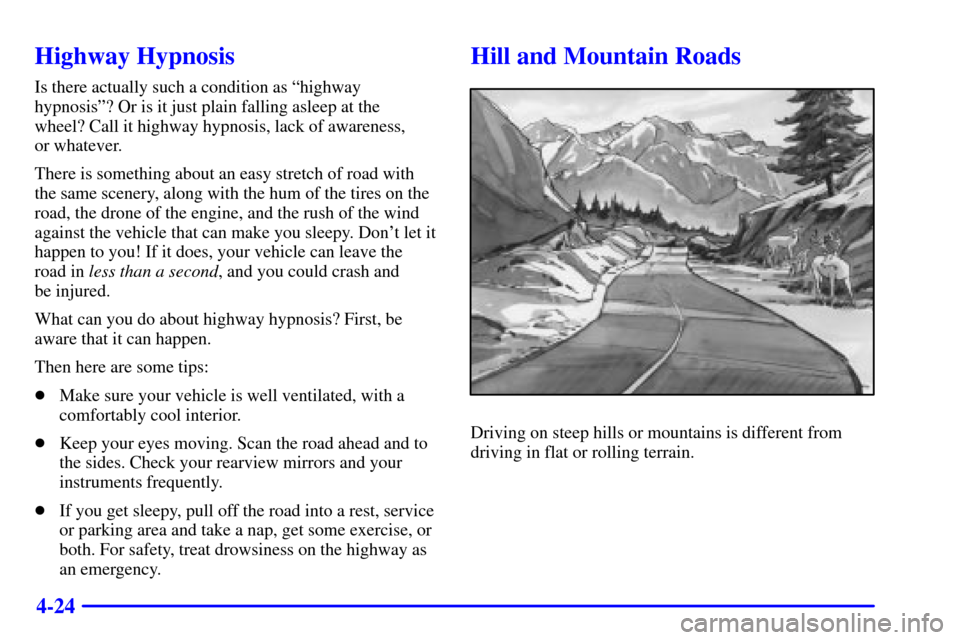
Driving on steep hills or mountains is different from
driving in flat or rolling terrain.
Page 208 of 357

4-42 When You Are Ready to Leave After
Parking on a Hill
1. Apply your regular brakes and hold the pedal down
while you:
�Start your engine;
�Shift into a gear; and
�Release the parking brake.
2. Let up on the brake pedal.
3. Drive slowly until the trailer is clear of the chocks.
4. Stop and have someone pick up and store the chocks.
Maintenance When Trailer Towing
Your vehicle will need service more often when you're
pulling a trailer. See the Maintenance Schedule for more
on this. Things that are especially important in trailer
operation are automatic transaxle fluid (don't overfill),
engine oil, drive belt, cooling system and brake system.
Each of these is covered in this manual, and the Index
will help you find them quickly. If you're trailering, it's
a good idea to review this information before you start
your trip.
Check periodically to see that all hitch nuts and bolts
are tight.
Engine Cooling When Trailer Towing
Your cooling system may temporarily overheat during
severe operating conditions. See ªEngine Overheatingº
in the Index.
Towing a Trailer (Except Models with
2.4L L4 Engine and 4
-Speed
Automatic Transaxle)
Do not tow a trailer if your vehicle is:
�equipped with a 2.2L L4 (Code 4) engine or
�equipped with a manual transaxle or a three
-speed
automatic transaxle.
Page 215 of 357
5-7
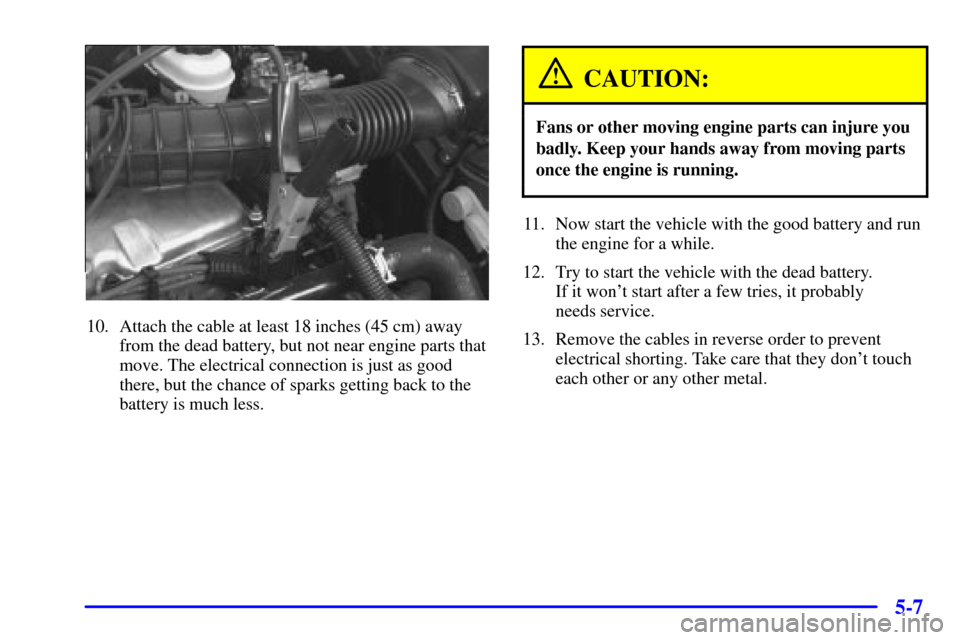
10. Attach the cable at least 18 inches (45 cm) away
from the dead battery, but not near engine parts that
move. The electrical connection is just as good
there, but the chance of sparks getting back to the
battery is much less.
CAUTION:
Fans or other moving engine parts can injure you
badly. Keep your hands away from moving parts
once the engine is running.
11. Now start the vehicle with the good battery and run
the engine for a while.
12. Try to start the vehicle with the dead battery.
If it won't start after a few tries, it probably
needs service.
13. Remove the cables in reverse order to prevent
electrical shorting. Take care that they don't touch
each other or any other metal.
Page 216 of 357
5-8
Jumper Cable Removal
A. Heavy, Unpainted Metal Engine Part
B. Good Battery
C. Dead BatteryTo disconnect the jumper cables from both vehicles,
do the following:
1. Disconnect the black negative (
-) cable from the
heavy, unpainted metal engine part on the vehicle
that had the dead battery.
2. Disconnect the black negative (
-) cable from the
negative (
-) terminal on the vehicle with the
good battery.
3. Disconnect the red positive (+) cable from the
vehicle with the good battery.
4. Disconnect the red positive (+) cable from the
other vehicle.
Towing Your Vehicle
Consult your dealer or a professional towing service if
you need to have your vehicle towed. See ªRoadside
Assistanceº and ªRecreational Vehicle Towingº in
the Index.
Page 218 of 357

5-10 If No Steam Is Coming From Your Engine
If you get an engine overheat warning but see or hear no
steam, the problem may not be too serious. Sometimes
the engine can get a little too hot when you:
�Climb a long hill on a hot day.
�Stop after high
-speed driving.
�Idle for long periods in traffic.
�Tow a trailer.
If you get the overheat warning with no sign of steam,
try this for a minute or so:
1. If you have an air conditioner and it's on, turn it off.
2. Turn on your heater to full hot at the highest fan
speed and open the window as necessary.3. If you're in a traffic jam, shift to NEUTRAL (N);
otherwise, shift to the highest gear while
driving
-- AUTOMATIC OVERDRIVE (D) for
four
-speed automatic transaxles or DRIVE (D) for
three
-speed automatic transaxles.
If you no longer have the overheat warning, you can
drive. Just to be safe, drive slower for about 10 minutes.
If the warning doesn't come back on, you can
drive normally.
If the warning continues, pull over, stop, and park your
vehicle right away.
If there's still no sign of steam, idle the engine for three
minutes while you're parked. If you still have the
warning, turn off the engine and get everyone out of the
vehicle until it cools down.
You may decide not to lift the hood but to get service
help right away.