Page 204 of 321
6-21
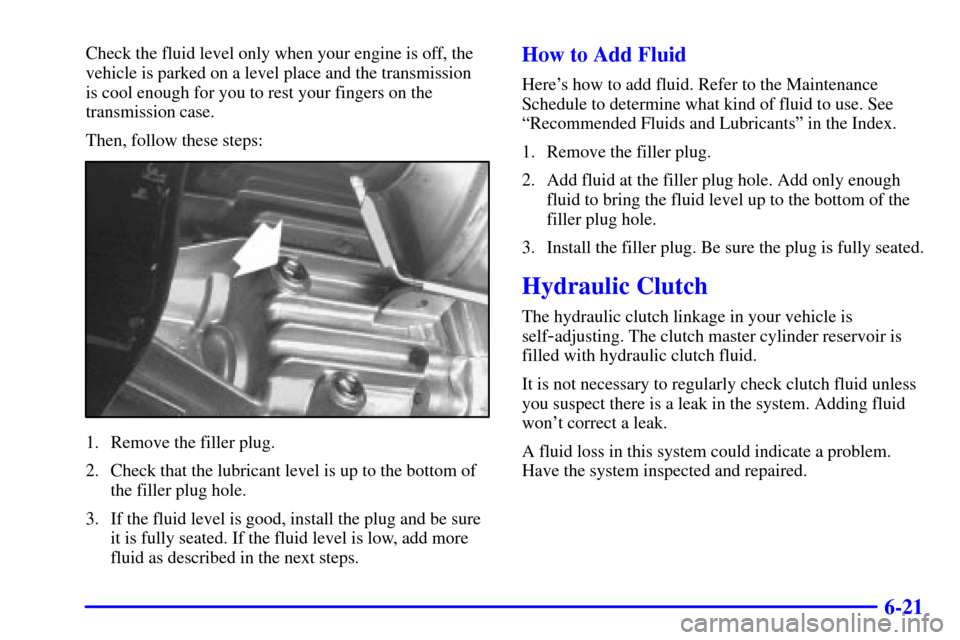
Check the fluid level only when your engine is off, the
vehicle is parked on a level place and the transmission
is cool enough for you to rest your fingers on the
transmission case.
Then, follow these steps:
1. Remove the filler plug.
2. Check that the lubricant level is up to the bottom of
the filler plug hole.
3. If the fluid level is good, install the plug and be sure
it is fully seated. If the fluid level is low, add more
fluid as described in the next steps.
How to Add Fluid
Here's how to add fluid. Refer to the Maintenance
Schedule to determine what kind of fluid to use. See
ªRecommended Fluids and Lubricantsº in the Index.
1. Remove the filler plug.
2. Add fluid at the filler plug hole. Add only enough
fluid to bring the fluid level up to the bottom of the
filler plug hole.
3. Install the filler plug. Be sure the plug is fully seated.
Hydraulic Clutch
The hydraulic clutch linkage in your vehicle is
self
-adjusting. The clutch master cylinder reservoir is
filled with hydraulic clutch fluid.
It is not necessary to regularly check clutch fluid unless
you suspect there is a leak in the system. Adding fluid
won't correct a leak.
A fluid loss in this system could indicate a problem.
Have the system inspected and repaired.
Page 205 of 321
6-22 When to Check and What to Use
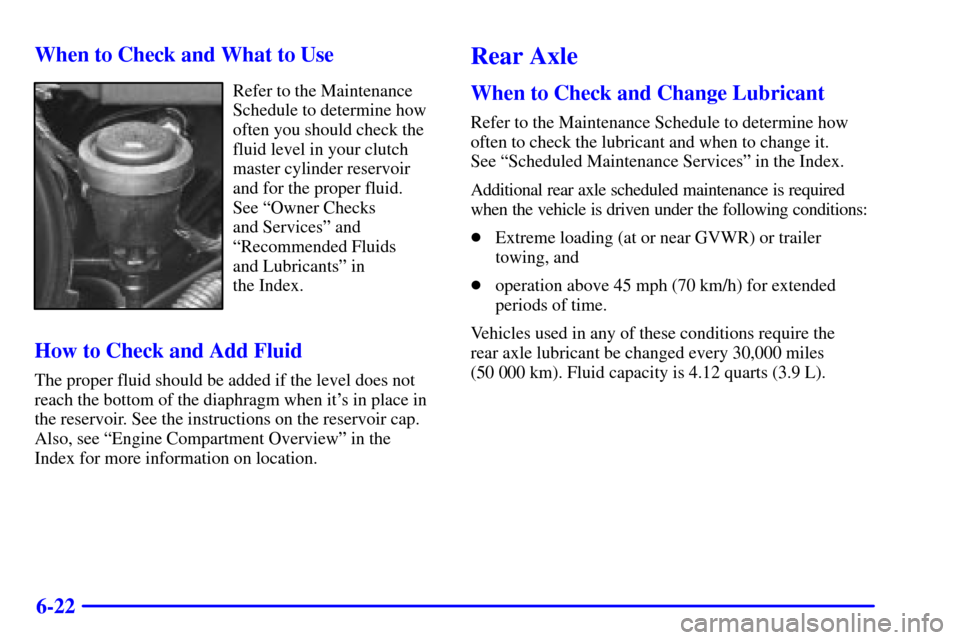
Refer to the Maintenance
Schedule to determine how
often you should check the
fluid level in your clutch
master cylinder reservoir
and for the proper fluid.
See ªOwner Checks
and Servicesº and
ªRecommended Fluids
and Lubricantsº in
the Index.
How to Check and Add Fluid
The proper fluid should be added if the level does not
reach the bottom of the diaphragm when it's in place in
the reservoir. See the instructions on the reservoir cap.
Also, see ªEngine Compartment Overviewº in the
Index for more information on location.
Rear Axle
When to Check and Change Lubricant
Refer to the Maintenance Schedule to determine how
often to check the lubricant and when to change it.
See ªScheduled Maintenance Servicesº in the Index.
Additional rear axle scheduled maintenance is required
when the vehicle is driven under the following conditions:
�Extreme loading (at or near GVWR) or trailer
towing, and
�operation above 45 mph (70 km/h) for extended
periods of time.
Vehicles used in any of these conditions require the
rear axle lubricant be changed every 30,000 miles
(50 000 km). Fluid capacity is 4.12 quarts (3.9 L).
Page 206 of 321
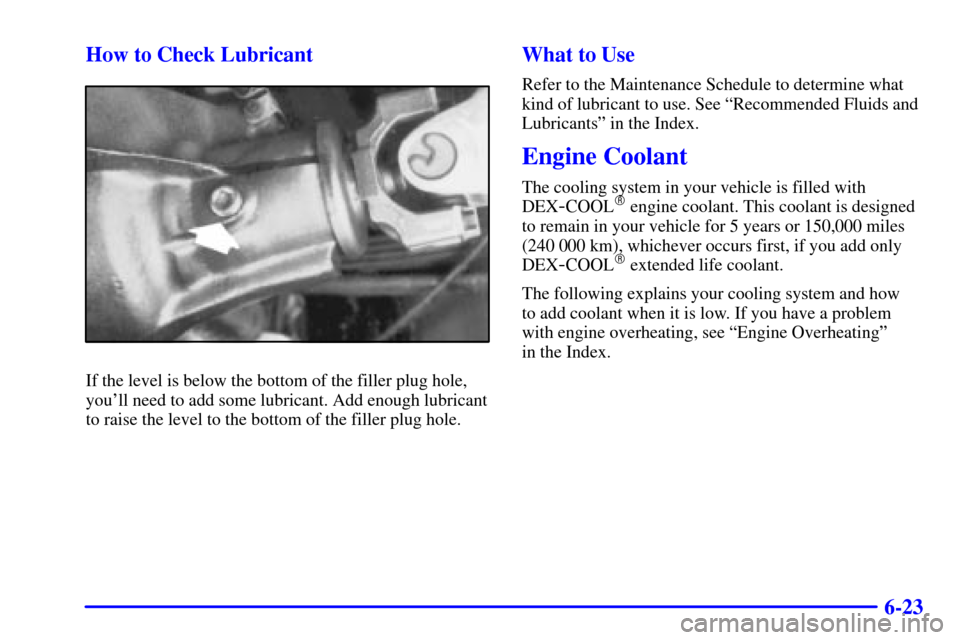
6-23 How to Check Lubricant
If the level is below the bottom of the filler plug hole,
you'll need to add some lubricant. Add enough lubricant
to raise the level to the bottom of the filler plug hole.
What to Use
Refer to the Maintenance Schedule to determine what
kind of lubricant to use. See ªRecommended Fluids and
Lubricantsº in the Index.
Engine Coolant
The cooling system in your vehicle is filled with
DEX
-COOL� engine coolant. This coolant is designed
to remain in your vehicle for 5 years or 150,000 miles
(240 000 km), whichever occurs first, if you add only
DEX
-COOL� extended life coolant.
The following explains your cooling system and how
to add coolant when it is low. If you have a problem
with engine overheating, see ªEngine Overheatingº
in the Index.
Page 213 of 321
6-30
The other reason is that fluid is leaking out of the brake
system. If it is, you should have your brake system
fixed, since a leak means that sooner or later your
brakes won't work well, or won't work at all.
So, it isn't a good idea to ªtop offº your brake fluid.
Adding brake fluid won't correct a leak. If you add fluid
when your linings are worn, then you'll have too much
fluid when you get new brake linings. You should add
(or remove) brake fluid, as necessary, only when work is
done on the brake hydraulic system.
CAUTION:
If you have too much brake fluid, it can spill
on the engine. The fluid will burn if the engine
is hot enough. You or others could be burned,
and your vehicle could be damaged. Add brake
fluid only when work is done on the brake
hydraulic system. See ªChecking Brake Fluidº
in this section.
Refer to the Maintenance Schedule to determine when to
check your brake fluid. See ªPeriodic Maintenance
Inspectionsº in the Index.Checking Brake Fluid
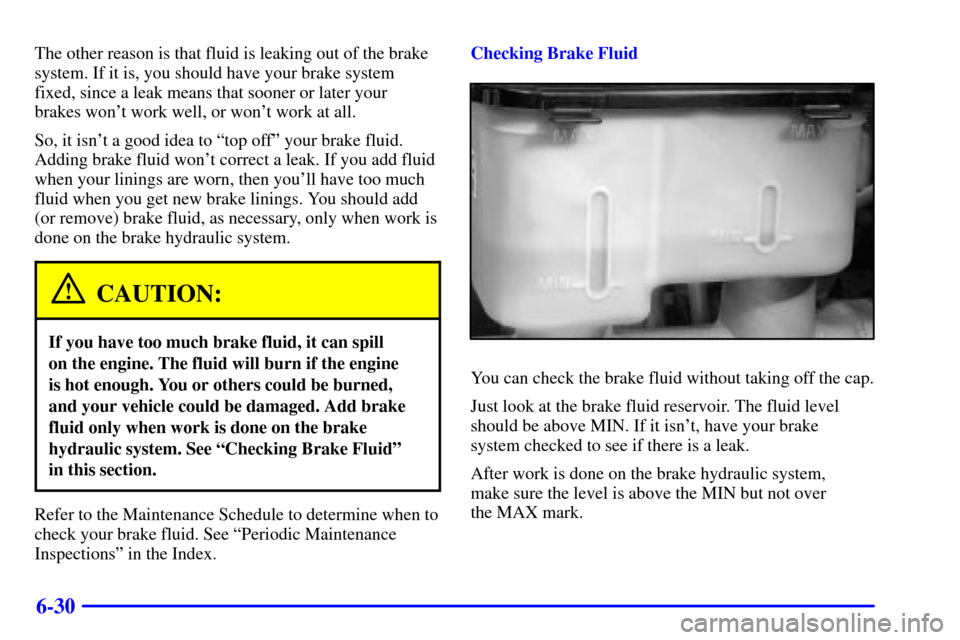
You can check the brake fluid without taking off the cap.
Just look at the brake fluid reservoir. The fluid level
should be above MIN. If it isn't, have your brake
system checked to see if there is a leak.
After work is done on the brake hydraulic system,
make sure the level is above the MIN but not over
the MAX mark.
Page 226 of 321
6-43 Tire Inspection and Rotation
Tires should be rotated every 6,000 to 8,000 miles
(10 000 to 13 000 km). Any time you notice unusual
wear, rotate your tires as soon as possible and check
wheel alignment. Also check for damaged tires or
wheels. See ªWhen It's Time for New Tiresº and
ªWheel Replacementº later in this section for more
information. Also see ªDual Tire Operationº later
in this section.
The purpose of regular rotation is to achieve more
uniform wear for all tires on the vehicle. The first
rotation is the most important. See ªScheduled
Maintenance Servicesº in the Index for scheduled
rotation intervals.
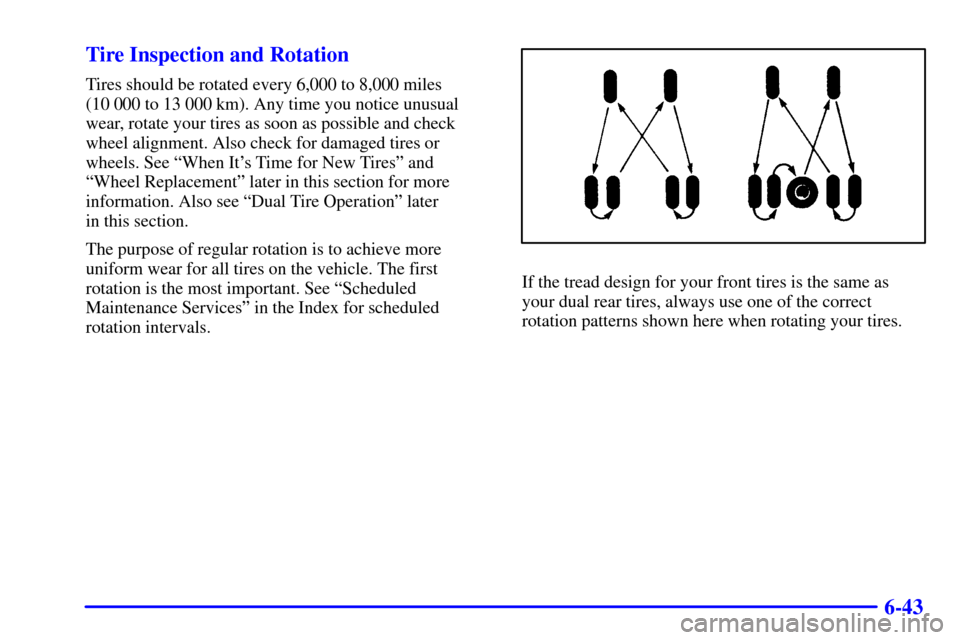
If the tread design for your front tires is the same as
your dual rear tires, always use one of the correct
rotation patterns shown here when rotating your tires.
Page 251 of 321
7-
7-1
Section 7 Maintenance Schedule
This section covers the maintenance required for your vehicle. Your vehicle needs these services to retain its safety,
dependability and emission control performance.
7
-2 Introduction
7
-4 Part A: Scheduled Maintenance Services
7
-9 Short Trip/City Scheduled Maintenance
7
-31 Long Trip/Highway Scheduled Maintenance7
-45 Part B: Owner Checks and Services
7
-50 Part C: Periodic Maintenance Inspections
7
-52 Part D: Recommended Fluids and Lubricants
7
-55 Part E: Maintenance Record
Page 253 of 321
7-3 How This Section is Organized
This maintenance schedule is divided into five parts:
ªPart A: Scheduled Maintenance Servicesº shows
what to have done and how often. Some of these
services can be complex, so unless you are technically
qualified and have the necessary equipment, you should
let your dealer's service department or another qualified
service center do these jobs.
CAUTION:
Performing maintenance work on a vehicle can
be dangerous. In trying to do some jobs, you can
be seriously injured. Do your own maintenance
work only if you have the required know
-how
and the proper tools and equipment for the job.
If you have any doubt, have a qualified
technician do the work.
If you want to get the service information, see ªService
and Owner Publicationsº in the Index.ªPart B: Owner Checks and Servicesº tells you
what should be checked and when. It also explains
what you can easily do to help keep your vehicle in
good condition.
ªPart C: Periodic Maintenance Inspectionsº explains
important inspections that your dealer's service
department or another qualified service center
should perform.
ªPart D: Recommended Fluids and Lubricantsº lists
some recommended products necessary to help keep
your vehicle properly maintained. These products, or
their equivalents, should be used whether you do the
work yourself or have it done.
ªPart E: Maintenance Recordº is a place for
you to record and keep track of the maintenance
performed on your vehicle. Keep your maintenance
receipts. They may be needed to qualify your vehicle
for warranty repairs.
Page 254 of 321
7-4
Part A: Scheduled
Maintenance Services
Using Your Maintenance Schedule
We at General Motors want to help you keep your
vehicle in good working condition. But we don't know
exactly how you'll drive it. You may drive very short
distances only a few times a week. Or you may drive
long distances all the time in very hot, dusty weather.
You may use your vehicle in making deliveries.
Or you may drive it to work, to do errands or in
many other ways.
Because of all the different ways people use their
vehicles, maintenance needs vary. You may need more
frequent checks and replacements. So please read the
following and note how you drive. If you have any
questions on how to keep your vehicle in good
condition, see your dealer.
This part tells you the maintenance services you should
have done and when you should schedule them. If you
go to your dealer for your service needs, you'll know
that GM
-trained and supported service people will
perform the work using genuine GM parts.The proper fluids and lubricants to use are listed in
Part D. Make sure whoever services your vehicle
uses these. All parts should be replaced and all
necessary repairs done before you or anyone else
drives the vehicle.
These schedules are for vehicles that:
�carry passengers and cargo within recommended
limits. You will find these limits on your vehicle's
Certification/Tire label. See ªLoading Your Vehicleº
in the Index.
�are driven on reasonable road surfaces within legal
driving limits.
�use the recommended fuel. See ªFuelº in the Index.
Selecting the Right Schedule
First you'll need to decide which of the two schedules is
right for your vehicle. Here's how to decide which
schedule to follow: