Page 70 of 321
2-21 Shift Speeds
CAUTION:
If you skip a gear when you downshift, you could
lose control of your vehicle. You could injure
yourself or others. Don't shift down more than
one gear at a time when you downshift.
If your speed drops below 20 mph (32 km/h), or if the
engine is not running smoothly, you should downshift to
the next lower gear. You may have to downshift two or
more gears to keep the engine running smoothly or for
good performance.Up Shift Light
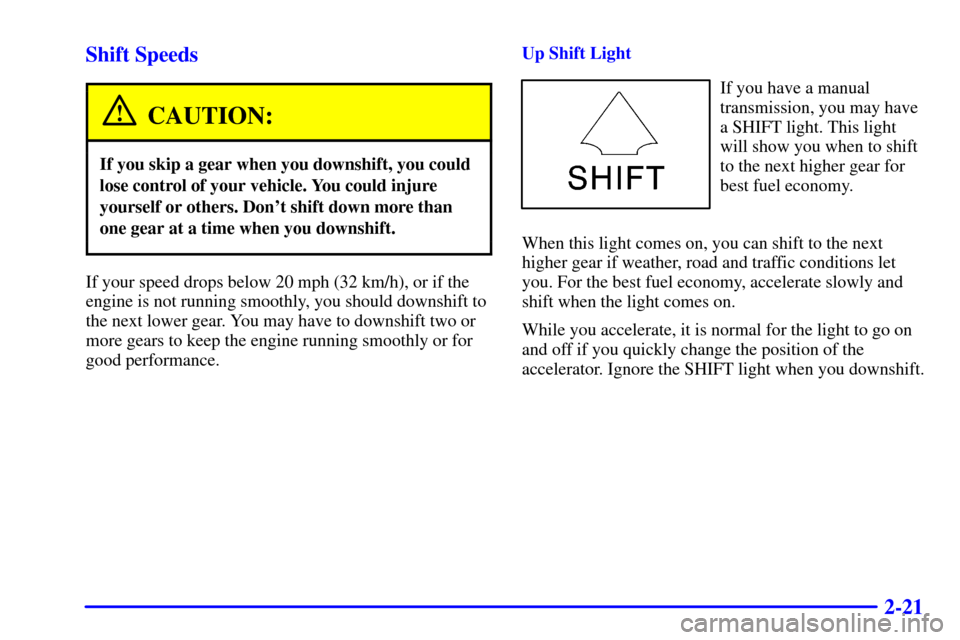
If you have a manual
transmission, you may have
a SHIFT light. This light
will show you when to shift
to the next higher gear for
best fuel economy.
When this light comes on, you can shift to the next
higher gear if weather, road and traffic conditions let
you. For the best fuel economy, accelerate slowly and
shift when the light comes on.
While you accelerate, it is normal for the light to go on
and off if you quickly change the position of the
accelerator. Ignore the SHIFT light when you downshift.
Page 71 of 321
2-22
Parking Brake
To set the parking brake, hold the regular brake pedal
down with your right foot. Push down the parking brake
pedal with your left foot.
If the ignition is on, the brake system warning light will
come on.
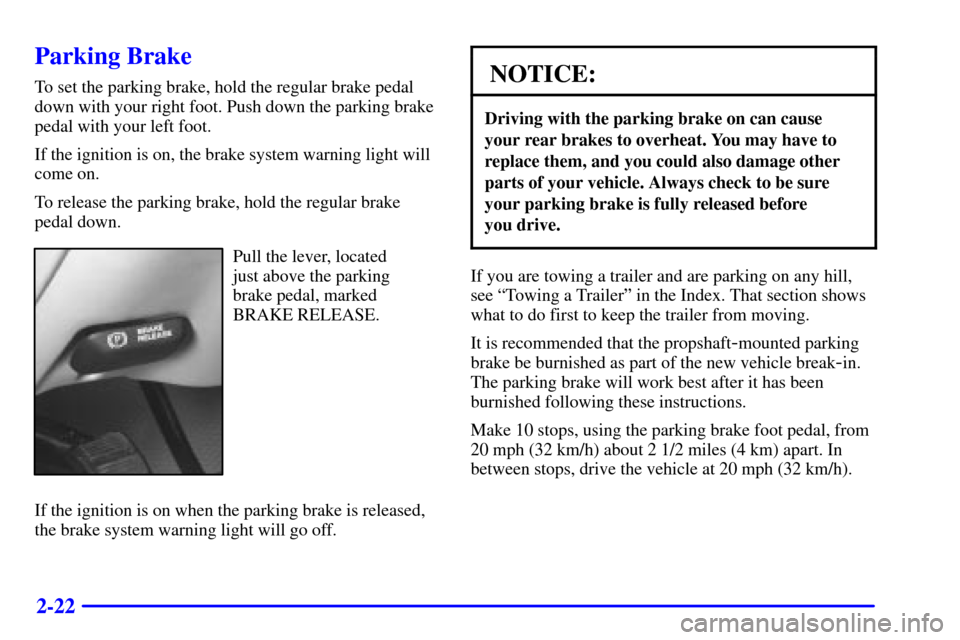
To release the parking brake, hold the regular brake
pedal down.
Pull the lever, located
just above the parking
brake pedal, marked
BRAKE RELEASE.
If the ignition is on when the parking brake is released,
the brake system warning light will go off.
NOTICE:
Driving with the parking brake on can cause
your rear brakes to overheat. You may have to
replace them, and you could also damage other
parts of your vehicle. Always check to be sure
your parking brake is fully released before
you drive.
If you are towing a trailer and are parking on any hill,
see ªTowing a Trailerº in the Index. That section shows
what to do first to keep the trailer from moving.
It is recommended that the propshaft
-mounted parking
brake be burnished as part of the new vehicle break
-in.
The parking brake will work best after it has been
burnished following these instructions.
Make 10 stops, using the parking brake foot pedal, from
20 mph (32 km/h) about 2 1/2 miles (4 km) apart. In
between stops, drive the vehicle at 20 mph (32 km/h).
Page 79 of 321
2-30 Headlamp High/Low-Beam Changer
To change the headlamps from low to high beam or high
to low beam, pull the multifunction lever all the way
toward you. Then release it.
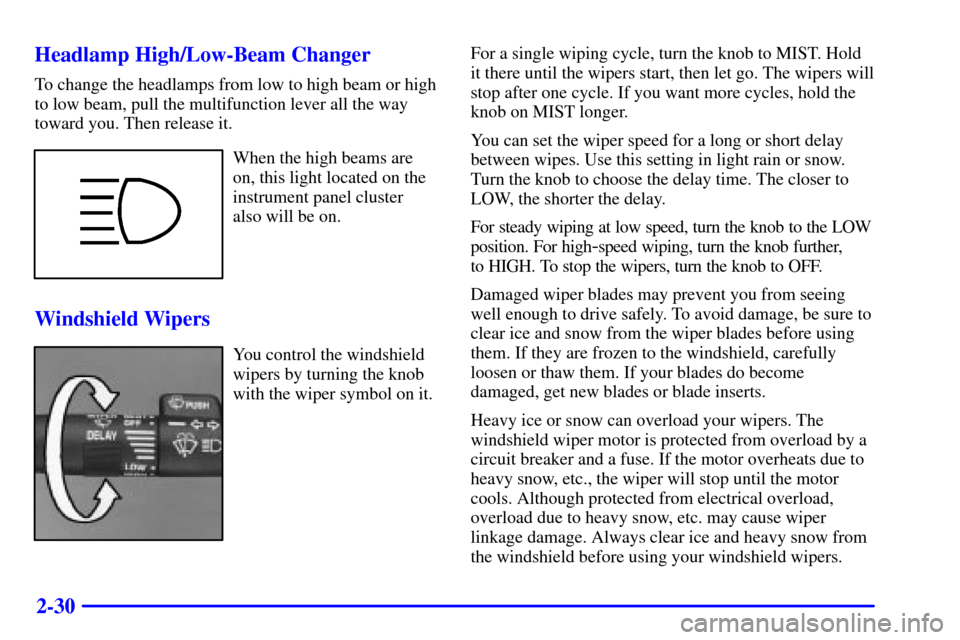
When the high beams are
on, this light located on the
instrument panel cluster
also will be on.
Windshield Wipers
You control the windshield
wipers by turning the knob
with the wiper symbol on it.For a single wiping cycle, turn the knob to MIST. Hold
it there until the wipers start, then let go. The wipers will
stop after one cycle. If you want more cycles, hold the
knob on MIST longer.
You can set the wiper speed for a long or short delay
between wipes. Use this setting in light rain or snow.
Turn the knob to choose the delay time. The closer to
LOW, the shorter the delay.
For steady wiping at low speed, turn the knob to the LOW
position. For high
-speed wiping, turn the knob further,
to HIGH. To stop the wipers, turn the knob to OFF.
Damaged wiper blades may prevent you from seeing
well enough to drive safely. To avoid damage, be sure to
clear ice and snow from the wiper blades before using
them. If they are frozen to the windshield, carefully
loosen or thaw them. If your blades do become
damaged, get new blades or blade inserts.
Heavy ice or snow can overload your wipers. The
windshield wiper motor is protected from overload by a
circuit breaker and a fuse. If the motor overheats due to
heavy snow, etc., the wiper will stop until the motor
cools. Although protected from electrical overload,
overload due to heavy snow, etc. may cause wiper
linkage damage. Always clear ice and heavy snow from
the windshield before using your windshield wipers.
Page 83 of 321
2-34
Using Cruise Control on Hills
How well your cruise control will work on hills depends
upon your speed, load and the steepness of the hills.
When going up steep hills, you may have to step on the
accelerator pedal to maintain your speed. If the
steepness of the hill causes the vehicle speed to drop
more than 15 mph (24 km/h) below the set speed, your
cruise control will automatically disengage. When going
downhill, you may have to brake or shift to a lower gear
to keep your speed down. Of course, applying the brake
takes you out of cruise control. Many drivers find this to
be too much trouble and don't use cruise control on
steep hills.
Ending Cruise Control
There are two ways to turn off the cruise control:
�Step lightly on the brake pedal or
�move the cruise switch to OFF.
Erasing Speed Memory
When you turn off the cruise control or the ignition,
your cruise control set speed memory is erased.Exterior Lamps
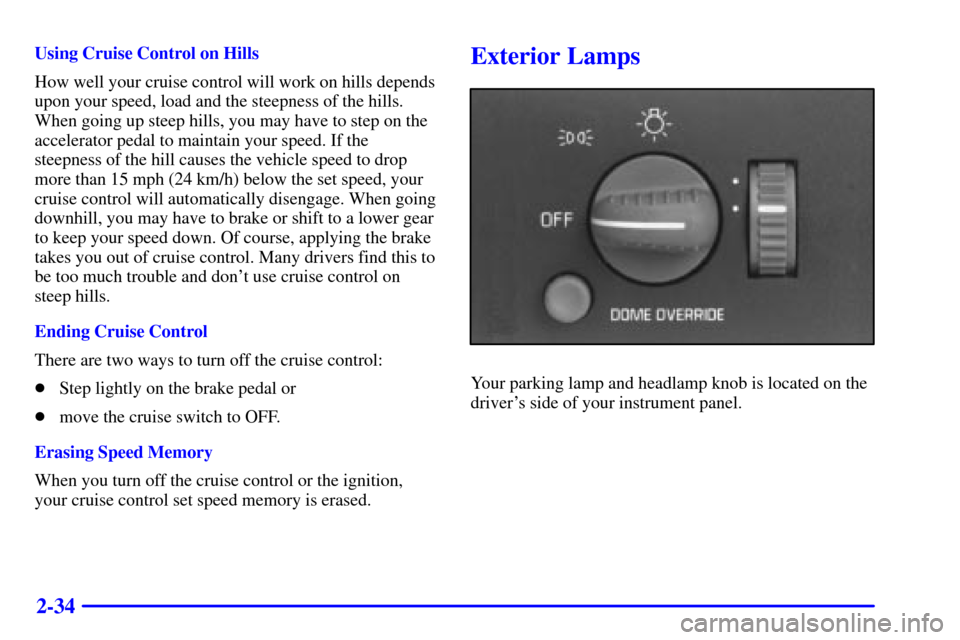
Your parking lamp and headlamp knob is located on the
driver's side of your instrument panel.
Page 84 of 321
2-35
Turn the knob clockwise to the parking lamp symbol, to
turn on the following:
�Parking Lamps
�Sidemarker Lamps
�Clearance Lamps
�Taillamps
�License Plate Lamps
�Instrument Panel Lights
Turn the knob clockwise again to the master lighting
symbol to turn on all the lamps listed as well as
the headlamps.
Turn the knob counterclockwise, to OFF, to turn off
your lamps.
You can turn your headlamps from high to low beams
by pulling on the turn signal/multifunction lever.
Headlamps On Reminder
A tone will sound when your headlamps are turned on
and the key is turned to OFF, LOCK or ACCESSORY.
If you need to use your headlamps when the key is
turned to OFF, LOCK or ACCESSORY, the buzzer can
be turned off by turning the thumbwheel next to the
parking lamp/headlamp knob all the way down.
Daytime Running Lamps
Daytime Running Lamps (DRL) can make it easier for
others to see the front of your vehicle during the day.
DRL can be helpful in many different driving
conditions, but they can be especially helpful in the
short periods after dawn and before sunset. Fully
functional daytime running lights are required on all
vehicles first sold in Canada.
The DRL system will make your headlamps come on
at a reduced brightness when the following conditions
are met:
�the ignition is on,
�the headlamp switch is off and
�the parking brake is released.
When the DRL are on, only your headlamps will be on.
The taillamps, sidemarker and other lamps won't be on.
Your instrument panel won't be lit up either.
When it begins to get dark, your DRL indicator light is a
reminder to turn your headlamp knob on. The other lamps
that come on with your headlamps will also come on.
Page 85 of 321

2-36
When you turn off the headlamp knob, the regular lamps
will go off, and your headlamps will change to the
reduced brightness of DRL.
To idle your vehicle with the DRL off, set the parking
brake. The DRL will stay off until you release the
parking brake.
As with any vehicle, you should turn on the regular
headlamp system when you need it.
Interior Lamps
Instrument Panel Intensity Control
The instrument panel intensity control is located to the
right of the parking lamps and headlamp knob.
Turn the thumbwheel up to adjust the instrument panel
lights. Turn the thumbwheel up to the first notch to
return the radio display and shift position indicator LED
display to full intensity when the headlamps or parking
lamps are on. To turn on the dome lamps (with the
vehicle doors closed) turn the thumbwheel up to the
second notch position.
Illuminated Entry
Your vehicle is equipped with an illuminated
entry feature.
When a door is opened, the dome lamps will come on if
the dome lamp button is out. When all the doors are
closed, or the dome lamp button is pressed in, the
lamps will stay on for a short period of time and will
then go out.
Front Reading Lamps (If Equipped)
If your vehicle has reading
lamps, press the button next
to the lamp to turn the lamp
on or off. The lamps can be
adjusted to point in the
direction you want.
Page 86 of 321
2-37 Dome Lamp
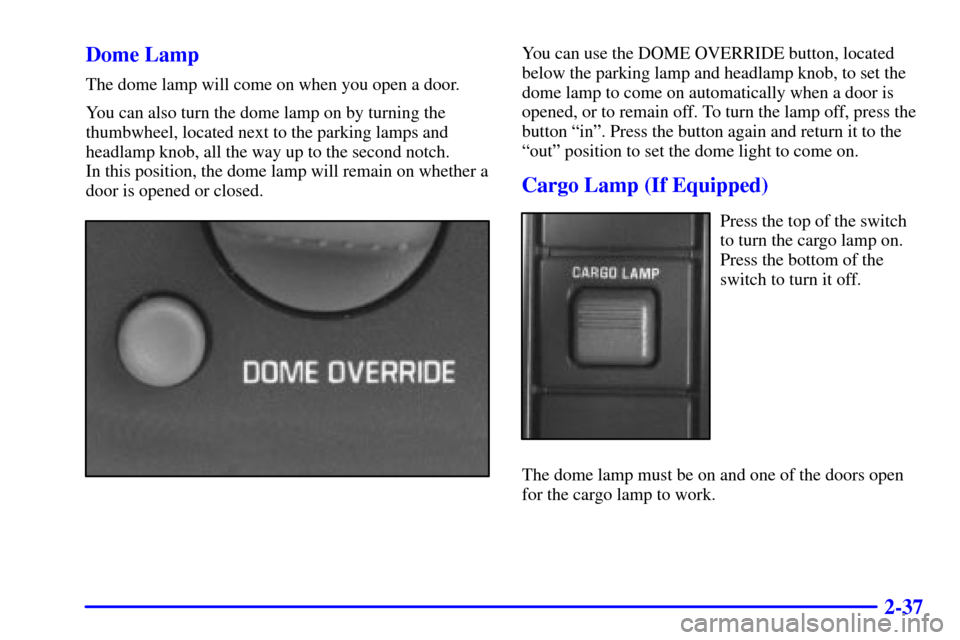
The dome lamp will come on when you open a door.
You can also turn the dome lamp on by turning the
thumbwheel, located next to the parking lamps and
headlamp knob, all the way up to the second notch.
In this position, the dome lamp will remain on whether a
door is opened or closed.
You can use the DOME OVERRIDE button, located
below the parking lamp and headlamp knob, to set the
dome lamp to come on automatically when a door is
opened, or to remain off. To turn the lamp off, press the
button ªinº. Press the button again and return it to the
ªoutº position to set the dome light to come on.
Cargo Lamp (If Equipped)
Press the top of the switch
to turn the cargo lamp on.
Press the bottom of the
switch to turn it off.
The dome lamp must be on and one of the doors open
for the cargo lamp to work.
Page 91 of 321
2-42 Armrest Storage Compartment
(If Equipped)
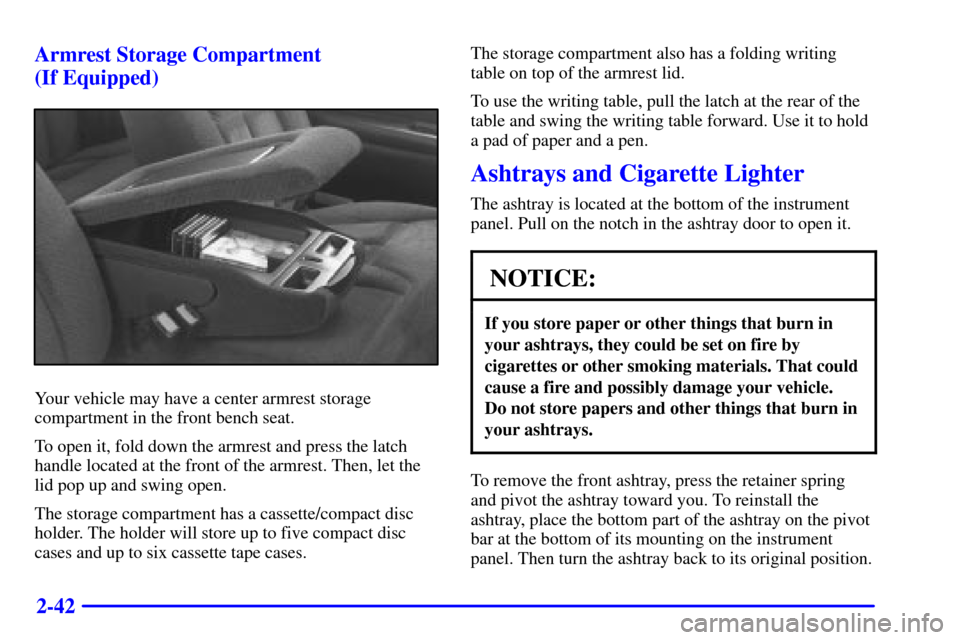
Your vehicle may have a center armrest storage
compartment in the front bench seat.
To open it, fold down the armrest and press the latch
handle located at the front of the armrest. Then, let the
lid pop up and swing open.
The storage compartment has a cassette/compact disc
holder. The holder will store up to five compact disc
cases and up to six cassette tape cases.The storage compartment also has a folding writing
table on top of the armrest lid.
To use the writing table, pull the latch at the rear of the
table and swing the writing table forward. Use it to hold
a pad of paper and a pen.
Ashtrays and Cigarette Lighter
The ashtray is located at the bottom of the instrument
panel. Pull on the notch in the ashtray door to open it.
NOTICE:
If you store paper or other things that burn in
your ashtrays, they could be set on fire by
cigarettes or other smoking materials. That could
cause a fire and possibly damage your vehicle.
Do not store papers and other things that burn in
your ashtrays.
To remove the front ashtray, press the retainer spring
and pivot the ashtray toward you. To reinstall the
ashtray, place the bottom part of the ashtray on the pivot
bar at the bottom of its mounting on the instrument
panel. Then turn the ashtray back to its original position.