Page 212 of 321
6-29
Open the cap labeled WASHER FLUID ONLY.
Add washer fluid until the tank is full.
NOTICE:
�When using concentrated washer fluid,
follow the manufacturer's instructions for
adding water.
�Don't mix water with ready
-to-use washer
fluid. Water can cause the solution to freeze
and damage your washer fluid tank and
other parts of the washer system. Also,
water doesn't clean as well as washer fluid.
�Fill your washer fluid tank only
three
-quarters full when it's very cold.
This allows for expansion if freezing
occurs, which could damage the tank
if it is completely full.
�Don't use engine coolant (antifreeze) in
your windshield washer. It can damage
your washer system and paint.
Brakes
Brake Fluid
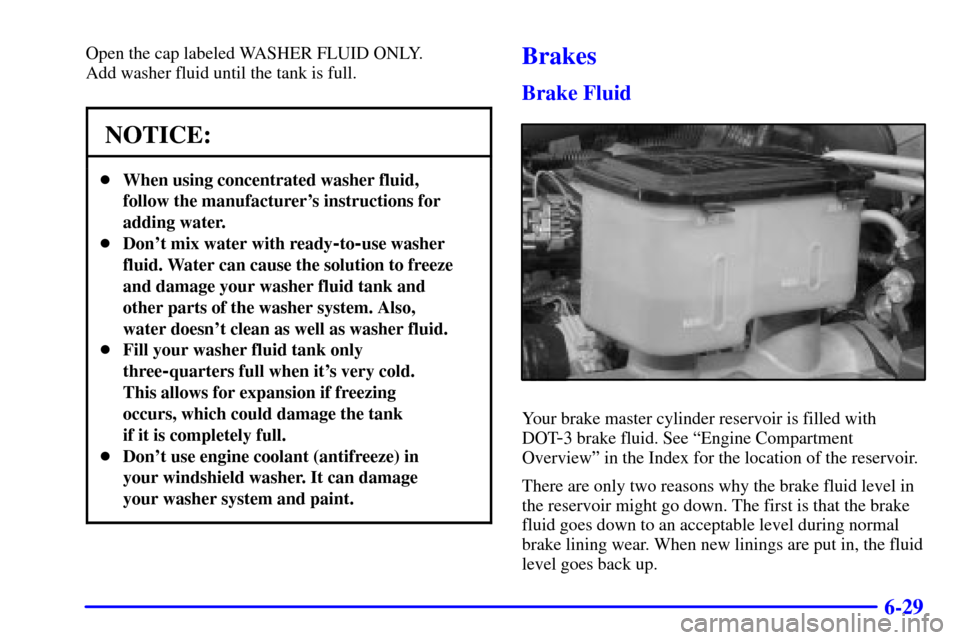
Your brake master cylinder reservoir is filled with
DOT
-3 brake fluid. See ªEngine Compartment
Overviewº in the Index for the location of the reservoir.
There are only two reasons why the brake fluid level in
the reservoir might go down. The first is that the brake
fluid goes down to an acceptable level during normal
brake lining wear. When new linings are put in, the fluid
level goes back up.
Page 213 of 321
6-30
The other reason is that fluid is leaking out of the brake
system. If it is, you should have your brake system
fixed, since a leak means that sooner or later your
brakes won't work well, or won't work at all.
So, it isn't a good idea to ªtop offº your brake fluid.
Adding brake fluid won't correct a leak. If you add fluid
when your linings are worn, then you'll have too much
fluid when you get new brake linings. You should add
(or remove) brake fluid, as necessary, only when work is
done on the brake hydraulic system.
CAUTION:
If you have too much brake fluid, it can spill
on the engine. The fluid will burn if the engine
is hot enough. You or others could be burned,
and your vehicle could be damaged. Add brake
fluid only when work is done on the brake
hydraulic system. See ªChecking Brake Fluidº
in this section.
Refer to the Maintenance Schedule to determine when to
check your brake fluid. See ªPeriodic Maintenance
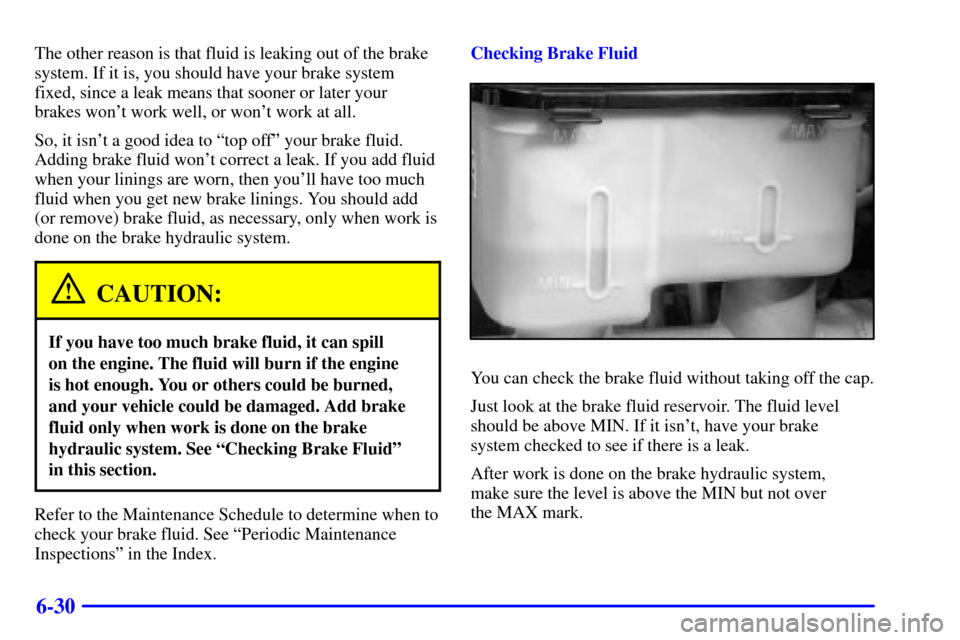
Inspectionsº in the Index.Checking Brake Fluid
You can check the brake fluid without taking off the cap.
Just look at the brake fluid reservoir. The fluid level
should be above MIN. If it isn't, have your brake
system checked to see if there is a leak.
After work is done on the brake hydraulic system,
make sure the level is above the MIN but not over
the MAX mark.
Page 214 of 321
6-31
What to Add
When you do need brake fluid, use only DOT
-3 brake
fluid. Refer to ªRecommended Fluids and Lubricantsº
in the Index. Use new brake fluid from a sealed
container only.
Always clean the brake fluid reservoir cap and the area
around the cap before removing it. This will help keep
dirt from entering the reservoir.
CAUTION:
With the wrong kind of fluid in your brake
system, your brakes may not work well, or they
may not even work at all. This could cause a
crash. Always use the proper brake fluid.
NOTICE:
�Using the wrong fluid can badly damage
brake system parts. For example, just a few
drops of mineral
-based oil, such as engine
oil, in your brake system can damage brake
system parts so badly that they'll have to
be replaced. Don't let someone put in the
wrong kind of fluid.
�If you spill brake fluid on your vehicle's
painted surfaces, the paint finish can be
damaged. Be careful not to spill brake fluid
on your vehicle. If you do, wash it off
immediately. See ªAppearance Careº in
the Index.
Page 216 of 321
6-33
Battery
Your new vehicle comes with a maintenance free
ACDelco� battery. When it's time for a new battery,
get one that has the replacement number shown on the
original battery's label. We recommend an ACDelco
battery. See ªEngine Compartment Overviewº in the
Index for battery location.
WARNING: Battery posts, terminals and related
accessories contain lead and lead compounds, chemicals
known to the State of California to cause cancer and
reproductive harm. Wash hands after handling.
Vehicle Storage
If you're not going to drive your vehicle for 25 days or more,
remove the black, negative (
-) cable from the battery.
This will help keep your battery from running down.
CAUTION:
Batteries have acid that can burn you and gas
that can explode. You can be badly hurt if you
aren't careful. See ªJump Startingº in the Index
for tips on working around a battery without
getting hurt.
Contact your dealer to learn how to prepare your vehicle
for longer storage periods.
Bulb Replacement
For any bulb changing procedure not listed in this
section, contact your GM dealership service department.
Before you replace any bulbs, be sure that all the lamps
are off and the engine isn't running. See ªReplacement
Bulbsº in the Index for the proper types of bulbs to use.
Halogen Bulbs
CAUTION:
Halogen bulbs have pressurized gas inside and
can burst if you drop or scratch the bulb. You or
others could be injured. Be sure to read and
follow the instructions on the bulb package.
Page 242 of 321
6-59
Vehicle Identification Number (VIN)
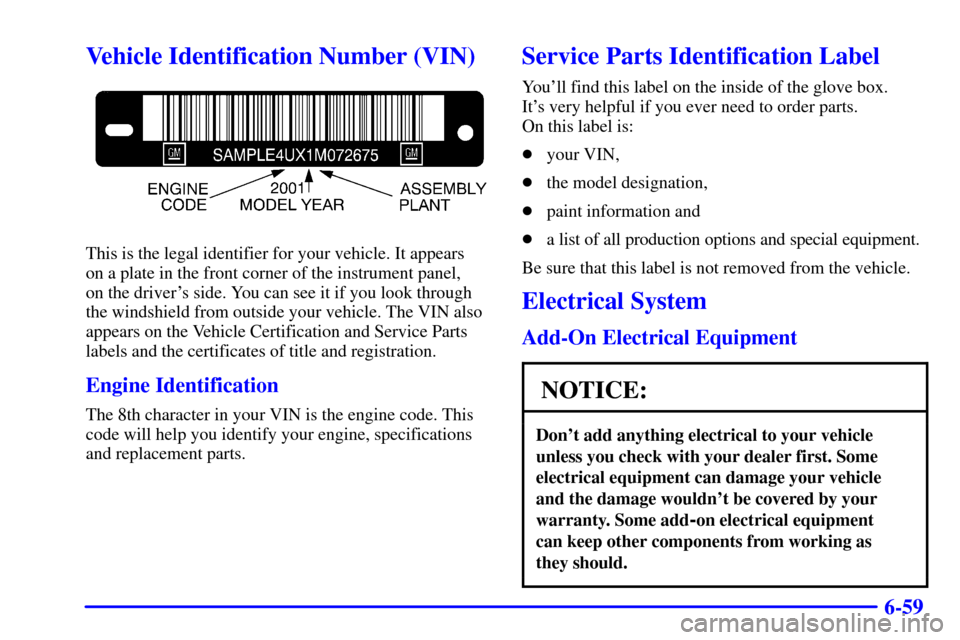
This is the legal identifier for your vehicle. It appears
on a plate in the front corner of the instrument panel,
on the driver's side. You can see it if you look through
the windshield from outside your vehicle. The VIN also
appears on the Vehicle Certification and Service Parts
labels and the certificates of title and registration.
Engine Identification
The 8th character in your VIN is the engine code. This
code will help you identify your engine, specifications
and replacement parts.
Service Parts Identification Label
You'll find this label on the inside of the glove box.
It's very helpful if you ever need to order parts.
On this label is:
�your VIN,
�the model designation,
�paint information and
�a list of all production options and special equipment.
Be sure that this label is not removed from the vehicle.
Electrical System
Add-On Electrical Equipment
NOTICE:
Don't add anything electrical to your vehicle
unless you check with your dealer first. Some
electrical equipment can damage your vehicle
and the damage wouldn't be covered by your
warranty. Some add
-on electrical equipment
can keep other components from working as
they should.
Page 245 of 321
6-62
Fuse/Circuit
BreakerUsage
4 Instrument Cluster, DRL Relay,
Lamp Switch, Keyless Entry, Low
Coolant Module, Illuminated Entry
Module, DRAC (Diesel Engine)
5 Not Used
6 Cruise Control
7 Auxiliary Power Outlet
8 Crank
9 License Lamp, Parking Lamps,
Taillamps, Roof Marker
Lamps, Front Sidemarkers,
Door Switch Illumination,
Headlamp Switch Illumination
10 Not Used
11 Wiper Motor, Washer Pump
12 A/C, A/C Blower,
High Blower Relay
13 Power Amp, Cigarette Lighter,
Door Lock RelayFuse/Circuit
BreakerUsage
14 Cluster, Comfort Controls,
Instrument Switches, Radio
Illumination, Chime Module
15 DRL Relay
16 Front and Rear Turn Signals,
Back
-Up Lamps
17 Radio (Ignition)
18 4WAL/VCM, ABS, Cruise Control
19 Radio (Battery)
20 PRNDL, Automatic Transmission,
Speedometer, Check Gages
Warning Light
21 Security/Steering
22 Not Used
23 Not Used
24 TP2 Relay (Gasoline Engine)
A Power Door Lock, Keyless
Entry Module
B Power Windows
Page 246 of 321
6-63
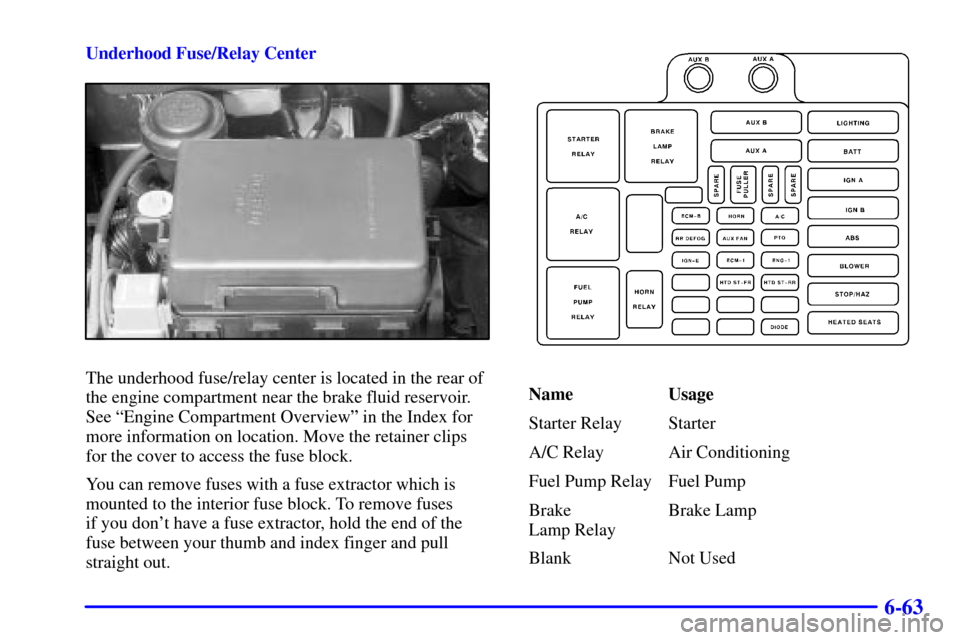
Underhood Fuse/Relay Center
The underhood fuse/relay center is located in the rear of
the engine compartment near the brake fluid reservoir.
See ªEngine Compartment Overviewº in the Index for
more information on location. Move the retainer clips
for the cover to access the fuse block.
You can remove fuses with a fuse extractor which is
mounted to the interior fuse block. To remove fuses
if you don't have a fuse extractor, hold the end of the
fuse between your thumb and index finger and pull
straight out.Name Usage
Starter Relay Starter
A/C Relay Air Conditioning
Fuel Pump Relay Fuel Pump
Brake
Lamp RelayBrake Lamp
Blank Not Used
Page 247 of 321
6-64
Name Usage
Horn Relay Horn
ECM
-B Fuel Pump, PCM/VCM
RR DEFOG Not Used
IGN
-E A/C Compressor Relay,
Dual Tanks
Blank Not Used
Blank Not Used
Blank Not Used
HORN Horn, Underhood Lamps
AUX FAN Not Used
ECM
-1 Injectors, PCM/VCM, Fuel
Solenoid (Diesel Engine) Fuel
Control Module (Diesel Engine)
HTD ST
-FR Not Used
Blank Not Used
Blank Not Used
A/C Air Conditioning
PTO PTO RelayName Usage
ENG
-1 Ignition Switch, EGR, Canister
Purge, EVRV Idle Coast
Solenoid, MAF, Heated O
2,
Fuel Heater (Diesel Engine),
Water Sensor (Diesel Engine),
Boost Solenoid (Diesel Engine),
EPR (Diesel Engine)
HTD ST
-RR Not Used
Blank Not Used
Diode Not Used
LIGHTING Headlamp and Panel Dimmer
Switch, Fog and Courtesy Fuses
BATT Battery, Fuse Block Busbar
IGN A Ignition Switch
IGN B Ignition Switch
ABS Anti
-Lock Brake Module
BLOWER High Blower Relay
STOP/HAZ Stoplamps
HEATED
SEATSNot Used