Page 15 of 371
1-3 Adaptive Seat Control (If Equipped)
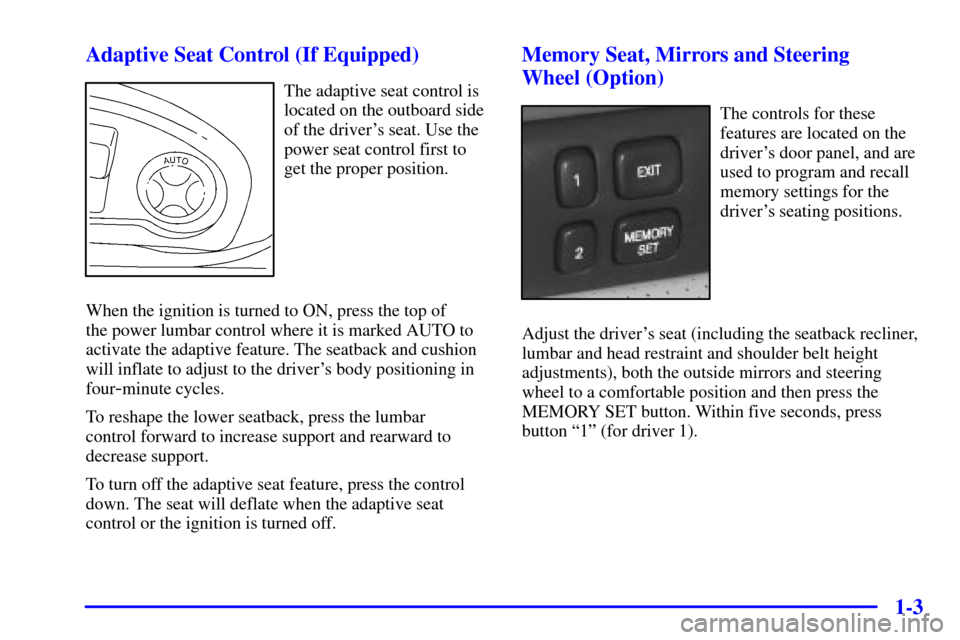
The adaptive seat control is
located on the outboard side
of the driver's seat. Use the
power seat control first to
get the proper position.
When the ignition is turned to ON, press the top of
the power lumbar control where it is marked AUTO to
activate the adaptive feature. The seatback and cushion
will inflate to adjust to the driver's body positioning in
four
-minute cycles.
To reshape the lower seatback, press the lumbar
control forward to increase support and rearward to
decrease support.
To turn off the adaptive seat feature, press the control
down. The seat will deflate when the adaptive seat
control or the ignition is turned off.
Memory Seat, Mirrors and Steering
Wheel (Option)
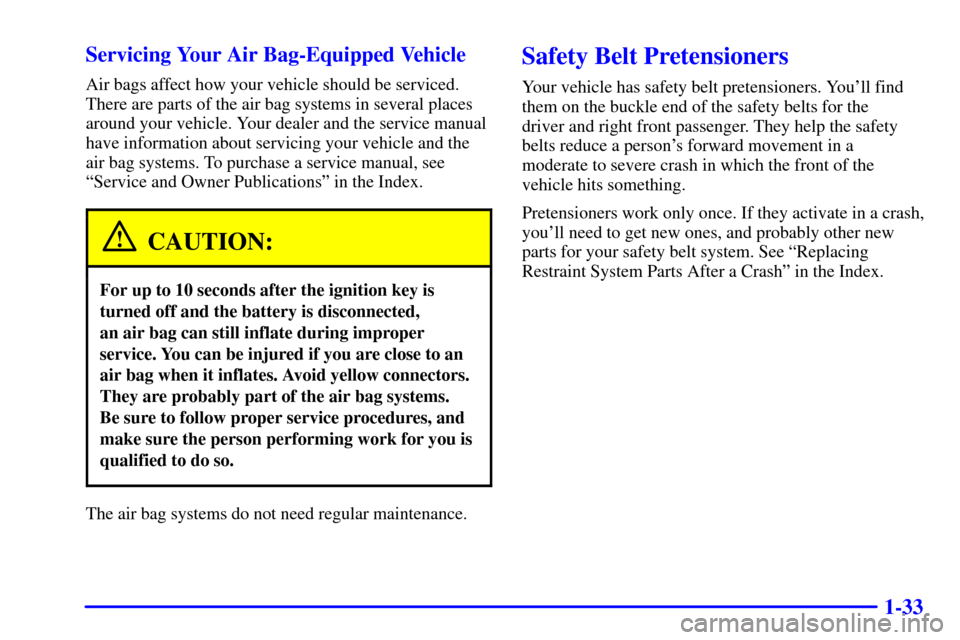
The controls for these
features are located on the
driver's door panel, and are
used to program and recall
memory settings for the
driver's seating positions.
Adjust the driver's seat (including the seatback recliner,
lumbar and head restraint and shoulder belt height
adjustments), both the outside mirrors and steering
wheel to a comfortable position and then press the
MEMORY SET button. Within five seconds, press
button ª1º (for driver 1).
Page 16 of 371

1-4
A second mirror, seating and steering wheel position
can be programmed by repeating the above steps and
pressing button ª2º (for driver 2). Each time a memory
button is pressed, a single beep will sound. Each time
button 1 or 2 is pressed and released while the vehicle is
in PARK (P), the memory positions will be recalled.
Each time button 1 or 2 is pressed and held while the
vehicle is out of PARK (P), the memory positions will
be recalled.
To stop recall movement of the memory seat and
steering wheel at any time, press one of the power seat,
steering wheel or mirror controls.
Two personalized exit positions can be set by first
recalling the driving position (by pressing 1 or 2),
then positioning the steering wheel and seat in the
desired exit positions and then pressing and releasing
the MEMORY SET button and, within five seconds,
pressing the EXIT button. With the vehicle in PARK (P),
the exit position for either previously set driver can be
recalled by pressing the EXIT button. The mirrors,
power lumbar and power head restraint and shoulder belt
height positions will not be stored or recalled for the
exit positions.If you use the remote keyless entry transmitter to enter
your vehicle, automatic seat and mirror movement will
occur. The numbers on the back of the transmitters,
1 and 2, correspond to the numbers on the buttons on
the door panel.
When the key is placed in the ignition in OFF or when
the unlock button is pressed on the remote keyless entry
transmitter, the seats and mirrors will automatically
adjust to the programmed position.
Programming for automatic seat, steering wheel and
mirror movement is done through the Driver Information
Center (DIC). You can choose to either select or not
select automatic seat and mirror movement using the
remote keyless entry transmitter, placing your key in
the ignition, or by exiting the vehicle. For programming
information, see ªVehicle Programming and
Personalization Featuresº in the Index.
Page 17 of 371
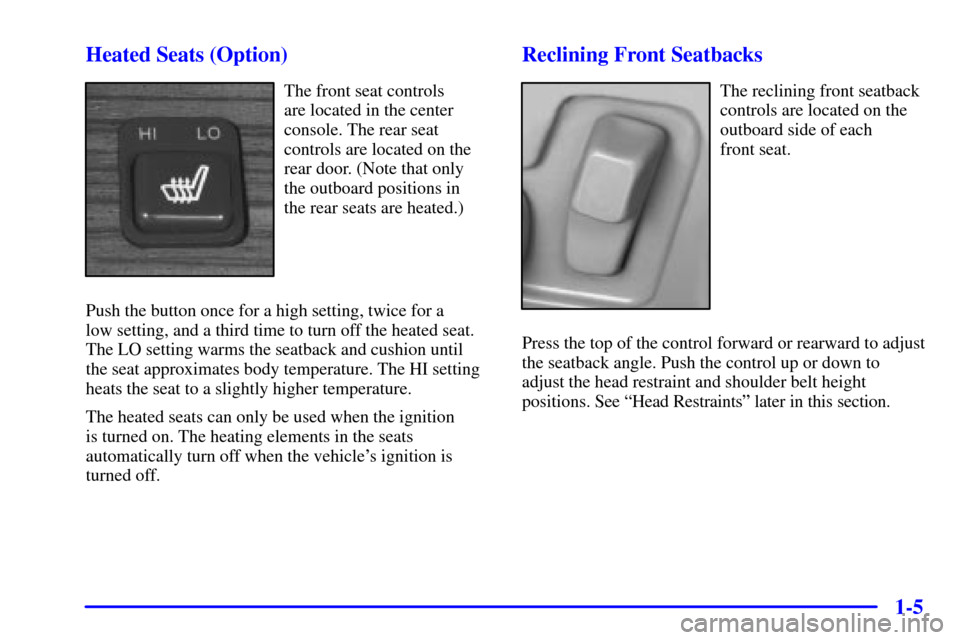
1-5 Heated Seats (Option)
The front seat controls
are located in the center
console. The rear seat
controls are located on the
rear door. (Note that only
the outboard positions in
the rear seats are heated.)
Push the button once for a high setting, twice for a
low setting, and a third time to turn off the heated seat.
The LO setting warms the seatback and cushion until
the seat approximates body temperature. The HI setting
heats the seat to a slightly higher temperature.
The heated seats can only be used when the ignition
is turned on. The heating elements in the seats
automatically turn off when the vehicle's ignition is
turned off.
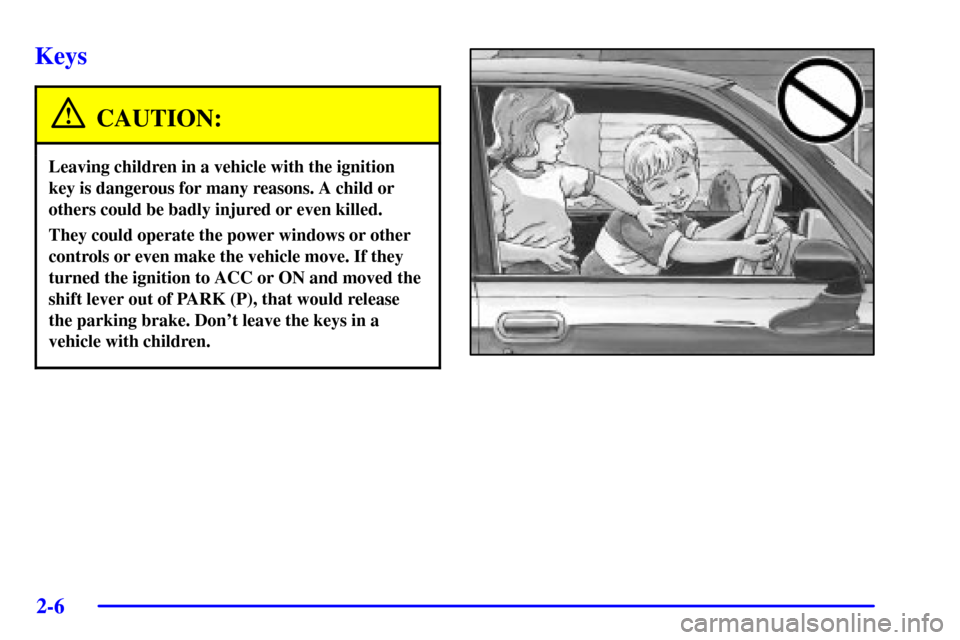
Reclining Front Seatbacks
The reclining front seatback
controls are located on the
outboard side of each
front seat.
Press the top of the control forward or rearward to adjust
the seatback angle. Push the control up or down to
adjust the head restraint and shoulder belt height
positions. See ªHead Restraintsº later in this section.
Page 45 of 371
1-33 Servicing Your Air Bag-Equipped Vehicle
Air bags affect how your vehicle should be serviced.
There are parts of the air bag systems in several places
around your vehicle. Your dealer and the service manual
have information about servicing your vehicle and the
air bag systems. To purchase a service manual, see
ªService and Owner Publicationsº in the Index.
CAUTION:
For up to 10 seconds after the ignition key is
turned off and the battery is disconnected,
an air bag can still inflate during improper
service. You can be injured if you are close to an
air bag when it inflates. Avoid yellow connectors.
They are probably part of the air bag systems.
Be sure to follow proper service procedures, and
make sure the person performing work for you is
qualified to do so.
The air bag systems do not need regular maintenance.
Safety Belt Pretensioners
Your vehicle has safety belt pretensioners. You'll find
them on the buckle end of the safety belts for the
driver and right front passenger. They help the safety
belts reduce a person's forward movement in a
moderate to severe crash in which the front of the
vehicle hits something.
Pretensioners work only once. If they activate in a crash,
you'll need to get new ones, and probably other new
parts for your safety belt system. See ªReplacing
Restraint System Parts After a Crashº in the Index.
Page 68 of 371
2-
2-1
Section 2 Features and Controls
Here you can learn about the many standard and optional features on your vehicle, and information on starting,
shifting and braking. Also explained are the instrument panel and the warning systems that tell you if everything is
working properly
-- and what to do if you have a problem.
2
-2 Windows
2
-6 Keys
2
-8 Door Locks
2
-11 Remote Keyless Entry System
2
-14 Trunk
2
-17 Theft
2
-18 Theft-Deterrent System
2
-20 PASS-Key� III
2
-22 New Vehicle ªBreak-Inº
2
-22 Ignition Positions
2
-24 Starting Your Engine
2
-25 Engine Coolant Heater (If Equipped)
2
-27 Automatic Transaxle Operation
2
-31 Parking Brake
2
-33 Shifting Into PARK (P)
2
-35 Shifting Out of PARK (P)
2
-35 Parking Over Things That Burn
2
-36 Engine Exhaust2
-36 Running Your Engine While You're Parked
2
-37 Tilt Wheel
2
-38 Turn Signal/Multifunction Lever
2
-46 Exterior Lamps
2
-51 Interior Lamps
2
-53 Mirrors
2
-57 Storage Compartments
2
-59 Sun Visors
2
-65 Sunroof (Option)
2
-66 HomeLink� Transmitter (If Equipped)
2
-70 The Instrument Panel -- Your
Information System
2
-75 Warning Lights, Gages and Indicators
2
-89 Driver Information Center (DIC)
2
-100 Vehicle Programming and Personalization
Features (If Equipped)
2
-108 Navigation (Option)
2
-109 Ultrasonic Rear Parking
Assist (URPA) (Option)
Page 71 of 371
2-4
Programming the Power Windows
If the battery on your vehicle has been recharged,
disconnected or is not working, you will need to
reprogram each front power window for the express
-up
feature to work. Before reprogramming, you will need
to replace or recharge your vehicle's battery.
To program each front window, follow these steps:
1. With the ignition in ACC, ON or with retained
accessory power present, close all doors.2. Press and hold the power window switch down until
the window has fully opened.
3. Press the up arrow on the power window switch until
the window is fully closed.
4. Continue holding the control up for approximately
two seconds after the window is completely closed.
The window is now programmed. Repeat the process for
each front window.
Page 73 of 371
2-6
Keys
CAUTION:
Leaving children in a vehicle with the ignition
key is dangerous for many reasons. A child or
others could be badly injured or even killed.
They could operate the power windows or other
controls or even make the vehicle move. If they
turned the ignition to ACC or ON and moved the
shift lever out of PARK (P), that would release
the parking brake. Don't leave the keys in a
vehicle with children.
Page 74 of 371
2-7
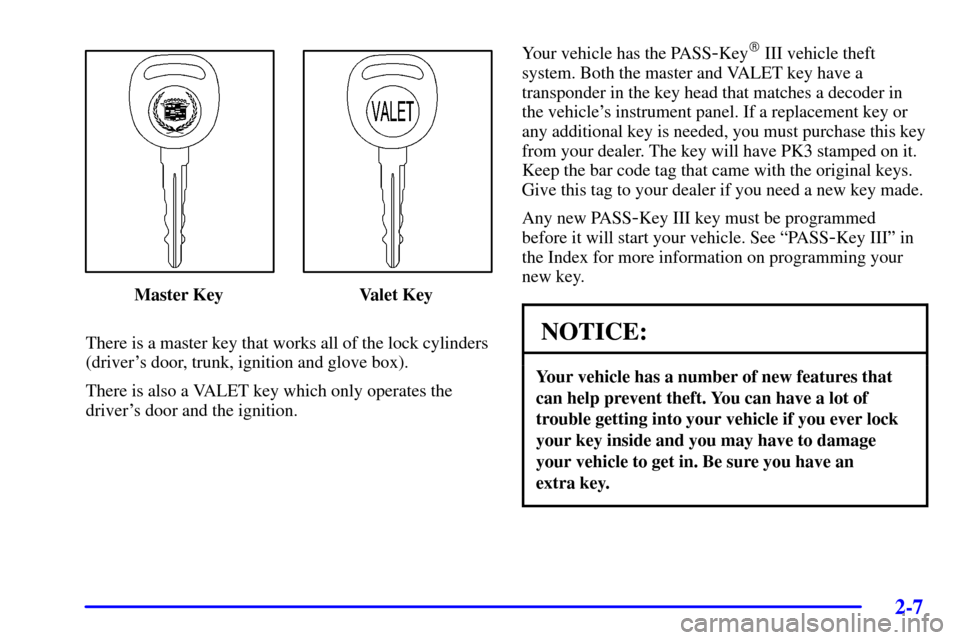
Master Key Valet Key
There is a master key that works all of the lock cylinders
(driver's door, trunk, ignition and glove box).
There is also a VALET key which only operates the
driver's door and the ignition.Your vehicle has the PASS
-Key� III vehicle theft
system. Both the master and VALET key have a
transponder in the key head that matches a decoder in
the vehicle's instrument panel. If a replacement key or
any additional key is needed, you must purchase this key
from your dealer. The key will have PK3 stamped on it.
Keep the bar code tag that came with the original keys.
Give this tag to your dealer if you need a new key made.
Any new PASS
-Key III key must be programmed
before it will start your vehicle. See ªPASS
-Key IIIº in
the Index for more information on programming your
new key.
NOTICE:
Your vehicle has a number of new features that
can help prevent theft. You can have a lot of
trouble getting into your vehicle if you ever lock
your key inside and you may have to damage
your vehicle to get in. Be sure you have an
extra key.