Page 253 of 371

4-39 When You Are Ready to Leave After
Parking on a Hill
1. Apply your regular brakes and hold the pedal down
while you:
�Start your engine;
�Shift into a gear; and
�Be sure the parking brake has released.
2. Let up on the brake pedal.
3. Drive slowly until the trailer is clear of the chocks.
4. Stop and have someone pick up and store the chocks.
Maintenance When Trailer Towing
Your vehicle will need service more often when you're
pulling a trailer. See the Maintenance Schedule booklet
for more on this. Things that are especially important
in trailer operation are automatic transaxle fluid
(don't overfill), engine oil, drive belt, cooling system
and brake system. If you're trailering, it's a good idea
to review this information before you start your trip.
Check periodically to see that all hitch nuts and bolts
are tight.
Engine Cooling When Trailer Towing
Your cooling system may temporarily overheat during
severe operating conditions. See ªEngine Overheatingº
in the Index.
Page 254 of 371
5-
5-1
Section 5 Problems on the Road
Here you'll find what to do about some problems that can occur on the road.
5
-2 Hazard Warning Flashers
5
-3 Other Warning Devices
5
-3 Jump Starting
5
-9 Towing Your Vehicle
5
-9 Engine Overheating5
-12 Cooling System
5
-17 If a Tire Goes Flat
5
-18 Changing a Flat Tire
5
-28 Compact Spare Tire
5
-29 If You're Stuck: In Sand, Mud, Ice or Snow
Page 256 of 371
5-3
Other Warning Devices
If you carry reflective triangles, you can set one up at
the side of the road about 300 feet (100 m) behind
your vehicle.
Jump Starting
If your battery has run down, you may want to use
another vehicle and some jumper cables to start your
vehicle. Please follow the steps below to do it safely.
CAUTION:
Batteries can hurt you. They can be
dangerous because:
�They contain acid that can burn you.
�They contain gas that can explode or ignite.
�They contain enough electricity to burn you.
If you don't follow these steps exactly, some or
all of these things can hurt you.
NOTICE:
Ignoring these steps could result in costly
damage to your vehicle that wouldn't be
covered by your warranty.
The ACDelco� battery in your vehicle has a
built
-in hydrometer. Do not charge, test or
jump start the battery if the hydrometer looks
clear or light yellow. Replace the battery when
there is a clear or light yellow hydrometer and
a cranking complaint.
Trying to start your vehicle by pushing or pulling
it won't work, and it could damage your vehicle.
1. Check the other vehicle. It must have a 12-volt
battery with a negative ground system.
NOTICE:
If the other system isn't a 12-volt system with a
negative ground, both vehicles can be damaged.
Page 257 of 371
5-4
2. Get the vehicles close enough so the jumper cables
can reach, but be sure the vehicles aren't touching
each other. If they are, it could cause a ground
connection you don't want. You wouldn't be able
to start your vehicle and the bad grounding could
damage the electrical systems.
To avoid the possibility of the vehicles rolling, set
the parking brake firmly on both vehicles involved in
the jump start procedure. Put an automatic transaxle
in PARK (P) or a manual transaxle in NEUTRAL
before setting the parking brake.
3. Turn off the ignition on both vehicles. Unplug
unnecessary accessories plugged into the cigarette
lighter. Turn off all lamps that aren't needed as well
as radios. This will avoid sparks and help save both
batteries. In addition, it could save your radio!
NOTICE:
If you leave your radio on, it could be badly
damaged. The repairs wouldn't be covered by
your warranty.
Open the hoods and locate the battery on the other
vehicle and the remote positive (+) terminal located
on the passenger's side of the engine compartment
of your vehicle. (You will not see the battery under
the hood of your vehicle, since it is located under
the rear seat on the passenger's side.) Find the
positive (+) and negative (
-) terminals on the
battery in the other vehicle.
You do not need to access your battery for jump
starting. The remote positive (+) terminal, located
on the passenger's side of the engine compartment,
is for this purpose.
Page 258 of 371
5-5
CAUTION:
An electric fan can start up even when the engine
is not running and can injure you. Keep hands,
clothing and tools away from any underhood
electric fan.
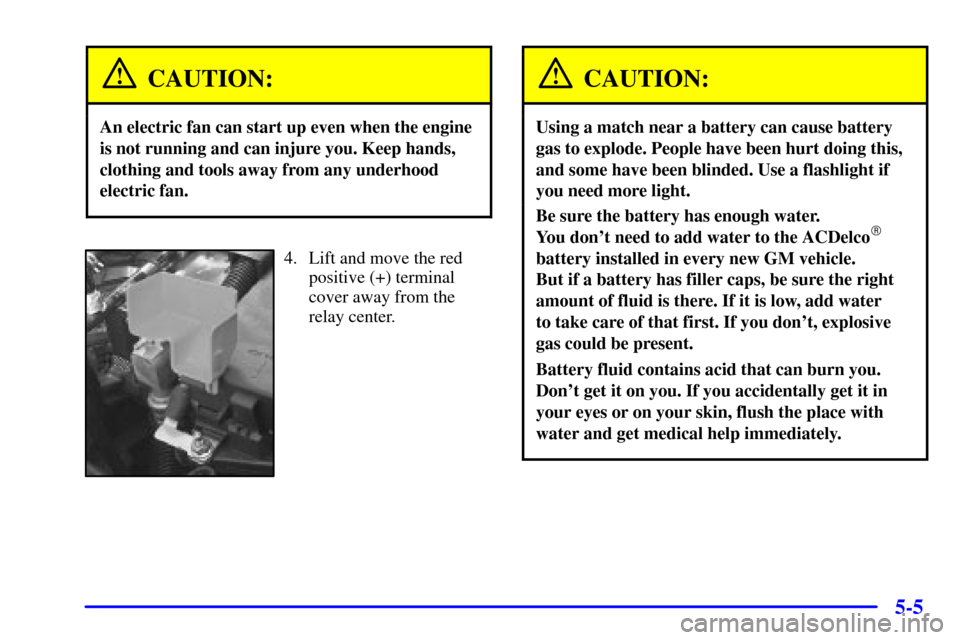
4. Lift and move the red
positive (+) terminal
cover away from the
relay center.
CAUTION:
Using a match near a battery can cause battery
gas to explode. People have been hurt doing this,
and some have been blinded. Use a flashlight if
you need more light.
Be sure the battery has enough water.
You don't need to add water to the ACDelco�
battery installed in every new GM vehicle.
But if a battery has filler caps, be sure the right
amount of fluid is there. If it is low, add water
to take care of that first. If you don't, explosive
gas could be present.
Battery fluid contains acid that can burn you.
Don't get it on you. If you accidentally get it in
your eyes or on your skin, flush the place with
water and get medical help immediately.
Page 260 of 371
5-7
8. Now connect the black
negative (
-) cable to
the good battery's
negative (
-) terminal.
Don't let the other end
of the negative (
-) cable
touch anything until the
next step. The other
end of the negative (
-)
cable doesn't go to the
dead battery.
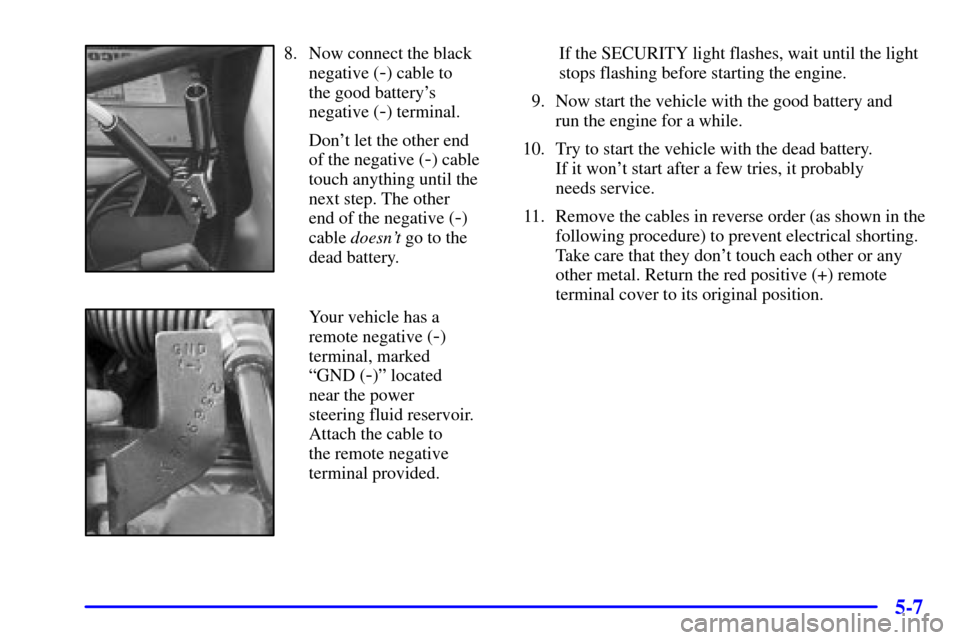
Your vehicle has a
remote negative (
-)
terminal, marked
ªGND (
-)º located
near the power
steering fluid reservoir.
Attach the cable to
the remote negative
terminal provided.If the SECURITY light flashes, wait until the light
stops flashing before starting the engine.
9. Now start the vehicle with the good battery and
run the engine for a while.
10. Try to start the vehicle with the dead battery.
If it won't start after a few tries, it probably
needs service.
11. Remove the cables in reverse order (as shown in the
following procedure) to prevent electrical shorting.
Take care that they don't touch each other or any
other metal. Return the red positive (+) remote
terminal cover to its original position.
Page 265 of 371
5-12
Cooling System
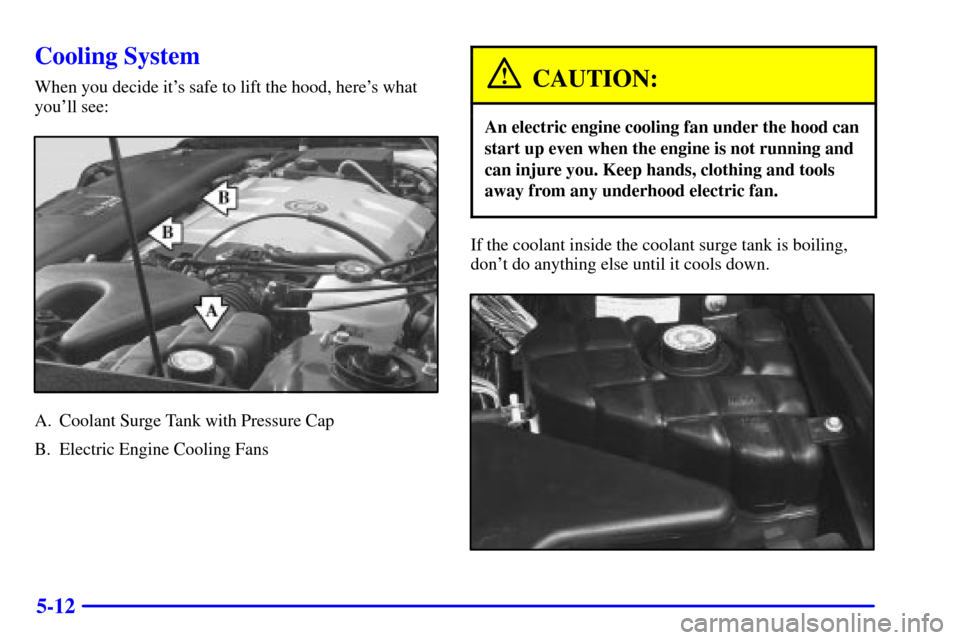
When you decide it's safe to lift the hood, here's what
you'll see:
A. Coolant Surge Tank with Pressure Cap
B. Electric Engine Cooling Fans
CAUTION:
An electric engine cooling fan under the hood can
start up even when the engine is not running and
can injure you. Keep hands, clothing and tools
away from any underhood electric fan.
If the coolant inside the coolant surge tank is boiling,
don't do anything else until it cools down.
Page 270 of 371
5-17
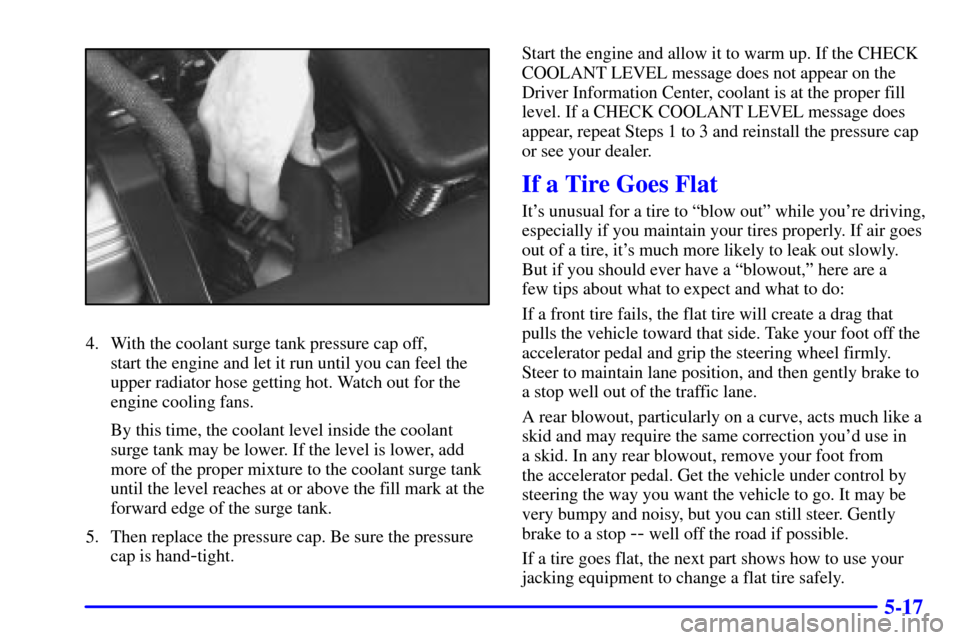
4. With the coolant surge tank pressure cap off,
start the engine and let it run until you can feel the
upper radiator hose getting hot. Watch out for the
engine cooling fans.
By this time, the coolant level inside the coolant
surge tank may be lower. If the level is lower, add
more of the proper mixture to the coolant surge tank
until the level reaches at or above the fill mark at the
forward edge of the surge tank.
5. Then replace the pressure cap. Be sure the pressure
cap is hand
-tight.Start the engine and allow it to warm up. If the CHECK
COOLANT LEVEL message does not appear on the
Driver Information Center, coolant is at the proper fill
level. If a CHECK COOLANT LEVEL message does
appear, repeat Steps 1 to 3 and reinstall the pressure cap
or see your dealer.
If a Tire Goes Flat
It's unusual for a tire to ªblow outº while you're driving,
especially if you maintain your tires properly. If air goes
out of a tire, it's much more likely to leak out slowly.
But if you should ever have a ªblowout,º here are a
few tips about what to expect and what to do:
If a front tire fails, the flat tire will create a drag that
pulls the vehicle toward that side. Take your foot off the
accelerator pedal and grip the steering wheel firmly.
Steer to maintain lane position, and then gently brake to
a stop well out of the traffic lane.
A rear blowout, particularly on a curve, acts much like a
skid and may require the same correction you'd use in
a skid. In any rear blowout, remove your foot from
the accelerator pedal. Get the vehicle under control by
steering the way you want the vehicle to go. It may be
very bumpy and noisy, but you can still steer. Gently
brake to a stop
-- well off the road if possible.
If a tire goes flat, the next part shows how to use your
jacking equipment to change a flat tire safely.