Page 6 of 335
Fuel
Checking Fluids and Lubricants
GM Oil Life System™
Engine Air Cleaner/Filter
Brakes
Bulb ReplacementWindshield Wiper Blade Replacement
Tires and Wheels
Appearance Care
Electrical System/Fuses and Circuit Breakers
Capacities and Specifications
Normal Maintenance Replacement Parts
Table of Contents (cont'd)
Maintenance Schedule Service and Appearance Care
Section
6
Scheduled Maintenance
Owner Checks and Services
Periodic Maintenance InspectionsRecommended Fluids and Lubricants
Maintenance Records
See separate Maintenance Schedule Booklet
iv
Page 11 of 335

ix
For example,
these symbols
are used on an
original battery:
CAUTION
POSSIBLE
INJURY
PROTECT
EYES BY
SHIELDING
CAUSTIC
BATTERY
ACID COULD
CAUSE
BURNS
AVOID
SPARKS OR
FLAMES
SPARK OR
FLAME
COULD
EXPLODE
BATTERY
These symbols
are important for
you and your
passengers
whenever your
vehicle is driven:
CHILD
RESTRAINT
TOP STRAP
ANCHOR
DOOR LOCK
UNLOCK
FASTEN
SEAT
BELTS
POWER
WINDOW
AIR BAG
These symbols
have to do with
your lamps:
MASTER
LIGHTING
SWITCH
TURN
SIGNALS
PARKING
LAMPS
HAZARD
WARNING
FLASHER
DAYTIME
RUNNING
LAMPS
FOG LAMPS
These symbols
are on some of
your controls:
WINDSHIELD
WIPER
WINDSHIELD
WASHER
WINDSHIELD
DEFROSTER
REAR
WINDOW
DEFOGGER
VENTILATING
FAN
These symbols
are used on
warning and
indicator lights:
ENGINE
COOLANT
TEMP
BATTERY
CHARGING
SYSTEM
BRAKE
COOLANT
ENGINE OIL
PRESSURE
ANTI-LOCK
BRAKES
Here are some
other symbols
you may see:
FUSE
LIGHTER
HORN
FUEL
Vehicle Symbols
These are some of the symbols you may find on your vehicle. Also see ªWarning Lights and Gagesº in the Index.
Page 12 of 335
For
a More
Detailed Look at
What's Under the Hood
See Section 6
Tire Pressure
See Section 6
Service Station Guide
Oil Viscosity
Engine Oil
See Section 6
Engine Oil Dipstick
See Section 6Remote Fuel
Door Release
See Section 6
Cooling System
See Section 5
Hood Release
See Section 6
Windshield Washer
Fluid
See Section 6
Spare Tire Pressure
See Section 5
Alternate
Fuel Door Release
See Section 6
Battery
See Section 6
Fuel
Use unleaded only.
See Section 6
for octane ratings.
Page 69 of 335
2-8 Anti-Lockout Feature
Leaving your key in any ignition position with either
door open will disable the use of the power door lock
switches as well as the lock button on the remote keyless
entry transmitter. If you close the doors, you can lock
them using the remote keyless entry transmitter. It is
always recommended that you remove your ignition key
when locking your vehicle.
The anti
-lockout feature can be overridden by holding
the driver's power door lock switch for three seconds
or longer.
Leaving Your Vehicle
If you are leaving the vehicle, open the door, set the
locks from the inside, get out and close the door.
Remote Keyless Entry System
With this feature, you can lock and unlock the doors,
unlock the trunk, open the fuel door and turn on your
vehicle's interior lamps from about 10 feet (3 m) away
using the remote keyless entry transmitter supplied with
your vehicle.
Your remote keyless entry system operates on a
radio frequency subject to Federal Communications
Commission (FCC) Rules and with Industry Canada.
This device complies with Part 15 of the FCC Rules.
Operation is subject to the following two conditions:
(1) this device may not cause harmful interference,
and (2) this device must accept any interference
received, including interference that may cause
undesired operation.
This device complies with RSS
-210 of Industry Canada.
Operation is subject to the following two conditions:
(1) this device may not cause interference, and (2) this
device must accept any interference received, including
interference that may cause undesired operation of
the device.
Page 71 of 335
2-10
Press this symbol to open the trunk.
(The VALET lockout button must be off.)
Press this button to open the fuel door.
(The VALET lockout button must be off.)
The remote keyless entry transmitter can also be used
to recall the memory seats for up to two drivers. For
more information, see ªMemory Seat and Mirrorsº
in the Index.
Matching Transmitter(s) to Your Vehicle
Each remote keyless entry transmitter is coded to
prevent another transmitter from unlocking your vehicle.
If a transmitter is lost or stolen, a replacement can be
purchased through your dealer. Remember to bring any
remaining transmitters with you when you go to your
dealer. When the dealer matches the replacement
transmitter to your vehicle, any remaining transmitters
must also be matched. Once your dealer has coded the
new transmitter, the lost transmitter will not unlock your
vehicle. Each vehicle can have only up to four
transmitters matched to it.
Battery Replacement
Under normal use, the battery in your remote keyless
entry transmitter should last about four years.
You can tell the battery is weak if the transmitter won't
work at the normal range in any location. If you have to
get close to your vehicle before the transmitter works,
it's probably time to change the battery.
NOTICE:
When replacing the battery, use care not to
touch any of the circuitry. Static from your
body transferred to these surfaces may damage
the transmitter.
Page 78 of 335
2-17 Valet Lockout Button
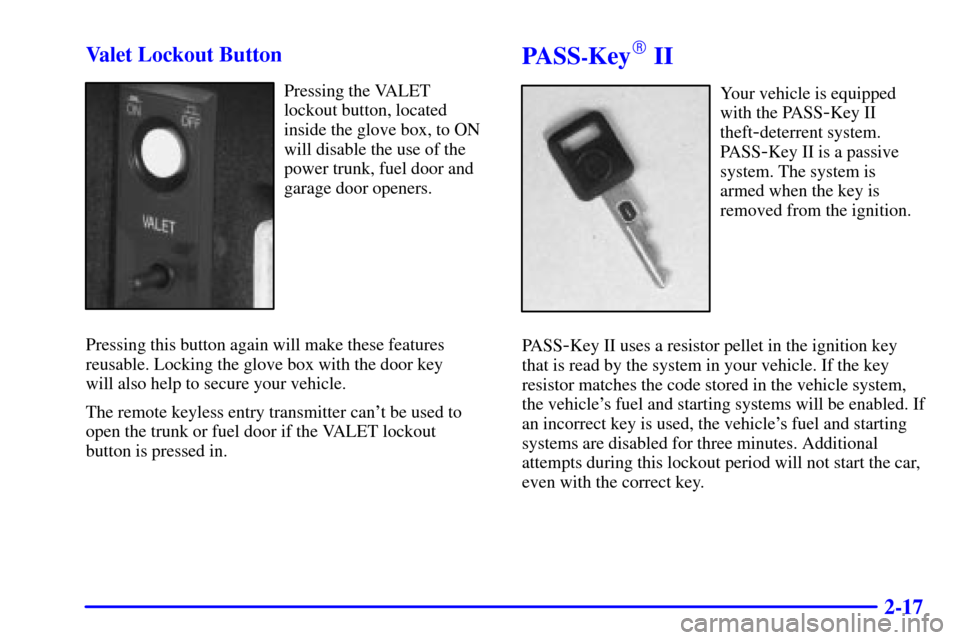
Pressing the VALET
lockout button, located
inside the glove box, to ON
will disable the use of the
power trunk, fuel door and
garage door openers.
Pressing this button again will make these features
reusable. Locking the glove box with the door key
will also help to secure your vehicle.
The remote keyless entry transmitter can't be used to
open the trunk or fuel door if the VALET lockout
button is pressed in.
PASS-Key� II
Your vehicle is equipped
with the PASS
-Key II
theft
-deterrent system.
PASS
-Key II is a passive
system. The system is
armed when the key is
removed from the ignition.
PASS
-Key II uses a resistor pellet in the ignition key
that is read by the system in your vehicle. If the key
resistor matches the code stored in the vehicle system,
the vehicle's fuel and starting systems will be enabled. If
an incorrect key is used, the vehicle's fuel and starting
systems are disabled for three minutes. Additional
attempts during this lockout period will not start the car,
even with the correct key.
Page 83 of 335

2-22
In very cold weather, 0�F (-18�C) or colder, the engine
coolant heater can help. You'll get easier starting and
better fuel economy during engine warm
-up. Usually,
the coolant heater should be plugged in a minimum of
four hours prior to starting your vehicle.
To Use the Engine Coolant Heater
1. Turn off the engine.
2. Open the hood and unwrap the electrical cord.
The electrical cord is located on the driver's side of
the engine, behind the transaxle dipstick/fluid fill
location (C) and next to the engine.
3. Plug it into a normal, grounded 110
-volt AC outlet.
CAUTION:
Plugging the cord into an ungrounded outlet
could cause an electrical shock. Also, the wrong
kind of extension cord could overheat and cause
a fire. You could be seriously injured. Plug the
cord into a properly grounded three
-prong
11 0
-volt AC outlet. If the cord won't reach, use a
heavy
-duty three-prong extension cord rated for
at least 15 amps.
4. Before starting the engine, be sure to unplug
and store the cord as it was before to keep it away
from moving engine parts. If you don't, it could
be damaged.
How long should you keep the coolant heater plugged
in? The answer depends on the outside temperature, the
kind of oil you have, and some other things. Instead of
trying to list everything here, we ask that you contact
your dealer in the area where you'll be parking your
vehicle. The dealer can give you the best advice for that
particular area.
Page 86 of 335

2-25
OVERDRIVE (�): This position is for normal driving.
If you need more power for passing, and you're:
�Going less than 35 mph (55 km/h), push the
accelerator pedal about halfway down.
�Going about 35 mph (55 km/h) or more, push the
accelerator all the way down.
The transaxle will shift down to the next gear and
have more power.
NOTICE:
If your vehicle seems to start up rather slowly, or
if it doesn't seem to shift gears as you accelerate,
something may be wrong with a transaxle system
sensor. If you drive very far that way, your
vehicle can be damaged. So if this happens, have
your vehicle serviced right away. Until then, you
can use SECOND (2) when you are driving less
than 35 mph (55 km/h) and OVERDRIVE (�)
for higher speeds.
THIRD (3): This position is also used for normal
driving, however, it offers more power and lower fuel
economy than OVERDRIVE (�).
Here are examples for using THIRD (3) instead
of OVERDRIVE (�):
�When driving on hilly, winding roads.
�When towing a trailer, so there is less shifting
between gears.
�When going down a steep hill.
SECOND (2): This position gives you more power than
Third (3). You can use SECOND (2) on hills. It can help
control your speed as you go down steep mountain
roads, but then you would also want to use your brakes
off and on.
NOTICE:
Don't shift into SECOND (2) unless you are going
slower than 65 mph (105 km/h), or you can
damage your engine.

