Page 262 of 335

6-8
Filling a Portable Fuel Container
CAUTION:
Never fill a portable fuel container while it is in
your vehicle. Static electricity discharge from the
container can ignite the gasoline vapor. You can
be badly burned and your vehicle damaged if this
occurs. To help avoid injury to you and others:
�Dispense gasoline only into
approved containers.
�Do not fill a container while it is inside a
vehicle, in a vehicle's trunk, pickup bed or
on any surface other than the ground.
�Bring the fill nozzle in contact with the
inside of the fill opening before operating
the nozzle. Contact should be maintained
until the filling is complete.
�Don't smoke while pumping gasoline.
Checking Things Under the Hood
CAUTION:
An electric fan under the hood can start up and
injure you even when the engine is not running.
Keep hands, clothing and tools away from any
underhood electric fan.
CAUTION:
Things that burn can get on hot engine parts and
start a fire. These include liquids like gasoline,
oil, coolant, brake fluid, windshield washer and
other fluids, and plastic or rubber. You or others
could be burned. Be careful not to drop or spill
things that will burn onto a hot engine.
Page 265 of 335
6-11
Before closing the hood, be sure all filler caps are on
properly. Then pull the hood down and close it firmly.
Underhood Lamp
Turn the parking lamps on to operate the underhood lamp.
The underhood lamp will come on when the hood is opened.
Engine Oil
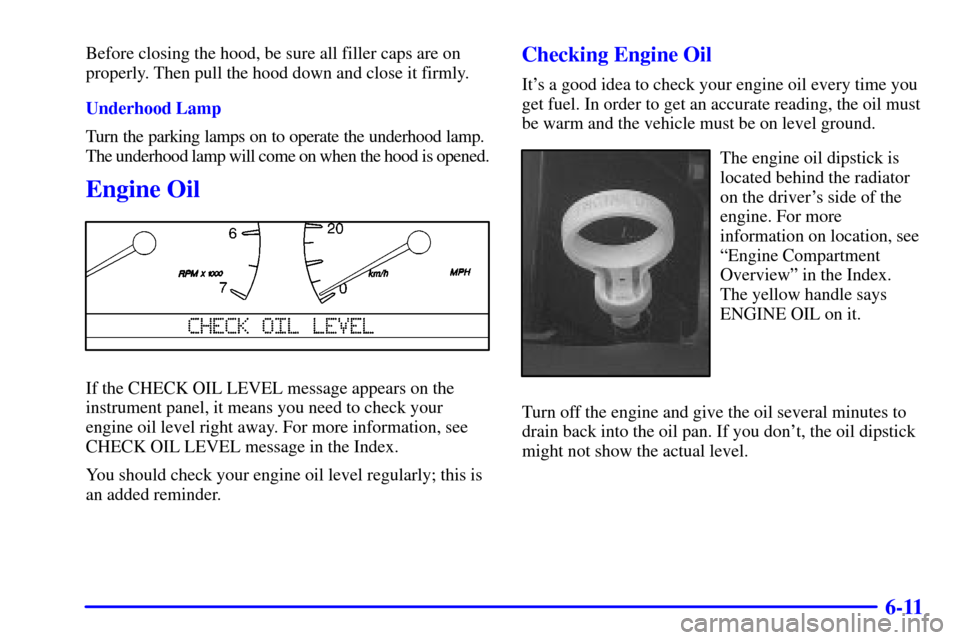
If the CHECK OIL LEVEL message appears on the
instrument panel, it means you need to check your
engine oil level right away. For more information, see
CHECK OIL LEVEL message in the Index.
You should check your engine oil level regularly; this is
an added reminder.
Checking Engine Oil
It's a good idea to check your engine oil every time you
get fuel. In order to get an accurate reading, the oil must
be warm and the vehicle must be on level ground.
The engine oil dipstick is
located behind the radiator
on the driver's side of the
engine. For more
information on location, see
ªEngine Compartment
Overviewº in the Index.
The yellow handle says
ENGINE OIL on it.
Turn off the engine and give the oil several minutes to
drain back into the oil pan. If you don't, the oil dipstick
might not show the actual level.
Page 295 of 335
6-41 Inflation -- Tire Pressure
The Tire-Loading Information label, which is located on
the rear edge of the driver's door, shows the correct
inflation pressures for your tires when they're cold.
ªColdº means your vehicle has been sitting for at least
three hours or driven no more than 1 mile (1.6 km).
If you'll be driving at high speeds (e.g., speeds of
100 mph (160 km/h) or higher), where it is legal, set the
cold inflation pressure to the maximum inflation pressure
shown on the tire sidewall, or to 38 psi (265 kPa),
whichever is lower. See the example below. When you
end this high
-speed driving, return to the cold inflation
pressure shown on the Tire
-Loading Information label.
Example:
You'll find maximum load and inflation pressure
molded on the tire's sidewall, in small letters, near the
rim flange. It will read something like this: Maximum
load 690 kg (1521 lbs.) @ 300 kPa (44 psi) Max. Press.
For this example, you would set the inflation pressure
for high
-speed driving at 38 psi (265 kPa).
NOTICE:
Don't let anyone tell you that underinflation or
overinflation is all right. It's not. If your tires
don't have enough air (underinflation), you can
get the following:
�Too much flexing
�Too much heat
�Tire overloading
�Bad wear
�Bad handling
�Bad fuel economy.
If your tires have too much air (overinflation),
you can get the following:
�Unusual wear
�Bad handling
�Rough ride
�Needless damage from road hazards.
Page 309 of 335

6-55
Underbody Maintenance
Chemicals used for ice and snow removal and dust control
can collect on the underbody. If these are not removed,
accelerated corrosion (rust) can occur on the underbody
parts such as fuel lines, frame, floor pan and exhaust
system even though they have corrosion protection.
At least every spring, flush these materials from the
underbody with plain water. Clean any areas where mud
and other debris can collect. Dirt packed in closed areas
of the frame should be loosened before being flushed.
Your dealer or an underbody car washing system can
do this for you.
Chemical Paint Spotting
Some weather and atmospheric conditions can create a
chemical fallout. Airborne pollutants can fall upon and
attack painted surfaces on your vehicle. This damage
can take two forms: blotchy, ringlet
-shaped
discolorations, and small irregular dark spots etched
into the paint surface.
Although no defect in the paint job causes this, Vehicle
will repair, at no charge to the owner, the surfaces of
new vehicles damaged by this fallout condition within
12 months or 12,000 miles (20 000 km) of purchase,
whichever occurs first.
Page 313 of 335
6-59 MaxiFuse
�/Relay Center
The MaxiFuses and relays are located next to the engine
compartment fuse block on the driver's side of the
engine. To access the compartment fuse block, remove
the shroud cover. If a MaxiFuse should blow, have your
vehicle serviced by your dealer immediately.
MaxiFuse
(8
-Way) Usage
BODY 1 Road Sensing Suspension (RSS)
Fuse (ETC Only), Convenience
Fuse, BATT Fuse, Antenna Fuse,
Passenger and Driver Seat Belt
Comfort Solenoids, Trunk and
Fuel Door Release Solenoids and
Relays, Door Lock/Unlock Relays,
Damper Relay (ETC Only),
Parking Lamp Relay, Right and
Left Park Fuse
BODY 2 Defog Relay, Pull
-Down Fuse,
Right and Left Heated Seat Fuses,
Electronic Level Control (ELC)
Relay, Heated Mirror Fuse,
Heated Backlite Fuse,
ELC Circuit Breaker
Page 314 of 335
6-60
MaxiFuse
(8
-Way) Usage
BODY 3 Controlled Power Relay,
Controlled Power Back
-Up Relay,
Cluster Fuse, Passenger Zone
Module (PZM) Fuse, Radio Fuse,
RAP Relay, Trunk and Fuel Door
Release Relay, High
-Beam Relay,
Comfort Fuse, AMP Fuse
(Optional), Right and Left Bose
Relay (Optional)
INADVERT Inadvertent Power Relay, Interior
Lamps Fuse, Cigarette Lighter
-1
Fuse, Courtesy Lamp Relay
LAMPS Headlamps Fuse/Relay, High/Low
Beam Control Relay, Fog Lamp
Fuse, DRL Fuse, Hazard Fuse,
Mirror Fuse, Inadvertent Power
Relay, Right and Left High
-Beam
Fuse, Right and Left Low
-Beam
Fuse, Stoplamp Fuse, Fog Lamp
Relay, DRL RelayMaxiFuse
(8
-Way) Usage
IGN 1 Rear Ignition
-1 Relay, Wiper
Fuse, Relay Ignition
-1 Fuse,
Supplemental Inflatable Restraint
(SIR) Fuse, Accessory Relay
WINDOWS Retained Accessory
Power (RAP) Relay
SEATS Horn Relay, Driver and Passenger
Lumbar In/Out Relays,
Driver and Passenger Lumbar
Up/Down Relays
Page 315 of 335
6-61
MaxiFuse
(6
-Way) Usage
BATT 3 Steering Column Ignition Switch
BATT 2 Steering Column Ignition Switch
IGN 1 Front Ignition
-1 Relay, Oxygen
Sensor 1 and 2 Fuse, Fuel Fuse,
Cruise Fuse, Fuel Pump Relay
BATT 1 Starter Relay and Solenoid,
Park/Reverse Fuse, Park Relay,
Powertrain Control Module
(PCM) Fuse, AC Compressor Fuse
and Relay, Fan Relays,
Reverse Relay
BRAKES Anti
-Lock Brake System (ABS)
Brake Modulator
COOL FNS Cooling Fan Relays 1 and 3Power
Distribution
BlockUsage
DRL Daytime Running Lamps (DRL)
HI/LO BEAM High and Low
-Beam Headlamps
HORN Horn
FOG LPS Fog Lamps
ACCESSORY Accessories
HEAD LPS Headlamps
Relays
INADVERT POWER RELAY
IGN 1 RELAY
STARTER RELAY
Page 318 of 335

6-64
Fuse Usage
DRL Daytime Running Lamp (DRL)
Relay, Left and Right Low Beam
in DRL Mode
IGN 0 (ENG) Powertrain Control
Module (PCM)
CRANK Powertrain Control
Module (PCM)
ABS Anti
-Lock Brake System
(ABS)/Traction Control System
IGN
-1 Rear Ignition-1 Relay, Front Fog
Lamp Relay, Controlled Power
Backup Relay, DRL Relay,
Canister Vent Solenoid
WIPERS Accessory Relay, Wiper Switch
A/C COMP AC Compressor Relay,
Cooling Fan Relays 1, 2, 3,
Compressor Clutch
PCM (BAT) PCM
PARK/REV Reverse Relay, Right and Left
Back
-Up Lamps, Electrochromic
Mirror (in Header), Park Relay,
Brake Transaxle
-Shift
Interlock (BTSI) SwitchFuse Usage
ECS Transaxle Shift Solenoids, Air
Meter, Canister Purge, PCM, Front
Ignition
-1 Relay
PCM (IGN) Powertrain Control
Module (PCM)
DIS Odd and Even Coil Packs
CRUISE Stepper Motor Cruise Control,
Low Refrigerant Pressure Cutoff
Switch, Park Relay
INJ Injectors 1, 4, 6, 7
INJ Injectors 2, 3, 5, 8
FUEL PUMP Fuel Pump Relay, Fuel Pump
OXY SEN1 Oxygen Sensor Front
OXY SEN2 Catalytic Converter (CAT)
Rear Oxygen Sensor,
Starter Enable Relay
Relays
A/C COMP
RELAY
FUEL PUMP
RELAY