Page 237 of 335

5-13
A low coolant level should be indicated by a CHECK
COOLANT LEVEL message on the Driver Information
Center. If it is, you may have a leak in the radiator
hoses, heater hoses, radiator, water pump or somewhere
else in the cooling system.
CAUTION:
Heater and radiator hoses, and other engine
parts, can be very hot. Don't touch them.
If you do, you can be burned.
Don't run the engine if there is a leak. If you run
the engine, it could lose all coolant. That could
cause an engine fire, and you could be burned.
Get any leak fixed before you drive the vehicle.
NOTICE:
Engine damage from running your engine
without coolant isn't covered by your warranty.
See ªOverheated Engine Protection Operating
Modeº in the Index.
NOTICE:
When adding coolant, it is important that you
use only DEX
-COOL� (silicate-free) coolant.
If coolant other than DEX-COOL is added to
the system, premature engine, heater core or
radiator corrosion may result. In addition, the
engine coolant will require change sooner
-- at
30,000 miles (50 000 km) or 24 months,
whichever occurs first. Damage caused by the
use of coolant other than DEX
-COOL� is not
covered by your new vehicle warranty.
If there seems to be no leak, with the engine on, check to
see if the electric engine cooling fans are running. If the
engine is overheating, both fans should be running. If
they aren't, your vehicle needs service.
Page 241 of 335
5-17
4. With the coolant surge tank pressure cap off, start the
engine and let it run until you can feel the upper
radiator hose getting hot. Watch out for the engine
cooling fans.
By this time, the coolant level inside the coolant
surge tank may be lower. If the level is lower, add
more of the proper mixture to the coolant surge tank
until the level reaches about 2.5 inches (6.4 cm)
below the base of the filler neck.5. Then replace the pressure cap. Be sure the arrows on
the pressure cap line up like this.
Start the engine and allow it to warm up. If the CHECK
COOLANT LEVEL message does not appear on the
Driver Information Center, coolant is at the proper fill
level. If a CHECK COOLANT LEVEL message does
appear, repeat Steps 1 to 3 and reinstall the pressure cap
or see your dealer.
Page 243 of 335
5-19
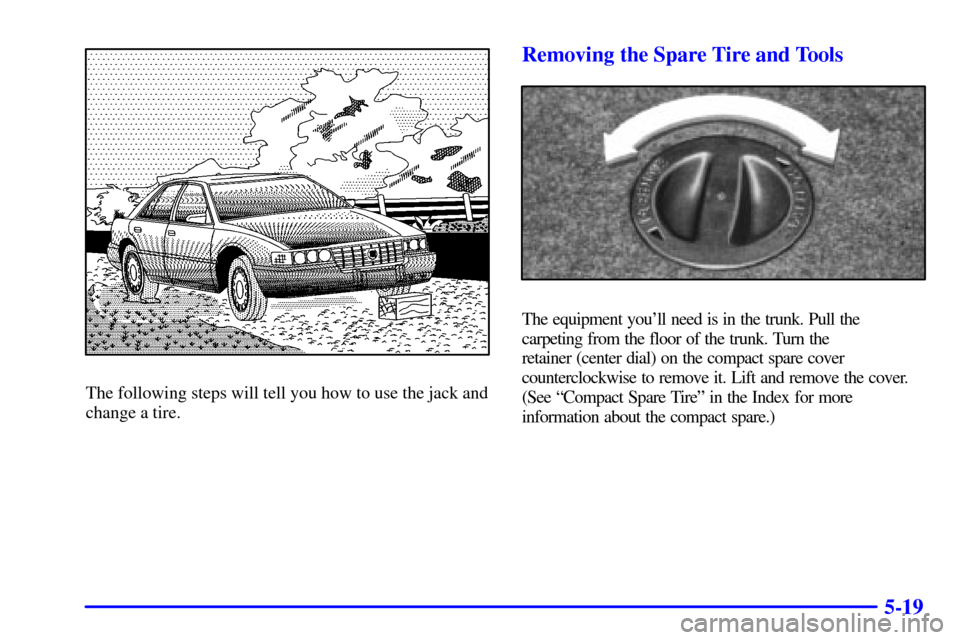
The following steps will tell you how to use the jack and
change a tire.
Removing the Spare Tire and Tools
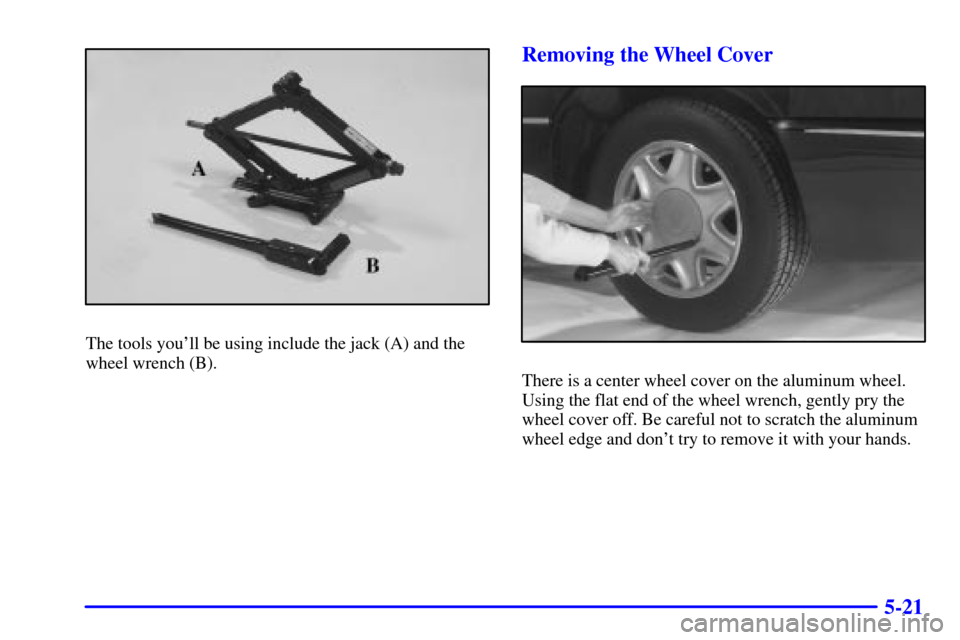
The equipment you'll need is in the trunk. Pull the
carpeting from the floor of the trunk. Turn the
retainer (center dial) on the compact spare cover
counterclockwise to remove it. Lift and remove the cover.
(See ªCompact Spare Tireº in the Index for more
information about the compact spare.)
Page 245 of 335
5-21
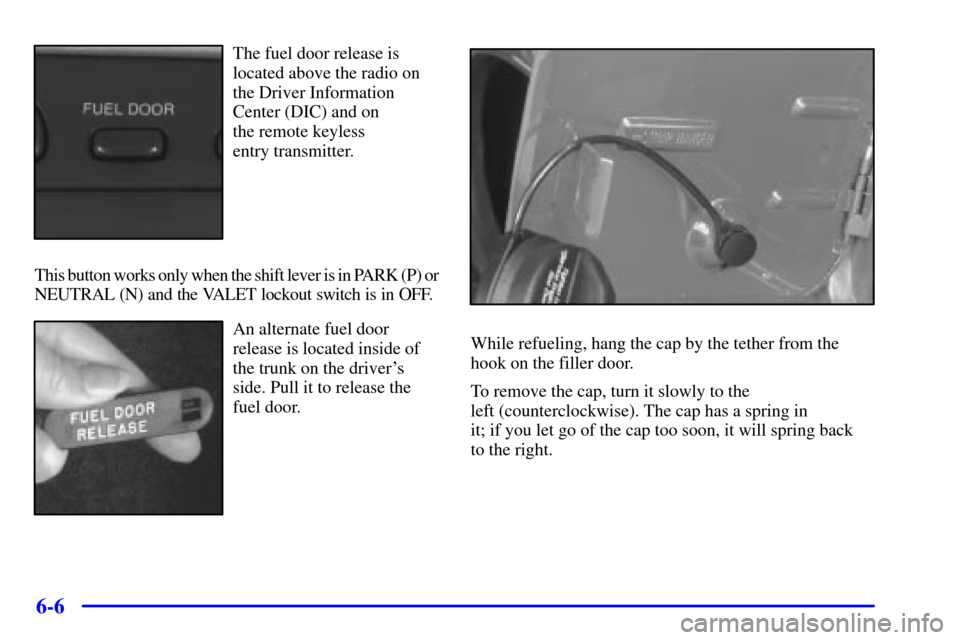
The tools you'll be using include the jack (A) and the
wheel wrench (B).
Removing the Wheel Cover
There is a center wheel cover on the aluminum wheel.
Using the flat end of the wheel wrench, gently pry the
wheel cover off. Be careful not to scratch the aluminum
wheel edge and don't try to remove it with your hands.
Page 260 of 335
6-6
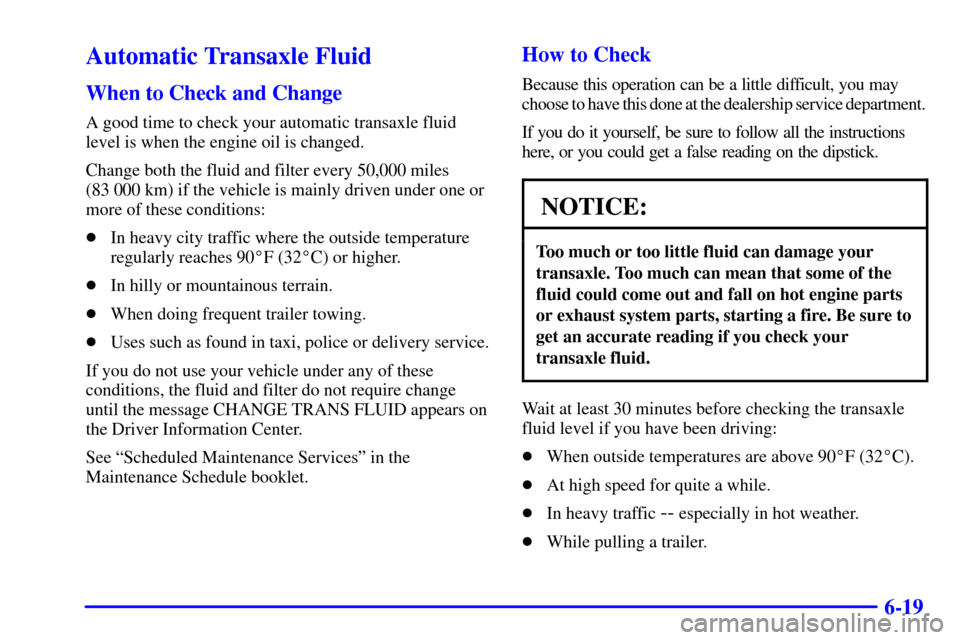
The fuel door release is
located above the radio on
the Driver Information
Center (DIC) and on
the remote keyless
entry transmitter.
This button works only when the shift lever is in PARK (P) or
NEUTRAL (N) and the VALET lockout switch is in OFF.
An alternate fuel door
release is located inside of
the trunk on the driver's
side. Pull it to release the
fuel door.While refueling, hang the cap by the tether from the
hook on the filler door.
To remove the cap, turn it slowly to the
left (counterclockwise). The cap has a spring in
it; if you let go of the cap too soon, it will spring back
to the right.
Page 269 of 335

6-15
How to Reset the Oil Life Indicator
1. After the oil has been changed, display the OIL LIFE
LEFT message by pressing the SKIP INFO button.
2. Then press and hold the NO INFO RESET button
until the display shows 100% ENGINE OIL LIFE.
This resets the oil life index.
The message will remain off until the next oil change
is needed. The percentage of oil life remaining may
be checked at any time by pressing the SKIP INFO
button several times until the OIL LIFE LEFT
message appears.
For more information on the Oil Life feature, see
ªOil Life Indicatorº in the Index.What to Do with Used Oil
Did you know that used engine oil contains certain
elements that may be unhealthy for your skin and could
even cause cancer? Don't let used oil stay on your skin
for very long. Clean your skin and nails with soap and
water, or a good hand cleaner. Wash or properly throw
away clothing or rags containing used engine oil. See
the manufacturer's warnings about the use and disposal
of oil products.
Used oil can be a real threat to the environment. If you
change your own oil, be sure to drain all free
-flowing oil
from the filter before disposal. Don't ever dispose of oil
by putting it in the trash, pouring it on the ground, into
sewers, or into streams or bodies of water. Instead,
recycle it by taking it to a place that collects used oil.
If you have a problem properly disposing of your used
oil, ask your dealer, a service station or a local recycling
center for help.
Page 273 of 335
6-19
Automatic Transaxle Fluid
When to Check and Change
A good time to check your automatic transaxle fluid
level is when the engine oil is changed.
Change both the fluid and filter every 50,000 miles
(83 000 km) if the vehicle is mainly driven under one or
more of these conditions:
�In heavy city traffic where the outside temperature
regularly reaches 90�F (32�C) or higher.
�In hilly or mountainous terrain.
�When doing frequent trailer towing.
�Uses such as found in taxi, police or delivery service.
If you do not use your vehicle under any of these
conditions, the fluid and filter do not require change
until the message CHANGE TRANS FLUID appears on
the Driver Information Center.
See ªScheduled Maintenance Servicesº in the
Maintenance Schedule booklet.
How to Check
Because this operation can be a little difficult, you may
choose to have this done at the dealership service department.
If you do it yourself, be sure to follow all the instructions
here, or you could get a false reading on the dipstick.
NOTICE:
Too much or too little fluid can damage your
transaxle. Too much can mean that some of the
fluid could come out and fall on hot engine parts
or exhaust system parts, starting a fire. Be sure to
get an accurate reading if you check your
transaxle fluid.
Wait at least 30 minutes before checking the transaxle
fluid level if you have been driving:
�When outside temperatures are above 90�F (32�C).
�At high speed for quite a while.
�In heavy traffic
-- especially in hot weather.
�While pulling a trailer.
Page 276 of 335

6-22 How to Reset Transaxle Fluid
Change Indicator
Your vehicle is equipped with a transaxle fluid change
indicator. A CHANGE TRANS FLUID message will
display on the Driver Information Center (DIC) when
the powertrain computer determines that the transaxle
fluid needs to be changed or at each 100,000 miles
(160 000 km) interval, whichever occurs first. See your
Maintenance Schedule booklet for more information.
When this message appears, change the transaxle fluid
and reset the transaxle fluid life indicator as follows:
1. Turn the ignition on but do not start the engine.
2. Press and hold the OFF and rear defog buttons on the
climate control system at the same time until the
TRANS FLUID RESET message appears on
the DIC.
Engine Coolant
The cooling system in your vehicle is filled with
DEX
-COOL� engine coolant. This coolant is designed
to remain in your vehicle for 5 years or 150,000 miles
(240 000 km), whichever occurs first, if you add only
DEX
-COOL� extended life coolant.
The following explains your cooling system and how to add
coolant when it is low. If you have a problem with engine
overheating, see ªEngine Overheatingº in the Index.
A 50/50 mixture of clean, drinkable water and
DEX
-COOL� coolant will:
�Give freezing protection down to
-34�F (-37�C).
�Give boiling protection up to 265�F (129�C).
�Protect against rust and corrosion.
�Help keep the proper engine temperature.
�Let the warning lights and gages work as they should.