Page 218 of 335
4-31
CAUTION:
Things you put inside your vehicle can strike
and injure people in a sudden stop or turn, or
in a crash.
�Put things in the trunk of your vehicle. In a
trunk, put them as far forward as you can.
Try to spread the weight evenly.
�Never stack heavier things, like suitcases,
inside the vehicle so that some of them are
above the tops of the seats.
�Don't leave an unsecured child restraint in
your vehicle.
�When you carry something inside the
vehicle, secure it whenever you can.
Electronic Level Control
This feature keeps the rear of your vehicle level as the
load changes. It's automatic
-- you don't need to
adjust anything.
Towing a Trailer
CAUTION:
If you don't use the correct equipment and drive
properly, you can lose control when you pull a
trailer. For example, if the trailer is too heavy, the
brakes may not work well
-- or even at all. You
and your passengers could be seriously injured.
You may also damage your vehicle; the resulting
repairs would not be covered by your warranty.
Pull a trailer only if you have followed all the
steps in this section. Ask your dealer for advice
and information about towing a trailer with
your vehicle.
Page 222 of 335

4-35 Safety Chains
You should always attach chains between your vehicle
and your trailer. Cross the safety chains under the tongue
of the trailer so that the tongue will not drop to the road
if it becomes separated from the hitch. Instructions
about safety chains may be provided by the hitch
manufacturer or by the trailer manufacturer. Follow the
manufacturer's recommendation for attaching safety
chains and do not attach them to the bumper. Always
leave just enough slack so you can turn with your rig.
And, never allow safety chains to drag on the ground.
Trailer Brakes
Because you have anti-lock brakes, don't try to tap into
your vehicle's hydraulic brake system. If you do, both
brake systems won't work well, or at all.
Driving with a Trailer
Towing a trailer requires a certain amount of experience.
Before setting out for the open road, you'll want to get
to know your rig. Acquaint yourself with the feel of
handling and braking with the added weight of the
trailer. And always keep in mind that the vehicle you are
driving is now a good deal longer and not nearly as
responsive as your vehicle is by itself.Before you start, check the trailer hitch and platform
(and attachments), safety chains, electrical connector,
lamps, tires and mirror adjustment. If the trailer has
electric brakes, start your vehicle and trailer moving and
then apply the trailer brake controller by hand to be sure
the brakes are working. This lets you check your
electrical connection at the same time.
During your trip, check occasionally to be sure that the
load is secure, and that the lamps and any trailer brakes
are still working.
Following Distance
Stay at least twice as far behind the vehicle ahead as you
would when driving your vehicle without a trailer. This
can help you avoid situations that require heavy braking
and sudden turns.
Passing
You'll need more passing distance up ahead when
you're towing a trailer. And, because you're a good deal
longer, you'll need to go much farther beyond the
passed vehicle before you can return to your lane.
Page 251 of 335
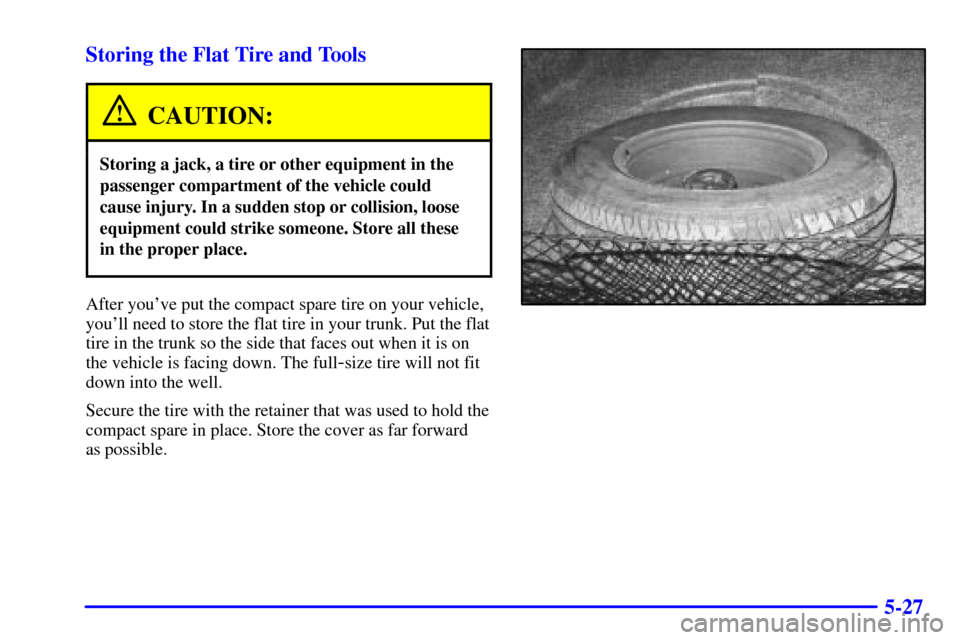
5-27 Storing the Flat Tire and Tools
CAUTION:
Storing a jack, a tire or other equipment in the
passenger compartment of the vehicle could
cause injury. In a sudden stop or collision, loose
equipment could strike someone. Store all these
in the proper place.
After you've put the compact spare tire on your vehicle,
you'll need to store the flat tire in your trunk. Put the flat
tire in the trunk so the side that faces out when it is on
the vehicle is facing down. The full
-size tire will not fit
down into the well.
Secure the tire with the retainer that was used to hold the
compact spare in place. Store the cover as far forward
as possible.
Page 272 of 335

6-18
Follow these steps to reinstall the engine air
cleaner/filter assembly:
1. Slide the lid into the slots in the front edge
of the base.
2. Pivot the cover and the air duct assembly
downward. Make sure that both latches are secure
and fully engaged.
3. Reinstall the clean air duct over the mass airflow
sensor. Make sure that the duct is secure around the
entire outer edge of the sensor.
4. Tighten the air duct clamp.
5. Reconnect the IAT sensor.
Refer to the Maintenance Schedule to determine when to
replace the air filter.
See ªScheduled Maintenance Servicesº in the
Maintenance Schedule booklet.
CAUTION:
Operating the engine with the air cleaner/filter
off can cause you or others to be burned. The air
cleaner not only cleans the air, it stops flame if
the engine backfires. If it isn't there, and the
engine backfires, you could be burned. Don't
drive with it off, and be careful working on the
engine with the air cleaner/filter off.
NOTICE:
If the air cleaner/filter is off, a backfire can cause
a damaging engine fire. And, dirt can easily
get into your engine, which will damage it.
Always have the air cleaner/filter in place when
you're driving.
Page 274 of 335
6-20
To get the right reading, the fluid should be at
normal operating temperature, which is 180�F to
200�F (82�C to 93�C).
Get the vehicle warmed up by driving about
15 miles (24 km) when outside temperatures are above
50�F (10�C). If it's colder than 50�F (10�C), you
may have to drive longer.
Checking the Fluid Level
Prepare your vehicle as follows:
�Park your vehicle on a level place. Keep the
engine running.
�With the parking brake applied, place the shift lever
in PARK (P).
�With your foot on the brake pedal, move the shift
lever through each gear range, pausing for about
three seconds in each range. Then, position the shift
lever in PARK (P).
�Let the engine run at idle for three to five minutes.Then, without shutting off the engine, follow these steps:
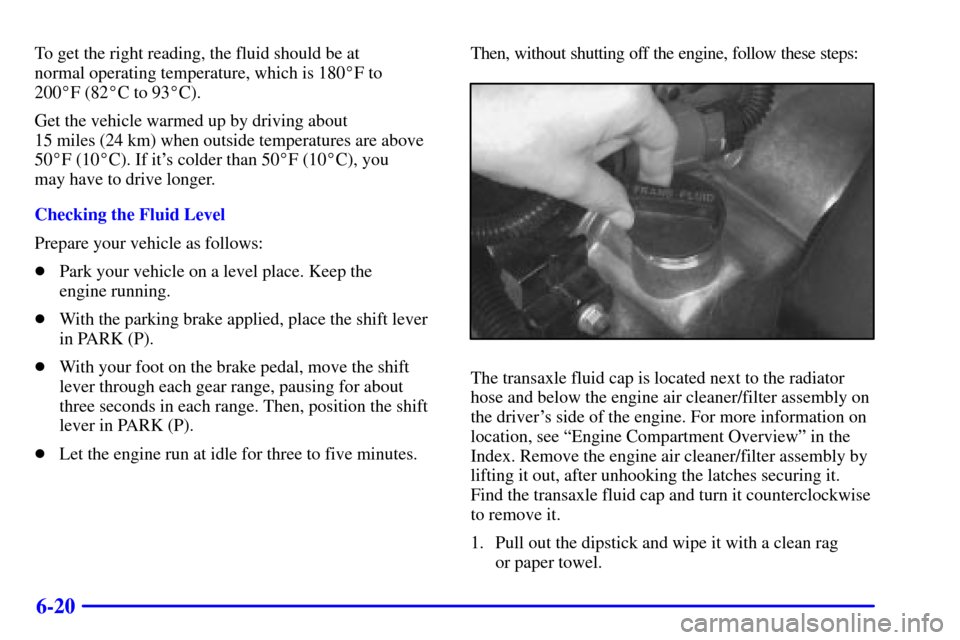
The transaxle fluid cap is located next to the radiator
hose and below the engine air cleaner/filter assembly on
the driver's side of the engine. For more information on
location, see ªEngine Compartment Overviewº in the
Index. Remove the engine air cleaner/filter assembly by
lifting it out, after unhooking the latches securing it.
Find the transaxle fluid cap and turn it counterclockwise
to remove it.
1. Pull out the dipstick and wipe it with a clean rag
or paper towel.
Page 302 of 335
6-48 Tire Chains
NOTICE:
If your vehicle has P235/60R16 size tires, don't
use tire chains. They can damage your vehicle
because there's not enough clearance.
Use another type of traction device only if its
manufacturer recommends it for use on your
vehicle and tire size combination and road
conditions. Follow that manufacturer's
instructions. To help avoid damage to your
vehicle, drive slowly, readjust or remove the
device if it's contacting your vehicle, and don't
spin your wheels.
NOTICE: (Continued)
NOTICE: (Continued)
If you do find traction devices that will fit, install
them on the front tires.
If you have other tires, use tire chains only
where legal and only when you must. Use only
SAE Class ªSº type chains that are the proper
size for your tires. Install them on the front tires
and tighten them as tightly as possible with the
ends securely fastened. Drive slowly and follow
the chain manufacturer's instructions. If you can
hear the chains contacting your vehicle, stop and
retighten them. If the contact continues, slow
down until it stops. Driving too fast or spinning
the wheels with chains on will damage
your vehicle.