Page 142 of 335

2-81
FUEL LEVEL LOW - 11 : This message serves as a
warning that the fuel level in the tank is critically low.
Stop for fuel soon.
HEADLAMPS SUGGESTED
- 23: If it's dark enough
outside and the Twilight Sentinel control is off, a
HEADLAMPS SUGGESTED message will display on
the DIC. This message informs the driver that turning on
the exterior lamps is recommended even though the
Daytime Running Lamps (DRL) are still illuminated
(it's become dark enough outside to require the
headlamps and/or other exterior lamps).
ICE POSSIBLE
- 13: This message appears when
the outside air temperature is cold enough to create icy
road conditions.
LOW REFRIG A/C OFF
- 12: This message means
that the air conditioning system detects a refrigerant
level that is low enough to cause damage to the air
conditioning compressor. Have the air conditioning
system serviced if this message appears.MONITORED SYSTEMS OK
- 1: This message only
appears in the ªrecallº mode by pressing the INFO
RESET (NO) button. It lets you know that no other
messages are stored or currently active.
OIL PRESSURE LOW STOP ENGINE
- 35: If this
message appears while the engine is running, stop the
engine and do not operate it until the cause of low oil
pressure is corrected. Severe damage to the engine can
result. A multiple chime will also sound when this
message is displayed.
OPTIONS NOT SET
- 99: This message will display if
a fault has occurred in your vehicle's memory. Have
your vehicle serviced by your dealership.
PROGRAM PASS KEY
- 31: This warning message
displays when the PASS
-Key� II pellet information has
not been programmed into your vehicle. See your
dealership for service.
Page 152 of 335
2-91 Oil Life Indicator
This feature lets you know when to change the engine
oil. It's based on the engine oil temperatures and your
driving patterns. To see the display, press the SKIP
INFO button several times until XX OIL LIFE LEFT
appears. If you see 99% OIL LIFE LEFT, 99 percent of
your current oil life remains.
The Driver Information Center (DIC) may display a
CHANGE ENGINE OIL message. Always keep a
written record of the mileage and date when you
changed your oil. For more information, see the
Maintenance Schedule booklet. If you see CHANGE
ENGINE OIL, it means that you have no oil life left and
you should change your engine oil right away.
When the oil is changed, you'll need to reset the system.
See ªOil Life Indicator, How to Resetº in the Index.
Page 209 of 335

4-22
Once you are moving on the freeway, make certain you
allow a reasonable following distance. Expect to move
slightly slower at night.
When you want to leave the freeway, move to the proper
lane well in advance. If you miss your exit, do not,
under any circumstances, stop and back up. Drive on to
the next exit.
The exit ramp can be curved, sometimes quite sharply.
The exit speed is usually posted.
Reduce your speed according to your speedometer, not
to your sense of motion. After driving for any distance
at higher speeds, you may tend to think you are going
slower than you actually are.
Before Leaving on a Long Trip
Make sure you're ready. Try to be well rested. If you
must start when you're not fresh
-- such as after a day's
work
-- don't plan to make too many miles that first part
of the journey. Wear comfortable clothing and shoes you
can easily drive in.Is your vehicle ready for a long trip? If you keep it
serviced and maintained, it's ready to go. If it needs
service, have it done before starting out. Of course,
you'll find experienced and able service experts in
Cadillac dealerships all across North America.
They'll be ready and willing to help if you need it.
Here are some things you can check before a trip:
�Windshield Washer Fluid: Is the reservoir full?
Are all windows clean inside and outside?
�Wiper Blades: Are they in good shape?
�Fuel, Engine Oil, Other Fluids: Have you checked
all levels?
�Lamps: Are they all working? Are the lenses clean?
�Tires: They are vitally important to a safe,
trouble
-free trip. Is the tread good enough for
long
-distance driving? Are the tires all inflated to the
recommended pressure?
�Weather Forecasts: What's the weather outlook
along your route? Should you delay your trip a short
time to avoid a major storm system?
�Maps: Do you have up
-to-date maps?
Page 224 of 335
4-37 Parking on Hills
CAUTION:
You really should not park your vehicle, with a
trailer attached, on a hill. If something goes
wrong, your rig could start to move. People can
be injured, and both your vehicle and the trailer
can be damaged.
But if you ever have to park your rig on a hill, here's
how to do it:
1. Apply your regular brakes, but do not shift
into PARK (P).
2. Have someone place chocks under the trailer wheels.
3. When the wheel chocks are in place, release the
regular brakes until the chocks absorb the load.
4. Reapply the regular brakes. Then shift into
PARK (P) firmly and apply your parking brake.
5. Release the regular brakes.
When You Are Ready to Leave After
Parking on a Hill
1. Apply your regular brakes and hold the pedal down
while you:
�Start your engine;
�Shift into a gear; and
�Be sure the parking brake has released.
2. Let up on the brake pedal.
3. Drive slowly until the trailer is clear of the chocks.
4. Stop and have someone pick up and store the chocks.
Maintenance When Trailer Towing
Your vehicle will need service more often when you're
pulling a trailer. See the Maintenance Schedule booklet for
more on this. Things that are especially important in trailer
operation are automatic transaxle fluid (don't overfill),
engine oil, drive belt, cooling system and brake system.
If you're trailering, it's a good idea to review this
information before you start your trip.
Check periodically to see that all hitch nuts and
bolts are tight.
Engine Cooling When Trailer Towing
Your cooling system may temporarily overheat during
severe operating conditions. See ªEngine Overheatingº
in the Index.
Page 233 of 335

5-9
3. Disconnect the red positive (+) cable from the
vehicle with the good battery.
4. Disconnect the red positive (+) cable from the
other vehicle.
Towing Your Vehicle
Consult your dealer or a professional towing service if
you need to have your vehicle towed. See ªRoadside
Assistanceº in the Index.
Engine Overheating
You will find an ENGINE COOLANT HOT, IDLE
ENGINE message or an ENGINE OVERHEATED,
STOP ENGINE message on the Driver Information
Center (DIC). You will also hear a chime. There is also
an engine temperature warning light and/or gage on the
instrument panel. See ªEngine Coolant Temperature
Warning Lightº or ªEngine Coolant Temperature Gageº
in the Index.
Overheated Engine Protection
Operating Mode
Should an overheated engine condition exist and the
message ENGINE OVERHEATED, STOP ENGINE is
displayed, an overheat protection mode which alternates
firing groups of cylinders helps prevent engine damage.
In this mode, you will notice a loss in power and engine
performance. This operating mode allows your vehicle
to be driven to a safe place in an emergency; you may
drive up to 50 miles (80 km). Towing a trailer in the
overheat protection mode should be avoided.
NOTICE:
After driving in the overheated engine protection
operating mode, to avoid engine damage, allow
the engine to cool before attempting any repair.
The engine oil will be severely degraded.
Repair the cause of coolant loss, change the oil
and reset the oil life indicator. See ªEngine Oilº
in the Index.
Page 236 of 335
5-12
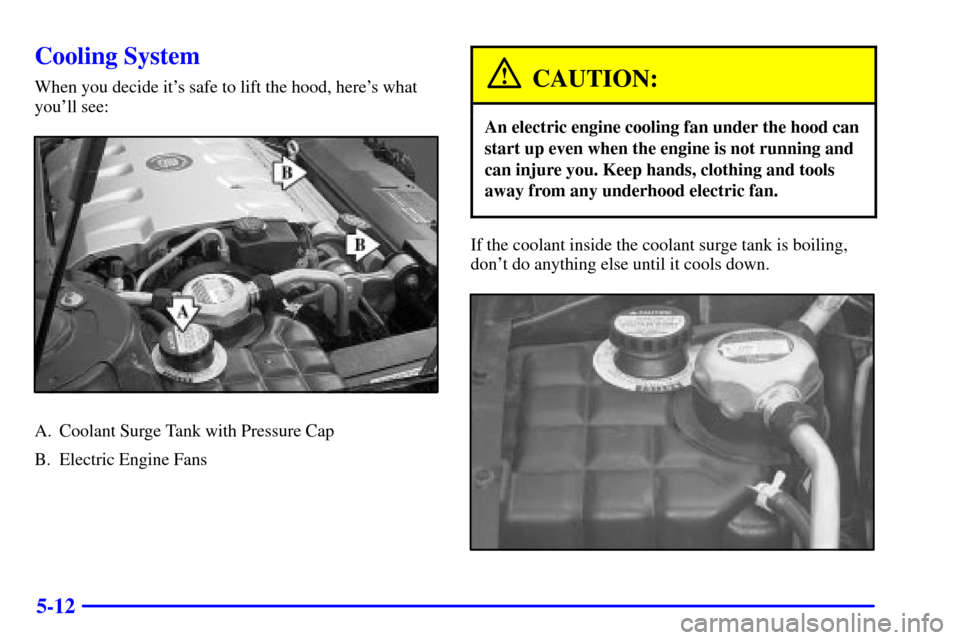
Cooling System
When you decide it's safe to lift the hood, here's what
you'll see:
A. Coolant Surge Tank with Pressure Cap
B. Electric Engine Fans
CAUTION:
An electric engine cooling fan under the hood can
start up even when the engine is not running and
can injure you. Keep hands, clothing and tools
away from any underhood electric fan.
If the coolant inside the coolant surge tank is boiling,
don't do anything else until it cools down.
Page 238 of 335

5-14 How to Add Coolant to the Coolant
Surge Tank
If you haven't found a problem yet, but the coolant level
isn't at the proper level (2.5 inches (6.4 cm) below the
base of the fill neck), add a 50/50 mixture of clean,
drinkable water and DEX
-COOL� coolant at the
coolant surge tank, but be sure the cooling system,
including the coolant surge tank pressure cap, is cool
before you do it. See ªEngine Coolantº in the Index for
more information.
CAUTION:
Steam and scalding liquids from a hot cooling
system can blow out and burn you badly. They are
under pressure, and if you turn the coolant surge
tank pressure cap
-- even a little -- they can come
out at high speed. Never turn the cap when the
cooling system, including the coolant surge tank
pressure cap, is hot. Wait for the cooling system
and coolant surge tank pressure cap to cool if you
ever have to turn the pressure cap.
CAUTION:
Adding only plain water to your cooling system
can be dangerous. Plain water, or some other
liquid like alcohol, can boil before the proper
coolant mixture will. Your vehicle's coolant
warning system is set for the proper coolant
mixture. With plain water or the wrong mixture,
CAUTION: (Continued)
Page 255 of 335

6-
6-1
Section 6 Service and Appearance Care
Here you will find information about the care of your vehicle. This section begins with service and fuel information,
and then it shows how to check important fluid and lubricant levels. There is also technical information about your
vehicle, and a part devoted to its appearance care.
6
-2 Service
6
-3 Fuel
6
-5 Fuels in Foreign Countries
6
-5 Filling Your Tank
6
-8 Filling a Portable Fuel Container
6
-8 Checking Things Under the Hood
6
-11 Engine Oil
6
-16 Engine Air Cleaner/Filter
6
-19 Automatic Transaxle Fluid
6
-22 Engine Coolant
6
-28 Windshield Washer Fluid
6
-29 Brakes
6
-32 Battery
6
-33 Bulb Replacement
6
-39 Windshield Wiper Blade Replacement
6
-40 Tires
6
-49 Appearance Care
6
-49 Cleaning the Inside of Your Vehicle6
-51 Care of Safety Belts
6
-51 Cleaning Glass Surfaces
6
-51 Cleaning the Outside of the Windshield and
Wiper Blades
6
-52 Weatherstrips
6
-52 Cleaning the Outside of Your Vehicle
6
-53 Cleaning Aluminum or Chrome-Plated
Wheels (If Equipped)
6
-54 Cleaning Tires
6
-54 Sheet Metal Damage
6
-55 Underbody Maintenance
6
-55 Chemical Paint Spotting
6
-56 GM Vehicle Care/Appearance Materials
6
-57 Vehicle Identification Number (VIN)
6
-58 Electrical System
6
-67 Replacement Bulbs
6
-67 Capacities and Specifications
6
-67 Normal Maintenance Replacement Parts