Page 155 of 328

3-3
Outside Temperature Display
The outside temperature is always displayed when your
vehicle's ignition is on. If the outside temperature
display begins to flash, this means that icy road
conditions are possible. Adjust your driving if needed.
The display will flash for about 30 seconds and then
remain on steady.
Mode Button
Press this button to deliver air through the floor, middle
or windshield outlets. The climate control system will
stay in the selected ECC mode until the MODE button is
pressed again or until the TEMP/AUTO knob is pressed.
Press the up or down arrow to see the available modes.
English/Metric Display
You can change the temperature display from English
(degrees Fahrenheit) to metric (degrees Celsius) by
pressing and holding the driver's side TEMP/AUTO
knob for approximately five seconds. Repeat the process
to change back to English from metric.Automatic Operation
Pressing the driver's side TEMP/AUTO knob sets the
system for automatic operation. Once the system is set,
sensors will control the air delivery mode. Air will come
from the floor, middle, side or windshield outlets. The
fan speed will vary as the system maintains the selected
temperature setting. (All previous manually set mode
settings will change back to a fully automatic mode
when the climate control system is turned on this way.)
Be careful not to put anything over the solar sensor
located in the middle of the instrument panel near the
windshield. This sensor is used by the automatic system
to regulate temperature.
To find your comfort zone, start with the 75�F (24�C)
setting and allow about 20 minutes for the system to
regulate air temperature. Adjust the temperature if
necessary. If you choose 60�F (16�C), the system will
remain at that maximum cooling setting and will not
regulate fan speed. If you choose the temperature of
90�F (32�C), the system will remain at that maximum
heating setting and will not regulate fan speed. Choosing
either maximum setting will not cause the system to heat
or cool any faster.
Page 158 of 328

3-6 Air Conditioning
On hot days, open the windows long enough to let hot
inside air escape. This reduces the time it takes for your
vehicle to cool down. Then keep your windows closed
for the air conditioner to work its best.
The climate control system will cool and dehumidify the
air inside the vehicle. While in the automatic operation
mode, the system will use recirculation as necessary to
cool the air. You may also need to adjust the interior
temperature. Turn either the TEMP/AUTO or
TEMP/OFF knob clockwise to increase the temperature
or counterclockwise to decrease temperature. Adjust the
fan speed as needed.
In order to obtain the maximum cool setting, both the
driver's TEMP/AUTO knob and the passenger's
TEMP/OFF knob must be turned to 60�F (16�C).
Heating
Adjust the interior temperature to your comfort level by
turning the TEMP/AUTO knob or the TEMP/OFF knob
clockwise to increase the temperature or
counterclockwise to decrease the temperature. If the fan
speed needs adjusting, press the up or down arrow.Outside air will be brought in and sent through the floor
outlets. The heater works best if you keep the windows
closed while using it.
In order to obtain the maximum heat setting, both the
driver's TEMP/AUTO knob and the passenger's
TEMP/OFF knob must be turned to 90�F (32�C).
Defrosting
Use defrost to remove fog or ice from the windshield
quickly in extremely humid or cold conditions.
Pressing the defrost button on the control panel (located
above the rear window defogger button) automatically
turns the fan to high speed. Make sure that the side air
vents are opened. Turn both the TEMP/AUTO knob and
the TEMP/OFF knob clockwise as needed to adjust the
temperature. To warm the foot area while in defrost,
press the MODE button until the heater/defrost symbol
appears (see ªManual Operationº earlier in this section).
Recirculation is not available in the defrost mode.
Page 220 of 328

4-37 Making Turns
NOTICE:
Making very sharp turns while trailering could
cause the trailer to come in contact with the
vehicle. Your vehicle could be damaged. Avoid
making very sharp turns while trailering.
When you're turning with a trailer, make wider turns
than normal. Do this so your trailer won't strike soft
shoulders, curbs, road signs, trees or other objects.
Avoid jerky or sudden maneuvers. Signal well
in advance.
Turn Signals When Towing a Trailer
When you tow a trailer, your vehicle may need a
different turn signal flasher and/or extra wiring. Check
with your dealer. The arrows on your instrument panel
will flash whenever you signal a turn or lane change.
Properly hooked up, the trailer lamps will also flash,
telling other drivers you're about to turn, change lanes
or stop.When towing a trailer, the arrows on your instrument
panel will flash for turns even if the bulbs on the trailer
are burned out. Thus, you may think drivers behind you
are seeing your signal when they are not. It's important
to check occasionally to be sure the trailer bulbs are
still working.
Driving On Grades
Reduce speed and shift to a lower gear before you start
down a long or steep downgrade. If you don't shift
down, you might have to use your brakes so much that
they would get hot and no longer work well.
On a long uphill grade, shift down and reduce your
speed to around 45 mph (70 km/h) or less to reduce the
possibility of engine and transmission overheating.
Page 221 of 328

4-38 Parking on Hills
CAUTION:
You really should not park your vehicle, with a
trailer attached, on a hill. If something goes
wrong, your rig could start to move. People can
be injured, and both your vehicle and the trailer
can be damaged.
But if you ever have to park your rig on a hill, here's
how to do it:
1. Apply the regular brakes, but do not shift
into PARK (P).
2. Have someone place chocks under the trailer wheels.
3. When the wheel chocks are in place, release the
regular brakes until the chocks absorb the load.
4. Reapply the regular brakes. Then shift into
PARK (P) firmly and apply the parking brake.
5. Release the regular brakes.
When You Are Ready to Leave After
Parking on a Hill
1. Apply your regular brakes and hold the pedal down
while you:
�Start your engine;
�Shift into a gear; and
�Be sure the parking brake has released.
2. Let up on the brake pedal.
3. Drive slowly until the trailer is clear of the chocks.
4. Stop and have someone pick up and store the chocks.
Maintenance When Trailer Towing
Your vehicle will need service more often when you're
pulling a trailer. See the Maintenance Schedule booklet for
more on this. Things that are especially important in trailer
operation are automatic transmission fluid (don't overfill),
engine oil, axle lubricant, drive belt, cooling system and
brake system. If you're trailering, it's a good idea to
review this information before you start your trip.
Check periodically to see that all hitch nuts and bolts are tight.
Engine Cooling When Trailer Towing
Your cooling system may temporarily overheat during
severe operating conditions. See ªEngine Overheatingº
in the Index.
Page 222 of 328
5-
5-1
Section 5 Problems on the Road
Here you'll find what to do about some problems that can occur on the road.
5
-2 Hazard Warning Flashers
5
-2 Other Warning Devices
5
-3 Jump Starting
5
-8 Towing Your Vehicle
5
-9 Engine Overheating5
-11 Cooling System
5
-17 If a Tire Goes Flat
5
-18 Changing a Flat Tire
5
-28 Spare Tire
5
-29 If You're Stuck: In Sand, Mud,
Ice or Snow
Page 230 of 328
5-9
Engine Overheating
You will find the warning light about a hot engine on the
instrument panel.
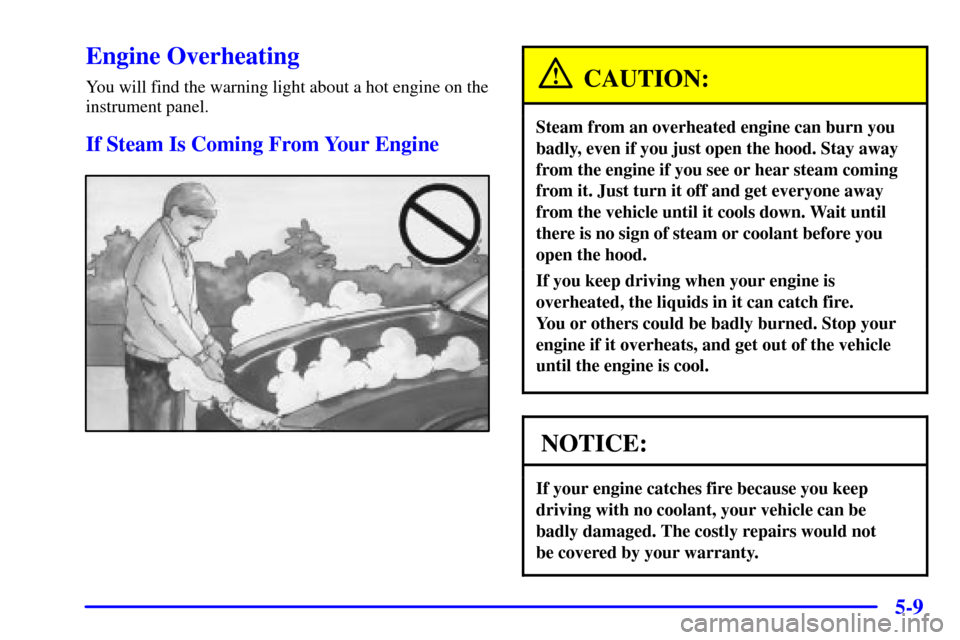
If Steam Is Coming From Your Engine
CAUTION:
Steam from an overheated engine can burn you
badly, even if you just open the hood. Stay away
from the engine if you see or hear steam coming
from it. Just turn it off and get everyone away
from the vehicle until it cools down. Wait until
there is no sign of steam or coolant before you
open the hood.
If you keep driving when your engine is
overheated, the liquids in it can catch fire.
You or others could be badly burned. Stop your
engine if it overheats, and get out of the vehicle
until the engine is cool.
NOTICE:
If your engine catches fire because you keep
driving with no coolant, your vehicle can be
badly damaged. The costly repairs would not
be covered by your warranty.
Page 233 of 328

5-12
The coolant level should be at or slightly above the
KALT/COLD line (seam).
You may have a leak in the radiator hoses, heater
hoses, radiator, water pump or somewhere else in the
cooling system.
CAUTION:
Heater and radiator hoses, and other engine
parts, can be very hot. Don't touch them.
If you do, you can be burned.
Don't run the engine if there is a leak. If you run
the engine, it could lose all coolant. That could
cause an engine fire, and you could be burned.
Get any leak fixed before you drive the vehicle.
NOTICE:
Engine damage from running your engine
without coolant isn't covered by your warranty.
NOTICE:
When adding coolant, it is important that you
use only DEX
-COOL� (silicate-free) coolant.
If coolant other than DEX-COOL is added to
the system, premature engine, heater core or
radiator corrosion may result. In addition, the
engine coolant will require change sooner
-- at
30,000 miles (50 000 km) or 24 months,
whichever occurs first. Damage caused by the
use of coolant other than DEX
-COOL� is not
covered by your new vehicle warranty.
If there seems to be no leak, with the engine on,
check to see if the electric engine cooling fans are
running. If the engine is overheating, both fans should
be running. If they aren't, your vehicle needs service.
Page 271 of 328

6-20 How to Check Lubricant
If the level is below the bottom of the filler plug hole,
you'll need to add some lubricant. Add enough lubricant
to raise the level to the bottom of the filler plug hole.
What to Use
Refer to the Maintenance Schedule to determine what
kind of lubricant to use. See ªRecommended Fluids and
Lubricantsº in the Maintenance Schedule booklet.
Engine Coolant
The cooling system in your vehicle is filled with
DEX
-COOL� engine coolant. This coolant is designed
to remain in your vehicle for 5 years or 150,000 miles
(240 000 km), whichever occurs first, if you add only
DEX
-COOL� extended life coolant.
The following explains your cooling system and how
to add coolant when it is low. If you have a problem
with engine overheating, see ªEngine Overheatingº
in the Index.
A 50/50 mixture of clean, drinkable water and
DEX
-COOL� coolant will:
�Give freezing protection down to
-34�F (-37�C).
�Give boiling protection up to 265�F (129�C).
�Protect against rust and corrosion.
�Help keep the proper engine temperature.
�Let the warning lights and gages work as
they should.