Page 221 of 365

5-3
Jump Starting
If your battery has run down, you may want to use
another vehicle and some jumper cables to start your
vehicle. But please use the following steps listed below
to do it safely.
If your vehicle has a dead battery or a battery with low
voltage, there are two override access slots that will
allow you to override the park lock system.
See ªShift Lock Releaseº in the Index.
CAUTION:
Batteries can hurt you. They can be
dangerous because:
�They contain acid that can burn you.
�They contain gas that can explode or ignite.
�They contain enough electricity to
burn you.
If you don't follow these steps exactly, some or all
of these things can hurt you.
NOTICE:
Ignoring these steps could result in costly damage
to your vehicle that wouldn't be covered by
your warranty.
The ACDelco� battery in your vehicle has a
built
-in hydrometer. Do not charge, test or jump
start the battery if the hydrometer looks clear or
light yellow. Replace the battery when there
is a clear or light yellow hydrometer and a
cranking complaint.
Trying to start your vehicle by pushing or pulling
it won't work, and it could damage your vehicle.
1. Check the other vehicle. It must have a 12-volt
battery with a negative ground system.
NOTICE:
If the other system isn't a 12-volt system with a
negative ground, both vehicles can be damaged.
ProCarManuals.com
Page 234 of 365
5-16 How to Add Coolant to the Radiator
NOTICE:
Your engine has a specific radiator fill procedure.
Failure to follow this procedure could cause your
engine to overheat and be severely damaged.
See ªEngine
Compartment
Overviewº in the
Index for more
information
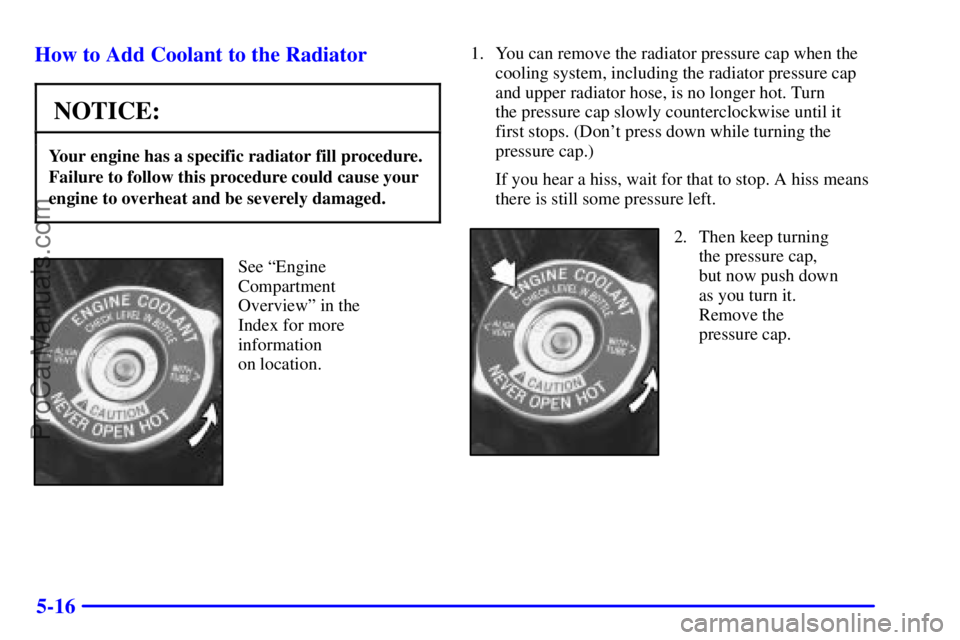
on location.1. You can remove the radiator pressure cap when the
cooling system, including the radiator pressure cap
and upper radiator hose, is no longer hot. Turn
the pressure cap slowly counterclockwise until it
first stops. (Don't press down while turning the
pressure cap.)
If you hear a hiss, wait for that to stop. A hiss means
there is still some pressure left.
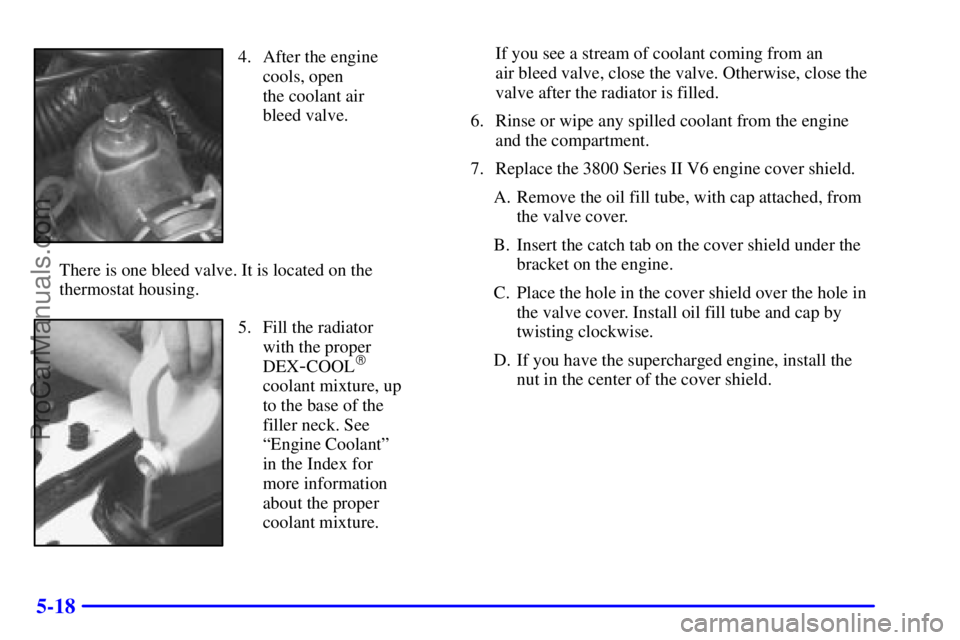
2. Then keep turning
the pressure cap,
but now push down
as you turn it.
Remove the
pressure cap.
ProCarManuals.com
Page 235 of 365
5-17
CAUTION:
You can be burned if you spill coolant on hot
engine parts. Coolant contains ethylene glycol
and it will burn if the engine parts are hot
enough. Don't spill coolant on a hot engine.
3. Remove the 3800 Series II V6 engine cover shield to
access the bleed valve.
A. Clean the area around the engine oil fill tube and cap
before removing. Twist the oil fill tube, with cap
attached, counterclockwise and remove it.
B. If you have the supercharged engine, remove the nut
in the center of the cover shield.
C. Lift the engine cover shield at the front, slide the
catch tab out of the engine bracket and remove the
cover shield.
D. Put the oil fill tube, with cap attached, in the
valve cover oil fill hole until you're ready to replace
the cover shield.
ProCarManuals.com
Page 236 of 365
5-18
4. After the engine
cools, open
the coolant air
bleed valve.
There is one bleed valve. It is located on the
thermostat housing.
5. Fill the radiator
with the proper
DEX
-COOL�
coolant mixture, up
to the base of the
filler neck. See
ªEngine Coolantº
in the Index for
more information
about the proper
coolant mixture.If you see a stream of coolant coming from an
air bleed valve, close the valve. Otherwise, close the
valve after the radiator is filled.
6. Rinse or wipe any spilled coolant from the engine
and the compartment.
7. Replace the 3800 Series II V6 engine cover shield.
A. Remove the oil fill tube, with cap attached, from
the valve cover.
B. Insert the catch tab on the cover shield under the
bracket on the engine.
C. Place the hole in the cover shield over the hole in
the valve cover. Install oil fill tube and cap by
twisting clockwise.
D. If you have the supercharged engine, install the
nut in the center of the cover shield.
ProCarManuals.com
Page 239 of 365
5-21
Changing a Flat Tire
If a tire goes flat, avoid further tire and wheel damage
by driving slowly to a level place. Turn on your hazard
warning flashers.
CAUTION:
Changing a tire can cause an injury. The vehicle
can slip off the jack and roll over you or other
people. You and they could be badly injured.
Find a level place to change your tire. To help
prevent the vehicle from moving:
1. Set the parking brake firmly.
2. Put the shift lever in PARK (P).
3. Turn off the engine.
To be even more certain the vehicle won't move,
you can put blocks at the front and rear of the
tire farthest away from the one being changed.
That would be the tire on the other side of the
vehicle, at the opposite end.
The following steps will tell you how to use the jack and
change a tire.
ProCarManuals.com
Page 240 of 365
5-22 Removing the Spare Tire and Tools
The equipment you'll need is in the trunk.
1. Turn the center nut on
the compact spare cover
counterclockwise to
remove it. Then lift and
remove the cover.
(See ªCompact Spare
Tireº in the Index for
more information about
the compact spare.)
2. Remove the spare tire.
ProCarManuals.com
Page 241 of 365
5-23
3. Turn the nut holding the jack counterclockwise and
remove it. Then remove the jack and wrench.The tools you'll be using include the jack (A), extension
and protection guide (B) and wheel wrench (C).
ProCarManuals.com
Page 243 of 365
5-25 Removing the Flat Tire and Installing the
Spare Tire
1. Using the wheel wrench, loosen all the wheel nuts.
Don't remove them yet.
2. Turn the jack handle clockwise to raise the jack
lift head.
CAUTION:
Getting under a vehicle when it is jacked up is
dangerous. If the vehicle slips off the jack, you
could be badly injured or killed. Never get under
a vehicle when it is supported only by a jack.
CAUTION:
Raising your vehicle with the jack improperly
positioned can damage the vehicle and even make
the vehicle fall. To help avoid personal injury and
vehicle damage, be sure to fit the jack lift head
into the proper location before raising
the vehicle.
ProCarManuals.com