Page 27 of 392

1-15
4. Push the latch plate into the buckle until it clicks.
Pull up on the latch plate to make sure it is secure.
If the belt isn't long enough, see ªSafety Belt
Extenderº at the end of this section.
Make sure the release button on the buckle is
positioned so you would be able to unbuckle the
safety belt quickly if you ever had to.The lap part of the belt should be worn low and snug on
the hips, just touching the thighs. In a crash, this applies
force to the strong pelvic bones. And you'd be less
likely to slide under the lap belt. If you slid under it, the
belt would apply force at your abdomen. This could
cause serious or even fatal injuries. The shoulder belt
should go over the shoulder and across the chest.
These parts of the body are best able to take belt
restraining forces.
The safety belt locks if there's a sudden stop or crash, or
if you pull the belt very quickly out of the retractor.
Shoulder Belt Height Adjuster
Before you begin to drive, move the shoulder belt height
adjuster to the height that is right for you.
Using the power seat control, raise or lower the
shoulder belt height adjuster by pushing the vertical
control up or down.
Adjust the height so that the shoulder portion of
the belt is centered on your shoulder. The belt should
be away from your face and neck, but not falling off
your shoulder.
Page 33 of 392
1-21
The best way to protect the fetus is to protect the
mother. When a safety belt is worn properly, it's more
likely that the fetus won't be hurt in a crash. For
pregnant women, as for anyone, the key to making
safety belts effective is wearing them properly.
Right Front Passenger Position
To learn how to wear the right front passenger's safety belt
properly, see ªDriver Positionº earlier in this section.
The right front passenger's safety belt works the same
way as the driver's safety belt
-- except for one thing.
If you ever pull the lap portion of the belt out all the
way, you will engage the child restraint locking feature.
If this happens, just let the belt go back all the way and
start again.
If your vehicle has a center passenger position, be
sure to use the correct buckle when buckling your
lap
-shoulder belt. If you find that the latch plate will not
go fully into the buckle, see if you are using the buckle
for the center passenger position.
Air Bag Systems
This part explains the frontal and side impact
air bag systems.
Your vehicle has four air bags
-- a frontal air bag for
the driver, another frontal air bag for the right front
passenger, a side impact air bag for the driver, and
another side impact air bag for the right front passenger.
Frontal air bags are designed to help reduce the risk of
injury from the force of an inflating frontal air bag. But
these air bags must inflate very quickly to do their job
and comply with federal regulations.
Page 38 of 392
1-26
CAUTION:
If something is between an occupant and an
air bag, the bag might not inflate properly or it
might force the object into that person. The path
of an inflating air bag must be kept clear. Don't
put anything between an occupant and an air
bag, and don't attach or put anything on the
steering wheel hub or on or near any other air
bag covering and don't let seat covers block the
inflation path of a side impact air bag.
When should an air bag inflate?
The driver's and right front passenger's frontal air bags
are designed to inflate in moderate to severe frontal or
near
-frontal crashes. But they are designed to inflate
only if the impact speed is above the system's
designed ªthreshold level.º
If your vehicle goes straight into a wall that doesn't move
or deform, the threshold level is about 9 to 15 mph
(14 to 24 km/h). The threshold level can vary, however,
with specific vehicle design, so that it can be somewhat
above or below this range.If your vehicle strikes something that will move or deform,
such as a parked car, the threshold level will be higher.
The driver's and right front passenger's frontal air bags are
not designed to inflate in rollovers, side impacts, or rear
impacts, because inflation would not help the occupant.
The side impact air bags are designed to inflate in
moderate to severe side crashes. A side impact air bag
will inflate if the crash severity is above the system's
designed ªthreshold level.º The threshold level can vary
with specific vehicle design. Side impact air bags are not
designed to inflate in frontal or near
-frontal impacts,
rollovers or rear impacts, because inflation would not
help the occupant. A side impact air bag will only
deploy on the side of the vehicle that is struck.
In any particular crash, no one can say whether an air
bag should have inflated simply because of the damage
to a vehicle or because of what the repair costs were. For
frontal air bags, inflation is determined by the angle of
the impact and how quickly the vehicle slows down in
frontal and near
-frontal impacts. For side impact air
bags, inflation is determined by the location and severity
of the impact.
Page 43 of 392
1-31
Rear Seat Passengers
It's very important for rear seat passengers to buckle up!
Accident statistics show that unbelted people in the rear
seat are hurt more often in crashes than those who are
wearing safety belts.
Rear passengers who aren't safety belted can be thrown
out of the vehicle in a crash. And they can strike others
in the vehicle who are wearing safety belts.
Rear Seat Outside Passenger Positions
Lap-Shoulder Belt
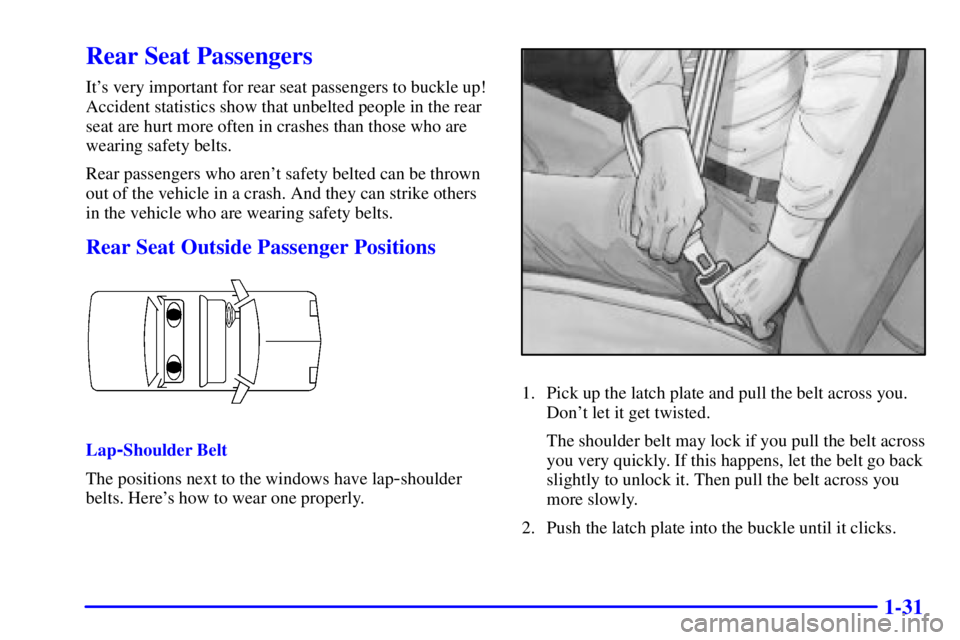
The positions next to the windows have lap
-shoulder
belts. Here's how to wear one properly.
1. Pick up the latch plate and pull the belt across you.
Don't let it get twisted.
The shoulder belt may lock if you pull the belt across
you very quickly. If this happens, let the belt go back
slightly to unlock it. Then pull the belt across you
more slowly.
2. Push the latch plate into the buckle until it clicks.
Page 45 of 392
1-33
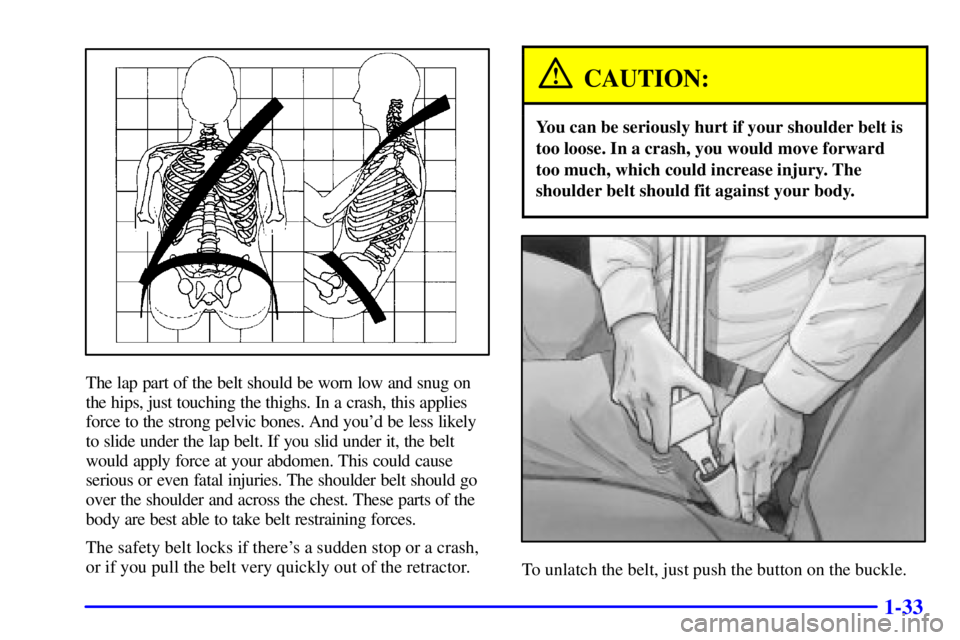
The lap part of the belt should be worn low and snug on
the hips, just touching the thighs. In a crash, this applies
force to the strong pelvic bones. And you'd be less likely
to slide under the lap belt. If you slid under it, the belt
would apply force at your abdomen. This could cause
serious or even fatal injuries. The shoulder belt should go
over the shoulder and across the chest. These parts of the
body are best able to take belt restraining forces.
The safety belt locks if there's a sudden stop or a crash,
or if you pull the belt very quickly out of the retractor.
CAUTION:
You can be seriously hurt if your shoulder belt is
too loose. In a crash, you would move forward
too much, which could increase injury. The
shoulder belt should fit against your body.
To unlatch the belt, just push the button on the buckle.
Page 63 of 392
1-51
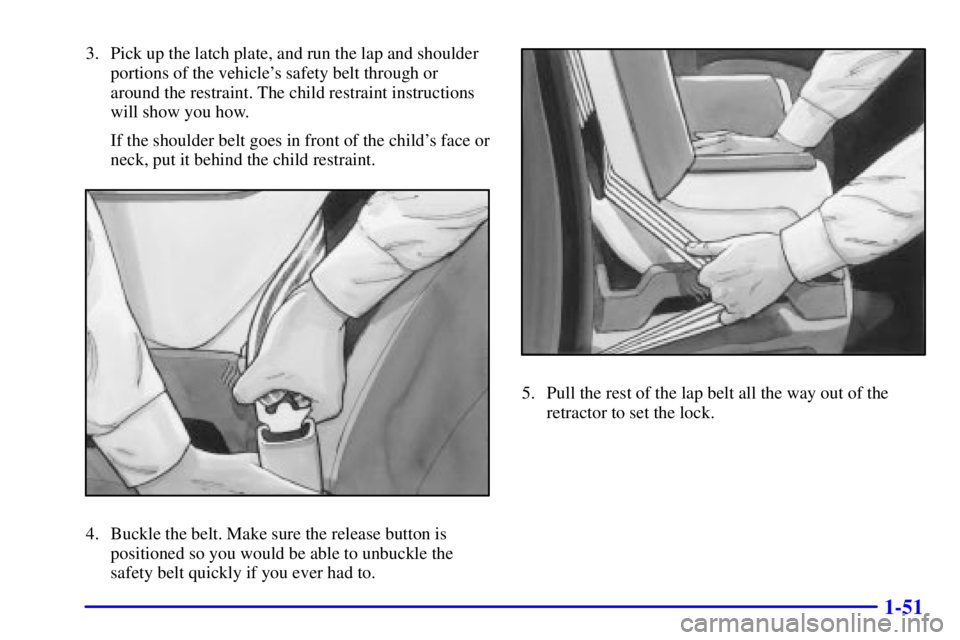
3. Pick up the latch plate, and run the lap and shoulder
portions of the vehicle's safety belt through or
around the restraint. The child restraint instructions
will show you how.
If the shoulder belt goes in front of the child's face or
neck, put it behind the child restraint.
4. Buckle the belt. Make sure the release button is
positioned so you would be able to unbuckle the
safety belt quickly if you ever had to.
5. Pull the rest of the lap belt all the way out of the
retractor to set the lock.
Page 69 of 392
2-
2-1
Section 2 Features and Controls
Here you can learn about the many standard and optional features on your vehicle, and information on starting,
shifting and braking. Also explained are the instrument panel and the warning systems that tell you if everything is
working properly
-- and what to do if you have a problem.
2
-2 Windows
2
-4 Keys
2
-6 Door Locks
2
-10 Remote Keyless Entry System
2
-15 Trunk
2
-17 Theft
2
-18 Content Theft-Deterrent System
2
-20 PASS-Key� III
2
-22 New Vehicle ªBreak-Inº
2
-22 Ignition Positions
2
-24 Starting Your Engine
2
-25 Engine Coolant Heater (Option)
2
-26 Automatic Transaxle Operation
2
-29 Parking Brake
2
-30 Shifting Into PARK (P)
2
-33 Shifting Out of PARK (P)
2
-33 Parking Over Things That Burn
2
-34 Engine Exhaust2
-34 Running Your Engine While You're Parked
2
-35 Tilt Wheel
2
-36 Turn Signal/Multifunction Lever
2
-43 Exterior Lamps
2
-45 Interior Lamps
2
-49 Mirrors
2
-55 Storage Compartments
2
-62 OnStar� System (If Equipped)
2
-65 Sunroof (Option)
2
-66 HomeLink� Transmitter (If Equipped)
2
-70 The Instrument Panel -- Your
Information System
2
-72 Instrument Panel Clusters
2
-75 Warning Lights, Gages and Indicators
2
-86 Driver Information Center (DIC) (If Equipped)
2
-96 Head-Up Display (HUD) (If Equipped)
2
-99 Ultrasonic Rear Parking Assist (URPA) (Option)
Page 71 of 392
2-3 Power Windows
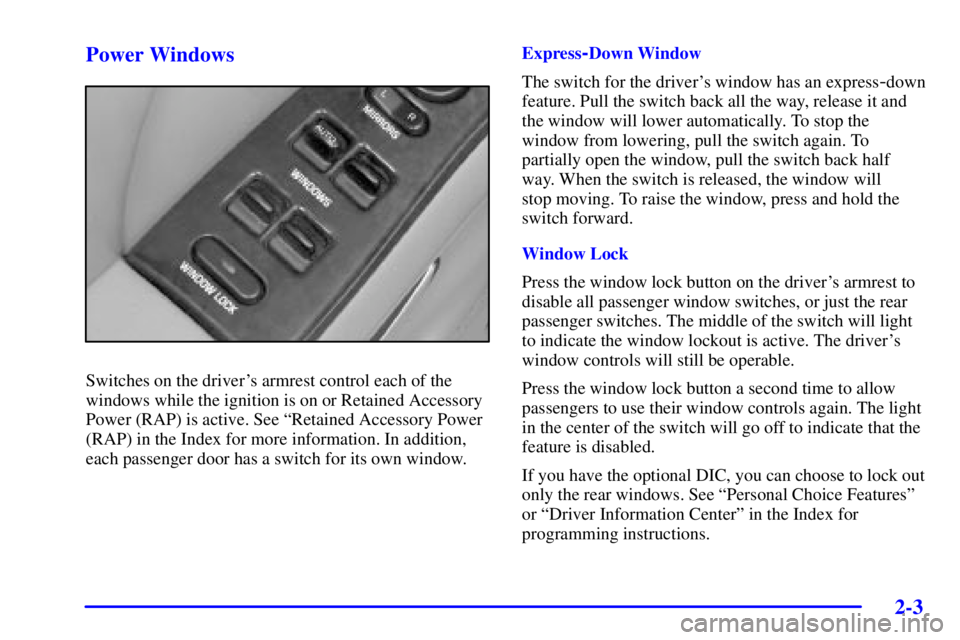
Switches on the driver's armrest control each of the
windows while the ignition is on or Retained Accessory
Power (RAP) is active. See ªRetained Accessory Power
(RAP) in the Index for more information. In addition,
each passenger door has a switch for its own window.Express
-Down Window
The switch for the driver's window has an express
-down
feature. Pull the switch back all the way, release it and
the window will lower automatically. To stop the
window from lowering, pull the switch again. To
partially open the window, pull the switch back half
way. When the switch is released, the window will
stop moving. To raise the window, press and hold the
switch forward.
Window Lock
Press the window lock button on the driver's armrest to
disable all passenger window switches, or just the rear
passenger switches. The middle of the switch will light
to indicate the window lockout is active. The driver's
window controls will still be operable.
Press the window lock button a second time to allow
passengers to use their window controls again. The light
in the center of the switch will go off to indicate that the
feature is disabled.
If you have the optional DIC, you can choose to lock out
only the rear windows. See ªPersonal Choice Featuresº
or ªDriver Information Centerº in the Index for
programming instructions.