Page 285 of 389

6-15 When to Change Engine Oil (Vehicles With
the GM Oil Life System� Option)
If so equipped, your vehicle has a computer that lets
you know when to change your engine oil. This is
not based on mileage, but on engine revolutions and
engine operating temperature. When the computer has
calculated that the oil needs changing, the GM Oil Life
System� will indicate that a change is necessary.
The mileage between oil and filter changes will vary
depending on how you drive your vehicle
-- usually
between 3,000 miles (5 000 km) and 10,000 miles
(16 000 km) since your last oil and filter change.
Under severe conditions, the system may come on
before 3,000 miles (5 000 km). Never drive your vehicle
more than 10,000 miles (16 000 km) or 12 months
(whichever occurs first) without an oil change.
The system won't detect dust in the oil. So, if you drive
in a dusty area, be sure to change your oil and filter
every 3,000 miles (5 000 km) or sooner. Remember
to reset the Oil Life System whenever the oil is changed.How to Reset the Oil Life System (If Equipped)
After changing the engine oil, the Oil Life System
should be reset. It will not reset itself. To reset the Oil
Life System, press and hold the RESET button on the
DIC for more than five seconds while OIL LIFE INDEX
is being displayed. The oil life will change to 100%.
What to Do with Used Oil
Did you know that used engine oil contains certain
elements that may be unhealthy for your skin and could
even cause cancer? Don't let used oil stay on your skin
for very long. Clean your skin and nails with soap and
water, or a good hand cleaner. Wash or properly throw
away clothing or rags containing used engine oil.
See the manufacturer's warnings about the use and
disposal of oil products.
Used oil can be a real threat to the environment. If you
change your own oil, be sure to drain all free
-flowing
oil from the filter before disposal. Don't ever dispose of
oil by putting it in the trash, pouring it on the ground,
into sewers, or into streams or bodies of water. Instead,
recycle it by taking it to a place that collects used oil.
If you have a problem properly disposing of your used
oil, ask your dealer, a service station or a local recycling
center for help.
Page 287 of 389
6-17
3. Disconnect the electrical
connector from the air
intake hose. This will
allow you to lift the
rear portion of the
engine air cleaner/filter.
4. After detaching the hose from the throttle body,
pull back the entire rear portion of the engine air
cleaner/filter by pulling upward and rearward.
5. Check or replace the engine air cleaner/filter.
6. Reinstall the rear section of the engine air cleaner/filter.
7. Reconnect the electrical connector.
8. Reattach the air intake hose by snapping it back onto
the throttle body.
9. Refasten the latches to the air cleaner housing cover.
Refer to the Maintenance Schedule to determine when to
replace the air filter.
See ªScheduled Maintenance Servicesº in the Index.
Page 289 of 389

6-19
Once you remove your filter, if you choose not to
replace it, it will not damage your vehicle. However, the
air will no longer be filtered.
Automatic Transaxle Fluid
When to Check and Change
A good time to check your automatic transaxle fluid
level is when the engine oil is changed.
Change both the fluid and filter every 50,000 miles
(83 000 km) if the vehicle is mainly driven under one
or more of these conditions:
�In heavy city traffic where the outside temperature
regularly reaches 90�F (32�C) or higher.
�In hilly or mountainous terrain.
�When doing frequent trailer towing.
�Uses such as found in taxi, police or delivery service.
If you do not use your vehicle under any of
these conditions, change the fluid and filter at
100,000 miles (166 000 km).
See ªScheduled Maintenance Servicesº in the Index.
How to Check
Because this operation can be a little difficult, you
may choose to have this done at the dealership
service department.
If you do it yourself, be sure to follow all the instructions
here, or you could get a false reading on the dipstick.
NOTICE:
Too much or too little fluid can damage your
transaxle. Too much can mean that some of the
fluid could come out and fall on hot engine parts
or exhaust system parts, starting a fire. Be sure
to get an accurate reading if you check your
transaxle fluid.
Wait at least 30 minutes before checking the transaxle
fluid level if you have been driving:
�When outside temperatures are above 90�F (32�C).
�At high speed for quite a while.
�In heavy traffic
-- especially in hot weather.
�While pulling a trailer.
Page 299 of 389

6-29
NOTICE:
�Using the wrong fluid can badly damage
brake system parts. For example, just a few
drops of mineral
-based oil, such as engine
oil, in your brake system can damage brake
system parts so badly that they'll have to be
replaced. Don't let someone put in the
wrong kind of fluid.
�If you spill brake fluid on your vehicle's
painted surfaces, the paint finish can be
damaged. Be careful not to spill brake fluid
on your vehicle. If you do, wash it off
immediately. See ªAppearance Careº in
the Index.
Brake Wear
Your vehicle has four-wheel disc brakes.
Disc brake pads have built
-in wear indicators that make
a high
-pitched warning sound when the brake pads are
worn and new pads are needed. The sound may come
and go or be heard all the time your vehicle is moving
(except when you are pushing on the brake pedal firmly).
CAUTION:
The brake wear warning sound means that soon
your brakes won't work well. That could lead to
an accident. When you hear the brake wear
warning sound, have your vehicle serviced.
Page 303 of 389
6-33
Bulb Replacement
For any bulb changing procedure not listed in this
section, contact your dealer's service department.
For the bulb types to be used in the following
procedures, see ªReplacement Bulbsº in the Index.
Halogen Bulbs
CAUTION:
Halogen bulbs have pressurized gas inside and
can burst if you drop or scratch the bulb. You or
others could be injured. Be sure to read and
follow the instructions on the bulb package.
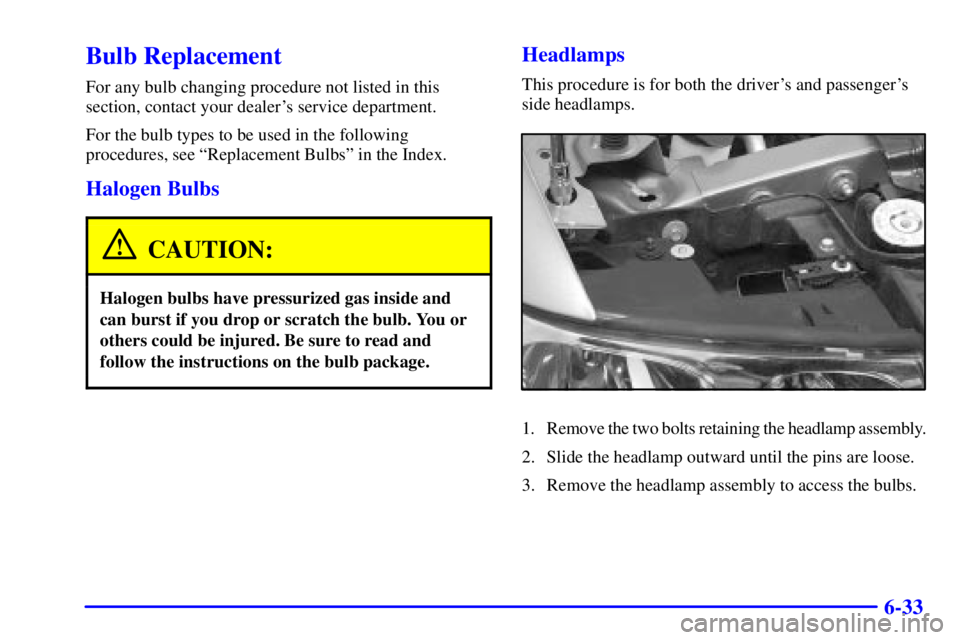
Headlamps
This procedure is for both the driver's and passenger's
side headlamps.
1. Remove the two bolts retaining the headlamp assembly.
2. Slide the headlamp outward until the pins are loose.
3. Remove the headlamp assembly to access the bulbs.
Page 305 of 389

6-35
If your vehicle is damaged in an accident, the headlamp
aim may be affected. Aim adjustment to the low beam
may be necessary if it is difficult to see lane markers
(for horizontal aim), or if oncoming drivers flash their
high beams at you (for vertical aim). If you believe your
headlamps need to be re
-aimed, we recommend that
you take your vehicle to your dealer for service.
However, it is possible for you to re
-aim your
headlamps as described in the following procedure.
NOTICE:
To make sure your headlamps are aimed
properly, read all the instructions before
beginning. Failure to follow these instructions
could cause damage to headlamp parts.
The vehicle should be properly prepared as follows:
�The vehicle should be placed so the headlamps
are 25 ft. (7.6 m) from a light colored wall or
other flat surface.
�The vehicle must have all four tires on a perfectly
level surface which is level all the way to the wall or
other flat surface.
�The vehicle should be placed so it is perpendicular to
the wall or other flat surface.
�The vehicle should not have any snow, ice or mud
attached to it.
�The vehicle should be fully assembled and all other
work stopped while headlamp aiming is being done.
�The vehicle should be normally loaded with a full
tank of fuel and one person or 160 lbs. (75 kg) on
the driver's seat.
�Tires should be properly inflated.
Headlamp aiming is done with the vehicle low beam
lamps. The high beam lamps will be correctly aimed
if the low beam lamps are aimed properly.
Page 313 of 389

6-43
Tires
Your new vehicle comes with high-quality tires made by
a leading tire manufacturer. If you ever have questions
about your tire warranty and where to obtain service, see
your Buick Warranty booklet for details.
CAUTION:
Poorly maintained and improperly used tires
are dangerous.
�Overloading your tires can cause
overheating as a result of too much friction.
You could have an air
-out and a serious
accident. See ªLoading Your Vehicleº in
the Index.
CAUTION: (Continued)
CAUTION: (Continued)
�Underinflated tires pose the same danger
as overloaded tires. The resulting accident
could cause serious injury. Check all tires
frequently to maintain the recommended
pressure. Tire pressure should be checked
when your tires are cold.
�Overinflated tires are more likely to be
cut, punctured or broken by a sudden
impact
-- such as when you hit a pothole.
Keep tires at the recommended pressure.
�Worn, old tires can cause accidents. If your
tread is badly worn, or if your tires have
been damaged, replace them.
Page 315 of 389

6-45 Check Tire Pressure System (If Equipped)
The check tire pressure system can alert you to a large
change in the pressure of one tire. The system won't
alert you before you drive that a tire is low or flat.
You must begin driving before the system will
work properly.
The CHECK TIRE PRESSURE message will appear
on the Driver Information Center (DIC) if pressure
difference (low pressure) is detected in one tire. The
check tire pressure system may not alert you if:
�more than one tire is low,
�the vehicle is moving faster than 65 mph (105 km/h),
�the system is not yet calibrated,
�the tire treadwear is uneven,
�the compact spare tire is installed,
�tire chains are being used, or
�the vehicle is being driven on a rough or frozen road.
If the anti
-lock brake system warning light comes on,
the check tire pressure system may not be working
properly. See your dealer for service. Also, see
ªAnti
-Lock Brake System Warning Lightº in the Index.The check tire pressure system detects differences
in tire rotation speeds that are caused by changes in
tire pressure. The system can alert you about a low
tire
-- but it doesn't replace normal tire maintenance.
See ªTiresº in the Index.
When the CHECK TIRE PRESSURE message appears
on the Driver Information Center, you should stop as
soon as you can and check all your tires for damage.
If a tire is flat, see ªIf a Tire Goes Flatº in the Index.
Also check the tire pressure in all four tires as soon as
you can. See ªInflation
-Tire Pressureº in the Index.
Any time you adjust a tire's pressure or have one or
more tires repaired or replaced, you'll need to reset
(calibrate) the check tire pressure system. You'll also
need to reset the system whenever you rotate the tires,
buy new tires, install or remove the compact spare, and
whenever the vehicle's battery has been disconnected.
Don't reset the check tire pressure system without first
correcting the cause of the problem and checking and
adjusting the pressure in all four tires. If you reset the
system when the tire pressures are incorrect, the check
tire pressure system will not work properly and may not
alert you when a tire is low or high.