Page 87 of 351

2-17
Trunk
CAUTION:
It can be dangerous to drive with the trunk lid
open because carbon monoxide (CO) gas can
come into your vehicle. You can't see or smell
CO. It can cause unconsciousness and even death.
If you must drive with the trunk lid open or if
electrical wiring or other cable connections must
pass through the seal between the body and the
trunk lid:
�Make sure all other windows are shut.
�Turn the fan on your heating or cooling
system to its highest speed with the setting
on VENT. That will force outside air into
your vehicle. See ªComfort Controlsº in
the Index.
�If you have air outlets on or under the
instrument panel, open them all the way.
See ªEngine Exhaustº in the Index.
Trunk Lock
To unlock the trunk from the outside, insert the door key
and turn it. You can also press the trunk symbol on your
remote keyless entry transmitter.
Remote Trunk Release
Press the button located
inside of the glove box door
to unlock the trunk from
inside the vehicle. The shift
lever must be in PARK (P)
for the remote trunk release
button to work.
Page 88 of 351
2-18 Trunk Assist Handle (If Equipped)
Your vehicle may have an assist handle located on
the inside of the trunk lid toward the driver's side of
the vehicle.Pull down on the handle to lower the trunk lid. Then
close the trunk with your other hand. If the trunk is
not properly closed, the DOOR/TRUNK light will
appear in the message center of your instrument panel
cluster. See ªDOOR/TRUNK Lightº in the Index
for more information.
NOTICE:
The trunk assist handle was not designed to be
used to tie down the trunk lid or as an anchor
point when securing items in the trunk. Improper
use of the trunk assist handle could damage it.
Page 96 of 351
2-26
4. Before starting the engine, be sure to unplug and
store the cord as it was before to keep it away
from moving engine parts. If you don't, it could
be damaged.
How long should you keep the coolant heater plugged
in? The answer depends on the outside temperature, the
kind of oil you have, and some other things. Instead of
trying to list everything here, we ask that you contact
your dealer in the area where you'll be parking your
vehicle. The dealer can give you the best advice for that
particular area.Automatic Transaxle Operation
Your automatic transaxle will have a shift lever on the
steering column.
The graphic shown above is displayed on your
instrument panel cluster in reference to your steering
column shift lever.
Maximum engine speed is limited on automatic transaxle
vehicles when you're in PARK (P) or NEUTRAL (N) to
protect driveline components from improper operation.
Page 107 of 351

2-37 Turn Signal and Lane Change Indicator
The turn signal has the following positions: two upward
(for right) and two downward (for left). These positions
allow you to signal a turn or a lane change.
To signal a turn, move the lever all the way up or down.
When the turn is finished, the lever will return automatically.
An arrow on the instrument
panel cluster will flash in
the direction of the turn
or lane change.
To signal a lane change, just raise or lower the lever
until the arrow starts to flash. Hold it there until you
complete your lane change. The lever will return by
itself when you release it.If the arrow flashes faster than normal as you signal
a turn or a lane change, a signal bulb may be burned
out and other drivers won't see your turn signal.
If a bulb is burned out, replace it to help avoid an
accident. If the arrows don't go on at all when you
signal a turn, check for burned
-out bulbs and then check
the fuse (see ªFuses and Circuit Breakersº in the Index).
A chime will sound if you leave your turn signal on for
more than 3/4 mile (1.2 km).
Headlamp High/Low-Beam Changer
To change your headlamps from low beams to high
beams, or high to low, pull the multifunction lever all
the way toward you. Then release it.
When the high beams are
on this light, located on
the instrument panel,
will also be on.
Page 109 of 351

2-39
CAUTION:
In freezing weather, don't use your washer until
the windshield is warmed. Otherwise the washer
fluid can form ice on the windshield, blocking
your vision.
The LOW WASH light
on your instrument panel
cluster will glow when
the fluid level is low.
Cruise Control (If Equipped)
With cruise control, you can maintain a speed of about
25 mph (40 km/h) or more without keeping your foot
on the accelerator. This can really help on long trips.
Cruise control does not work at speeds below about
25 mph (40 km/h).When you apply your brakes, the cruise control
shuts off.
CAUTION:
�Cruise control can be dangerous where
you can't drive safely at a steady speed.
So, don't use your cruise control on
winding roads or in heavy traffic.
�Cruise control can be dangerous on
slippery roads. On such roads, fast changes
in tire traction can cause needless wheel
spinning, and you could lose control.
Don't use cruise control on slippery roads.
If your vehicle is in cruise control when the enhanced
traction system begins to limit wheel spin, the cruise
control will automatically disengage. See ªEnhanced
Traction Systemº in the Index. When road conditions
allow you to safely use it again, you may turn the cruise
control back on.
Page 110 of 351
2-40
Setting Cruise Control
CAUTION:
If you leave your cruise control switch on when
you're not using cruise, you might hit a button
and go into cruise when you don't want to.
You could be startled and even lose control.
Keep the cruise control switch off until you
want to use cruise control.
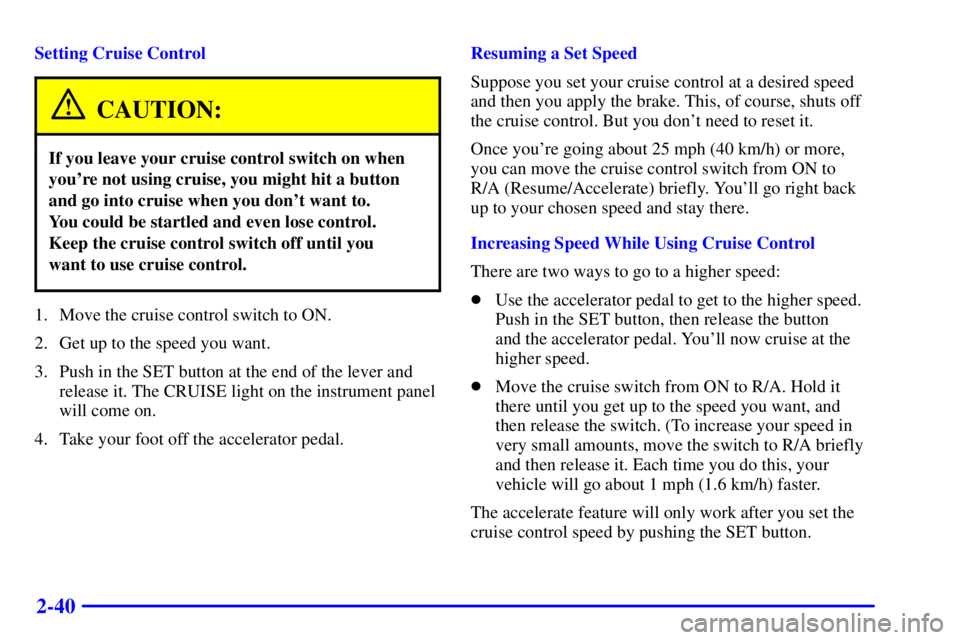
1. Move the cruise control switch to ON.
2. Get up to the speed you want.
3. Push in the SET button at the end of the lever and
release it. The CRUISE light on the instrument panel
will come on.
4. Take your foot off the accelerator pedal.Resuming a Set Speed
Suppose you set your cruise control at a desired speed
and then you apply the brake. This, of course, shuts off
the cruise control. But you don't need to reset it.
Once you're going about 25 mph (40 km/h) or more,
you can move the cruise control switch from ON to
R/A (Resume/Accelerate) briefly. You'll go right back
up to your chosen speed and stay there.
Increasing Speed While Using Cruise Control
There are two ways to go to a higher speed:
�Use the accelerator pedal to get to the higher speed.
Push in the SET button, then release the button
and the accelerator pedal. You'll now cruise at the
higher speed.
�Move the cruise switch from ON to R/A. Hold it
there until you get up to the speed you want, and
then release the switch. (To increase your speed in
very small amounts, move the switch to R/A briefly
and then release it. Each time you do this, your
vehicle will go about 1 mph (1.6 km/h) faster.
The accelerate feature will only work after you set the
cruise control speed by pushing the SET button.
Page 112 of 351

2-42
Exterior Lamps
The lamp controls
are located on the
instrument panel.
They control these systems:
�Headlamps
�Taillamps
�Parking Lamps
�License Lamps
�Sidemarker Lamps
�Instrument Panel Lights
�Courtesy LampsIf you pull the knob out halfway, it will turn on your
parking lamps and your other operating lamps. If you
pull the knob all the way out, your headlamps will then
come on.
Push the knob in all the way to turn off the lamps.
A warning chime will sound if you open the driver's
door when you turn the ignition switch to OFF, LOCK
or ACC with the lamps on.
Daytime Running Lamps / Automatic
Headlamp Control
Daytime Running Lamps (DRL) can make it easier for
others to see the front of your vehicle during the day.
DRL can be helpful in many different driving conditions,
but they can be especially helpful in the short periods
after dawn and before sunset. Fully functional daytime
running lights are required on all vehicles first sold
in Canada.
A light sensor on top of the instrument panel makes the
DRL work, so be sure it isn't covered.
The DRL system will make your front turn signal lamps
come on when:
�The ignition is on,
�the headlamp switch is off and
�the parking brake is released.
Page 113 of 351

2-43
When the DRL are on, only your front turn signal lamps
will be on. The headlamps, taillamps, sidemarker and
other lamps won't be on. Your instrument panel won't
be lit up either.
When it's dark enough outside, your front turn signal
lamps will turn off and your vehicle's headlamps and
parking lamps will turn on. The other lamps that come
on with your headlamps will also come on.
When it's bright enough outside, your headlamps will go
off and your front turn signal lamps will come on.
To idle your vehicle with the DRL and automatic
headlamp control off, set the parking brake while the
ignition is in OFF or LOCK. Then start your vehicle.
The DRL, headlamps and parking lamps will stay off
until you release the parking brake.
To turn off the automatic headlamp feature when it's
dark outside, move the exterior lamp control to the
parking lamp position. Your parking lamps will remain
illuminated and your headlamps will turn off.
As with any vehicle, you should turn on the regular
headlamp system when you need it.Delayed Headlamp Illumination
Delayed headlamp illumination provides a period of
exterior lighting as you leave your vehicle's area. The
feature is activated when your vehicle's headlamps are
on due to the automatic headlamp control feature
described previously in this section, and when your
vehicle's ignition is turned off. Your headlamps will
then remain on until the headlamp switch is moved from
OFF to the parking lamp position or until a 90 second
lighting period has ended.
If you turn off the ignition with the headlamp switch in
the parking lamp or headlamp position, the delayed
headlamp illumination cycle will not occur.
You can customize the vehicle to activate delayed
headlamp illumination when your vehicle's ignition
is turned off under the conditions described above,
or you may choose not to activate this feature under
any conditions.

