2001 BMW Z8 tow
[x] Cancel search: towPage 86 of 170

86n
To ensure that your vehicle continues to
provide maximum economy throughout
an extended service life, we request
that you devote careful attention to the
following section.
Your BMW Z8 is a masterpiece of
superlative technology. To ensure
that you derive maximum satisfaction
from its extensive array of advanced
features while simultaneously creating
the basis for many years of driving
pleasure, we urge you to observe the
following precautions during the initial
operation period.<
Engine and differentialUp to 1,200 miles (2,000 km):
Drive at varying engine and road
speeds, but do not exceed 4,500 rpm
(4,500/min), or a road speed of 106 mph
(170 km/h).
Obey your local and state maximum
speed limits.
Avoid depressing the accelerator to the
full-throttle position .
Once you have driven 1,200 miles
(2,000 km), you can begin to gradually
increase both the engine speed and
road speed.
You should also comply with these
break-in procedures if the engine or
differential is replaced later in the
course of the vehicle service life.TiresOwing to technical factors associated
with their manufacture, tires do not
achieve their full traction potential until
an initial break-in period has elapsed.
Thus, drive with extra care during the
initial 200 miles (300 km).
Obey your local and state maximum
speed limits.
When the vehicle is being driven
on wet or slushy roads, a wedge
of water may form between the tire and
the road surface. This phenomenon is
referred to as "aquaplaning" and can
lead to partial or complete loss of trac-
tion, vehicle control and braking effec-
tiveness. Reduce your speed on wet
roads.<
Brake systemApproximately 300 miles (500 km) must
elapse before the brake pads and
rotors achieve the optimal pad-surface
and wear patterns required for trouble-
free operation and long service life.
To break in the separate parking brake
drums, apply the parking brake lightly
when coasting to a standstill (at a traffic
signal, for instance), provided that
traffic conditions allow you to do so.
To avoid corrosion, repeat this proce-
dure from time to time.
The brake lamps do not come
on when the parking brake is
engaged.
Vacuum for the brake system servo unit
on your BMW is available only when the
engine is running. When you move the
vehicle with the engine shut off Ð when
towing, for instance Ð substantially
higher levels of pedal force will be
required to brake the vehicle.
Engage the gears carefully and without
high engine speeds during this break-in
period.
Break-in procedures
Page 87 of 170

87n
IndexDataTechnologyRepairsCar careControlsOverview
Brakes:
Do not rest your foot on the brake
pedal while driving. Even light but
consistent pressure on the brake pedal
could lead to high temperatures, brake
wear, and possibly, to brake system
failure.
Aquaplaning:
Reduce speed while driving on wet or
slushy roads, otherwise, a wedge of
water can form between the tires and
the road surface. This phenomenon is
referred to as "aquaplaning" or "hydro-
planing." It is characterized by a partial
or complete loss of contact between
the tires and the road surface. The ulti-
mate results are loss of steering and
braking control.
Driving through water:
When there is water on the roads, do
not drive in it if it is deeper than 1 ft
(30 cm), and even then, only at walking
speed, otherwise the vehicle can
sustain damage to the engine, the elec-
trical systems and the transmission.<
The catalytic converter reduces harmful
exhaust emissions.
It is designed for use with unleaded fuel
only. Even minute quantities of lead
would be enough to permanently
damage both the catalytic converter
and the system oxygen sensor.To ensure efficient, trouble-free engine
operation and to avoid potential damage:>Be sure to comply with the scheduled
maintenance requirements
>Fill the fuel tank well before it is empty
>Tow-start only when the engine is
cold. If you attempt to tow-start with
a warm engine, unburned residual
fuel in the catalytic converter could
ignite and cause damage. It is better
to start the vehicle with a battery
charger or assistance from another
vehicle
>Avoid other situations where the fuel
is either not burned or burns incom-
pletely, such as engaging the starter
frequently or for extended periods, or
repeated start attempts in which the
engine does not start (stopping and
restarting an engine which is running
properly does not present a pro-
blem). Never allow the engine to run
with any of the spark plug cables
disconnected.Be sure to comply with the
instructions above to prevent
unburned fuel from reaching the cata-
lytic converter. Otherwise, there is the
danger of overheating and damage to
the catalytic converter.
Extreme temperatures are present with
the catalytic converter both on this and
every catalytic converter-equipped
vehicle. Heat shields are installed adja-
cent to some sections of the exhaust
system. Never remove these shields;
do not apply undercoating to their
surfaces. When driving, standing at
idle, and parking the vehicle, take care
to avoid contact between the exhaust
system and flammable materials (grass,
hay, leaves etc.). Such contact could
start a fire, resulting in serious personal
injury and property damage.<
Driving notes Catalytic converter
Page 99 of 170

99n
IndexDataTechnologyRepairsCar careControlsOverview
Avoid overloading the vehicle so
that the permitted load on the tires
is not exceeded. Overloading can lead
to overheating and increases the rate
at which damage develops inside the
tires. You could have a blowout as a
result.
Unusual vibrations encountered during
normal vehicle operation can indicate
tire failure or some other vehicle defect,
as can variations in normal vehicle
response, such as a pronounced
tendency to pull to the left or right.
Should this occur, respond by immedi-
ately reducing your speed. Proceed
carefully to the nearest BMW center or
professional tire center, or have the
vehicle towed in to have it and its tires
inspected.
Tire damage can endanger the lives of
both the vehicle occupants and other
road users.<
To maintain good handling and vehicle
response, use only tires of a single tread
configuration from a single manufac-
turer. BMW tests and approves wheel/
tire combinations. Refer to page 103.DOT Quality GradesTread wear
Traction AA A B C
Temperature A B C
All passenger vehicle tires
must conform to Federal Safety
Requirements in addition to these
grades.
when tested under controlled condi-
tions on a specified government test
course.
For example, a tire graded 150 would
wear one and one-half (1g) times as
well on the government course as a tire
graded 100. The relative performance
of tires depends upon the actual condi-
tions of their use, however, and may
depart significantly from the norm due
to variations in driving habits, service
practices and differences in road char-
acteristics and climate.
TractionThe traction grades, from highest to
lowest, are AA, A, B and C.
Those grades represent the tire's ability
to stop on wet pavement as measured
under controlled conditions on speci-
fied government test surfaces of
asphalt and concrete. A tire marked C
may have poor traction performance.
The traction grade assigned to
this tire is based on straight-
ahead braking traction tests, and does
not include acceleration, cornering,
aquaplaning, or peak traction charac-
teristics.<
Tire condition Tire replacement
Page 127 of 170

Overview
Controls and features
Operation, care
and maintenance
Owner service procedures
Technical data
Index Advanced technology
127n
IndexDataTechnologyRepairsCar careControlsOverview
Replacement procedures:
Onboard tool kit128
Windshield wiper blades128
Lamps and bulbs129
Changing a wheel135
Battery136
Fuses138
In case of electrical
malfunction:
Fuel filler door140
Luggage compartment lid,
storage compartment140
Passenger door141
Closing the convertible top141
Giving and receiving
assistance:
Jump starting143
Towing the vehicle144
Repairs
Page 128 of 170

128n
The onboard tool kit is located under
the luggage compartment's floor panel.
520de059
1 To move the wipers to the fold-out
position:
Turn the ignition on. Set the wiper
lever in position 1 (intermittent mode).
Turn the ignition back off during the
wiper-delay pause. The wipers will
then be roughly vertical
2 Swivel the wiper arm completely out
from the windshield
3 Position the wiper blade at an angle
and pull the release spring (arrow)
4 Fold the wiper blade down and
unhook it toward the windshield
5 Pull the wiper blade past the wiper
arm toward the top
6 Insert a new wiper blade and press it
in until you hear it click into place. 520de060
Fold the wipers back onto the
windshield before turning the igni-
tion key to position 1 or 2. If you do not,
the wipers could be damaged.<
Use only wiper blades approved
by BMW.<
Onboard tool kit Windshield wiper blades
Page 131 of 170
131n
IndexDataTechnologyRepairsCar careControlsOverview
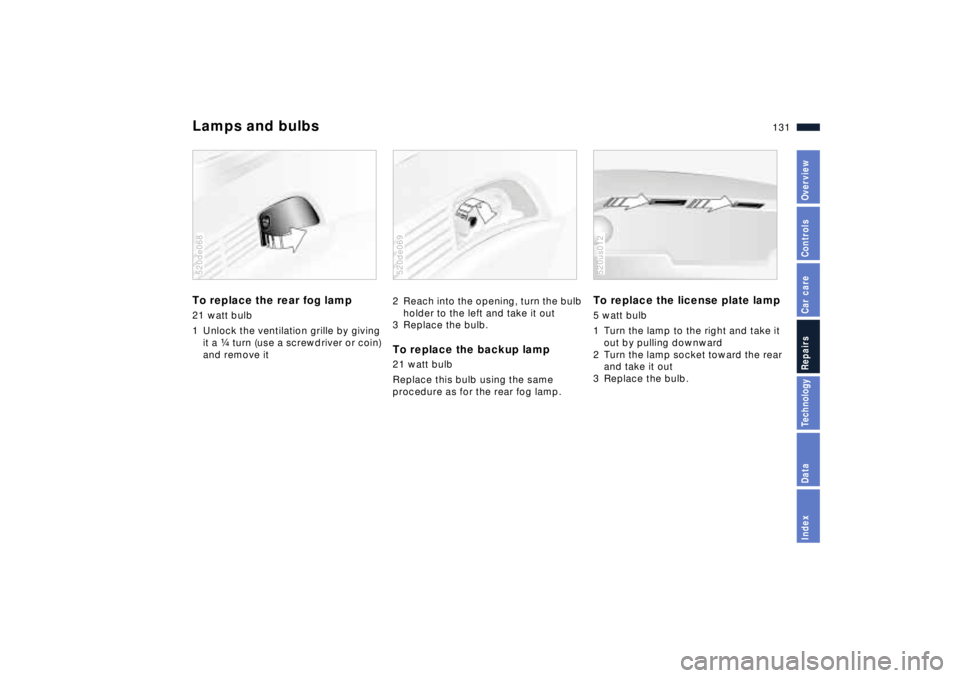
Lamps and bulbsTo replace the rear fog lamp 21 watt bulb
1 Unlock the ventilation grille by giving
it a f turn (use a screwdriver or coin)
and remove it520de068
2 Reach into the opening, turn the bulb
holder to the left and take it out
3 Replace the bulb.To replace the backup lamp 21 watt bulb
Replace this bulb using the same
procedure as for the rear fog lamp.520de069
To replace the license plate lamp5 watt bulb
1 Turn the lamp to the right and take it
out by pulling downward
2 Turn the lamp socket toward the rear
and take it out
3 Replace the bulb.520us012
Page 144 of 170

144n
Jump starting Towing the vehicle6 Start the support vehicle's engine
and let it run
7 Start the engine on the vehicle
needing the jump start, and allow it to
run as usual. If the first start attempt
is not successful, wait a few minutes
before another attempt in order to
allow the discharged battery to
recharge
8 Before disconnecting the jumper
cables from your BMW, turn on the
lamps, set the blower to the highest
speed and allow the engine to run for
at least 10 seconds. This will prevent
a voltage surge from the voltage
regulator to the electrical accessories
9 Then disconnect the jumper cables in
reverse sequence.
Have the battery recharged if necessary.
Tow fittingThe screw-in tow fitting is stored in the
onboard tool kit; be sure that it remains
in the vehicle at all times. This fitting
is designed for installation in the tow
sockets located at the front and rear of
the vehicle. It is intended for towing on
paved road surfaces only.
It should not be used to pull a vehicle
out of deep snow, mud, sand, etc.
Always observe all applicable towing
laws and regulations.Access to tow socketsFront:
The uppermost grille stub is clipped on
the grille Ð which is located below the
main grille on the lower right Ð and this
grille can be pulled off, if you pull
forward on it.520de152
Rear:
Use a screwdriver to press sideways on
the opening to remove the cover (arrow).
Screw the tow fitting in until it
bottoms firmly. If this is not done,
the threads could be damaged.
Do not tow the vehicle by any compo-
nents of the running gear, or lash them
down in any way. If you do so, the
components could be damaged,
leading to possible accidents.<
Use only a nylon towing strap to tow
the vehicle. The inherent resilience of
this material helps protect both vehicles
from sudden jerking movements.520de164
Page 145 of 170

145n
IndexDataTechnologyRepairsCar careControlsOverview
Towing the vehicle
Avoid "off-center" towing. Be sure
that the tow rope is pulled tightly
when the towing vehicle begins to
move.<
The towed vehicle should always
be the lighter of the two vehicles.
If this is not the case, it is no longer
possible to control vehicle response.<
Tow-startingFor instructions on jump starting, refer
to page 143.
Never attempt to use your vehicle to
push another vehicle, since damage to
the energy-absorbing bumpers could
result.
Towing a vehicle1 Put the manual-shift gear lever in
neutral
2 Towing speed:
Max. 45 mph (70 km/h)
3 Towing distance:
Max. 95 miles (150 km)
4 Leave the ignition key in position 1
to ensure that the brake lamps, turn
signals, horn and windshield wipers
remain operative, and to prevent the
steering lock detent from engaging
5 Switch on the hazard-warning system
(comply with country-specific regula-
tions).
Find some means of identifying the
vehicle in tow, e. g. place a sign or
warning triangle in the rear window.
Make sure that the ignition key
remains in position 1 even
when the electrical system has failed
to prevent the steering lock from
engaging. The steering and brakes are
without power assist when the engine is
not running. This means that increased
effort is required for steering and
braking.<
Towing with a commercial tow
truck>Do not tow with sling-type equipment
>Use a wheel lift or flat bed equipment
>Please comply with applicable towing
laws.
Never allow passengers to ride in a
towed vehicle for any reason.<520us014