2001 BMW SPORT WAGON flat tire
[x] Cancel search: flat tirePage 190 of 238
190nChanging a wheel
Safety measures in the event of a
flat tire or wheel change:
Stop the vehicle as far as possible from
passing traffic. Park on a firm, flat,
surface. Switch on the hazard warning
flashers.
Turn the steering wheel to the straight-
ahead position, remove the key and
engage the steering lock. Shift into 1st
or reverse (selector lever in Park with
automatic transmission) and engage
the parking brake.
All passengers should be outside the
vehicle and well away from your imme-
diate working area (behind a guardrail,
for instance).
If necessary, set up your warning trian-
gle or portable hazard warning lamp on
the roadside at an appropriate distance
from the rear of the vehicle. Comply
with all safety guidelines and regula-
tions.
Change the wheel only on a level, firm
surface which is not slippery. Avoid
jacking the vehicle on a soft or slippery
support surface (snow, ice, loose
gravel, etc.), since it could slide side-
ways.Position the jack on a firm support
surface.
Do not place wooden blocks or similar
objects under the jack. If this is done,
the jack might not be able to reach its
full support capacity because of the
limited height.
Do not lie under the vehicle or start the
engine when the vehicle is supported
by the jack – risk of fatal injury. <
What you will need
In order to avoid rattling noises later,
note the position of the tools when you
remove them and return them to their
original position when you are through
using them.
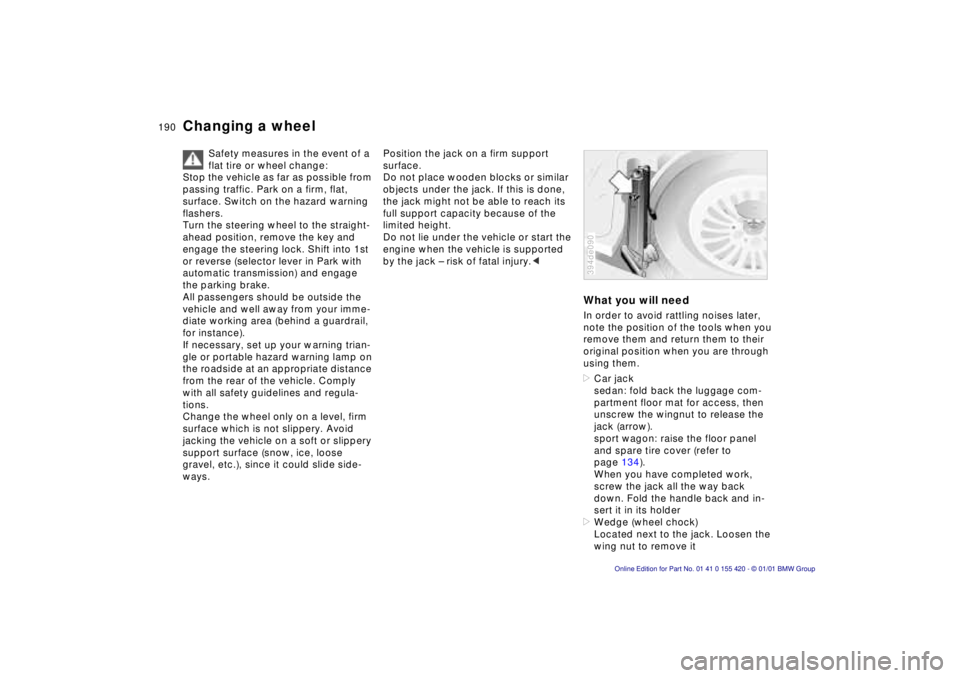
> Car jack
sedan: fold back the luggage com-
partment floor mat for access, then
unscrew the wingnut to release the
jack (arrow).
sport wagon: raise the floor panel
and spare tire cover (refer to
page 134).
When you have completed work,
screw the jack all the way back
down. Fold the handle back and in-
sert it in its holder
> Wedge (wheel chock)
Located next to the jack. Loosen the
wing nut to remove it
394de090
Page 192 of 238
192nChanging a wheel
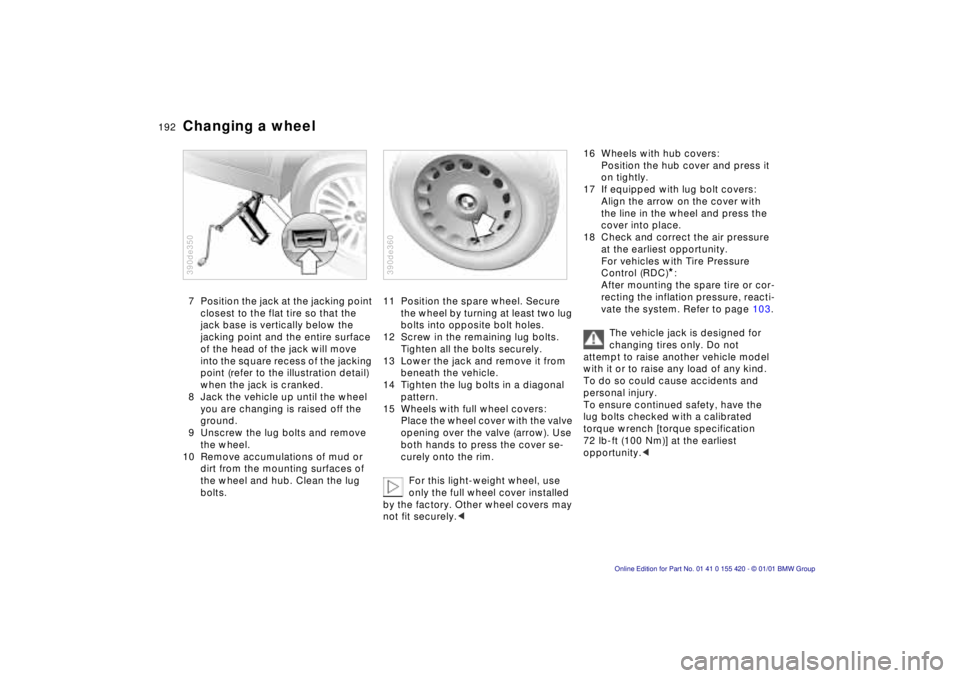
7 Position the jack at the jacking point
closest to the flat tire so that the
jack base is vertically below the
jacking point and the entire surface
of the head of the jack will move
into the square recess of the jacking
point (refer to the illustration detail)
when the jack is cranked.
8 Jack the vehicle up until the wheel you are changing is raised off the
ground.
9 Unscrew the lug bolts and remove the wheel.
10 Remove accumulations of mud or
dirt from the mounting surfaces of
the wheel and hub. Clean the lug
bolts.
390de350
11 Position the spare wheel. Secure the wheel by turning at least two lug
bolts into opposite bolt holes.
12 Screw in the remaining lug bolts. Tighten all the bolts securely.
13 Lower the jack and remove it from beneath the vehicle.
14 Tighten the lug bolts in a diagonal pattern.
15 Wheels with full wheel covers: Place the wheel cover with the valve
opening over the valve (arrow). Use
both hands to press the cover se-
curely onto the rim.
For this light-weight wheel, use
only the full wheel cover installed
by the factory. Other wheel covers may
not fit securely. <
390de360
16 Wheels with hub covers:
Position the hub cover and press it
on tightly.
17 If equipped with lug bolt covers: Align the arrow on the cover with
the line in the wheel and press the
cover into place.
18 Check and correct the air pressure at the earliest opportunity.
For vehicles with Tire Pressure
Control (RDC)
*:
After mounting the spare tire or cor-
recting the inflation pressure, reacti-
vate the system. Refer to page 103.
The vehicle jack is designed for
changing tires only. Do not
attempt to raise another vehicle model
with it or to raise any load of any kind.
To do so could cause accidents and
personal injury.
To ensure continued safety, have the
lug bolts checked with a calibrated
torque wrench [torque specification
72 lb-ft (100 Nm)] at the earliest
opportunity. <
Page 206 of 238
206n
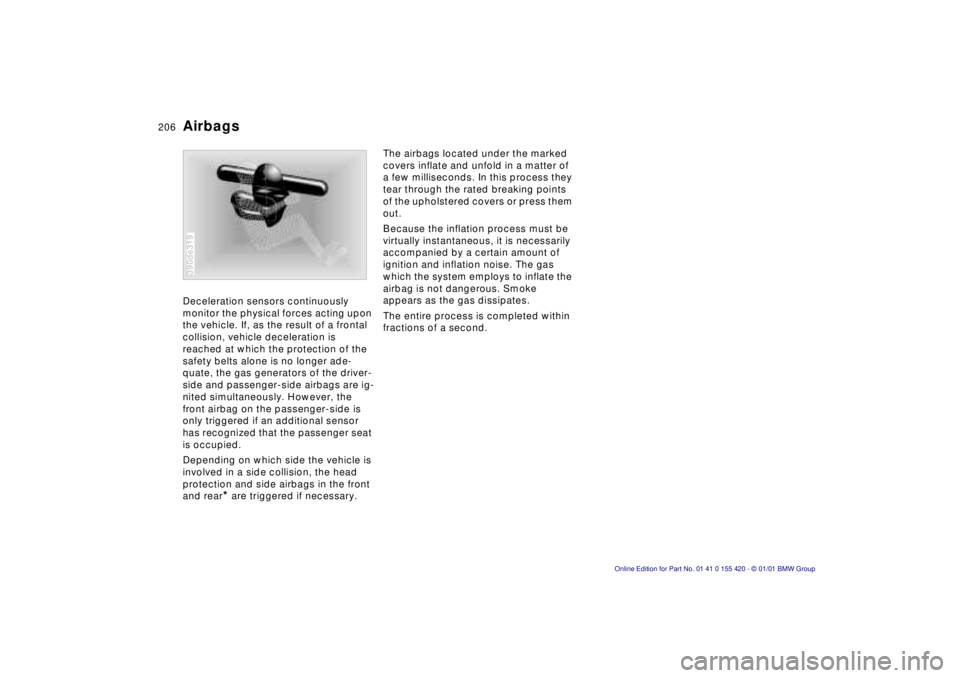
Deceleration sensors continuously
monitor the physical forces acting upon
the vehicle. If, as the result of a frontal
collision, vehicle deceleration is
reached at which the protection of the
safety belts alone is no longer ade-
quate, the gas generators of the driver-
side and passenger-side airbags are ig-
nited simultaneously. However, the
front airbag on the passenger-side is
only triggered if an additional sensor
has recognized that the passenger seat
is occupied.
Depending on which side the vehicle is
involved in a side collision, the head
protection and side airbags in the front
and rear
* are triggered if necessary.
390de319
The airbags located under the marked
covers inflate and unfold in a matter of
a few milliseconds. In this process they
tear through the rated breaking points
of the upholstered covers or press them
out.
Because the inflation process must be
virtually instantaneous, it is necessarily
accompanied by a certain amount of
ignition and inflation noise. The gas
which the system employs to inflate the
airbag is not dangerous. Smoke
appears as the gas dissipates.
The entire process is completed within
fractions of a second.
Airbags
Page 230 of 238

Everything from A to Z
Door locks, care146
Doors
emergency release38
manual operation38
t
remote control40
unlocking and locking38
DOT Quality Grades151
Drive belts224
Driving in winter146
Driving notes141
Driving through water141
DSC (Dynamic Stability
Control)24, 102, 208
DSP sound system211
refer also to the Radio
Owner's Manual
Dynamic Brake Control
(DBC)23, 100, 145
Dynamic Stability Control
(DSC)24, 102, 208
E
Electric power seat52
Electric power windows49
Electrical defect
fuel filler door198
t
sliding/tilt sunroof198
t
tailgate199
Electrical heating, exterior
mirror57
Electrical steering wheel,
adjusting56Electrical system224
Electronic vehicle
immobilizer37
Elements of operation16
Emergency operation
doors38
t
fuel filler door198
t
luggage compartment lid/
tailgate43, 199
t
sliding/tilt sunroof198
t
Energy control84
Engine
compartment160
coolant167
Engine oil
consumption165
grades166
level23
pressure22
specifications166
t
Engine specifications218
Error indicators86
Estimated time of arrival97
Exterior finish172
Exterior mirror56
electrical heating57
Exterior mirror with
automatic dimming
feature211
F
Failure messages86
t
Failure of an electrical
accessory196
t
Failure warnings86
t
Filler cap cover28
Filling capacities223
Filling the washer
reservoir164
t
First-aid kit27
t
Fittings, tow-starting and
towing201
t
Flashlight124
Flat tire150, 190
t
Fog lamp, bulb
replacement185
t
Footbrake144
Footwell lamps107
bulb replacement189
t
Forward/backward
adjustment, seats52, 55
Front fog lamps106
Front seat adjustment52
Frost protection,
radiator167
Fuel29
gauge84
quality29
tank capacity223
Fuel consumption97
average97
indicator84Fuel filler door, release after
electrical fault198
t
Fuses196
t
, 197
G
Gasoline29
gauge84
quality29
Glove compartment124
bulb replacement189
t
Gross vehicle weight221
H
Handbrake23, 70
Hands-free system125
Hazard warning
flashers27
t
Hazard warning
triangle27
t
Head restraints53
Headlamp covers,
care171
t
, 183
t
Headlamp flasher78
Headlamp washer
system164
Heated seats119
Heated steering wheel120
Heating and
ventilation108, 114
Heating while stopped118
Heating, rapid113
Heavy loads136
Page 231 of 238

Everything from A to Z
231n
IndexDataTechnologyRepairsCar careControlsOverview
Height219
Height adjustment
seats52
steering wheel56
Help with jump
starting200
t
HiFi system211
High beams24
bulb replacement183
t
High Performance Synthetic
Oils166
High-mount brake lamp187
Hood release159
t
Horn25
Hydraulic Brake Assistant,
refer to DBC23, 100, 145
I
Ice warning83
Identification number of the
vehicle169
Identification, tires153
Ignition key36
Ignition lock68
Imprint4
Independent
ventilation94, 120
Independent ventilation,
refer also to the onboard
monitor Owner's Manual
Indicator lamps22
t
Inflation
pressure29
t
, 30, 150
monitoring103, 213
INSPECTION85
Instrument cluster18, 20
Instrument lighting105
Instrument panel20
Instrument panel switch78
Instruments18
Integrated rear
suspension214
Intensive
cleaning78, 79, 164
Interaxle tire rotation152
Interference indicators86
Interference with
car phones149
Interior lamps106
bulb replacement188
t
remote control40
Interior mirror57
with automatic dimming
feature211
Interior motion sensor48
deactivation48
Interior rearview mirror
with automatic dimming
feature57
Interlock68
Intermittent mode78
J
Jack190
t
Jump starting200
t
KKey Memory60
Key, transmitter36
Keys36
Keys with remote control36
Kickdown73, 76LLashing eye136
Leather care175
Length219
Level control
system23, 214
inactive148t
License plate lamps, bulb
replacement188t
Light switch105
Light-alloy wheels156
Lighter126
Lights-on warning105
LIMIT95
Load-securing devices136
Locking and unlocking the
doors38
Louvers108, 114
Low beams105
bulb replacement183tLow-fuel warning lamp84
Lug bolts191
Lug wrench191t
Luggage compartment46
capacity221
hanger46
lamps106
Luggage compartment
lamps, bulb
replacement189t
Luggage compartment lid/
tailgate43
emergency actuation43
opening separately43
remote control41
secure separately43
unlock in case of electrical
fault43t
Luggage space46
Luggage straps46
Lumbar support54
MM+S tires154
Magic Eye194
Maintenance85t, 170t
Malfunction displays86t
Page 234 of 238

Everything from A to Zroll-up cover132
securing a load136
ski bag131
tail lamp assembly, bulb
replacement186t
tailgate, manual release
after electrical fault198t
Sports seat55
Sports steering wheel26
Start the engine69
Starting69
Starting assistance200t
Starting help200
Starting off147
Starting problems
69, 142t, 200t
Starting the engine68t
Steel wheel158
Steering148
Steering wheel
adjustment56
heating120
lock68
memory58
Steptronic75
Stopwatch93
Storage124
Summer tires153
Sun blind cover120
Sun visors57Sunroof50
with glass moonroof51
Switching off the engine69
Switch-on times
input94
Symbols4
TTachometer84
Tail lamp assembly, bulb
replacement186t
Tail lamps186
Tailgate199
convenience opening
mode40
manual release after
electrical fault199
refer also to luggage
compartment
release after an electrical
defect199t
Tank capacity223
Technical
modifications6, 177
Telephone hookup125
Temperature display, engine
coolant85
Temperature display,
outside temperature83
Temperature gauge85
Temperature
layering111, 119Tensioning straps46
Thigh support
adjustment55
Third brake lamp, bulb
replacement187t
Through-loading
system128
Tilt alarm40
Tilt alarm sensor48
deactivation48
Tilt function
passenger side exterior
mirror59
steering wheel56
Time
calling up92
changing92
of arrival, estimated97
Tire
change190
code153
damage150
inflation pressure30, 150
monitoring inflation
pressure103, 213
renewal151
rotation between
axles151
tread150
valve caps154
wear indicator150Tire Pressure Control
(RDC)103, 213
Tire, changing190t
Tools182t
Torque218
Tow fittings201t
Towing201t
Tow-starting201t
Track width219
Traction control system,
refer to ASC+T/DSC
Transmission70, 75
Transmitter key36
Transporting children
safely66
Tread depth indicators150
Tread depth, tires150
Tread wear indicator150
Trip odometer83
Trunk, refer to luggage
compartment
Turn signal indicator78
bulb replace-
ment184t, 186t
Turning circle219
UUniform Tire Quality Grading
(UTQR)152
Universal Transmitter121
Use antifreeze167t
Page 236 of 238
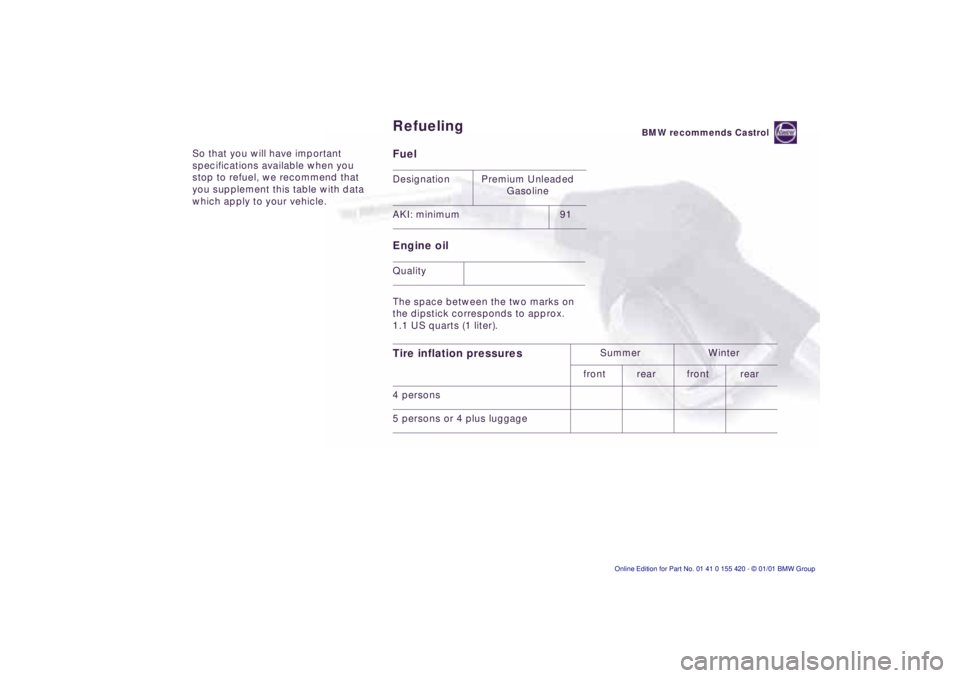
So that you will have important
specifications available when you
stop to refuel, we recommend that
you supplement this table with data
which apply to your vehicle. Fuel
Engine oil
The space between the two marks on
the dipstick corresponds to approx.
1.1 US quarts (1 liter).
Designation Premium Unleaded Gasoline
AKI: minimum 91
Quality
Tire inflation pressures Summer Winter
front rear front rear
4 persons
5 persons or 4 plus luggage
RefuelingBMW recommends Castrol