2001 BMW SPORT WAGON flat tire
[x] Cancel search: flat tirePage 87 of 238

IndexDataTechnologyRepairsCar careControlsOverview
87n
Check Control>RELEASE PARKINGBRAKE
>COOLANT TEMPERATURE
The coolant is overheated. Stop the
vehicle immediately and switch off
the engine. Refer to pages 85
and 16 7.
>STOP!ENGINE OILPRESS
The oil pressure is too low. Stop the
vehicle immediately and switch off
the engine. Refer to page 22.
>CHECK BRAKE FLUID
Indicates that brake fluid is down to
roughly minimum level. Top up the
brake fluid at the next opportunity.
Refer to page 168. Have the source
of the brake fluid loss diagnosed and
corrected by your BMW center.
>TIRE DEFECT
*
Reduce vehicle speed immediately
and stop the vehicle. Avoid hard
brake applications. Do not oversteer.
Refer to page 104.
>SELFLEVEL SUSP.INACT
Please consult the nearest authorized
BMW center. Refer to page 148.
>SPEED LIMIT
*
Display if the programmed speed
limit has been exceeded.Priority 2
These displays appear for 20 seconds
when the ignition key is turned to posi-
tion 2. The warning symbols remain
after the message disappears. You can
display the messages again by pressing
the CHECK button 3:
>TRUNKLID OPEN
Message appears only when the
vehicle is initially set in motion.
>DOOR OPEN
This message appears after a mini-
mal defined road speed has been ex-
ceeded.
>FASTEN SEAT BELTS
*
In addition to this message, a
warning lamp with the safety belt icon
appears and an acoustical signal
sounds.
>WASHER FLUID LOW
Too low; top up fluid at the next
opportunity. Refer to page 164.
>CHECK ENGINE OIL LEV
The oil level is at the absolute mini-
mum, and therefore engine oil should
be added as soon as possible. Refer
to page 165. Until then, do not drive
more than approx. 30 miles (50 km)>CHECK FILLER CAP
Check that the filler cap is closed
correctly, refer to page 28. A loose or
missing cap will activate the message
"CHECK FILLER CAP" in the Check
Control
* or the Service Engine Soon
lamp.
>OUTSIDE TEMP. +207 (–56)
This display is only an example. The
current temperature is displayed at
outside temperatures of +37.57
(+36) and below. Refer also to
page 83.
>SET TIRE PRESSURE
*
The RDC has imported the current in-
flation pressure in the tires as the tar-
get values which the system will
monitor. Refer to page 103.
>CHECK TIRE PRESSURE
*
Check and correct the tire inflation
pressure to specifications at the earli-
est opportunity (next stop for fuel).
Refer to page 104.
>TIRECONTROL INACTIVE
*
A temporary interference of the RDC
or a system fault. Refer to page 104.
>CHECK BRAKE LIGHTS
A lamp has failed or the electrical cir-
cuit has a fault. Refer to pages 186
and 196 or consult a BMW center.
Page 103 of 238
IndexDataTechnologyRepairsCar careControlsOverview
103n
ASC+T/DSC
*
Tire Pressure Control (RDC)
*
To reactivate the systemPress the button again; the indicator
lamp goes out.
The laws of physics cannot be
repealed, even with ASC+T/DSC.
An appropriate driving style always
remains the responsibility of the driver.
We therefore urge you to avoid using
the additional safety margin of the
system as an excuse for taking risks.<
For additional details concerning
ASC+T/DSC, please refer to the
chapter describing "Advanced
technology" on page 207.
The concept RDC monitors the tire pressures at all
four wheels, even when the vehicle is
moving. The system provides an alert
whenever the inflation pressure drops
significantly below the specified pres-
sure in one or more tires.
In order for the system to "learn" the
correct tire inflation pressure, check the
inflation pressure in all tires. Refer to
the table of "Tire inflation pressures"
beginning on page 29 and make any
necessary corrections. Then activate
the system.
This indicator lamp in the in-
strument cluster or the Check
Control will inform you if the
tire pressure is not correct.
Activate the system1 Turn the ignition key to position 2 (do
not start the engine).
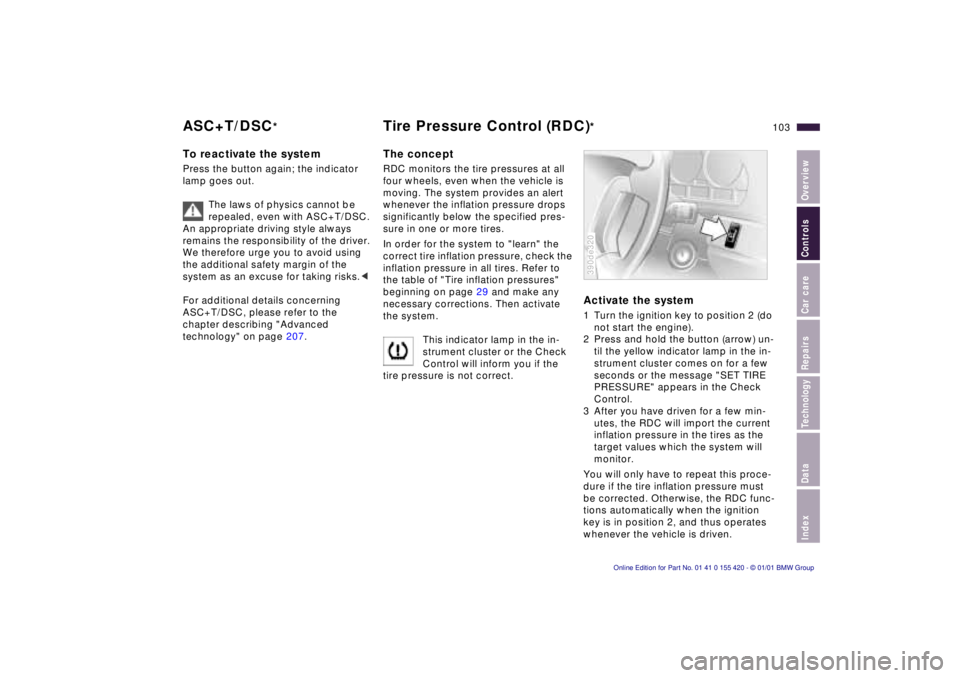
2 Press and hold the button (arrow) un-
til the yellow indicator lamp in the in-
strument cluster comes on for a few
seconds or the message "SET TIRE
PRESSURE" appears in the Check
Control.
3 After you have driven for a few min-
utes, the RDC will import the current
inflation pressure in the tires as the
target values which the system will
monitor.
You will only have to repeat this proce-
dure if the tire inflation pressure must
be corrected. Otherwise, the RDC func-
tions automatically when the ignition
key is in position 2, and thus operates
whenever the vehicle is driven.390de320
Page 104 of 238

104n
Tire Pressure Control (RDC)
*
Loss of tire pressureIf, after a certain period of time, the air
pressure has gone down significantly
(which is normal for any tire), the yellow
indicator lamp comes on or the mes-
sage "CHECK TIRE PRESSURE" ap-
pears in the Check Control.
This alerts you that you should have the
tires inflated to the specified pressures
as soon as possible.
If you are prompted to check the
tire pressure shortly after a cor-
rection has been made, this indicates
that the corrected values were not ac-
curate. Please check the inflation pres-
sure again and make corrections ac-
cording to the inflation pressure table.<
Flat tireIf there is a tire failure with a loss of air
pressure, the red indicator lamp comes
on or the message "TIRE DEFECT" ap-
pears in the Check Control. In addition,
a gong sounds.
If this occurs, reduce vehicle speed im-
mediately and stop the vehicle in a safe
location. Avoid hard brake applications.
Do not oversteer. Replace the flat tire.
The spare tire which is available in
your vehicle as standard equip-
ment is equipped with the electronics
required for RDC and, following activa-
tion of the system, is also monitored af-
ter it is mounted.<
The RDC cannot alert you to se-
vere and sudden tire damage
caused by external factors.<
Have the tires changed by your
authorized BMW center.
Your BMW center has the information
needed for working with RDC and is
equipped with the necessary special
tools.<
System interferenceDuring the period of the malfunction,
the yellow indicator lamp comes on
or the message "TIRECONTROL
INACTIVE" appears in the Check
Control.
You will also see the same message
>in the event of a system fault
>if a wheel is mounted without the
RDC electronics
>if, in addition to the spare tire,
additional wheels with RDC
electronics are on board.
Please contact your BMW center for
additional information.
Page 139 of 238
Index
Data
Technology
Repairs
Car care
Controls
Overview
Overview
Controls and features Operation, care
and maintenance
Owner service procedures
Technical dataIndex
Advanced technology
139
n
Special operating instructions:
Break-in procedure 140
Driving notes 141
Catalytic converter 142
Antilock Brake System (ABS) 143
Disc brakes 144
Brake system 146
Winter operation 146
Power steering 148
Level control system 148
Cellular phone 149
Radio reception 149
Wheels and tires:
Tire inflation pressure 150
Tire condition 150
Tire replacement 151
Tire rotation 152
Wheel and tire combinations 153
Winter tires 154
Snow chains 155
Approved wheel and tire specifications 156 Under the hood:
Hood
159
Engine compartment 160
Washer fluids 164
Washer nozzles 164
Engine oil 165
Coolant 167
Brake fluid 168
Vehicle Identification Number 169
Care and maintenance:
The BMW Maintenance System 170
Caring for your car 171
Airbags 176
Vehicle storage 176
Laws and regulations:
Technical modifications 177
California Proposition 65 Warning 177
OBD interface socket 178
Page 150 of 238
150n
Information for your safety
The factory-approved radial tires are
matched to the car and have been
selected to provide optimum safety and
driving comfort on your vehicle.
It is not merely the tire's service life, but
also driving comfort and – above all else
– driving safety which depend on the
condition of the tires and the mainte-
nance of the specified tire pressure.
Incorrect inflation pressure is a frequent
cause of tire damage. It also signifi-
cantly influences the roadholding ability
of your BMW.
Check tire inflation pressures –
including the spare tire – regularly
(refer to page 29), at least every two
weeks and before beginning a longer
trip. If this is not done, incorrect tire
pressures can cause driving instability
and tire damage, ultimately resulting in
accidents. <
Tire tread – tire damage
Inspect your tires frequently for tread
wear, signs of damage and for foreign
objects lodged in the tread. Check the
tread depth.
Tread depth should not be allowed to
go below 0.12 in (3 mm), even though
the legally specified minimum tread
depth is only 0.063 in (1.6 mm). At a
tread depth of 0.063 in (1.6 mm), tread
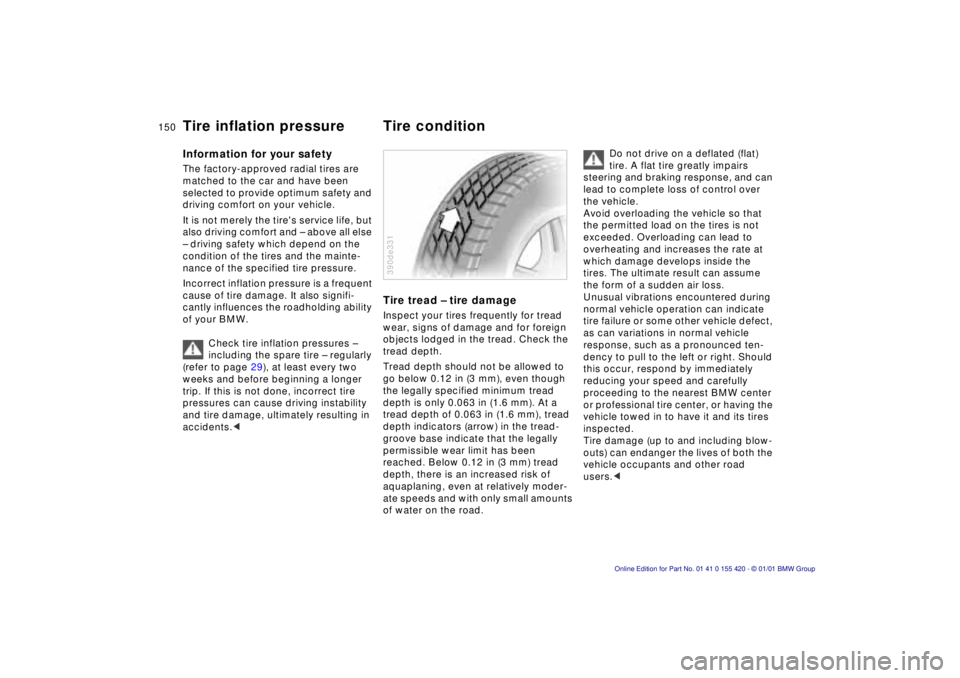
depth indicators (arrow) in the tread-
groove base indicate that the legally
permissible wear limit has been
reached. Below 0.12 in (3 mm) tread
depth, there is an increased risk of
aquaplaning, even at relatively moder-
ate speeds and with only small amounts
of water on the road.
390de331
Do not drive on a deflated (flat)
tire. A flat tire greatly impairs
steering and braking response, and can
lead to complete loss of control over
the vehicle.
Avoid overloading the vehicle so that
the permitted load on the tires is not
exceeded. Overloading can lead to
overheating and increases the rate at
which damage develops inside the
tires. The ultimate result can assume
the form of a sudden air loss.
Unusual vibrations encountered during
normal vehicle operation can indicate
tire failure or some other vehicle defect,
as can variations in normal vehicle
response, such as a pronounced ten-
dency to pull to the left or right. Should
this occur, respond by immediately
reducing your speed and carefully
proceeding to the nearest BMW center
or professional tire center, or having the
vehicle towed in to have it and its tires
inspected.
Tire damage (up to and including blow-
outs) can endanger the lives of both the
vehicle occupants and other road
users. <
Tire inflation pressure Tire condition
Page 151 of 238

Index
Data
Technology
Repairs
Car care
Controls
Overview
151nTire replacement
To maintain good handling and vehicle
response, use only tires of a single
tread configuration from a single manu-
facturer. BMW tests and approves
wheel/tire combinations. Refer to
page 153.
DOT Quality Grades
Treadwear
Traction AA A B C
Temperature A B C
All passenger car tires must con-
form to Federal Safety Require-
ments in addition to these grades. <
Treadwear
The treadwear grade is a comparative
rating based on the wear rate of the tire
when tested under controlled condi-
tions on a specified government test
course.
For example, a tire graded 150 would
wear one and one-half (1g) times as
well on the government course as a tire
graded 100. The relative performance
of tires depends upon the actual condi-
tions of their use, however, and may
depart significantly from the norm due
to variations in driving habits, service
practices and differences in road char-
acteristics and climate.
Traction
The traction grades, from highest to
lowest, are AA, A, B and C.
Those grades represent the tire's ability
to stop on wet pavement as measured
under controlled conditions on speci-
fied government test surfaces of as-
phalt and concrete. A tire marked C
may have poor traction performance.
The traction grade assigned to
this tire is based on straight-
ahead braking traction tests, and does
not include acceleration, cornering, hy-
droplaning, or peak traction character-
istics. <
Temperature
The temperature grades are A (the
highest), B and C, representing the
tire's resistance to the generation of
heat and its ability to dissipate heat
when tested under controlled condi-
tions on a specified indoor laboratory
test wheel.
Sustained high temperature can cause
the material of the tire to degenerate
and reduce tire life, and excessive tem-
perature can lead to sudden tire failure.
The grade C corresponds to a level of
performance which all passenger car
tires must meet under the Federal Mo-
tor Vehicle Safety Standard No. 109.
Grades B and A represent higher levels
of performance on the laboratory test
wheel than the minimum required by
law.
The temperature grade for this tire
is established for a tire that is
properly inflated and not overloaded.
Excessive speed, underinflation, or ex-
cessive loading, either separately or in
combination, can cause heat buildup
and possible tire failure. <
Page 153 of 238

Index
Data
Technology
Repairs
Car care
Controls
Overview
153nTire rotation Wheel and tire combinations
Should you decide to rotate the tires, it
is essential to comply with the follow-
ing: rotate tires on the same side only,
since braking characteristics and road
grip could otherwise be adversely
affected.
Following tire rotation, correct the tire
inflation pressure.
If different tire sizes are mounted
on the front and rear axles (refer to
page 156), the wheels may not be
rotated from one axle to the other.
Refer to the information beginning on
page 156.
Because of the high speeds this vehicle
can reach, the use of specific tire
brands, specifications and dimensions
is mandatory. Consult any BMW center
for details.
Comply with national, state, or province
regulations.
The correct wheel-tire combina-
tion affects different systems such
as ABS, ATC, ASC+T/DSC. The func-
tion of these systems is impaired if im-
proper wheel-tire combinations are
used.
For this reason, use only tires of the
same brand and tread pattern. In the
event of a flat tire if you have mounted
winter tires, for example, remount the
approved wheel-tire combination as
soon as possible. <
Codes on tires and wheels
The tire codes will aid you in selecting
the correct tire.
Codes on radial tires:
The speed rating indicates the ap-
proved maximum speed for the tire.
Summer tires:
S = up to 112 mph (180 km/h)
T = up to 118 mph (190 km/h)
H = up to 130 mph (210 km/h)
V = up to 150 mph (240 km/h)
W = up to 167 mph (270 km/h)
Y = up to 186 mph (300 km/h)
ZR= over 150 mph (240 km/h)Example:
Nominal width
in mm
Aspect ratio in %
Radial tire code
Rim diameter in inches
Load rating
(not on ZR tires)
Speed rating
(before R on ZR tires)
235/60 R 16 100 W
Page 155 of 238

Index
Data
Technology
Repairs
Car care
Controls
Overview
155nWinter tires Snow chains*
Do not exceed specified
maximum speeds
Never exceed the maximum
speed for which the tires are
rated.
Unprofessional attempts by laymen to
service tires can lead to damage and
accidents.
Have this work performed by skilled
professionals only. Any BMW center
has the required technical knowledge
and the proper equipment and will be
happy to assist you. <
Tire condition, tire pressure
Winter tires display a perceptible loss in
their ability to cope with winter driving
conditions once the tread wears to be-
low 0.16 in (4 mm), and should thus be
replaced.
Comply with the specified tire inflation
pressures – and be sure to have the
wheel and tire assemblies balanced
every time you change the tires.
Storage
Store tires in a cool, dry place, away
from light whenever possible. Protect
the tires against contact with oil, grease
and fuel. Use narrow-link BMW snow chains
on
summer or winter tires only in pairs and
only on the rear wheels. Comply with all
manufacturer's safety precautions
when mounting the chains.
It is not possible to mount snow
chains on tires with 17-inch
wheels. <