2001 BMW M ROADSTER COUPE engine
[x] Cancel search: enginePage 10 of 171

Contents
Overview
Controls and features
Cockpit16
Instrument cluster18
Indicator and warning lamps20
Hazard warning flashers24
Warning triangle24
First-aid kit25
Refueling25
Fuel specifications26
Tire inflation pressure26
Tire inflation pressure (table)27
Opening and closing:
Keys30
Electronic vehicle
immobilizer31
Central locking system32
Opening and closing from the
outside32
Opening and closing from the
inside33
Luggage compartment lid34
Electric power windows35
Sunroof – coupe36
Convertible top – roadster37
Adjustments:
Seats46
Mirrors47
Safety systems:
Safety belts49
Airbags51
Transporting children safely53
Driving:
Steering/Ignition lock55
Starting the engine56
Switching off the engine57
Parking brake57
Manual transmission58
Turn signal indicators/High
beams58
Wiper/Washer system59
Rear window defroster60
Cruise control61
Everything under control:
Odometer62
Tachometer62
Fuel gauge62
Coolant temperature gauge63
Engine oil temperature gauge63
Service Interval Display64
Outside temperature64
Clock64
Technology for safety and
driving convenience:
Dynamic Stability Control
(DSC)65
Tire Pressure Warning (RDW)67
Lamps:
Parking lamps/Low beams69
Interior lamps70
Reading lamps71
Controlling the climate
for pleasant driving:
Heating and ventilation/
Air conditioner72
Seat heating77
Contents
ProCarManuals.com
Page 11 of 171

11n
Controls and features
Operation, care and maintenance
Cabin convenience:
Glove compartment78
Storage compartments78
Storage boxes78
Beverage holder79
Ashtray79
Cigarette lighter80
Loading and transporting:
coupe:
Roll-up cover81
Partition net81
Cargo loading82
Roof-mounted luggage
rack83
Special operating instructions:
Break-in procedure86
Driving notes87
Catalytic converter88
Antilock Brake System (ABS)89
Disc brakes91
Brake system92
Winter operation93
Power steering94
Cellular phone95
Radio reception95
Hardtop – roadster96
Wheels and tires:
Notes on tire inflation
pressure98
Tire condition98
Tire replacement99
Tire rotation100
Wheel and tire
combinations101
Special features of winter
tires102
Snow chains102
Approved wheel and tire
specifications103
Under the hood:
Hood104
Engine compartment106
Fluids for the washer
systems108
Washer nozzles108
Engine oil109
Coolant111
Brake fluid112
Vehicle Identification
Number113
Care and maintenance:
The BMW Maintenance
System114
Caring for your vehicle115
Airbags122
Storing your vehicle123
Laws and regulations:
Technical modifications124
California Proposition
65 Warning124
OBD connector125
ProCarManuals.com
Page 12 of 171

Contents
Owner service procedures
Advanced technology
Technical data
Replacement procedures:
Onboard tool kit128
Windshield wiper blades128
Lamps and bulbs129
Master key with battery-
powered lamp134
Changing a wheel135
Repairing a flat tire135
Battery140
Fuses142
In case of electrical
malfunction:
Power convertible top143
Fuel filler door143
Assistance, giving and
receiving:
Jump-starting144
Towing the vehicle145Airbags150
Radio reception150
Dynamic Stability Control
(DSC)151
Safety belt tensioner151
Interior rearview mirror with
automatic dimming
feature152
Limited slip differential153Engine specifications156
Dimensions157
Weights158
Capacities159
Electrical system160
Drive belts160
ProCarManuals.com
Page 19 of 171

19n
IndexDataTechnologyRepairsCar careControlsOverview
Instrument cluster
1 Fuel gauge with indicator lamp
for reserve range62
2 Indicator lamp for turn signals23
3 Speedometer
4 Indicator and warning lamps for:
>
Battery charge current20
>
High beams23
>
Engine oil pressure20
5 Tachometer62
6 Coolant temperature gauge63
Also refer to Engine oil temperature
gauge on page63
7 Indicator and warning lamps for:
>
Brake pad wear22
>
Brake hydraulic
system/Cornering Brake Control
(CBC)20, 21
>
Parking brake21
>
Airbags21
8 Indicator and warning lamps for:
>
Service Engine Soon22
>
Check Filler Cap22
>
Safety belts21
>
Engine oil level22
>
Antilock Brake System (ABS)22
9 Indicator lamp for Dynamic Stability
Control (DSC)21, 2210 Trip odometer62
11 Service Interval Display64, 114
12 Odometer62
13 Indicator and warning lamps for:
>
Engine electronics22
>
Tire Pressure Warning
(RDW)21, 22
14 Trip odometer reset button62
The illustration shows the instrument
cluster in the US version. In the Cana-
dian models, some of the indicator and
warning lamps have a different appear-
ance. Refer to pages 20 to 23.
ProCarManuals.com
Page 20 of 171
20n
Indicator and warning lamps
Technology that monitors itself
Many of the systems of your BMW
monitor themselves automatically, both
during engine starts and while you are
driving. Indicator and warning lamps
that are identified by "
l
" are tested for
proper functioning whenever the igni-
tion key is turned. They each light up
once for different periods of time.
If a fault should occur in one of these
systems, the corresponding lamp does
not go out after the engine is started or
it lights up while the vehicle is moving.
You will see how to react to this below.
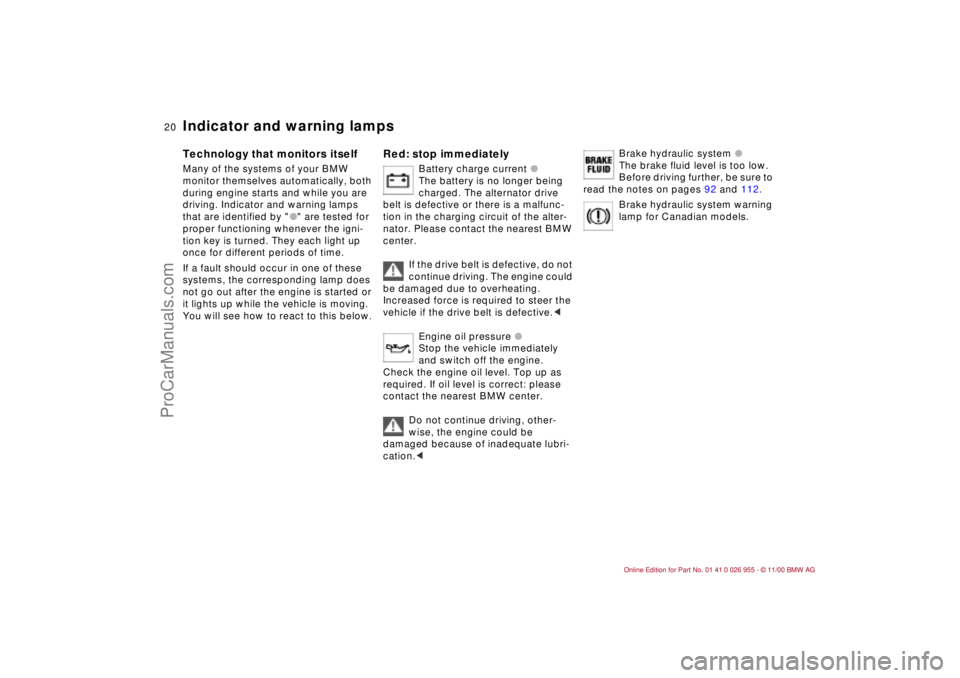
Red: stop immediately
Battery charge current
l
The battery is no longer being
charged. The alternator drive
belt is defective or there is a malfunc-
tion in the charging circuit of the alter-
nator. Please contact the nearest BMW
center.
If the drive belt is defective, do not
continue driving. The engine could
be damaged due to overheating.
Increased force is required to steer the
vehicle if the drive belt is defective.
<
Engine oil pressure
l
Stop the vehicle immediately
and switch off the engine.
Check the engine oil level. Top up as
required. If oil level is correct: please
contact the nearest BMW center.
Do not continue driving, other-
wise, the engine could be
damaged because of inadequate lubri-
cation.
<
Brake hydraulic system
l
The brake fluid level is too low.
Before driving further, be sure to
read the notes on pages 92 and 112.
Brake hydraulic system warning
lamp for Canadian models.
ProCarManuals.com
Page 22 of 171
22n
Indicator and warning lamps
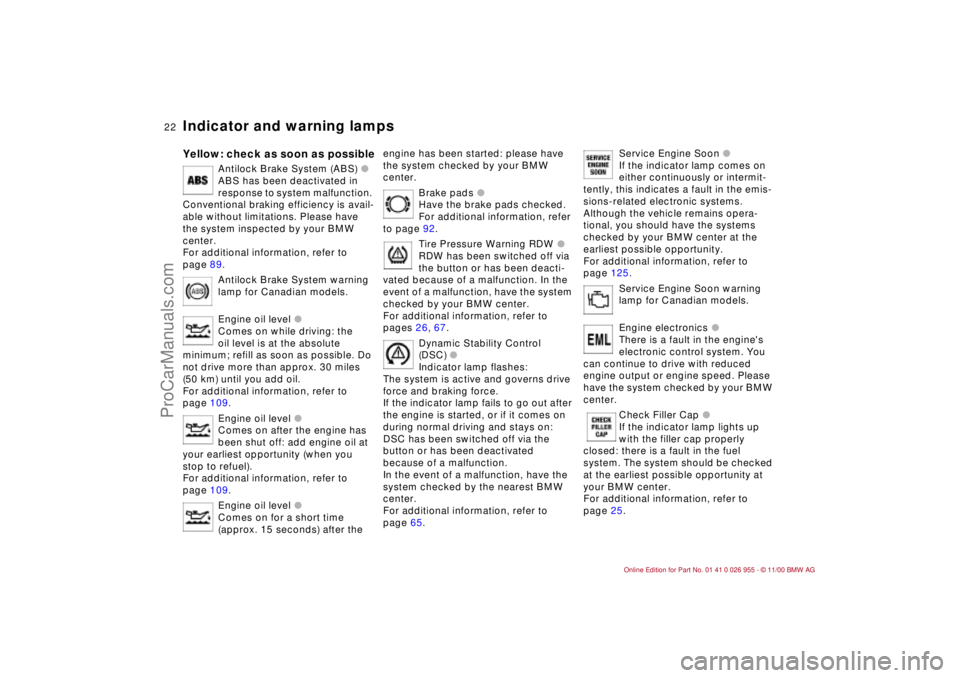
Yellow: check as soon as possible
Antilock Brake System (ABS)
l
ABS has been deactivated in
response to system malfunction.
Conventional braking efficiency is avail-
able without limitations. Please have
the system inspected by your BMW
center.
For additional information, refer to
page 89.
Antilock Brake System warning
lamp for Canadian models.
Engine oil level
l
Comes on while driving: the
oil level is at the absolute
minimum; refill as soon as possible. Do
not drive more than approx. 30 miles
(50 km) until you add oil.
For additional information, refer to
page 109.
Engine oil level
l
Comes on after the engine has
been shut off: add engine oil at
your earliest opportunity (when you
stop to refuel).
For additional information, refer to
page 109.
Engine oil level
l
Comes on for a short time
(approx. 15 seconds) after the
engine has been started: please have
the system checked by your BMW
center.
Brake pads
l
Have the brake pads checked.
For additional information, refer
to page 92.
Tire Pressure Warning RDW
l
RDW has been switched off via
the button or has been deacti-
vated because of a malfunction. In the
event of a malfunction, have the system
checked by your BMW center.
For additional information, refer to
pages 26, 67.
Dynamic Stability Control
(DSC)
l
Indicator lamp flashes:
The system is active and governs drive
force and braking force.
If the indicator lamp fails to go out after
the engine is started, or if it comes on
during normal driving and stays on:
DSC has been switched off via the
button or has been deactivated
because of a malfunction.
In the event of a malfunction, have the
system checked by the nearest BMW
center.
For additional information, refer to
page 65.
Service Engine Soon
l
If the indicator lamp comes on
either continuously or intermit-
tently, this indicates a fault in the emis-
sions-related electronic systems.
Although the vehicle remains opera-
tional, you should have the systems
checked by your BMW center at the
earliest possible opportunity.
For additional information, refer to
page 125.
Service Engine Soon warning
lamp for Canadian models.
Engine electronics
l
There is a fault in the engine's
electronic control system. You
can continue to drive with reduced
engine output or engine speed. Please
have the system checked by your BMW
center.
Check Filler Cap
l
If the indicator lamp lights up
with the filler cap properly
closed: there is a fault in the fuel
system. The system should be checked
at the earliest possible opportunity at
your BMW center.
For additional information, refer to
page 25.
ProCarManuals.com
Page 25 of 171
25n
IndexDataTechnologyRepairsCar careControlsOverview
First-aid kit
*
Refueling
M coupeIn the luggage compartment at the left
rear. Release the Velcro
® fasteners.
M roadsterIn the luggage compartment on the left
in a storage area; swing retaining strap
upward.
Some of the articles in the first-aid
kit may be used within a limited
time only. For this reason, check the
expiration dates of each of the items
regularly, and replace any whose expi-
ration dates have passed. You can
acquire replacements in any drugstore
or pharmacy.
Comply with legal requirements which
cover availability of a first-aid kit in the
vehicle.<
Before filling the tank, shut off the
engine, as otherwise fuel cannot
flow into the tank and the Service
Engine Soon warning lamp may come
on. Refer to page 22.<
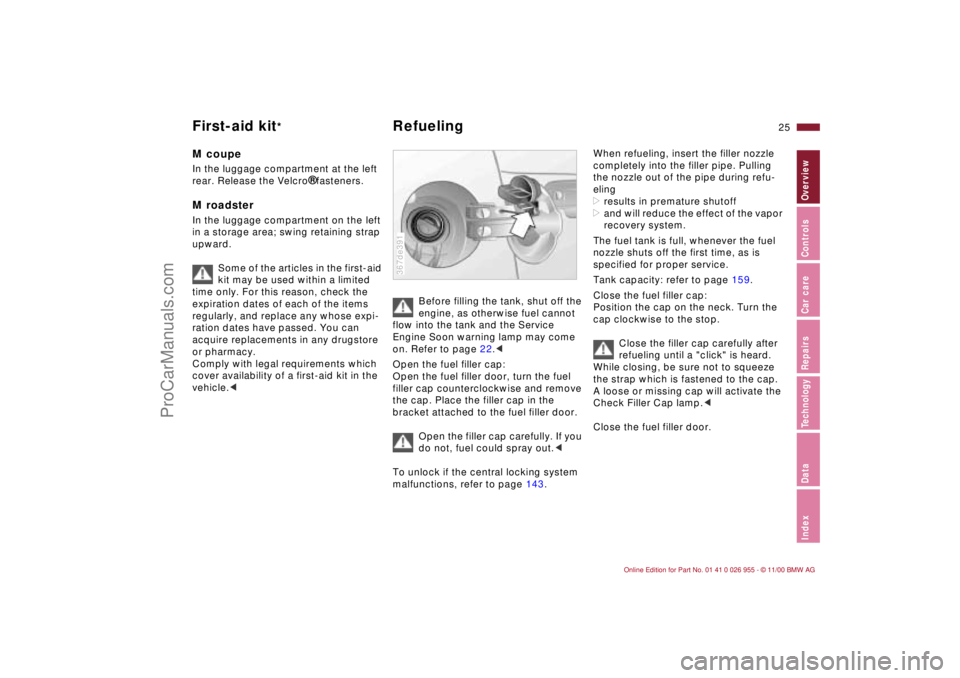
Open the fuel filler cap:
Open the fuel filler door, turn the fuel
filler cap counterclockwise and remove
the cap. Place the filler cap in the
bracket attached to the fuel filler door.
Open the filler cap carefully. If you
do not, fuel could spray out.<
To unlock if the central locking system
malfunctions, refer to page 143.
367de391
When refueling, insert the filler nozzle
completely into the filler pipe. Pulling
the nozzle out of the pipe during refu-
eling
>results in premature shutoff
>and will reduce the effect of the vapor
recovery system.
The fuel tank is full, whenever the fuel
nozzle shuts off the first time, as is
specified for proper service.
Tank capacity: refer to page 159.
Close the fuel filler cap:
Position the cap on the neck. Turn the
cap clockwise to the stop.
Close the filler cap carefully after
refueling until a "click" is heard.
While closing, be sure not to squeeze
the strap which is fastened to the cap.
A loose or missing cap will activate the
Check Filler Cap lamp.<
Close the fuel filler door.
ProCarManuals.com
Page 26 of 171
26n
Refueling Fuel specifications Tire inflation pressure
When handling fuels, comply with
all of the applicable safety precau-
tions displayed at gas stations.
Never carry spare fuel containers in
your vehicle. Whether they are empty or
full, these containers can leak, cause an
explosion, or lead to fire in the event of
a collision.<
The engine uses lead-free gasoline
only.
Required fuel:
>Premium Unleaded Gasoline,
min. 91 AKI.
AKI = Anti Knock Index
Do not use leaded fuels. The use
of leaded fuels will cause perma-
nent damage to the system's oxygen
sensor and the catalytic converter.<
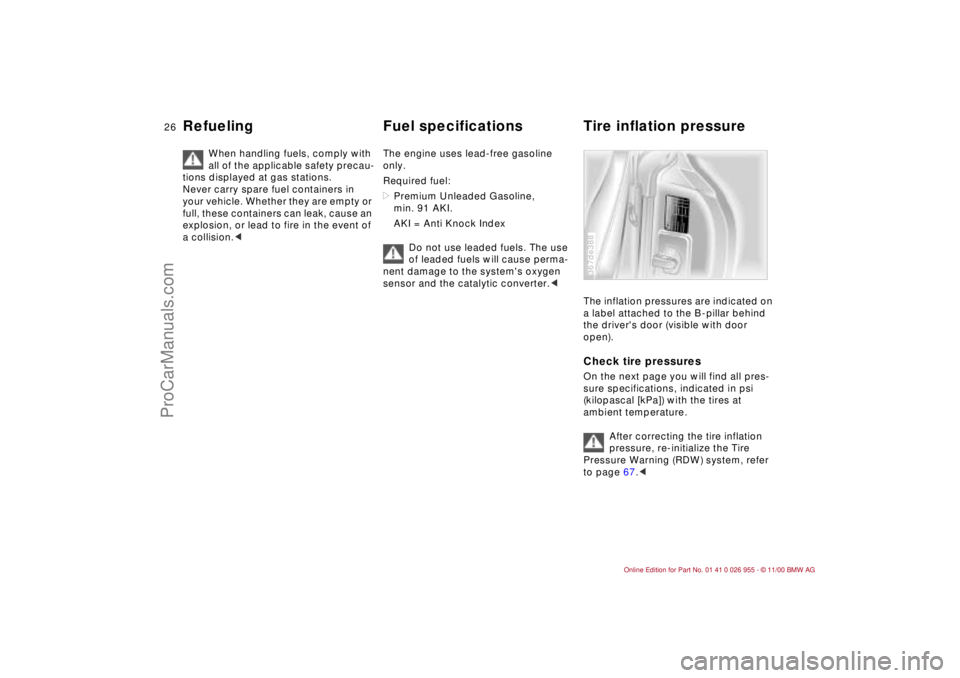
The inflation pressures are indicated on
a label attached to the B-pillar behind
the driver's door (visible with door
open).Check tire pressuresOn the next page you will find all pres-
sure specifications, indicated in psi
(kilopascal [kPa]) with the tires at
ambient temperature.
After correcting the tire inflation
pressure, re-initialize the Tire
Pressure Warning (RDW) system, refer
to page 67.<367de388
ProCarManuals.com