2001 BMW M ROADSTER COUPE ESP
[x] Cancel search: ESPPage 95 of 171

95n
IndexDataTechnologyRepairsCar careControlsOverview
Cellular phone
*
Radio reception
Mobile communications systems
(cellular phones, two-way radios, etc.)
are approved only up to a power output
of 10 watts. Nonetheless, they may
cause interference in the operation of
your vehicle if they are not specifically
designed for use in your vehicle. BMW
can neither test nor assume responsi-
bility for every individual product being
offered on the market. We recommend
that you consult your BMW center
before purchasing any device of this
kind.
To ensure that your BMW continues to
provide reliable and trouble-free opera-
tion, refrain from using a cellular phone
or other radio device with an antenna
located inside the passenger compart-
ment. The antenna should always be
fitted on the outside of the vehicle.
Before loading the vehicle on
a car-carrier train or driving it
through a car wash, remove the
antenna.<
The reception and sound quality
obtained from mobile radios varies
according to a variety of factors,
including the broadcast range of the
transmitter and the directional orienta-
tion of the antenna.
Interference factors such as high-
tension power lines, buildings and
natural obstructions can all lead to
unavoidable reception interference,
regardless of how well the vehicle's
sound system is operating. Climatic
factors such as intense solar radiation,
fog, rain and snow can also interfere
with reception.
Cellular phones without official BMW
approval can also generate interference
during use. This phenomenon assumes
the form of a low-pitched hum
emanating from the speaker system.
Please refer to the Owner's Manual
provided with your sound system for
detailed information on its use.Whenever necessary (when
entering a car wash, for instance),
remove the rod antenna
* (refer also to
page 116). To remove the antenna,
grasp the rod at the bottom and
unscrew it to the left from the antenna
base.<
You will find additional information
concerning radio reception in the
chapter "Advanced technology" on
page 150.
ProCarManuals.com
Page 96 of 171
96n
Hardtop
* – roadster
The fabric top does not have to be
removed even in winter, when the
hardtop is normally in constant use. In
order to prevent water spots and
mildew stains, the fabric top must be
completely dry before it is stored in the
convertible top compartment.
Two people are necessary for the
installation and removal of the hardtop.
Work with extreme caution during this
operation to avoid paint damage and
damage to the body and hardtop.
You may purchase a Hardtop lift
* from
your BMW center. This accessory is
especially designed to facilitate installa-
tion and removal of the hardtop.
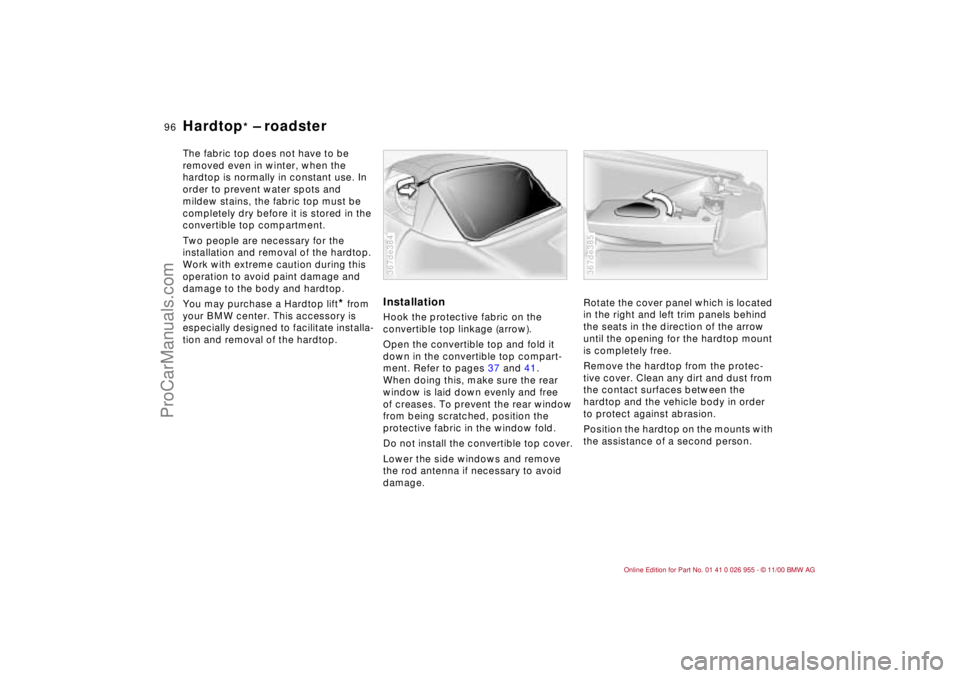
InstallationHook the protective fabric on the
convertible top linkage (arrow).
Open the convertible top and fold it
down in the convertible top compart-
ment. Refer to pages 37 and 41.
When doing this, make sure the rear
window is laid down evenly and free
of creases. To prevent the rear window
from being scratched, position the
protective fabric in the window fold.
Do not install the convertible top cover.
Lower the side windows and remove
the rod antenna if necessary to avoid
damage.367de384
Rotate the cover panel which is located
in the right and left trim panels behind
the seats in the direction of the arrow
until the opening for the hardtop mount
is completely free.
Remove the hardtop from the protec-
tive cover. Clean any dirt and dust from
the contact surfaces between the
hardtop and the vehicle body in order
to protect against abrasion.
Position the hardtop on the mounts with
the assistance of a second person.367de385
ProCarManuals.com
Page 98 of 171
98n
Information for your safetyThe factory-approved radial tires are
matched to your vehicle and have been
selected to provide optimum safety and
driving comfort on your vehicle.
In a very real sense, tire life, driving
comfort and your own safety are riding
on correct tire specifications and infla-
tion pressures.
Incorrect inflation pressure is a
frequent cause of tire damage. It
also significantly influences the road-
holding ability of your BMW. Check tire
inflation pressures regularly (refer to
page 26), at least every two weeks and
before you begin an extended journey.
If this is not done, incorrect tire pres-
sures may cause unstable driving, tire
damage and accidents.<
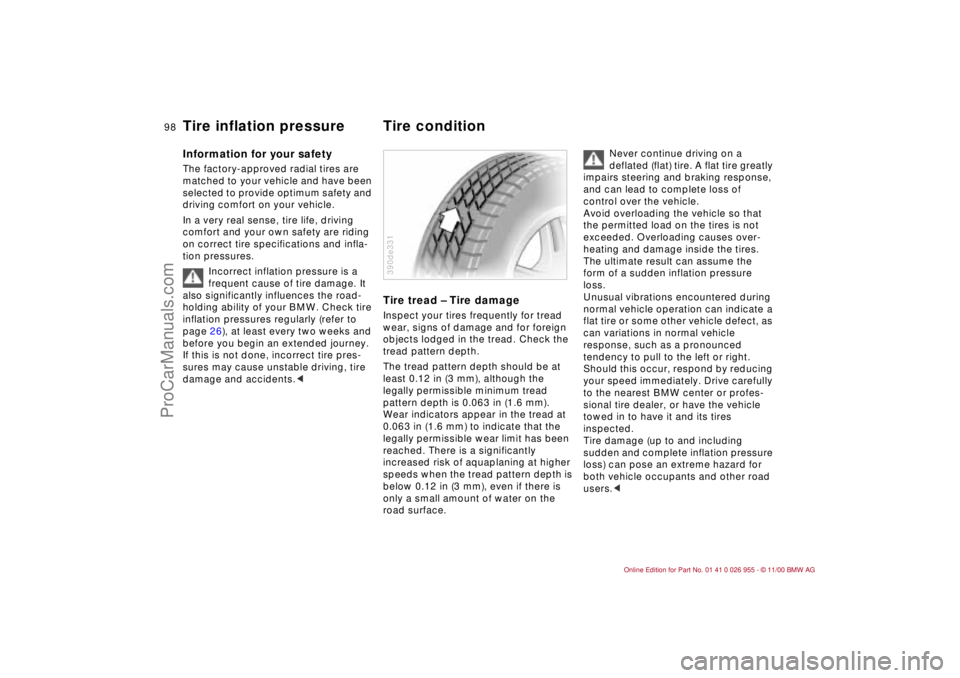
Tire tread – Tire damageInspect your tires frequently for tread
wear, signs of damage and for foreign
objects lodged in the tread. Check the
tread pattern depth.
The tread pattern depth should be at
least 0.12 in (3 mm), although the
legally permissible minimum tread
pattern depth is 0.063 in (1.6 mm).
Wear indicators appear in the tread at
0.063 in (1.6 mm) to indicate that the
legally permissible wear limit has been
reached. There is a significantly
increased risk of aquaplaning at higher
speeds when the tread pattern depth is
below 0.12 in (3 mm), even if there is
only a small amount of water on the
road surface.390de331
Never continue driving on a
deflated (flat) tire. A flat tire greatly
impairs steering and braking response,
and can lead to complete loss of
control over the vehicle.
Avoid overloading the vehicle so that
the permitted load on the tires is not
exceeded. Overloading causes over-
heating and damage inside the tires.
The ultimate result can assume the
form of a sudden inflation pressure
loss.
Unusual vibrations encountered during
normal vehicle operation can indicate a
flat tire or some other vehicle defect, as
can variations in normal vehicle
response, such as a pronounced
tendency to pull to the left or right.
Should this occur, respond by reducing
your speed immediately. Drive carefully
to the nearest BMW center or profes-
sional tire dealer, or have the vehicle
towed in to have it and its tires
inspected.
Tire damage (up to and including
sudden and complete inflation pressure
loss) can pose an extreme hazard for
both vehicle occupants and other road
users.<
Tire inflation pressure Tire condition
ProCarManuals.com
Page 99 of 171

99n
IndexDataTechnologyRepairsCar careControlsOverview
Tire replacementTo maintain good handling and vehicle
response, use only tires of a single tread
configuration from a single manufac-
turer. BMW tests and approves wheel
and tire specifications. Refer to
page 103.DOT Quality GradesTread wear
Traction AA A B C
Temperature A B C
All passenger vehicle tires must
conform to Federal Safety
Requirements in addition to these
grades.
when tested under controlled condi-
tions on a specified government test
course.
For example, a tire graded 150 would
wear one and one-half (1g) times as
well on the government course as a tire
graded 100. The relative performance
of tires depends upon the actual condi-
tions of their use, however, and may
depart significantly from the norm due
to variations in driving habits, service
practices and differences in road char-
acteristics and climate.TractionThe traction grades, from highest to
lowest, are AA, A, B and C.
Those grades represent the tire's ability
to stop on wet pavement as measured
under controlled conditions on speci-
fied government test surfaces of
asphalt and concrete. A tire marked C
may have poor traction performance.
The traction grade assigned to
this tire is based on straight-
ahead braking traction tests, and does
not include acceleration, cornering,
aquaplaning, or peak traction charac-
teristics.
tire's resistance to the generation of
heat and its ability to dissipate heat
when tested under controlled condi-
tions on a specified indoor laboratory
test wheel.
Sustained high temperature can cause
the material of the tire to degenerate
and reduce tire life, and excessive
temperature can lead to a sudden flat
tire. The grade C corresponds to a level
of performance which all passenger
vehicle tires must meet under the
Federal Motor Vehicle Safety Standard
No. 109. Grades B and A represent
higher levels of performance on the
laboratory test wheel than the minimum
required by law.
The temperature grade for this tire
is established for a tire that is
properly inflated and not overloaded.
Excessive speed, underinflation, or
excessive loading, either separately or
in combination, can cause heat buildup
and possible tire failure.
tread shoulder and maximum section
width. For example:
Tread wear 200 Traction AA
Temperature A
ProCarManuals.com
Page 100 of 171

100n
Tire replacement Tire rotation
Do not use retreaded tires as this
could negatively affect driving
safety. This is due to the possible varia-
tions in casing structures and, in some
instances, to their extreme age, factors
which can lead to a decrease in their
durability.<
Tire ageThe date on which the tire was manu-
factured is indicated by the code on the
sidewall:
DOT ... 3200 indicates that the tire was
manufactured in week 32 of 2000.
BMW recommends the replacement
of all tires when the tires are no more
than 6 years old, even if a tire usage of
10 years is possible.
Spare tires over 6 years old should be
used only in case of emergency. A tire
of this age should be replaced by a new
tire immediately, and should not be
fitted together with new tires.
Between the axlesTread wear at the front and rear axle is
different and will vary according to indi-
vidual driving conditions. In the interest
of safety and optimal vehicle response,
we advise against rotating wheels from
front to rear and vice versa.
If rotating the wheels between the axles
is under consideration for economic
reasons, the costs for remounting the
wheels must be calculated against any
savings which might result from the
anticipated extension in tire life. Rota-
tion should always be carried out at
short intervals (max. 3,000 miles/
5,000 km). Consult your BMW center for
more information.Should you decide to rotate the wheels,
it is essential to comply with the
following:
Rotate wheels on the same side of the
vehicle only, otherwise braking effi-
ciency and road grip could be adversely
affected.
Following rotation, correct the tire infla-
tion pressure.
If tires with different sizes are
mounted on the front and rear
axles (refer to page 103), the wheels
may not be rotated from one axle to the
other.<
ProCarManuals.com
Page 101 of 171

101n
IndexDataTechnologyRepairsCar careControlsOverview
Wheel and tire combinationsThe right choice
Use only wheels and tires
approved by BMW for the corre-
sponding vehicle model, as otherwise
the tires may make contact with the
body as the result of tolerances despite
the same nominal size being used,
leading to serious accidents. If non-
approved wheels and tires are used,
BMW cannot evaluate their suitability,
and therefore cannot be held liable for
driving safety.<
For wheel and tire specifications
approved by BMW, refer to the informa-
tion on page 103.
The correct wheel and tire combi-
nation affects different systems
such as ABS, DSC and RDW. The func-
tion of these systems is impaired if
improper wheel and tire combinations
are used.
For this reason, use only tires of the
same brand and tread pattern on the
vehicle and, for example, restore the
approved wheel and tire combination
following a flat tire as soon as
possible.<
Codes on tires and wheelsThe code on tires has the following
meaning.
Codes on radial tires:
The speed rating indicates the
approved maximum speed for the tire.
Summer tires:
S = up to 112 mph (180 km/h)
T = up to 118 mph (190 km/h)
H = up to 130 mph (210 km/h)
V = up to 149 mph (240 km/h)
W = up to 167 mph (270 km/h)
Y = up to 186 mph (300 km/h)
ZR = over 149 mph (240 km/h) Example:
Nominal width
in mm
Aspect ratio in %
Belt rating ID code
for radial tires
Wheel diameter in inches
Load rating
(not on ZR tires)
Speed rating
(before R on ZR tires)
205/60 R 15 91 H
All season and winter tires:
Q M+S = up to 100 mph (160 km/h)
T M+S = up to 118 mph (190 km/h)
H M+S = up to 130 mph (210 km/h)
Codes on light-alloy wheels:
Protect valve inserts against dirt by
using screw-on valve caps.
Dirt in the valves frequently leads to
slow leaks.Storage Store tires in a cool, dry place,
protecting them against light whenever
possible. Protect the tires against
contact with oil, grease and fuel. Example:
Rim width
in inches
Code letter for
flange type
Symbol for full-drop
center rim
Rim diameter in inches
Extended hump on
the 2 rim shoulders
7x15EH2
J
ProCarManuals.com
Page 102 of 171

102n
Special features of winter tires Snow chains
*
Choosing the right tireBMW recommends winter tires (M+S
radial tires) for operation under
inclement winter driving conditions.
While so-called all season tires (M+S
designation) provide better winter trac-
tion than summer tires with the load
ratings H, V, W, Y and ZR, they gener-
ally do not achieve the performance of
winter tires.
In the interests of sure tracking and safe
steering response, mount winter tires
which are made by the same manufac-
turer and which have the same tread
pattern at all four wheels.Comply with recommended speed
Never exceed the maximum
speed for which the winter tires
are rated.
Unprofessional attempts by laymen to
service tires can lead to damage and
accidents.
Have this work performed by skilled
professionals only. Any BMW center
has the required technical knowledge
and the proper equipment and will be
happy to assist you.<
Tire condition, tire pressureOnce the tire wears to below 0.16 in
(4 mm), winter tires display a percep-
tible decrease in their ability to cope
with winter driving conditions, and
should be replaced in the interest of
safety.
Comply with the specified tire inflation
pressures – and be sure to have the
wheel and tire assemblies balanced
every time you change the tires.The use of narrow-link BMW snow
chains on winter tires is approved only
in pairs and only on the rear wheels.
Comply with all manufacturer's safety
precautions when mounting the chains.
Deactivate the Tire Pressure
Warning (RDW) when using snow
chains. The snow chains can lead to
malfunction warnings and undetected
losses in pressure.
For further information, refer to
page 67.<
ProCarManuals.com
Page 104 of 171
104n
Do not work on your vehicle
without appropriate skills. Always
switch off the engine and allow it to
cool down before working in the engine
compartment. Always disconnect the
battery before working on any electrical
systems or equipment, especially when
these are located within the engine
compartment. Comply with all appli-
cable instructions and warnings. If you
are not familiar with all guidelines, have
the work performed by your BMW
center. Otherwise, safety hazards for
vehicle occupants and other road users
may occur as a result of improper
handling of components and mate-
rials.<
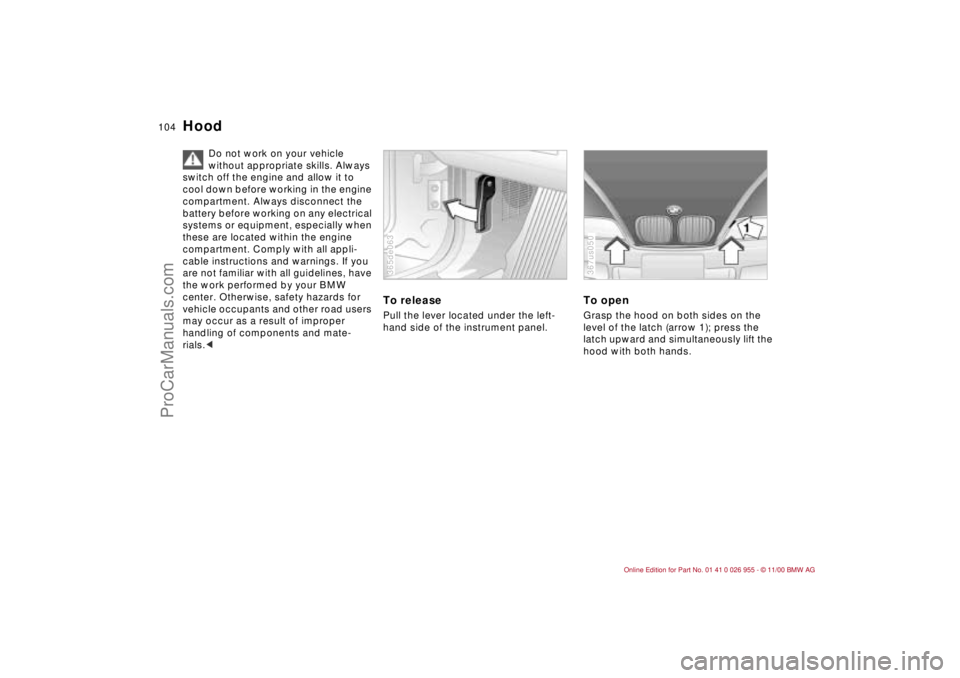
To release Pull the lever located under the left-
hand side of the instrument panel.365de063
To openGrasp the hood on both sides on the
level of the latch (arrow 1); press the
latch upward and simultaneously lift the
hood with both hands.367us050
Hood
ProCarManuals.com