2001 BMW 330i SEDAN Controls
[x] Cancel search: ControlsPage 109 of 211
109n
IndexDataTechnologyRepairsCar careControlsOverview
Through-loading system
*
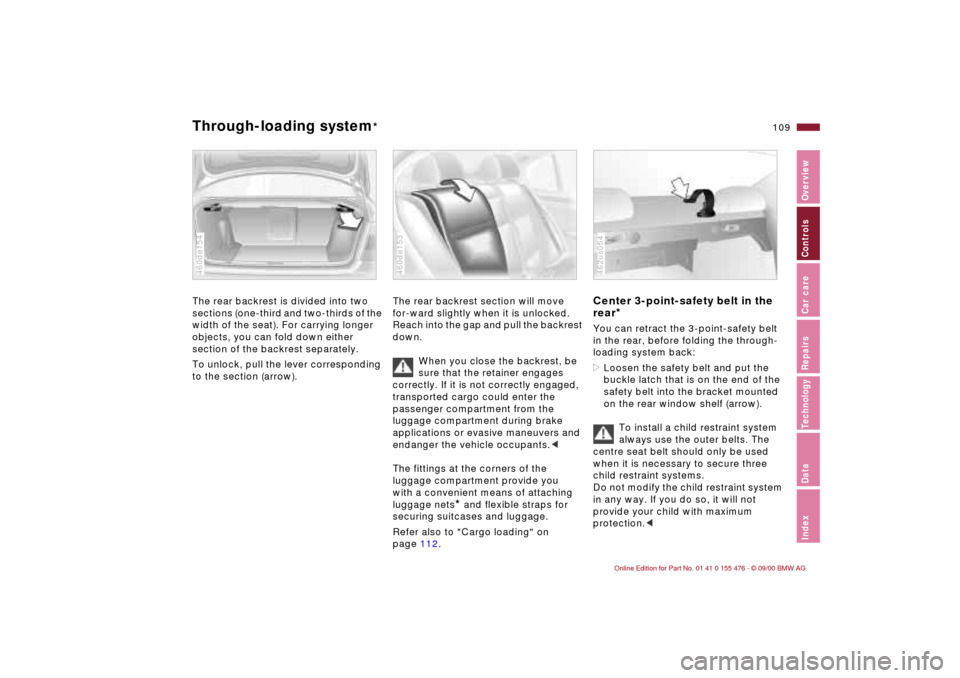
The rear backrest is divided into two
sections (one-third and two-thirds of the
width of the seat). For carrying longer
objects, you can fold down either
section of the backrest separately.
To unlock, pull the lever corresponding
to the section (arrow).460de154
The rear backrest section will move
for-ward slightly when it is unlocked.
Reach into the gap and pull the backrest
down.
When you close the backrest, be
sure that the retainer engages
correctly. If it is not correctly engaged,
transported cargo could enter the
passenger compartment from the
luggage compartment during brake
applications or evasive maneuvers and
endanger the vehicle occupants.<
The fittings at the corners of the
luggage compartment provide you
with a convenient means of attaching
luggage nets
* and flexible straps for
securing suitcases and luggage.
Refer also to "Cargo loading" on
page 112.
460de153
Center 3-point-safety belt in the
rear
*
You can retract the 3-point-safety belt
in the rear, before folding the through-
loading system back:
>Loosen the safety belt and put the
buckle latch that is on the end of the
safety belt into the bracket mounted
on the rear window shelf (arrow).
To install a child restraint system
always use the outer belts. The
centre seat belt should only be used
when it is necessary to secure three
child restraint systems.
Do not modify the child restraint system
in any way. If you do so, it will not
provide your child with maximum
protection.<462us054
Page 111 of 211
111n
IndexDataTechnologyRepairsCar careControlsOverview
Ski bag
*
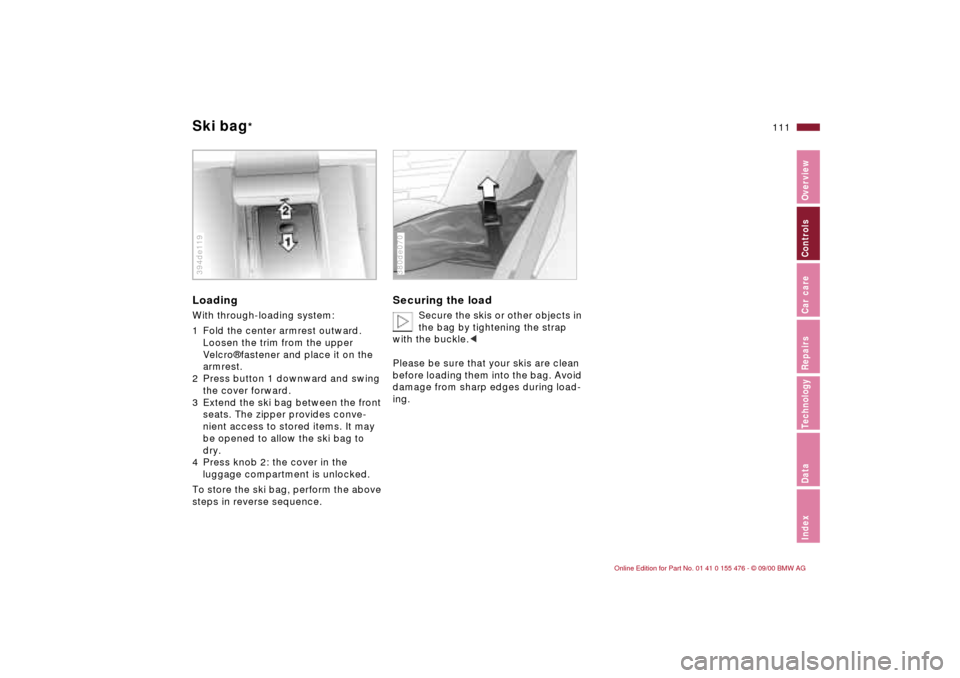
LoadingWith through-loading system:
1 Fold the center armrest outward.
Loosen the trim from the upper
Velcro¨ fastener and place it on the
armrest.
2 Press button 1 downward and swing
the cover forward.
3 Extend the ski bag between the front
seats. The zipper provides conve-
nient access to stored items. It may
be opened to allow the ski bag to
dry.
4 Press knob 2: the cover in the
luggage compartment is unlocked.
To store the ski bag, perform the above
steps in reverse sequence.394de119
Securing the load
Secure the skis or other objects in
the bag by tightening the strap
with the buckle.<
Please be sure that your skis are clean
before loading them into the bag. Avoid
damage from sharp edges during load-
ing.
380de070
Page 113 of 211

113n
IndexDataTechnologyRepairsCar careControlsOverview
Cargo loading Roof-mounted luggage rack
*
Always position and secure the
load correctly. If you do not, it can
endanger the passengers during brak-
ing or evasive maneuvers.
Do not exceed the permissible gross
vehicle weight and the permissible axle
loads (refer to page 194). If you do, the
operating safety of the vehicle is no
longer ensured and you are in violation
of the law.
Do not carry hard or heavy objects
unsecured in the passenger compart-
ment. If you do so, they may be
projected through the air during braking
and evasive maneuvers, thus
endangering vehicle occupants.<
AnchorsAccess to the anchors:
To open the cover (arrow), please use
the tool included with the luggage rack
system.
A special roof-rack system is available
for your BMW as an optional extra.
Please comply with the precautions in-
cluded with the installation instructions.
Because roof racks raise the center of
gravity of the vehicle when loaded, they
exercise a major effect on its handling
and steering response.
You should therefore always remember
not to exceed the approved roof weight,
the approved gross vehicle weight or
the axle weights when loading the rack.
You will find the specifications under
"Technical Data" on page 194.462de271
Make sure that the load is not too heavy,
and attempt to distribute it evenly.
Always load the heaviest pieces first (on
the bottom). Be sure that adequate
clearance is maintained for raising the
sliding/tilt sunroof, and that objects do
not project into the opening path of the
luggage compartment lid.
Secure the roof luggage correctly and
securely to prevent it from shifting or
being lost during driving (danger to
following traffic).
Drive smoothly and avoid sudden ac-
celeration or braking. Do not corner at
high speeds.
The roof load increases the aerody-
namic resistance. Increased fuel
consumption and additional stresses
on the vehicle's body result from this.
Page 115 of 211

Overview
Controls and features
Operation, care
and maintenance
Owner service procedures
Technical data
Index Advanced technology
115n
IndexDataTechnologyRepairsCar careControlsOverview
Under the hood:
Hood134
Engine compartment136
Washer fluids138
Washer nozzles138
Engine oil139
Coolant142
Brake fluid143
Vehicle Identification
Number144
Care and maintenance:
The BMW Maintenance
System145
Caring for your vehicle146
Airbags151
Airbags152
Laws and regulations:
Technical modifications to the
vehicle153
California Proposition
65 Warning153
OBD interface socket154
Car care Special operating instructions:
Break-in procedures116
Driving notes117
Catalytic converter117
Antilock Brake System
(ABS)118
Disc brakes120
Brake system121
Winter operation122
Power steering123
Cellular phones124
Radio reception124
Wheels and tires:
Tire inflation pressure125
Tire condition125
Tire replacement126
Tire rotation127
Wheel and tire
combinations128
Winter tires129
Snow chains129
Approved wheel and tire
specifications130
Page 117 of 211

117n
IndexDataTechnologyRepairsCar careControlsOverview
Brakes:
Do not drive with your foot resting
on the brake pedal. Even light but
consistent pedal pressure can lead to
high temperatures, brake wear, and
possibly to brake failure.
Aquaplaning:
Reduce your speed when you drive on
wet or slushy roads. If you do not, a
wedge of water can form between the
tires and the road surface. This
phenomenon is referred to as aqua-
planing or hydroplaning. It is character-
ized by a partial or complete loss of
contact between the tires and the road
surface. The ultimate results are loss of
steering and braking control.
Driving through water:
Do not drive through water that is
deeper than 1 foot (30 cm). If you must
drive through water accumulations up
to that depth, drive only at walking
speed. Driving at a faster speed could
cause damage to the engine, the elec-
trical systems and the transmission.
Package tray:
Never use the rear window shelf to
store heavy or bulky objects. If you do
so, such objects could pose the risk of
injury to vehicle occupants during
braking or evasive maneuvers or in a
crash.
Clothes hooks:
When suspending clothing from the
hooks, be sure that they will not
obstruct the driver's vision. Do not hang
heavy objects on the hooks. If you do
so, such objects could pose the risk of
personal injury during braking or
evasive maneuvers.
use with unleaded fuel only.
Even minute quantities of lead would be
enough to permanently damage both
the catalytic converter and the system
oxygen sensor.
To ensure efficient, trouble-free engine
operation and avoid potential damage:
>Be sure to comply with the scheduled
maintenance requirements.
>Fill the fuel tank well before it is
empty.
>Tow-start only when the engine is
cold. If you attempt to tow-start with
a warm engine, unburned residual
fuel in the catalytic converter could
ignite and cause damage. It is better
to jump-start the vehicle with outside
assistance.
>Avoid other situations in which the
fuel is not burned, or burns incom-
pletely, such as engaging the starter
frequently or for extended periods, or
repeated start attempts in which the
engine does not start (stopping and
restarting an engine which is running
properly does not present a problem).
Never allow the engine to run with
any of the spark plug cables discon-
nected.
Driving notes Catalytic converter
Page 118 of 211

118n
Catalytic converter Antilock Brake System (ABS)
Be sure to comply with the
instructions above to prevent
unburned fuel from reaching the cata-
lytic convertor. If you do not, the cata-
lytic converter could respond by
overheating, leading to serious
damage.
Extreme temperatures occur at the
catalytic converter on this and every
catalyst-equipped vehicle. Heat shields
are installed adjacent to some sections
of the exhaust system. Never remove
these shields; do not apply under-
coating to their surfaces. When driving,
standing at idle, and parking the
vehicle, take extra care to avoid contact
between the exhaust system and flam-
mable materials (grass, hay, leaves,
etc.). Such contact could lead to a fire,
resulting in serious personal injury and
property damage.<
The concept ABS enhances active safety by helping
to prevent the wheels from locking
under braking. This is because locked
wheels are dangerous. When the front
wheels slide, the driver loses steering
control over the vehicle. Traction loss at
the rear wheels can cause the rear end
to break into an uncontrolled skid.
The system can achieve the shortest
braking distances possible under most
conditions (on straight-aways and in
curves, on asphalt, ice, wet road
surfaces, etc.).
ABS is designed to meet two essential
requirements during every brake appli-
cation:
>To help provide vehicle stability
>To help maintain steering control and
maneuverability Ð on all types of road
surfaces (asphalt, concrete, mud, wet
road surfaces, snow, ice).Braking with ABSThe system becomes operative once
the vehicle exceeds a speed of approx.
6 mph (10 km/h). Below approx. 4 mph
(6 km/h), it is once again deactivated.
This means that the wheels can lock in
the final phase of a panic stop Ð a factor
of no significance in actual use.If you are in a situation that requires full
braking, you will exploit the full benefits
of the ABS system if you apply
maximum brake pressure ("panic
stop"). Since the vehicle maintains
steering responsiveness, you can avoid
possible obstacles with a minimum of
steering effort, despite the full brake
application.
The ABS system closed-loop control
circuit cycles in fractions of a second. A
pulsation at the brake pedal, together
with the sounds associated with the
hydraulic controls, tells you that the
brake system is within its maximum
limit range and reminds you that you
should adapt road speed to the road
conditions.
On road surfaces that have a loose
surface layer on a firm base with good
traction (on gravel or snow, for
example), or when snow chains are
mounted, braking distances may be
longer than with locked wheels.
However, ABS continues to provide
enhanced vehicle stability and steering
response under these conditions.
Information for your safetyNot even ABS can suspend the laws of
physics. ABS cannot prevent the
Page 119 of 211
119n
IndexDataTechnologyRepairsCar careControlsOverview
Antilock Brake System (ABS)consequences of brake applications
with inadequate clearances for safety
between vehicles, when exceeding the
speed limit, or the risks involved when
aquaplaning occurs. Responsibility for
these types of situations remains in the
hands (and at the feet) of the driver. You
should never allow the added safety of
ABS to mislead you into taking
increased risks.
Do not make any modifications to
the ABS system. Service proce-
dures on ABS are to be performed by
authorized technicians only.
opment of ABS. When braking during
cornering with high lateral accelera-
tion, or when braking during a lane
change, vehicle stability is improved
and the steering response is enhanced.In the event of a fault
If the ABS in the instrument
cluster lights up, refer to
page 22. The brake system then
reverts to conventional operation as on
vehicles without ABS. However, have
the brake system checked by your
BMW center as soon as possible. To
prevent undetected defects and cumu-
lative faults from adversely affecting the
brake system, refer any problems to
your BMW center at the earliest oppor-
tunity.
ABS warning lamp for Canadian
models.
If the brake warning lamp
comes on together with the indi-
cator lamps for ABS and
ASC+T/DSC, refer to page 21,
the entire ABS, CBC and
ASC+T/DSC control system has
failed. Continue driving
cautiously and defensively.
Avoid full brake applications. This could
cause the vehicle to lose stability and
you might no longer be able to control
it.
Have the system checked as soon as
possible by your BMW center.
CBC, ABS and ASC+T/DSC
and
ADB/ADB-X/DBC indicator and
warning lamps for Canadian
models.
Dynamic Brake Control (DBC)*DBC is included in the DSC, refer to
information beginning on page 84.
If you step on the brake rapidly, this
system automatically produces
maximum braking force boost and thus
helps to achieve the shortest possible
braking distance during "panic stops."
All of the benefits of the ABS system
are exploited under these circum-
stances.
Do not reduce the pressure on the
brake pedal for the duration of the
brake application. When the brake
pedal is released, the DBC is deacti-
vated.
In the event of a malfunction,
the yellow brake warning lamp
comes on. Normal braking effi-
ciency and ABS are still fully available.
Have the system checked and repaired
at your BMW center as soon as
possible.
Please observe the section "Infor-
mation for your safety" concerning
the ABS system, which also applies to
the DSC system.<
Page 121 of 211

121n
IndexDataTechnologyRepairsCar careControlsOverview
Brake systemBrake fluid level
If the brake warning lamp
comes on and the parking brake
has been released:
The brake fluid level is too low in the
reservoir (refer to page 143).
If the brake fluid level is too low and
brake pedal travel has become notice-
ably longer, there may be a defect in
one of the hydraulic circuits of the brake
system.
Brake warning lamp for Cana-
dian models.
Proceed to the nearest BMW
center. Higher brake application
pressure may be necessary under these
conditions, and brake pedal travel may
be significantly longer. Please
remember to adapt your driving style
accordingly.<
Brake pads
If the warning lamp for the brake
pads lights up:
The brake pads have reached
their minimum pad thickness. Proceed
to the nearest BMW center as soon as
possible to have the pads replaced.
For your own safety: use only
brake pads that BMW has
approved for your particular vehicle
model. BMW cannot evaluate non-
approved brake pads to determine if
they are suited for use, and therefore
cannot ensure the operating safety of
the vehicle if they are installed.<