Page 185 of 215
185n
IndexDataTechnologyRepairsCar careControlsOverview
Page 187 of 215
Overview
Controls and features
Operation, care
and maintenance
Owner service procedures
Technical data
Index Advanced technology
187n
IndexDataTechnologyRepairsCar careControlsOverview
Adaptive Transmission Control
(ATC)188
Airbags189
Automatic Stability Control plus
Traction (ASC+T)/Dynamic
Stability Control (DSC)189
Radio reception190
Safety belt tensioner190
Interior rearview mirror
with automatic dimming
feature191
Rain sensor191
Tire Pressure Control (RDC)192
Self-diagnostics192
Rollover protection system193
Xenon lamps193
Technol-
Page 189 of 215

189n
IndexDataTechnologyRepairsCar careControlsOverview
Deceleration sensors continuously
monitor the acceleration forces acting
upon the vehicle. If, as the result of a
frontal collision, a deceleration is
reached at which the protection of the
safety belts alone is no longer
adequate, the gas generators of the
driver and passenger-front airbags are
ignited. However, the passenger-side
airbag is only triggered if an additional
sensor has recognized that the
passenger seat is occupied.
In the event of a side collision, the side
airbags in the front and/or rear
* are
triggered if necessary.
390de012
The airbags located under the marked
covers inflate and unfold in a matter of
a few milliseconds. In this process, they
tear through the designed separation
points of the upholstered covers or
press them out.
Because the inflation process must be
virtually instantaneous, it is accompa-
nied by a certain amount of ignition and
inflation noise, which will be drowned
out by the noise from the accident
itself. The gas required to inflate the
airbags is not dangerous, and the
associated smoke then dissipates.
The entire process is completed within
fractions of a second.Highly sensitive sensors monitor the
number of revolutions of the wheels.
When equipped with DSC, they also
monitor steering angle, lateral accelera-
tion, brake pressure and the movement
of the vehicle around its vertical axis.
If differences in the wheel speeds
occur, ASC+T counteracts the danger
of wheelspin by reducing engine
torque; if necessary, ASC+T will also
respond by applying the brakes to the
rear wheels.
In addition, DSC permanently monitors
the vehicle's current operating condi-
tion and compares it with an ideal
condition that is calculated from the
sensor's signals. If deviations from this
occur (understeering or oversteering,
for instance), DSC can stabilize the
vehicle in fractions of a second by
reducing engine output and with the
assistance of braking intervention at
individual wheels. Dangerous skids are
thus prevented before they can even
start, and all of this is possible, of
course, only within physically possible
limits. You may need some time to
become accustomed to the system's
intervention. However, it provides
optimum drive force and vehicle
stability. The braking intervention may
be accompanied by sounds specific to
the system.
Airbags ASC+T/DSC
*
Page 191 of 215

191n
IndexDataTechnologyRepairsCar careControlsOverview
Interior rearview mirror with automatic dimming feature
* Rain sensor
*
The interior rearview mirror with auto-
matic dimming feature reduces blinding
from following traffic by adapting the
intensity of the reflected images to
correspond to levels of light registered
by the unit's sensors. The mirror reverts
to its undimmed setting as soon as the
light source disappears. One lamp
sensor is mounted on the front of the
mirror housing. This sensor, which is
directed forward, measures light inten-
sity in the area ahead of the vehicle.
The second sensor is integrated within
the mirror's glass. The electronic
control system compares the light
intensity from front and rear. The differ-
ence provides the basic parameter
used to modulate an electrical current
and induce chemical changes in a
semisolid layer incorporated in the lens.46cus036
The semisolid reacts chemically to this
electrical current, thus providing
dimming of the mirror through an infi-
nitely-variable range (electrochromic
technology).
As a result, it is no longer necessary to
dim the mirror manually, and the driver
can concentrate completely on traffic
conditions.
Depending on the degree of wetness on
the windshield, the rain sensor controls
the operation of the windshield wipers.
Infrared light is carried along the surface
of the windshield in an optical conductor
in such a manner that it is reflected
completely when the windshield is dry.
The quantity of reflected light is
measured. If there is moisture on the
glass, the amount of light reflected is
reduced since the infrared light at the
surface of the windshield can escape.
The quantity of reflected light is thus a
means of gauging the degree of wetness
on the windshield. When the system is
set to the "Intermittent" wiper speed, the
wipers react immediately Ð if water is
splashed onto the windshield by vehicles
traveling ahead of you, for example. As a
result, the rain sensor provides a contri-
bution to driving safety and comfort.
390de133
Page 193 of 215

193n
IndexDataTechnologyRepairsCar careControlsOverview
Rollover protection system
Xenon lamps
*
The rollover protection system offers
additional protection to the airbags and
the safety belts. It uses highly sensitive
sensors that respond immediately to
any unstable vehicle condition encoun-
tered while driving, e. g. a steep angle
or loss of wheel contact with the
ground. The protective bar in the rear
headrests would be triggered in this
type of situation.
The xenon lamp provides forward illu-
mination with significantly more bright-
ness and uniformity than the traditional
halogen lamp.
In a xenon lamp, an electric arc replaces
the filament in order to generate intense
illumination. A gas mixture in a quartz
glass tube with metal vapor is ignited by
a high electric voltage. The arc that is
generated is then sustained by a lower
voltage. When the lamp is turned on,
there is a brief warm-up period.
Maximum brightness is attained in
approx. 15 seconds.
390de134
Xenon lamps provide significantly
improved visibility, especially during
adverse weather conditions and difficult
driving situations (e. g. driving at night in
heavy rain or through road repair areas
where there are no lane markers).
Vehicles with xenon lamps are equipped
with an automatic headlamp range
control. As a result, the lane ahead of
you is always optimally lighted, even
under varying load conditions, and
drivers in oncoming traffic are not
blinded.
Xenon lamps make a significant contri-
bution to highway safety since other
highway users, bicyclists and motor-
cyclists in the right lane, and pedes-
trians are more easily detected.
Page 195 of 215
Overview
Controls and features
Operation, care
and maintenance
Owner service procedures
Technical data
Index Advanced technology
195n
IndexDataTechnologyRepairsCar careControlsOverview
Engine data196
Dimensions197
Weights198
Capacities199
Electrical system200
Drive belts200
Data
Page 197 of 215
197n
IndexDataTechnologyRepairsCar careControlsOverview
46cus051
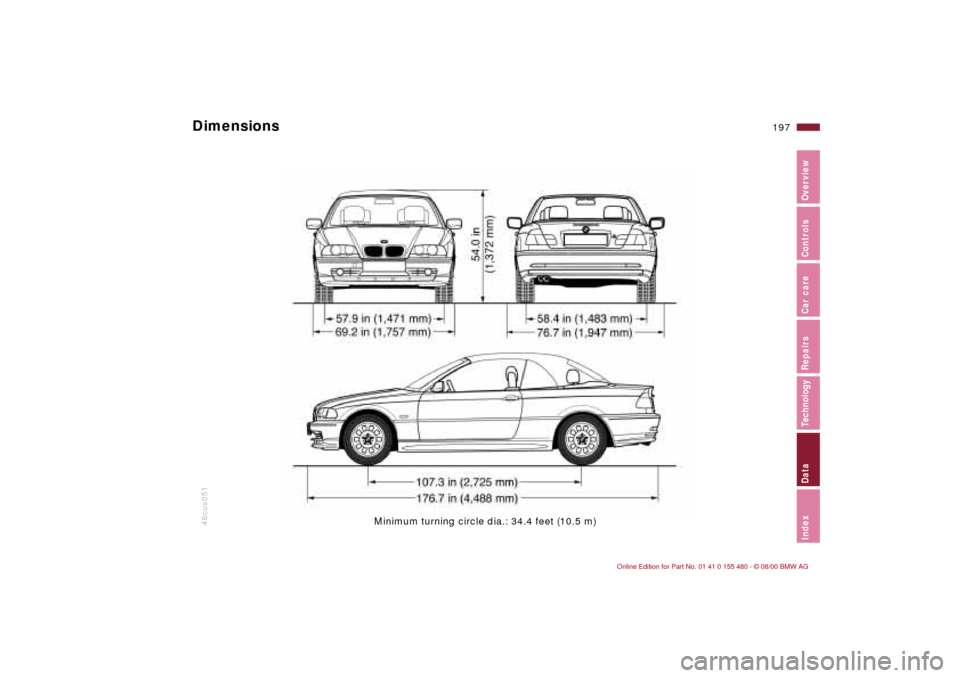
Minimum turning circle dia.: 34.4 feet (10.5 m)
Dimensions
Page 199 of 215
199n
IndexDataTechnologyRepairsCar careControlsOverview
Capacities
Notes
Fuel tank
Reserve gal. (liters)
gal. (liters)approx. 16.6 (approx. 63)
approx. 2.1 (approx. 8)Fuel specification: page 27
Windshield/headlamp washer system quarts (liters) approx. 5.6 (approx. 5.3) Specifications: page 144
Cooling system including heater circuit quarts (liters) approx. 8.9 (approx. 8.4) Specifications: page 147
Engine oil filter change quarts (liters) approx. 6.9 (approx. 6.5) BMW High Performance
Synthetic Oil
Specifications: page 146
Manual and automatic transmission, transfer box
and differentialÐ Lifetime fluid, no fluid
change required